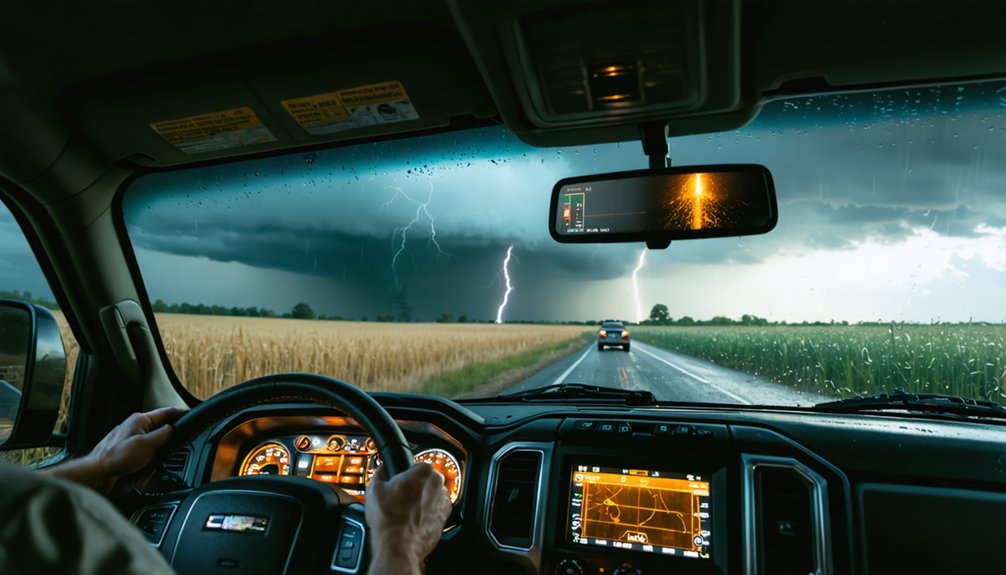
When you chase close-up supercells, you’re simultaneously managing five compounding threats: rain-wrapped tornadoes that eliminate visual confirmation, large hail that can destroy your vehicle within seconds, flash floods that block your egress routes, supercell winds exceeding 100 mph that collapse escape vectors, and positioning mistakes that trap you as storm dynamics shift faster than you can react. Each hazard amplifies the others, turning manageable risks into lethal entrapments. The full breakdown of each threat reveals exactly how quickly your options disappear.
Key Takeaways
- Rain-wrapped tornadoes eliminate visual confirmation, forcing storm chasers to operate blind with severely limited warning time.
- Hail exceeding 3.5 inches can destroy vehicles within seconds, often arriving before a tornado becomes visible.
- Flash floods can saturate roads and block escape routes within minutes, trapping storm chasers in dangerous terrain.
- Supercell winds exceeding 100 mph can instantly eliminate escape routes, reducing vehicle control and available options.
- Positioning errors near the hook echo compound risk factors, gradually trapping storm chasers as storm dynamics shift.
How Rain-Wrapped Tornadoes Appear Without Warning
Rain-wrapped tornadoes are among the most dangerous phenomena a storm chaser can encounter, because the surrounding precipitation removes your primary means of early detection—visual confirmation.
Visual concealment within HP supercells occurs when rain curtains envelope the mesocyclone, preventing you from identifying rotation until you’re dangerously close to the circulation. You’re effectively maneuvering blind inside the bear’s cage.
Rapid development compounds this threat considerably. A tornado can intensify from a weak circulation to a violent vortex within minutes, leaving you minimal reaction time if you’ve already committed to a forward position.
Radar interpretation becomes your primary tool, but real-time data gaps and beam resolution limitations mean you can’t fully compensate for lost visual awareness.
Maintain escape routes and never penetrate the precipitation core.
How Hail Can Destroy Your Storm Chasing Vehicle
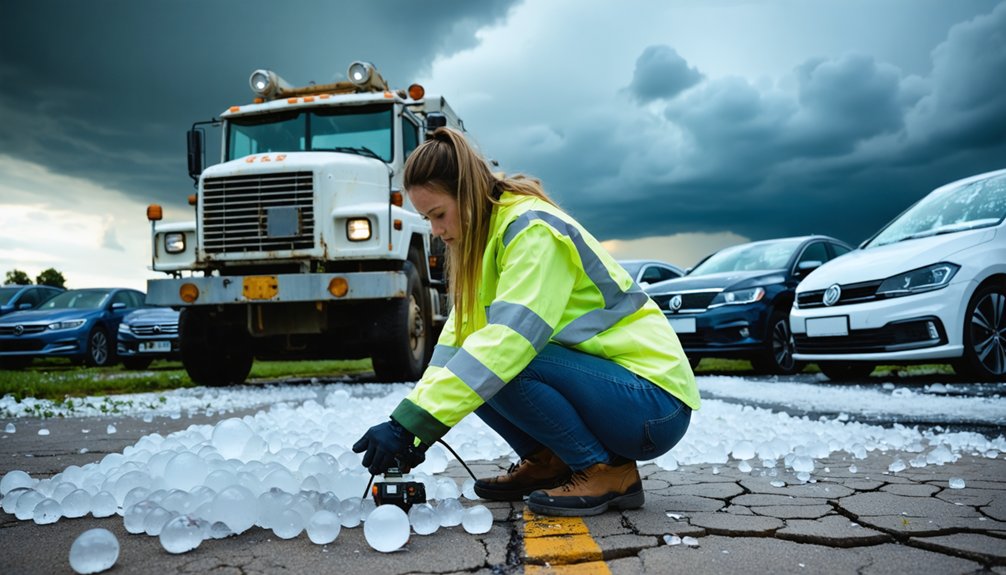
Beyond visual threats, the storm itself can destroy your vehicle before a tornado ever forms. Supercells in severe-risk environments regularly produce hail exceeding 3.5 inches in diameter—large enough to shatter windshields, collapse roof panels, and compromise structural integrity within seconds.
Hail damage at this scale isn’t cosmetic; it’s vehicle destruction.
What makes this especially dangerous is timing. Hail often arrives before a tornado becomes visible, stripping away your reaction window. You won’t see it building until it’s already hitting your hood.
Once you’re inside the core, there’s no maneuvering out cleanly.
If you’re chasing close, you’re gambling your vehicle against a hazard that moves faster than your exit options. Positioning outside the hail core isn’t optional—it’s operationally critical.
How Flash Floods and Hydroplaning Trap Storm Chasers
Flooding and hydroplaning don’t announce themselves—they’re already compromising your control before you recognize the threat. Heavy precipitation ahead of a supercell saturates roadways fast, and once your tires lose contact, steering becomes ineffective. You’re no longer driving; you’re sliding.
Flash flooding compounds this by transforming low-lying roads into channeled storm surge within minutes. What looked passable on approach becomes a trap on exit. You can’t outrun water that’s already cutting off your route.
Lightning strikes add another constraint—they force you away from open high ground, pushing you toward lower terrain where flood risk concentrates. Between hydroplaning on rain-saturated pavement, rising water blocking egress, and electrical hazard restricting movement, your positioning options collapse simultaneously.
Recognize water threats early, or they eliminate your escape before you act.
How Supercell Winds Cut Off Your Escape Route
Supercell winds don’t just threaten your vehicle—they actively restructure your exit options in real time. Storm dynamics shift faster than most chasers anticipate. A supercell producing 70 mph outflow can transform a viable escape corridor into a blocked route within minutes.
Supercell winds don’t just threaten your vehicle—they erase your exit options before you’ve finished planning them.
Wind acceleration isn’t linear—it’s abrupt, catching you mid-maneuver with diminishing road traction and compromised vehicle control.
You’re not just fighting wind force; you’re steering through a rapidly narrowing decision window. Downbursts can exceed 100 mph, and when they align with your intended exit vector, you’ve lost your margin.
Staying ahead of these dynamics requires constant positional reassessment, not reactive driving. Once the storm’s hazard zone expands over your route, your freedom of movement collapses fast—often faster than you can act.
How Positioning Mistakes Get Storm Chasers Killed
Positioning errors kill storm chasers not through bad luck, but through compounding decisions that erode escape options before the threat becomes visible. When you park too close to the hook echo or enter the precipitation core, you’re surrendering your ability to read storm infrastructure—the spatial relationship between inflow, wall cloud, and forward flank that tells you where the storm is going.
Each wrong decision compounds the last. Communication breakdowns between chase partners or between you and your data feed accelerate the cascade. You misread the radar, hold position too long, and suddenly the circulation is between you and every viable exit.
The storm doesn’t trap you instantly. You trap yourself incrementally, one positioning miscalculation at a time, until options disappear entirely.
Frequently Asked Questions
What Radar Tools Do Storm Chasers Rely on for Real-Time Supercell Tracking?
Like a telegraph operator reading Morse code, you’ll rely on radar technology and storm visualization tools—WSR-88D NEXRAD, dual-polarization radar, and GR2Analyst—to track supercell rotation, velocity, and precipitation in real time.
How Do HP Supercells Differ in Danger From Classic Supercell Storms?
HP supercells hide their tornado potential behind rain-wrapped cores, stripping you of visual storm structure clarity. You’re maneuvering blind, where classic supercells let you read rotation openly and maintain critical escape awareness before committing to an intercept.
Can Storm Chasing Vehicles Be Specially Reinforced to Withstand Supercell Conditions?
Yes, you can reinforce vehicles with vehicle armor and structural reinforcement, yet even hardened platforms can’t eliminate hail damage, entrapment, or sudden tornado exposure—hazards that coincide precisely when supercell conditions intensify unexpectedly around you.
How Do Experienced Chasers Decide When to Abandon a Storm Intercept Entirely?
You’ll abandon a storm intercept when storm behavior signals unacceptable risk: rain-wrapped tornadoes, collapsing escape routes, rapid core shifts, or radar misreads. Effective risk mitigation demands you prioritize survival over data—recognize entrapment conditions early and exit decisively.
What Role Does Storm Motion Speed Play in Overall Chasing Risk Assessment?
Fast escape, sudden trap — storm speed’s a critical risk factor. When a supercell accelerates unexpectedly, you’re losing your exit window fast, demanding you constantly reassess positioning before storm motion outpaces your tactical decision-making.
References
- https://www.youtube.com/watch?v=qbvz7HkOJso
- https://www.wiu.edu/SevereWeather/images/presentations/Ethan_Schisler_Storm_Spotting.pdf
- https://crazystormchasers.com/navigating-the-dangers-of-chasing-supercell-storms/
- https://www.youtube.com/watch?v=fABwvj0rP_A
- https://www.atms.unca.edu/cgodfrey/courses/swfex/pdf/ChasingSafety.pdf
- https://www.youtube.com/watch?v=uCLaE6ELFik
- https://www.youtube.com/watch?v=0QL0aVmZGi4