Ryan Hall, Y’all launched his YouTube channel on January 4, 2021, after a December 2020 snowstorm exposed critical gaps in real-time weather coverage. He left Mississippi State University in 2016, abandoning traditional broadcast meteorology to build an independent digital platform. Operating from Kentucky, he coordinates contracted storm chasers through his nonprofit Y’all Squad without ever deploying into the field himself. His EF-4 tornado coverage in December 2021 cemented his national credibility, and there’s much more to uncover about how he did it.
Key Takeaways
- Ryan Hall launched his YouTube channel on January 4, 2021, after identifying gaps in accessible, real-time weather coverage during a December 2020 snowstorm.
- He left Mississippi State University in 2016, abandoning traditional broadcasting to pursue independent digital weather coverage with greater reach and freedom.
- His December 2021 coverage of an EF-4 tornado in western Kentucky transformed his channel into a nationally recognized weather platform.
- Hall coordinates a network of contracted storm chasers from Kentucky, combining radar analysis, weather models, and field reports for live broadcasts.
- Despite criticism over forecast accuracy, his decentralized model proved livestreaming is an effective emergency communication tool, building millions of loyal viewers.
The Man Behind Ryan Hall, Y’all
Born on March 9, 1994, Ryan Keith Hall is the American YouTuber and internet personality behind the weather brand Ryan Hall, Y’all. He enrolled at Mississippi State University in 2014 to pursue broadcast meteorology education, interning at WYMT-TV that same year.
By 2016, he’d left campus, abandoning the traditional TV broadcaster path entirely.
That decision proved strategic. Rather than anchoring a local newscast, Hall built his social media strategy around direct-to-audience weather coverage, branding himself the “Internet’s Weather Man.” You’re looking at someone who bypassed institutional gatekeepers and took forecasting straight to the people who needed it most.
His platform centers on severe-weather forecasts and real-time livestreams, reflecting a calculated shift from legacy media toward independent, digital-first meteorology that prioritizes audience autonomy and immediate access.
How Ryan Hall Y’all Went From Meteorology Student to Storm Chaser
In 2014, you’ll find that Hall enrolled at Mississippi State University to study broadcast meteorology and interned at WYMT-TV that same year.
Mississippi State Meteorology Beginnings
Growing up with a passion for weather, Ryan Hall enrolled at Mississippi State University in 2014 to study broadcast meteorology, simultaneously landing an internship at WYMT-TV that same year.
His meteorology education positioned him for a conventional broadcasting career, one bound by network schedules and regional market constraints. By 2016, however, he’d left Mississippi State, recognizing that traditional TV couldn’t deliver the reach or freedom he wanted. That decision proved pivotal.
Rather than chasing ratings within a local station’s boundaries, Hall pursued storm chasing directly, building skills that would later fuel explosive YouTube growth. You can trace his entire digital trajectory back to that calculated departure from academia.
He traded a structured broadcast path for an independent platform, and that trade ultimately reshaped how millions access severe weather coverage.
Leaving College Behind
When Hall left Mississippi State in 2016, he didn’t exit quietly—he redirected entirely. He abandoned the traditional broadcaster pipeline and moved toward direct storm-chasing operations, cutting out institutional gatekeepers completely. That decision proved strategic.
Rather than anchoring a local newscast, he leveraged emerging weather technology to build his own broadcast infrastructure. He didn’t need a network—he needed a signal, a camera, and an audience willing to engage with real-time severe weather data as it developed.
That shift toward audience engagement outside legacy media defined his entire trajectory. You can trace every major milestone back to this single pivot point: choosing field-level storm coverage over studio-bound forecasting.
Freedom from institutional constraints gave Hall the operational flexibility that traditional broadcasting would’ve never allowed.
Storm Chasing Career Shift
Abandoning the broadcaster pipeline was only half the decision—storm chasing filled the other half. Hall pivoted from Mississippi State’s structured meteorology program toward field-driven, real-time severe weather coverage. That shift redefined what meteorology innovation looks like outside traditional media.
His model operates on three core mechanics:
- Contracted chasers pursue storms on the ground while Hall broadcasts remotely from Kentucky headquarters.
- Livestreams deliver continuous, data-driven coverage directly to millions of viewers without network gatekeepers.
- Social media influence amplifies real-time alerts, reaching audiences faster than conventional broadcast cycles.
You’re watching a system built for independence—no station directors, no broadcast windows, no corporate filters. Hall’s career shift didn’t just change his trajectory; it restructured how direct-to-audience severe weather coverage operates at scale.
The Snowstorm That Started the Ryan Hall Y’all Channel
A December 2020 snowstorm served as the direct catalyst for Hall’s YouTube channel. You can trace the channel’s origin to that single weather event, which pushed Hall to launch a dedicated platform for severe-weather coverage.
He posted his first weather video on January 4, 2021, establishing what would become Ryan Hall, Y’all.
December 2020 Snowstorm Inspiration
During a December 2020 snowstorm, Hall identified a gap in real-time, accessible weather coverage and used that moment as the catalyst to launch his YouTube channel. You can trace the entire Ryan Hall, Y’all brand back to that single weather event, which exposed how underserved audiences were for direct, unfiltered digital forecasting.
Hall’s weather innovation model emerged from three core observations:
- Traditional broadcasters couldn’t deliver live, continuous storm coverage at scale.
- Viewers wanted raw, real-time data without network filtering.
- YouTube offered an unrestricted platform for direct-to-audience severe weather reporting.
He posted his first weather video on January 4, 2021, officially launching the channel. That decision transformed a single snowstorm into a scalable, audience-driven weather platform built on speed, transparency, and precision.
First Video Posted
On January 4, 2021, Hall uploaded his first weather video to YouTube, converting the momentum from the December 2020 snowstorm into a live, data-driven broadcast format. He bypassed traditional broadcasting gatekeepers entirely, deploying weather technology to deliver real-time forecasts directly to viewers on demand.
That decision proved strategic. Rather than filtering content through local TV stations, Hall leveraged social media engagement to build an independent audience accountable only to the data. You’re watching a model where the broadcaster controls the platform, the format, and the timing.
The channel, branded as Ryan Hall, Y’all, positioned itself around severe weather coverage and forecasts from day one. That first upload wasn’t experimental — it was deliberate, establishing a direct-to-audience infrastructure that would scale rapidly over the following months.
How Ryan Hall Y’all Covers Storms Without Leaving Kentucky
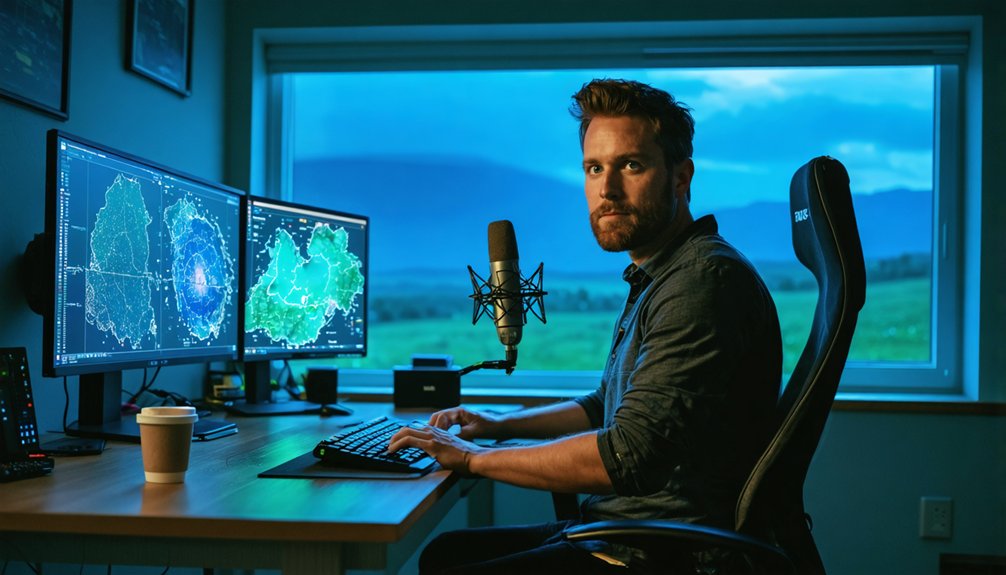
While most storm chasers work the field directly, Hall runs his operation from a Kentucky headquarters, coordinating a network of contracted chasers deployed on the ground. This weather innovation redefines how severe weather gets covered and delivered to you in real time.
His decentralized model works through three core functions:
- Ground deployment – Contracted chasers position themselves near active storm cells, capturing live footage.
- Central broadcasting – Hall analyzes incoming data, radar, and field reports, then broadcasts directly to millions of viewers.
- Audience engagement – Viewers receive continuous safety updates, keeping them informed throughout active events.
You’re not watching a passive broadcast. You’re tapped into a precision operation that prioritizes both storm accuracy and public safety, all driven without Hall ever leaving his headquarters.
How the Y’all Squad Storm Chasing Operation Works
That Kentucky headquarters doesn’t operate in isolation — it powers a structured nonprofit called the Y’all Squad, which Hall launched roughly a year before his People profile.
The Kentucky base isn’t just an office — it’s the engine behind the structured nonprofit known as the Y’all Squad.
The organization deploys contracted storm chasers directly into severe-weather zones while Hall coordinates remotely using weather models to track storm movement in real time.
Chasers on the ground — sometimes equipped with drone technology — pursue tornadoes and document impact zones as events unfold.
Beyond data collection, the Y’all Squad responds to disaster-affected communities, delivering food, supplies, and replacement items to local shelters.
Each disaster event generates roughly $30,000 to $50,000 in donations, funding those relief efforts directly.
You’re watching a dual-function operation: precise storm intelligence gathered in the field, combined with immediate community support where it’s needed most.
The Tornado Coverage That Put Ryan Hall Y’all on the Map
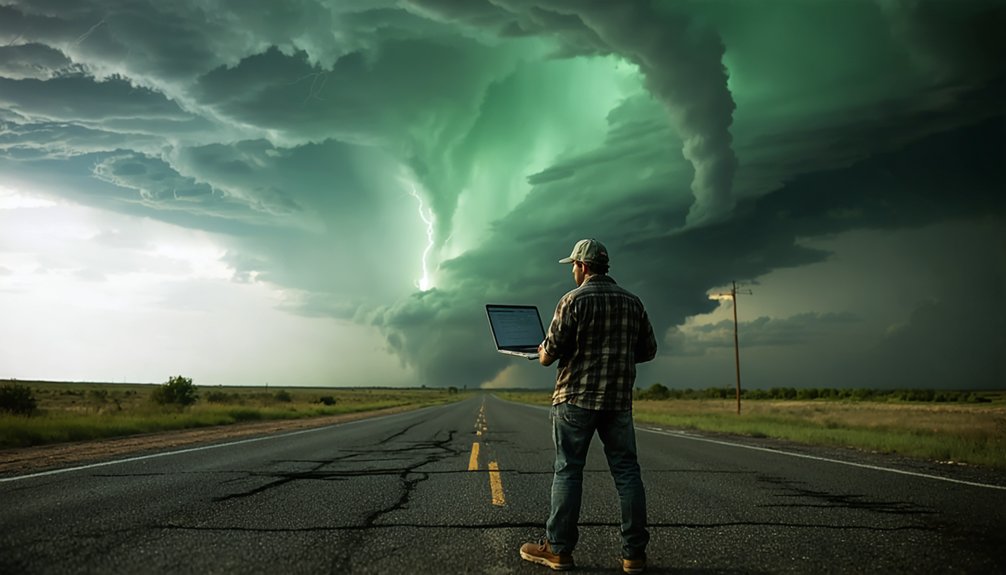
When an EF-4 tornado tore through western Kentucky and Mayfield in December 2021, Hall’s livestream coverage turned a growing YouTube channel into a nationally recognized weather platform. His use of weather technology delivered real-time tracking data directly to viewers who needed actionable information fast.
That event demonstrated three measurable outcomes:
- Audience engagement spiked as millions tuned in simultaneously, validating livestreaming as a legitimate emergency communication tool.
- Hall’s decentralized model—broadcasting from Kentucky headquarters while contracted chasers worked the ground—proved operationally effective under extreme conditions.
- The coverage established public trust in independent digital meteorology outside traditional broadcast networks.
You don’t need a television station to reach millions during a crisis. Hall’s December 2021 coverage proved that direct-to-audience weather platforms can deliver critical information faster than conventional media.
The Forecasting Criticism Ryan Hall Y’all Has Faced
Hall’s rapid rise hasn’t come without scrutiny. As his platform expanded, so did social media scrutiny over his forecast accuracy.
Critics pointed to a 2022 video in which Hall claimed to predict exactly when specific regions would receive snow — a level of precision that meteorologists typically avoid given atmospheric variability.
Pinpointing snowfall timing down to narrow windows overstates what current modeling reliably supports. When those predictions miss, audiences notice, and the backlash spreads fast across social platforms.
You should understand that digital weather personalities operate under a different accountability standard than traditional broadcasters. Every claim is archived, clipped, and recirculated.
Hall’s entertainment-driven format builds engagement, but it also amplifies errors. Forecast accuracy isn’t optional — it’s the credibility foundation his entire platform depends on.
Frequently Asked Questions
What Is Ryan Hall Y’all’s Net Worth or Estimated Annual Income?
Like chasing storms without a map, pinning down Ryan Hall Y’all’s exact net worth isn’t possible here—no verified data on his storm chasing or weather forecasting earnings exists within the available information provided to you.
Is Ryan Hall Y’all Formally Certified as a Professional Meteorologist?
Ryan Hall doesn’t hold formal meteorology credentials or meet traditional certification requirements. He studied broadcast meteorology at Mississippi State but left in 2016, building his platform through self-driven storm chasing and direct digital audience engagement instead.
Does Ryan Hall Y’all Have a Family or Spouse?
With millions tuning into his storm chasing livestreams, the knowledge base doesn’t reveal details about Ryan Hall’s family or spouse. His weather forecasting career and personal relationships aren’t documented in the available information you’d need.
How Many Subscribers Does Ryan Hall Y’all Currently Have?
The knowledge doesn’t specify his exact subscriber count. However, you can track his growth directly — his storm chasing techniques and weather prediction tools have driven millions of viewers to his livestreams, reflecting massive, freedom-driven audience engagement.
What Equipment Does Ryan Hall Y’all Use for Broadcasting?
The provided knowledge doesn’t detail the specific camera gear Ryan Hall uses for storm chasing broadcasts. You’d need to check his channel directly for precise equipment specs, as that technical data isn’t available here.
References
- https://ryanhallyall.com/
- https://www.youtube.com/@RyanHallYall
- https://www.facebook.com/ryanhallyall/
- https://www.youtube.com/watch?v=hVr4pn-Uz1Y
- https://people.com/real-life-twister-chasers-go-viral-with-livestreams-then-help-survivors-rebuild-exclusive-8704217
- https://www.youtube.com/watch?v=k4Gcr5Aci0E
- https://x.com/ryanhallyall/status/2048162587070579162