When you trace Sean Casey’s IMAX tornado film journey, you find a filmmaker who transformed storm chasing into precision cinematography. Casey built the 14,000-pound Tornado Intercept Vehicle to position a 70mm camera inside an actual tornado’s core. He partnered with VORTEX2 researchers and Doppler on Wheels technology to time intercepts with scientific accuracy. His film *Tornado Alley* redefined severe-weather documentation entirely. The full engineering, science, and survival story runs much deeper than it first appears.
Key Takeaways
- Sean Casey, born in 1967, is an American IMAX filmmaker who combined storm chasing with documentary filmmaking to capture tornadoes on 70mm film.
- Casey built the 14,000-pound Tornado Intercept Vehicle 2 (TIV2) with bullet-resistant windows to safely position his IMAX camera near tornadoes.
- He collaborated with VORTEX2 researchers and atmospheric scientist Joshua Wurman, using Doppler on Wheels radar for real-time storm data during filming.
- The project resulted in *Tornado Alley*, an IMAX/3D film blending cinematic storytelling with legitimate atmospheric science and unprecedented tornado footage.
- Casey faced life-threatening near-misses when unpredictable tornado shifts tested TIV2’s engineering limits, requiring split-second survival decisions under extreme wind loads.
Who Is Sean Casey, the IMAX Storm Chaser?
Sean Casey—born Sean Cameron Casey on December 28, 1967—is an American IMAX filmmaker and storm chaser who’s built his career around capturing tornadoes on large-format film.
You’re looking at someone who merged two demanding disciplines—IMAX filmmaking and storm chasing—into a singular, high-risk pursuit.
Casey gained wider public recognition through the Discovery Channel’s reality series *Storm Chasers*, where audiences watched him push specialized vehicles directly into severe weather.
His work isn’t recreational thrill-seeking; it’s a calculated technical mission to document tornado formation from positions most cinematographers would never attempt.
Why Casey Spent Years Trying to Film Inside a Tornado
When you consider what drives a filmmaker to spend years pursuing a single shot, Casey’s obsession with capturing the interior of a tornado reveals how far large-format cinematography can push both technology and human nerve.
You’re looking at a project that demanded more than conventional storm-chasing equipment could deliver, forcing Casey to engineer purpose-built vehicles capable of withstanding the very phenomenon he was trying to film.
That tension between the camera’s technical requirements and the tornado’s destructive force became the defining challenge of his career, shaping every decision from vehicle design to field strategy.
The Tornado Filming Obsession
Few filmmaking challenges rival what Casey set out to accomplish: capturing the interior of a tornado on large-format IMAX film. His obsession wasn’t reckless—it combined disciplined tornado filming techniques with storm chasing ethics that prioritized data collection alongside cinematic impact.
Consider what you’re actually dealing with:
- A 70mm IMAX camera demands stable, precise positioning inside nature’s most violent atmospheric event.
- Storm chasing ethics require balancing personal risk against genuine scientific contribution.
- Large-format film needs adequate light exposure—conditions inside a tornado remain unpredictable.
You’d understand why Casey spent years refining his approach rather than rushing the process. Each season delivered new variables. Each near-miss sharpened his methodology.
The obsession wasn’t about spectacle—it was about documenting something humanity had never actually seen before.
Pushing Large-Format Weather Cinematography
Capturing a tornado’s interior on 70mm IMAX film isn’t merely a logistical challenge—it’s a convergence of atmospheric science, optical physics, and mechanical engineering that Casey spent years working to solve.
Large format cinematography demands stability, precise focus, and controlled lighting conditions—none of which a tornado offers. You’re dealing with violently rotating debris fields, extreme pressure differentials, and near-zero visibility.
Standard severe weather documentation methods couldn’t satisfy IMAX’s uncompromising technical requirements. Casey needed a platform stable enough to keep a 70mm camera operational while positioned inside a meteorological event capable of destroying reinforced structures.
Every design decision—from bullet-resistant polycarbonate windows to the TIV2’s 14,000-pound frame—directly addressed specific cinematographic constraints. He wasn’t just chasing tornadoes; he was engineering controlled conditions for capturing unprecedented atmospheric footage.
Why Casey Had to Build His Own Tornado Vehicle
Before Casey could get close enough to a tornado to film it properly, he needed a vehicle built for that specific purpose—not a rented minivan.
Standard vehicles couldn’t handle the storm chasing challenges he faced. So in 2003, he began constructing the TIV1, eventually followed by the more advanced TIV2.
The tornado vehicle design had to solve three critical problems:
- Weight and stability – TIV2 weighed roughly 14,000 pounds to resist violent wind forces.
- Impact resistance – Windows used 1.5-inch bullet-resistant polycarbonate to deflect deadly debris.
- Mobility – A top speed of 100 mph let Casey reposition quickly during rapidly shifting storms.
You can’t film inside a tornado from something fragile.
Casey built the tool the mission demanded.
How the Tornado Intercept Vehicle Was Built
Building the TIV wasn’t just a matter of welding steel plates onto a truck frame and calling it done.
Casey began TIV construction in 2003, engineering a purpose-built platform capable of surviving direct tornado contact. The TIV design prioritized storm safety through reinforced armor, low ground clearance, and hydraulic spikes that anchored the vehicle against violent updrafts.
Windows used 1.5-inch-thick bullet-resistant polycarbonate, giving you visibility without sacrificing structural integrity.
1.5-inch bullet-resistant polycarbonate — thick enough to stop rounds, clear enough to watch a tornado swallow you whole.
TIV2 pushed the concept further, reaching a reported 14,000 pounds while maintaining a top speed of 100 mph. That combination let Casey position aggressively without surrendering escape options.
Every component served a calculated purpose — nothing decorative, nothing wasted.
You’re looking at a machine built entirely around one mission: surviving inside a tornado long enough to film it.
How the TIV2 Was Engineered to Survive a Direct Tornado Hit
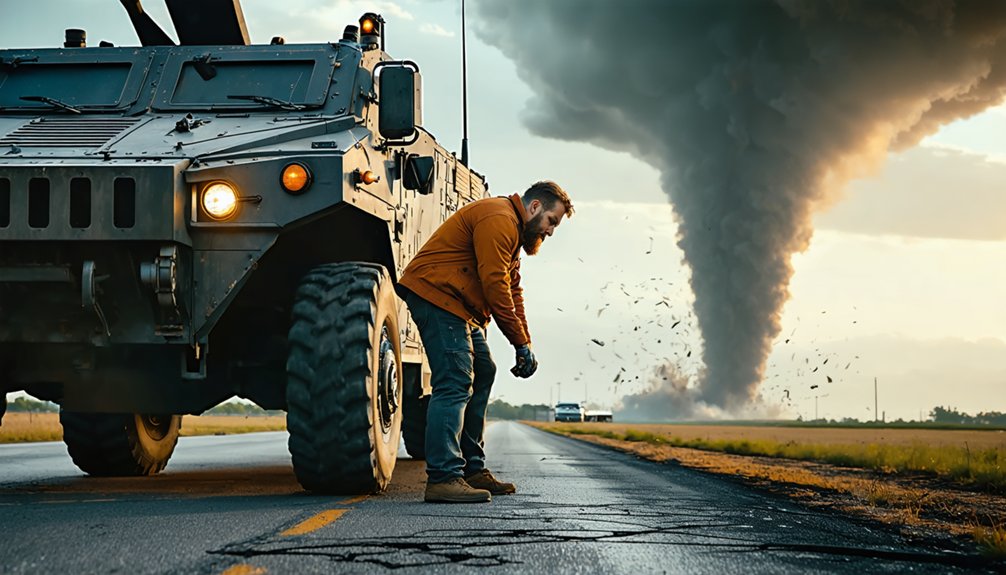
Every design decision inside TIV2 traced back to a single engineering problem: how do you keep a vehicle intact when a tornado wraps around it?
The TIV2 design answered that through deliberate engineering choices built around tornado resilience.
Three critical features defined the build:
- Mass and stability – At roughly 14,000 pounds, TIV2 resisted being lifted or rolled by violent rotational winds.
- Bullet-resistant polycarbonate windows – At 1.5 inches thick, they deflected high-velocity debris that would shatter conventional glass instantly.
- Speed capability – A 100 mph top speed let Casey reposition or escape when intercept angles shifted dangerously.
You’re looking at a vehicle engineered not to survive despite a tornado’s force, but specifically because of it.
The VORTEX2 Researchers Casey Partnered With to Study Tornadoes
When you examine Casey’s fieldwork, you’ll find that he didn’t operate in isolation—he actively partnered with VORTEX2 researchers to combine cinematic documentation with rigorous atmospheric science.
At the center of that collaboration was atmospheric scientist Joshua Wurman, whose Doppler on Wheels radar trucks gave Casey’s team precise, real-time data on tornado structure and movement.
This partnership let you see how filmmaking and field research reinforced each other: Wurman’s instruments tracked storm dynamics while Casey’s TIV2 pushed toward the core to capture what the radar was already measuring.
VORTEX2 Research Partnership Overview
While Casey’s filmmaking ambitions required dramatic tornado footage, his partnership with VORTEX2 researchers gave the project a rigorous scientific foundation.
You’ll recognize three core contributions the collaboration delivered:
- Defined VORTEX2 objectives — researchers systematically targeted tornado formation, structure, and dissipation, giving Casey’s missions precise scientific purpose beyond dramatic visuals.
- Deployed VORTEX2 technology — atmospheric scientist Joshua Wurman’s Doppler on Wheels radar trucks measured internal wind fields with high-resolution accuracy, producing data unavailable through standard observation methods.
- Integrated dual-purpose fieldwork — Casey’s camera crews and VORTEX2 scientists coordinated intercepts simultaneously, maximizing each storm encounter for both large-format footage and atmospheric measurement.
This alliance transformed *Tornado Alley* from a spectacle-driven documentary into a scientifically grounded record of severe-weather dynamics you can trust.
Doppler On Wheels Collaboration
Several of VORTEX2‘s most critical instruments arrived on Casey’s intercepts through Joshua Wurman’s Doppler on Wheels, or DOW, radar trucks.
These mobile Doppler Technology platforms gave Casey’s team real-time velocity and wind-field data that stationary radar simply can’t provide. Wurman’s DOW units would position themselves near developing supercells, scanning rotating columns while Casey maneuvered the TIV2 toward intercept position.
The collaboration meant Casey wasn’t chasing blind—he’s working from precise, continuously updated atmospheric readings. Weather Instruments mounted across the DOW trucks measured wind shear, precipitation intensity, and storm structure simultaneously.
That layered data stream allowed Casey’s crew to anticipate tornadic development with greater accuracy, increasing both scientific yield and crew safety. The DOW partnership fundamentally transformed Casey’s film mission into a coordinated, instrument-driven field operation.
What Made *Tornado Alley* Different From Other Storm Films?
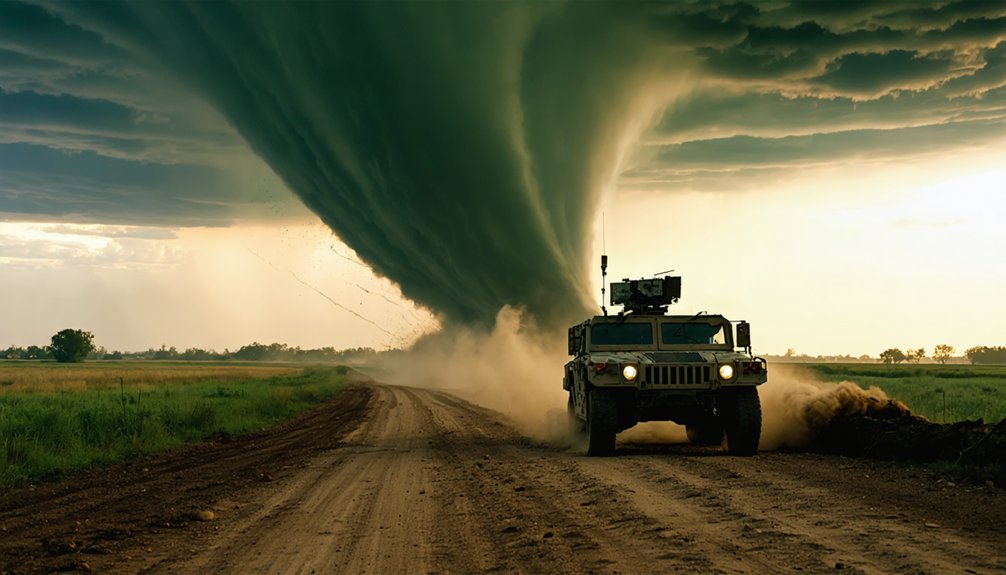
- IMAX film innovation: Casey mounted a 70mm camera inside the TIV2, capturing tornado cinematography techniques previously impossible from stationary or handheld rigs.
- Scientific integration: The film embedded VORTEX2 researchers alongside Casey’s crew, merging documentary storytelling with real atmospheric data collection.
- 3D severe-weather immersion: The IMAX/3D format placed you inside supercell environments with unprecedented visual depth, transforming passive viewing into an experiential encounter.
You weren’t watching storm footage—you were studying it.
Casey’s approach demanded both engineering precision and cinematic courage, producing a film that respected your intelligence while delivering raw, unfiltered atmospheric power.
The Tornado Encounters Casey Barely Survived
Casey’s public interviews documented close calls that exposed the limits of even the TIV2’s formidable engineering—encounters where tornadoes shifted unpredictably, cutting off escape routes and forcing split-second decisions under catastrophic wind loads.
Storm chasing at that intensity meant accepting margins that conventional safety calculus wouldn’t tolerate. When a tornado redirected faster than radar projections indicated, you couldn’t outrun it—you absorbed the hit and relied on 14,000 pounds of hardened steel and 1.5-inch polycarbonate to hold.
Tornado survival in those moments depended less on planning and more on structural integrity tested beyond design specifications. Casey’s accounts weren’t dramatized for audiences—they reflected genuine engineering stress events where the difference between documentation and disaster measured only in seconds and wind-speed variance.
Frequently Asked Questions
What Is Sean Casey’s Full Name and Date of Birth?
You’re looking at Sean Cameron Casey as his full name, with a birth date of December 28, 1967. This filmmaker’s identity anchors his groundbreaking storm-chasing legacy, merging technical precision with fearless IMAX tornado documentation.
How Much Did Building the Original TIV Reportedly Cost?
Building the original TIV reportedly cost you over $80,000—a significant investment in tornado engineering that transformed storm chasing from rented minivans into a purpose-built, debris-resistant interceptor capable of withstanding nature’s most destructive, high-velocity atmospheric forces.
What Specific Polycarbonate Thickness Was Used in TIV2 Windows?
At 14,000 pounds, TIV2’s engineered resilience impresses. You’ll find its windows used 1.5-inch (40mm) bullet-resistant polycarbonate, showcasing exceptional polycarbonate properties and window durability engineered to withstand tornado-force debris impacts with uncompromising protective performance.
What Year Was *Tornado Alley* Officially Released to Audiences?
You’ll find that *Tornado Alley* officially hit audiences in 2011, showcasing groundbreaking film techniques that captured raw tornado impact through immersive IMAX 3D technology, giving you unfiltered, large-format access to nature’s most unrestricted, powerful atmospheric forces.
What Additional Custom Vehicles Did Casey Develop Beyond the TIV?
Beyond the TIV, you’ll find Casey’s custom vehicle innovations expanded into the rugged Subanator/Suba-TIV and the aqua TIV, storm chasing equipment engineered to conquer diverse, extreme environments — pushing boundaries wherever dangerous weather threatened to release its raw fury.
References
- https://en.wikipedia.org/wiki/Sean_Casey_(filmmaker)
- https://www.npr.org/2011/06/01/136861305/filmmaker-shoots-at-the-heart-of-the-tornado
- https://www.kunc.org/2011-06-01/filmmaker-shoots-at-the-heart-of-the-tornado
- https://bransonimax.com/movies/tornado-alley-3d-imax-adventure/
- https://www.facebook.com/p/Sean-Casey-IMAX-film-makerStorm-Chaser-100046858756663/
- https://gsfilms.com/film-catalog-post/tornado-alley/
- https://www.whitakercenter.org/digital-cinema/movies/tornado-alley-3d/
- https://www.youtube.com/watch?v=j1M0thg2jcQ
- https://www.imdb.com/title/tt1852955/
- https://www.reddit.com/r/tornado/comments/1335jhn/sean_caseys_movie_from_storm_chasers_ever_come_out/