If you remember Joel Taylor from Discovery Channel’s *Storm Chasers*, you knew him as a fearless Oklahoma-bred meteorologist who chased violent storms alongside Reed Timmer. But in January 2018, he died aboard the *Harmony of the Seas*, and toxicology reports confirmed MDMA poisoning as the primary cause, complicated by ketamine, MDA, and Zolpidem interactions. Authorities ruled his death accidental. His legacy remains rooted in advancing public weather awareness — and there’s much more to his story than headlines captured.
Key Takeaways
- Joel Taylor, an Oklahoma-born meteorologist, gained fame through Discovery Channel’s “Storm Chasers,” where he starred alongside Reed Timmer.
- Taylor was found unresponsive in his cabin before docking in San Juan, Puerto Rico, with no evidence of foul play.
- MDMA poisoning was ruled the primary cause of death, with additional substances including MDA, ketamine, and Zolpidem detected.
- Authorities ruled his death accidental, citing dangerous polysubstance interactions that caused fatal cardiac and neurological stress.
- His legacy endures through his contributions to weather awareness, storm chasing culture, and public understanding of severe weather systems.
Who Was Joel Taylor, Storm Chaser?
Joel Taylor was an Oklahoma-born meteorologist best known for his work on Discovery Channel’s “Storm Chasers,” where he pursued some of nature’s most dangerous weather events alongside co-star Reed Timmer. He earned his degree from the University of Oklahoma School of Meteorology, grounding his on-screen daring in genuine scientific knowledge.
Joel’s personality combined calculated risk-taking with authentic passion for weather science, earning him respect within a tight-knit community that values both courage and responsibility. Storm chasing ethics demand that chasers balance public safety awareness against personal danger, and Taylor embodied that tension throughout his career.
Though the show concluded years before his death at 38, his contributions to public weather awareness and his influence on storm chasing culture remain a defining part of his legacy.
Joel Taylor’s Career on Discovery’s Storm Chasers
Starring alongside meteorologist Reed Timmer on Discovery Channel’s “Storm Chasers,” Joel Taylor built a reputation as one of television’s most compelling weather science communicators.
You’d recognize his fearless approach to storm chaser techniques, which brought viewers directly into the heart of violent weather systems across America’s plains. Taylor’s willingness to pursue high-risk encounters with tornadoes demonstrated both his meteorological expertise and his commitment to expanding public understanding of meteorological impacts.
He graduated from the University of Oklahoma School of Meteorology, giving his on-screen work genuine scientific credibility. His contributions extended beyond entertainment, helping audiences grasp how severe weather forms and behaves.
Though the show concluded years before his death, Taylor’s professional legacy remained firmly rooted in his dedication to advancing weather awareness through direct field experience.
Drug Arrests Before the Harmony of the Seas Sailed
Before the Harmony of the Seas even departed from Fort Lauderdale, law enforcement had already made several drug possession arrests among passengers boarding the vessel.
These pre-departure arrests painted a clear picture of the drug culture surrounding this particular voyage, signaling that the cruise experience wouldn’t be without its complications.
The pre-departure arrests foreshadowed a voyage already shadowed by substance use before it even began.
The ship carried celebrities, including Olivia Newton-John and the electronic duo Galantis, attracting a crowd where substance use appeared prevalent.
Authorities followed standard procedure, notifying law enforcement upon docking in San Juan after Taylor’s body was discovered.
Early reports suggested he’d consumed ecstasy and cocaine alongside fellow passengers.
This environment set a troubling backdrop for what ultimately became a fatal night, demonstrating how unchecked substance use can produce irreversible consequences regardless of professional accomplishment or public profile.
The Night Joel Taylor Died on Harmony of the Seas
On the night of January 23, 2018, witnesses aboard the Harmony of the Seas saw two men carry Joel Taylor off the dance floor, a detail that would later become one of the few documented accounts of his final hours.
The cruise atmosphere that night featured high-profile performances, creating conditions where the night events unfolded largely unnoticed.
Key facts surrounding his death:
- Taylor was found unresponsive in his cabin before the ship docked in San Juan, Puerto Rico.
- Family members identified his body following its discovery.
- San Juan Police Department found no evidence of foul play.
- Toxicology later confirmed multiple substances in his system, including MDMA and ketamine.
He died at sea, with authorities notified upon docking per standard maritime procedure.
What Killed Joel Taylor? The Toxicology Report Explained
Five months after Taylor was carried off that dance floor, the Puerto Rico Bureau of Forensic Sciences released the toxicology report that answered what had killed him.
The toxicology insights confirmed MDMA poisoning as the primary cause, with additional substance interactions complicating the picture considerably. Ketamine, MDA, and Zolpidem were all detected in his system alongside the ecstasy.
These substance interactions proved fatal. Combining a stimulant like MDMA with a dissociative like ketamine, a psychedelic amphetamine like MDA, and a sleep medication like Zolpidem creates dangerous cardiac and neurological stress.
Authorities ruled the death accidental, citing no evidence of foul play. The report made clear that no single substance necessarily killed Taylor — the lethal factor was the volatile combination working simultaneously against his body.
Was Joel Taylor’s Death Accidental or Suspicious?
When authorities discovered Joel Taylor unresponsive aboard the Harmony of the Seas, early circumstances naturally raised questions.
However, investigators found no evidence of foul play.
However, investigators found no evidence of foul play, pointing instead toward an accidental death.
San Juan Police Department cleared suspicious activity, pointing instead toward an accidental overdose from dangerous substance interactions.
The toxicology report confirmed this conclusion with four key findings:
- MDMA served as the primary cause of death
- Ketamine, Zolpidem, and MDA were detected alongside MDMA
- No evidence supported criminal involvement
- Puerto Rico’s Bureau of Forensic Sciences ruled the death accidental
You can see how combining multiple controlled substances created a lethal chemical environment.
The five-month investigation produced a clear, evidence-based verdict: Taylor’s death wasn’t suspicious — it resulted from voluntarily mixing dangerous substances whose interactions proved fatally unpredictable.
The Danger of Mixing MDMA, Ketamine, and Zolpidem
When you mix MDMA, ketamine, and zolpidem, you’re combining substances that strain your cardiovascular system, suppress your central nervous system, and impair your body’s ability to regulate itself simultaneously.
MDMA raises your heart rate and body temperature while ketamine acts as a dissociative anesthetic. Adding zolpidem—a sedative—creates a cocktail that can shut down critical bodily functions.
Toxicology confirmed that Taylor had all three substances in his system alongside MDA, making his death a stark example of how polysubstance use exponentially increases the risk of fatal overdose.
Combined Substances’ Deadly Effects
The toxicology report confirmed that Taylor’s death resulted from a lethal combination of MDMA, ketamine, zolpidem, and MDA — each substance dangerous on its own, but catastrophically more so together.
Understanding polysubstance interactions explains why this combination proved fatal:
- MDMA raises body temperature and strains the cardiovascular system.
- Ketamine suppresses respiratory function and consciousness.
- Zolpidem amplifies sedation, compounding ketamine’s depressant effects.
- MDA intensifies neurotoxic stress alongside MDMA.
When you combine stimulants with depressants, your body receives contradictory signals it can’t reconcile.
Drug safety experts consistently warn that mixing these substances exponentially multiplies overdose risk.
Taylor’s case isn’t just tragic — it’s a documented example of how polysubstance combinations overwhelm even a healthy body’s ability to survive.
Risks Of Polysubstance Use
Mixing MDMA, ketamine, and zolpidem isn’t just risky — it’s a physiological contradiction your body can’t resolve.
MDMA floods your system with serotonin while spiking your heart rate and body temperature. Ketamine simultaneously depresses your central nervous system.
Add zolpidem, a sedative that further suppresses neurological function, and you’ve created competing chemical demands your organs can’t manage.
Your cardiovascular system strains under stimulation while your respiratory system slows toward failure.
That’s the core of polysubstance risks — each substance compounds the toxicity of the others exponentially, not additively.
Joel Taylor’s death illustrates why drug awareness matters beyond individual substances.
Understanding how combinations interact isn’t optional knowledge — it’s survival knowledge.
You retain the freedom to make choices, but those choices carry consequences your body ultimately calculates without negotiation.
How Reed Timmer and Fellow Storm Chasers Responded
When you look at the immediate aftermath of Joel Taylor’s death, you’ll find that his “Storm Chasers” co-star Reed Timmer was among the first to publicly express grief, taking to Twitter to share his shock and sorrow.
The storm chasing community rallied around Timmer’s sentiment, mourning the loss of a fellow meteorologist who’d built his reputation pursuing some of nature’s most violent phenomena.
Taylor’s death sent ripples through a tight-knit professional circle that knew him not as a cautionary tale, but as a colleague whose risks had always been measured in wind speeds, not substances.
Reed Timmer’s Twitter Response
News of Joel Taylor’s death sent shockwaves through the storm chasing community, with co-star Reed Timmer taking to Twitter to publicly mourn his former colleague.
Reed Timmer’s condolences reached thousands through Twitter tributes that reflected genuine grief. You can trace the community’s reaction through four key elements:
- Timmer posted directly on Twitter, expressing personal loss publicly.
- Fellow storm chasers amplified his message, spreading awareness rapidly.
- The tributes highlighted Taylor’s professional contributions to meteorology and public weather awareness.
- Community responses underscored Taylor’s lasting impact beyond his television career.
Timmer’s openness demonstrated how tightly knit the storm chasing world remains.
Despite Taylor’s death occurring far from any storm system, his colleagues refused to let professional boundaries define how they honored him.
Storm Chasing Community Mourns
Three days after Joel Taylor’s body was discovered aboard the Harmony of the Seas, Reed Timmer and fellow storm chasers had already mobilized on social media to publicly honor their colleague.
You’ll notice how quickly the storm chasing community rallied—Timmer’s Twitter response sparked broader conversations about Taylor’s community impact, drawing tributes from meteorologists and weather enthusiasts alike.
The outpouring wasn’t performative; it reflected genuine respect for Taylor’s contributions to public weather awareness during his time on Discovery Channel’s *Storm Chasers*.
Legacy preservation became a clear priority as colleagues emphasized his professional achievements rather than his circumstances of death.
His funeral, held in Oklahoma one week after his passing, gave the community a formal opportunity to collectively grieve and celebrate a life defined by calculated risk and scientific passion.
Joel Taylor’s Funeral in Oklahoma
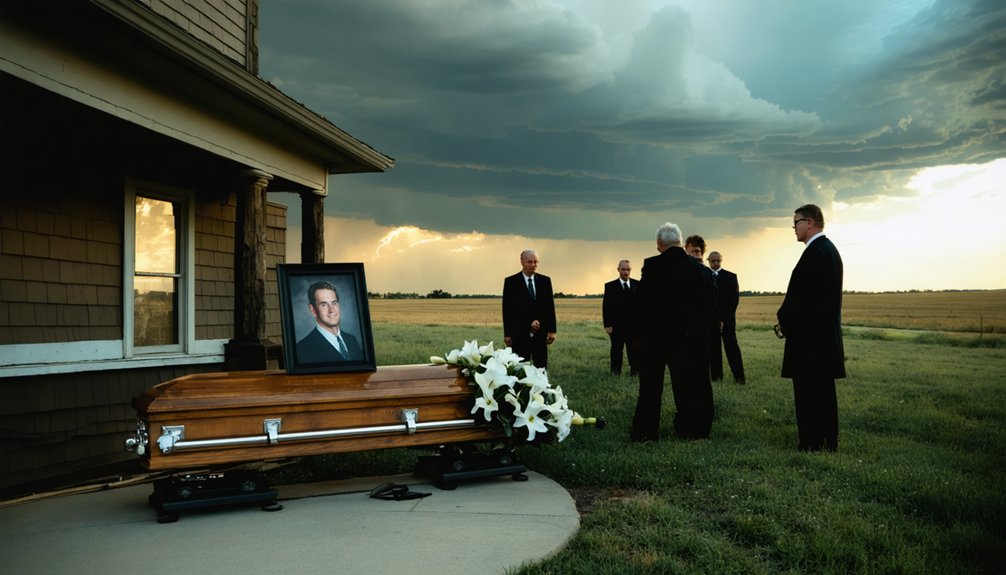
Following his death at sea on January 23, 2018, Joel Taylor’s body was transported from Puerto Rico to his home state of Oklahoma, where his funeral took place roughly a week later. The funeral arrangements reflected both his roots and the community support he’d earned throughout his career.
Key facts surrounding Taylor’s Oklahoma farewell:
- His body required official release from Puerto Rican authorities before transport could proceed.
- Reed Timmer and fellow storm chasers publicly mourned his loss via social media.
- Oklahoma’s meteorological community acknowledged his University of Oklahoma background during remembrances.
- His death prompted broader conversations about personal freedom and the risks of recreational drug use.
Taylor’s colleagues remembered him as a skilled meteorologist whose contributions extended well beyond television.
Frequently Asked Questions
Which Celebrities Were Performing on the Harmony of the Seas Cruise?
“All that glitters is not gold” — you’d have witnessed star-studded cruise performances and celebrity sightings firsthand, as Olivia Newton-John and Galantis were actively entertaining guests aboard Harmony of the Seas.
How Old Was Joel Taylor When He Died?
Joel Taylor was 38 when he died, a sobering age timeline that cuts short a promising career. You can’t ignore the personal impact of losing such a skilled meteorologist so young.
Where Did Joel Taylor Study Meteorology?
You’d think storm chasing requires no formal training, but Joel Taylor’s meteorology education proves otherwise — he studied at the University of Oklahoma School of Meteorology, where academic rigor shaped his celebrated storm chasing career.
How Long After Death Was the Toxicology Report Released?
You’ll find that the toxicology timeline stretched five months after Joel Taylor’s January 2018 death, with report details confirming MDMA poisoning as the primary cause finally released in June 2018, giving you concrete, evidence-based answers.
Which Cruise Line Was Joel Taylor Sailing With?
Like a storm chaser maneuvering turbulent skies, you’d find Taylor’s final cruise experience was aboard Royal Caribbean’s Harmony of the Seas — a vessel that, unlike storm chasing’s open plains, couldn’t protect him from danger within.
References
- https://www.fox6now.com/news/storm-chasers-star-joel-taylor-dead-at-38
- https://www.imdb.com/news/ni61890098/
- https://www.foxnews.com/entertainment/storm-chasers-star-joel-taylor-died-of-ecstasy-overdose
- https://www.tmz.com/2018/06/22/storm-chasers-joel-taylor-died-of-ecstasy-poisoning-on-cruise-shipdrug-overdose-cruise-ship/
- https://www.imdb.com/news/ni62105156/
- https://www.nickiswift.com/369356/a-look-at-the-tragic-death-of-joel-taylor-from-storm-chasers/
- https://www.foxnews.com/entertainment/storm-chasers-star-joel-taylors-family-identify-his-body-in-puerto-rico-after-cruise-death
- https://coed.com/2018/01/24/joel-taylor-cause-of-death-how-did-storm-chaser-die/
- https://www.fox13seattle.com/news/storm-chasers-star-joel-taylor-dead-at-38
- https://www.washingtonblade.com/2018/06/22/storm-chasers-joel-taylors-cause-of-death-released/