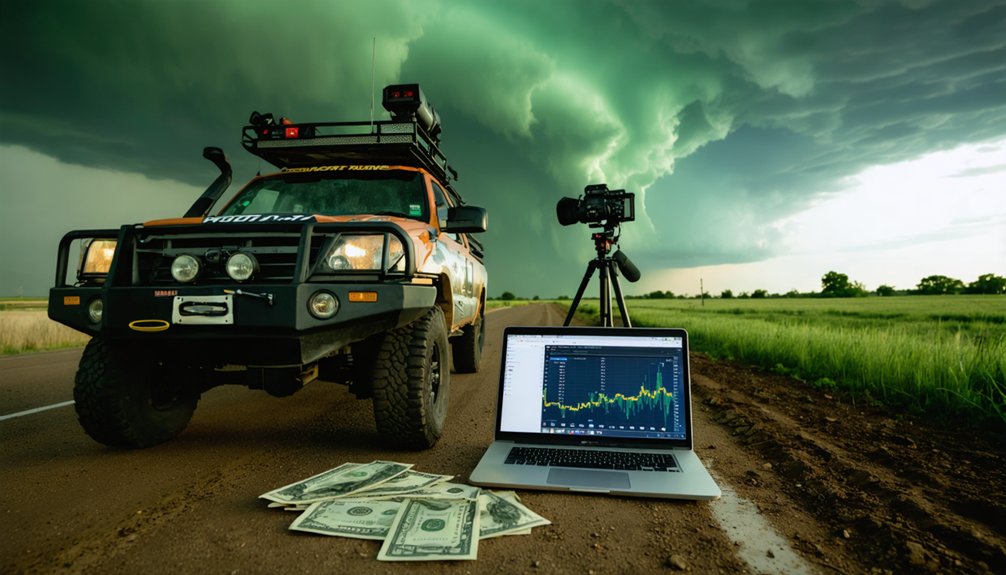
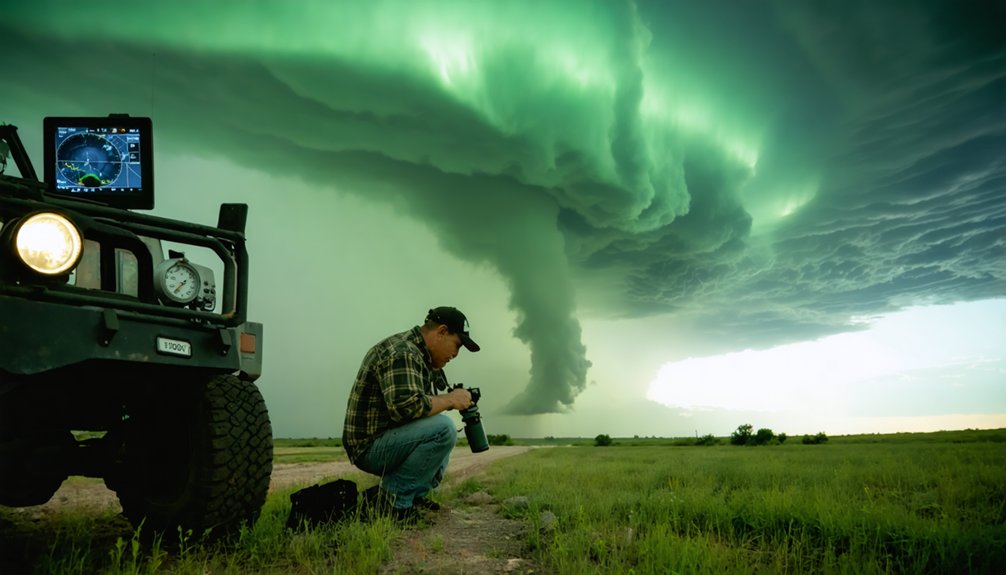
Storm chasing costs you an estimated $13,700 per season before you earn a single dollar. You’ll spend roughly $6,200 on vehicle operation, $1,592 on fuel, $2,500 on lodging and data, and $5,000 on first-year gear alone. The average storm chaser earns $45,374 annually, but operational overhead aggressively compresses those margins. Whether it’s worth the investment depends entirely on how strategically you manage costs and diversify your income — and there’s far more to unpack here.
Key Takeaways
- Storm chasing costs approximately $13,700 per season, covering vehicle operation, gear, lodging, food, and data expenses before any earnings.
- Average storm chasers earn $45,374 annually, but high operational overhead significantly reduces actual profit margins.
- Initial gear costs start at $5,000, but maintenance, upgrades, and software licensing fees create ongoing financial burdens.
- Footage sales alone are insufficient for profit; diversifying income through tours, sponsorships, and content monetization improves financial sustainability.
- Restricting chase radius, carpooling, and sharing lodging can meaningfully reduce seasonal costs, making storm chasing more financially viable.
What Does Storm Chasing Actually Cost Per Season?
When you add up every line item, a single storm chasing season runs approximately $13,700 before you’ve earned a dollar.
Vehicle operation costs $6,200 across 20,000 miles at $0.31 per mile, while fuel efficiency directly impacts the $1,591.89 annual fuel expenditure covering 8,520 miles.
First-year gear and camera equipment demands $5,000 upfront.
Hotels and food contribute $1,500, and cellular data adds another $1,000 annually.
Expense tracking through spreadsheets isn’t optional—it’s how you identify where your money actually goes.
Spreadsheets don’t lie—they show exactly where every dollar disappears before a single storm develops.
Per-chase out-of-pocket costs range $2,000–$5,000, depending on distance and duration. Local chasing within a 1.5-hour radius considerably reduces that burden.
Without diversified income streams, these costs produce zero return, making disciplined financial management your most essential operational tool.
Storm Chasing Fuel Costs: What You’ll Spend on the Road
Fuel sits at the center of every storm chasing budget, and the numbers are specific enough to plan around. A typical season runs 8,520 miles across roughly 16 chases, consuming 448.42 gallons at $3.55 per gallon. Your cost analysis lands at $1,591.89 annually — a manageable figure if you’re chasing locally.
Key fuel efficiency and spending benchmarks to track:
- Average per-chase mileage: 533 miles
- 2022 comparison baseline: $1,438 for 7,190 miles over 15 chases
- Extended tank range: 600 miles, critical for remote plains operations
Electric vehicles remain impractical given range constraints and sparse charging infrastructure on the plains. Staying within your home state or a 1.5-hour radius directly reduces this line item without sacrificing meaningful chase opportunities.
Vehicle Wear, Mileage, and First-Year Gear Expenses
Beyond fuel, vehicle wear accumulates fast once you’re logging 20,000 miles per season. At $0.31 per mile, you’re absorbing $6,200 annually in vehicle depreciation and maintenance expenses before accounting for unexpected repairs.
Remote plains terrain compounds mechanical strain, accelerating wear on tires, brakes, and suspension systems.
First-year costs hit hardest. Gear and camera equipment alone run $5,000 upfront, and that’s before you’ve turned a single mile. Combined with mileage costs, your initial season demands serious capital without guaranteed returns.
The math is straightforward: $5,000 in gear plus $6,200 in mileage expenses equals $11,200 before fuel, lodging, or communications.
You’re building infrastructure, not generating income. Understanding these fixed costs upfront lets you structure your operation for long-term sustainability rather than financial collapse.
How Much Storm Chasers Spend on Hotels, Food, and Data
Hotels, food, and communications stack another $2,500 onto your annual operating costs once fuel and mileage are accounted for. Managing these seasonal costs requires disciplined hotel budgeting, controlled food expenses, and smart data plans.
- Lodging and food average $1,500 annually for a normal chase season across the Plains.
- Cellular data plans add roughly $1,000 per year, covering real-time radar and field communications.
- Cost-sharing strategies like carpooling and splitting rooms meaningfully reduce individual seasonal costs.
You’re not locked into paying full price on any of these categories. Frugal chasers consistently cut lodging expenses by coordinating with others.
Your data plan, however, isn’t negotiable—reliable connectivity directly impacts decision-making in the field.
Together, these three expense categories push your pre-income total to approximately $13,700 annually.
Can Storm Chasers Actually Make a Living?
Spending $13,700 before earning a single dollar raises an obvious question: can storm chasing actually pay for itself? Rarely, unless you build income diversification into your model from the start.
Average annual pay sits at $45,374, but that figure doesn’t account for your operational overhead eating directly into margins.
The $45,374 average salary sounds promising — until operational overhead silently dismantles those margins.
You won’t profit through footage sales alone. Licensing, consulting, educational content, and guided tours must supplement your core chasing strategies to generate meaningful returns.
Financial harm statistically outpaces storm-related injuries, making cost control as critical as route planning.
Tracking every expense through spreadsheets lets you identify which pursuits deliver value and which drain resources.
Without that discipline, you’re funding a hobby, not building a sustainable operation. Freedom comes from treating chasing like a business, not a passion project.
How Experienced Chasers Build Income Beyond the Chase
Diversification separates chasers who sustain operations from those who burn through capital chasing revenue that never materializes.
You’ll need income diversification strategies that convert your expertise into multiple revenue streams simultaneously.
Proven channels include:
- Content and commerce: Online content monetization through YouTube, paired with affiliate marketing partnerships and merchandise sales, generates passive income between seasons.
- Direct services: Storm chasing tours generate $1,500 per participant, while educational workshops and community engagement initiatives build credibility and recurring clientele.
- Strategic alliances: Sponsorship opportunities from gear manufacturers offset equipment costs when you’ve documented measurable audience reach.
Your first-year $13,700 expense baseline produces zero profit without this layered approach.
Treating storm chasing as a platform rather than a singular pursuit transforms operational costs into justifiable business investments against diversified returns.
When Storm Chasing Costs More Than You Can Recover
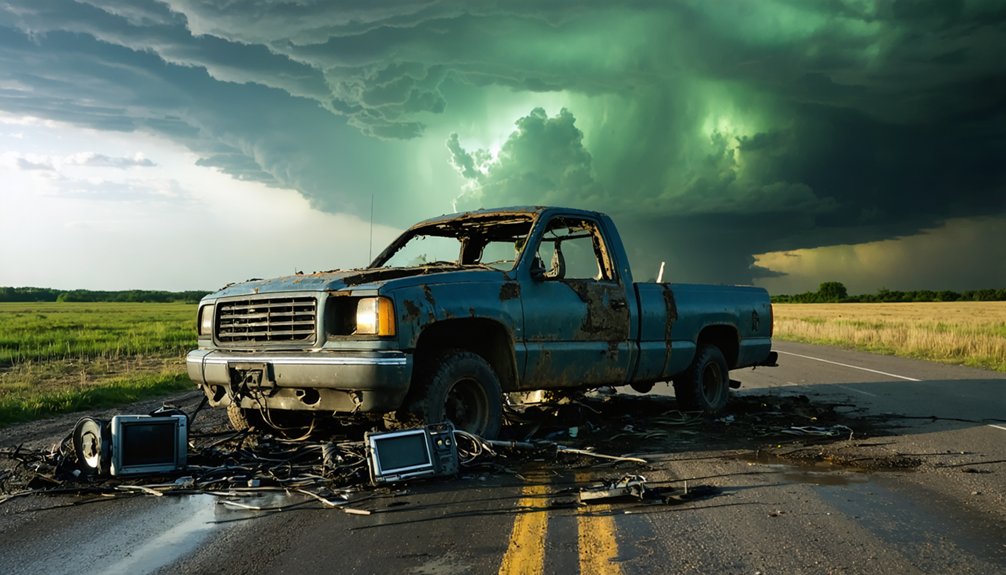
Even with disciplined diversification, storm chasing crosses into unrecoverable financial territory when cumulative expenses outpace every revenue channel you’ve built.
Six-figure cumulative costs since 1993 confirm that storm chasing profitability remains structurally elusive without a broader business model absorbing losses.
Your first-year $13,700 baseline generates zero profit, and without media licensing, tours, or educational content, annual deficits compound indefinitely.
Financial harm statistically threatens you more than any tornado.
Pursuing long-distance chases rather than maintaining a local or 1.5-hour radius accelerates that financial erosion.
Financial sustainability requires honest spreadsheet accounting, not optimism.
If your revenue streams can’t offset vehicle depreciation, fuel, lodging, and equipment replacement simultaneously, you’re funding a liability, not building an enterprise.
Recognize that threshold before losses become irreversible.
Hidden Storm Chasing Expenses Beginners Rarely Budget For
When you start chasing storms, you’ll likely overlook three budget killers: carbon costs tied to 2,466.31 pounds of annual emissions, cellular and data fees averaging $1,000 per year, and gear overruns that push first-year equipment expenses to $5,000 or beyond.
You’ll often underestimate how quickly communication costs compound across a full season, particularly when extended operations demand consistent real-time data access across remote plains corridors.
Tracking these hidden line items through disciplined spreadsheet logging isn’t optional—it’s the analytical discipline that separates chasers who stay solvent from those who absorb preventable financial losses.
Carbon Emission Costs
Key environmental impact considerations:
- Fuel consumption totals 448.42 gallons annually across 8,520 miles, directly driving emissions output.
- Extended range tanks increase per-trip capacity but concentrate carbon output into fewer, longer runs.
- Local chasing strategies within a 1.5-hour radius reduce both costs and cumulative emissions considerably.
You won’t find carbon costs on any invoice, but they’re real operational variables worth tracking.
Spreadsheet documentation of mileage helps you quantify your environmental footprint alongside your financial one, giving you complete operational transparency.
Unexpected Communication Fees
Carbon emissions track one invisible cost—cellular data and communication tools fees add another layer beginners almost never budget for.
You’ll spend roughly $1,000 annually on cellular service alone, but that figure assumes predictable usage. Storm chasing pushes you into high-data environments fast—streaming radar, uploading footage, and running GPS simultaneously drains your plan’s limits quickly.
Unexpected data charges hit hardest during extended Plains chases, where roaming zones and throttled speeds force you toward premium tiers or emergency overages.
You’re not just paying for convenience; you’re paying for operational survival. Budget these fees separately from fuel and lodging. Treat communication infrastructure as mission-critical gear, not an afterthought.
Underestimating this line item compromises both your data access and your seasonal financial projections.
Gear And Equipment Overruns
Gear expenses hit harder than most beginners anticipate, and the $5,000 first-year estimate for cameras and equipment represents only your entry point.
Gear maintenance and equipment upgrades compound costs well beyond initial projections, particularly as your operations scale.
Three critical overruns you’ll likely face:
- Weatherproofing failures force premature camera replacements after exposure to hail, rain, and debris.
- Software licensing for editing suites adds recurring annual fees your spreadsheet rarely captures initially.
- Equipment upgrades become necessary as technology evolves and client expectations rise.
Avoiding loans for $20,000 editing gear makes strategic sense given low media sales potential.
Track every gear maintenance expenditure meticulously. Your financial independence depends on distinguishing necessary upgrades from expensive impulse purchases that erode already thin operational margins.
How to Keep Storm Chasing Costs Manageable Long-Term
Restricting your chasing radius to your home state or a 1.5-hour range dramatically cuts fuel and lodging costs compared to long-distance Plains pursuits.
When you do venture farther, carpooling and splitting hotel rooms can reduce your share of the typical $1,500 seasonal lodging expense.
Structuring your operations around local storm activity first lets you build experience and equipment gradually without absorbing the full $13,700 single-season cost upfront.
Prioritize Local Chasing
Staying within your home state or a 1.5-hour radius from your base greatly reduces fuel consumption, lodging costs, and cumulative mileage—three of the largest expense drivers in storm chasing.
Local storm exploration eliminates overnight hotel stays and minimizes fuel expenditure, keeping your seasonal budget lean. These budget-friendly strategies compound over time, preserving capital for equipment upgrades rather than operational overhead.
Prioritizing proximity delivers measurable financial advantages:
- Fuel savings: Shorter distances mean fewer gallons consumed and lower per-chase costs
- No lodging expenses: Day trips eliminate the $1,500 annual hotel burden entirely
- Reduced mileage wear: Staying local cuts into the 20,000-mile seasonal accumulation, lowering vehicle depreciation at $0.31 per mile
Local-first chasing isn’t a limitation—it’s a tactically sound financial discipline.
Share Expenses Strategically
Local chasing cuts your baseline costs considerably, but even regional and Plains-targeted pursuits become financially viable when you distribute expenses across multiple chasers.
Expense sharing transforms otherwise prohibitive solo costs into manageable contributions. Carpooling directly reduces fuel expenditures—448.42 gallons at $3.55 per gallon totals $1,591.89 annually, a figure that splits cleanly across two or three committed partners. Shared lodging cuts the $1,500 Plains hotel budget proportionally, freeing capital for equipment or data subscriptions.
Effective cost management requires formal coordination. Establish clear agreements covering fuel splits, food contributions, and communication expenses before departure.
Spreadsheet tracking guarantees accountability and prevents disputes. Professional tours reaching $1,500 per person also become financially tolerable through carpooling arrangements.
Strategic expense sharing doesn’t compromise your independence—it protects it by keeping operations solvent long-term.
Frequently Asked Questions
Are Storm Chasing Expenses Tax Deductible if Treated as a Business?
If you classify storm chasing as a business, you can deduct expenses like fuel, gear, and lodging. Understanding tax implications of proper business classification lets you offset your $13,700 seasonal costs considerably.
How Does Storm Chasing Insurance Coverage Work for Vehicle Damage?
You’ll need specialized coverage, you’ll face higher premiums, and you’ll navigate complex insurance claims when storm damage occurs. Standard auto policies typically exclude intentional storm exposure, so you must secure commercial or specialty vehicle protection explicitly covering storm chasing activities.
What Permits or Licenses Do Storm Chasers Legally Need to Operate?
You don’t need specific storm chaser regulations or legal requirements to operate. Standard driver’s licenses, vehicle registration, and insurance suffice. You’re free to chase without permits, though private property access and local traffic laws still apply.
How Do Storm Chasing Costs Compare Between Different Regions of America?
Local chasing cuts your costs considerably—sticking within a 1.5-hour radius keeps storm seasons affordable. Regional pricing varies greatly, as Plains pursuits hit $1,500 in lodging alone, while hometown chasing nearly eliminates that expense entirely.
Can Storm Chasing Equipment Be Rented Instead of Purchased Outright?
You can explore rental options for various equipment types, though the knowledge base doesn’t confirm this directly. Purchasing remains the documented approach, with first-year gear costs hitting $5,000, impacting your financial freedom considerably.
References
- https://clarencesmith.substack.com/p/the-true-cost-of-storm-chasing
- https://stormtrack.org/threads/the-real-cost-of-storm-chasing-and-how-to-fund-it.27891/
- https://www.stormchase.us/Articles/money.html
- https://www.ziprecruiter.com/Salaries/Storm-Chasers-Salary
- https://stormhighway.com/chasingfaq.php