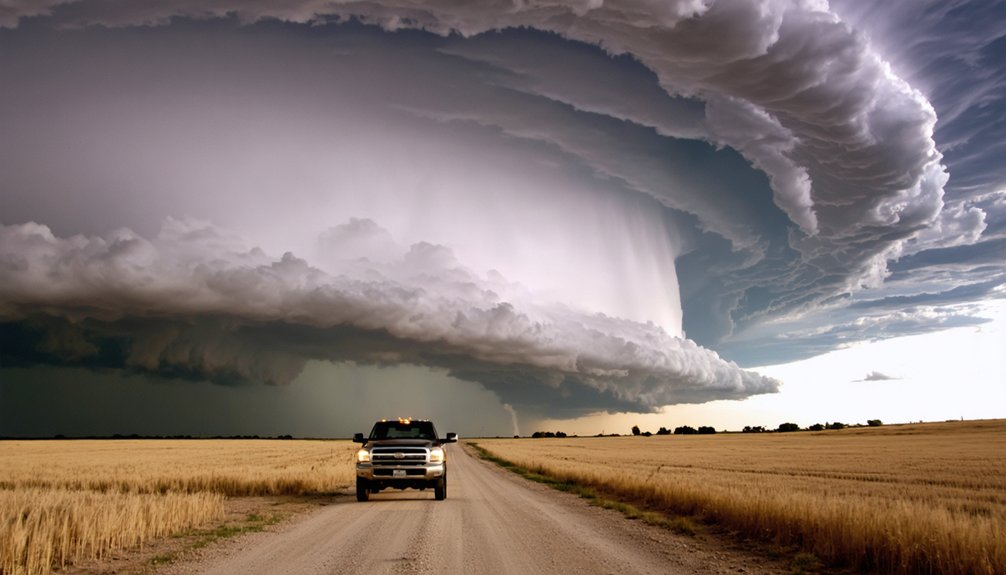
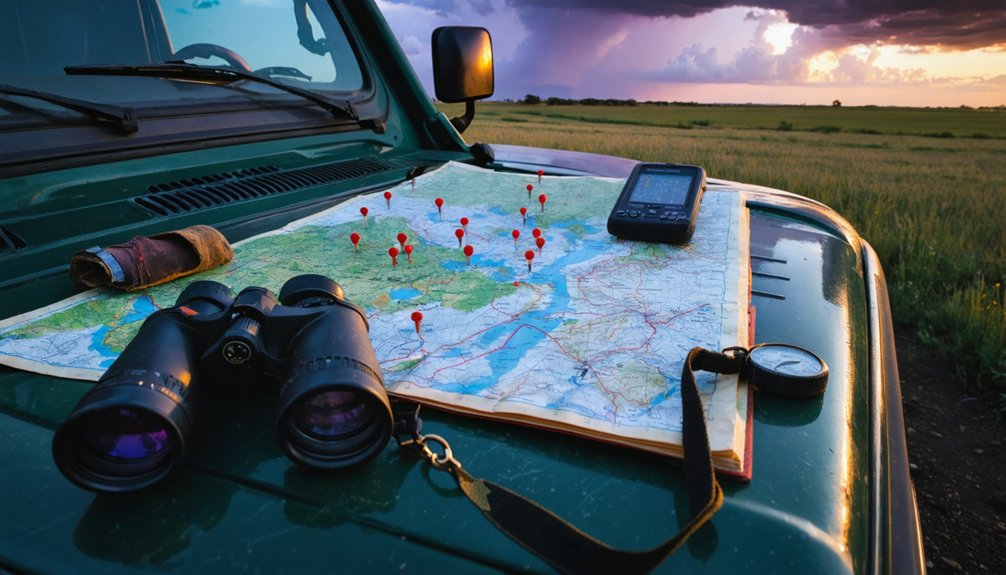
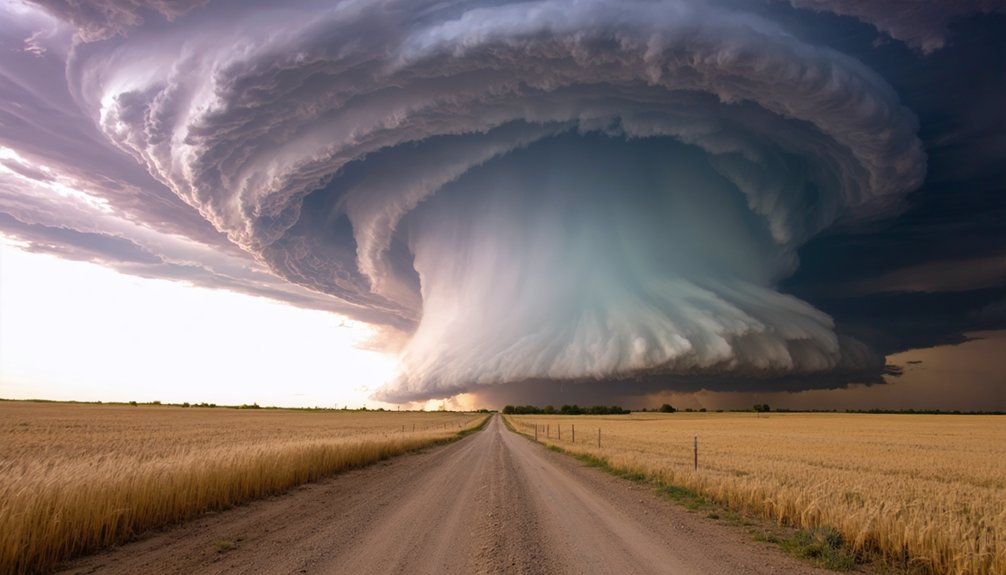
Storm chasing in Dixie Alley demands a fundamentally different skill set than chasing in the Great Plains. You’re dealing with rain-wrapped tornadoes, fast-moving HP supercells, dense tree cover, and nighttime storm threats that eliminate visual confirmation entirely. Mississippi and Alabama sit at the epicenter of this volatility, where Gulf moisture and aggressive wind shear collide year-round. Understanding these regional dynamics isn’t optional — it’s survival-critical, and everything you need to chase Dixie Alley safely and effectively is covered ahead.
Key Takeaways
- Dixie Alley tornadoes are often rain-wrapped, fast-moving, and occur at night, making them more dangerous and harder to track than Tornado Alley storms.
- Core states like Mississippi and Alabama experience violent, long-track tornadoes fueled by Gulf moisture and strong wind shear, especially during cooler months.
- The threat season spans January through late spring and resurges in autumn, requiring year-round preparation and continuous situational awareness from chasers.
- Essential gear includes a ruggedized laptop with radar software, night-vision dashcam, dedicated GPS, handheld weather station, and backup power banks.
- West-central Mississippi offers open sight lines for early storm observation before rain wraps occur, making it an ideal chase positioning area.
What Makes Dixie Alley More Dangerous Than Tornado Alley?
While Tornado Alley gets most of the cultural attention, Dixie Alley poses a measurably greater threat to life and property across several key dimensions.
You’re dealing with fundamentally different tornado dynamics here. Storm formation occurs within high-precipitation supercells fed by Gulf moisture, producing rain-wrapped tornadoes that chasers, spotters, and law enforcement simply can’t see clearly.
These systems move faster due to stronger upper-level wind shear, particularly during cooler months, giving you less reaction time. Unlike Tornado Alley’s predictable spring afternoon window, Dixie Alley sustains instability past sunset, generating dangerous nighttime and early morning tornadoes.
Faster-moving storms. Less reaction time. And they don’t stop after dark.
Dense tree cover further obscures visual confirmation. The 2011 Super Outbreak, the largest ever recorded, centered here and killed over 300 people, demonstrating exactly what these compounding factors produce.
Historic Outbreaks That Prove Why Dixie Alley Demands Respect
When you examine Dixie Alley‘s history, the deadliest recorded outbreaks establish an undeniable pattern of catastrophic tornadic activity.
The 1971 outbreak, which prompted Allen Pearson to coin the term “Dixie Alley,” produced nine long-track violent tornadoes that killed 121 people, confirming the region’s exceptional threat profile.
The 2011 Super Outbreak then set the benchmark for modern tornado disasters, generating over 300 deaths and ranking as the fourth-deadliest tornado event in U.S. history, with Mississippi and Alabama absorbing the epicenter of destruction.
Deadliest Recorded Tornado Outbreaks
Few regions in the United States have absorbed the kind of repeated, catastrophic tornado violence that Dixie Alley has, and the historical record makes that case with brutal clarity.
The 1971 outbreak launched serious tornado forecasting efforts after nine long-track violent tornadoes killed 121 people. Then the 2011 Super Outbreak redefined catastrophic storm patterns entirely, producing over 300 deaths and ranking as the fourth-deadliest outbreak in U.S. history.
The Easter 2020 outbreak further confirmed this region’s volatility. What you’re studying here isn’t a statistical anomaly — it’s a documented pattern of concentrated destruction driven by Gulf moisture, strong wind shear, and rain-wrapped supercells that compromise visibility.
Understanding these events gives you the analytical foundation necessary to respect and navigate Dixie Alley responsibly.
2011 Super Outbreak Impact
The 2011 Super Outbreak didn’t just break records — it restructured how meteorologists and emergency managers understand large-scale tornado events in the southeastern United States.
Over 300 deaths and hundreds of confirmed tornadoes forced a complete reassessment of tornado preparedness protocols across Mississippi, Alabama, and surrounding states.
You’re looking at the fourth-deadliest outbreak in U.S. history — one that exposed critical gaps in public warning response, shelter accessibility, and real-time communication systems.
The super outbreak demonstrated that Dixie Alley‘s combination of rain-wrapped tornadoes, nocturnal timing, and fast-moving tracks creates compounding dangers that standard preparedness frameworks weren’t built to address.
If you’re chasing or living in this region, studying 2011 isn’t optional — it’s foundational to understanding what this corridor is genuinely capable of producing.
Mississippi and Alabama: The Core States Every Chaser Must Know
Mississippi and Alabama sit at the geographic and meteorological core of Dixie Alley, making them essential study territory for any serious storm chaser. Mississippi geography positions the state directly adjacent to Gulf of Mexico moisture pathways, fueling persistent atmospheric instability that extends well past sunset.
You’ll encounter high-precipitation supercells here that obscure tornado structures beneath heavy rainfall, demanding sharp situational awareness rather than visual confirmation.
Alabama storms present equally complex challenges, producing long-track violent tornadoes driven by powerful wind shear during cooler months. The 2011 Super Outbreak centered across both states, delivering over 300 fatalities and demonstrating the region’s catastrophic potential.
You must understand that faster-moving, rain-wrapped tornadoes operating at night define these environments, eliminating any margin for complacency in your chase strategy.
Why Spring and Winter Dominate the Dixie Alley Chase Calendar
Unlike Tornado Alley’s concentrated spring peak, Dixie Alley’s threat calendar stretches from January through late spring and resurges in late autumn, driven by sustained Gulf of Mexico moisture that doesn’t respect seasonal boundaries.
Winter Risks here aren’t theoretical — January through March produces active storm episodes with reduced daylight, increasing your nighttime exposure to fast-moving, rain-wrapped tornadoes.
Winter tornadoes don’t wait for daylight — January through March brings fast-moving, rain-wrapped threats that strike without warning.
Spring Patterns intensify as Gulf moisture collides with strengthening wind shear, generating long-track violent tornadoes across Mississippi and Alabama.
You’re operating in a region where two distinct peak windows demand year-round preparation rather than a single seasonal commitment.
The dispersed threat calendar also breeds resident complacency, which affects your ground support network.
You can’t rely on locally heightened awareness the way traditional Tornado Alley chasers can during their concentrated spring window.
Rain-Wrapped Tornadoes: The Defining Hazard of Dixie Alley Chasing
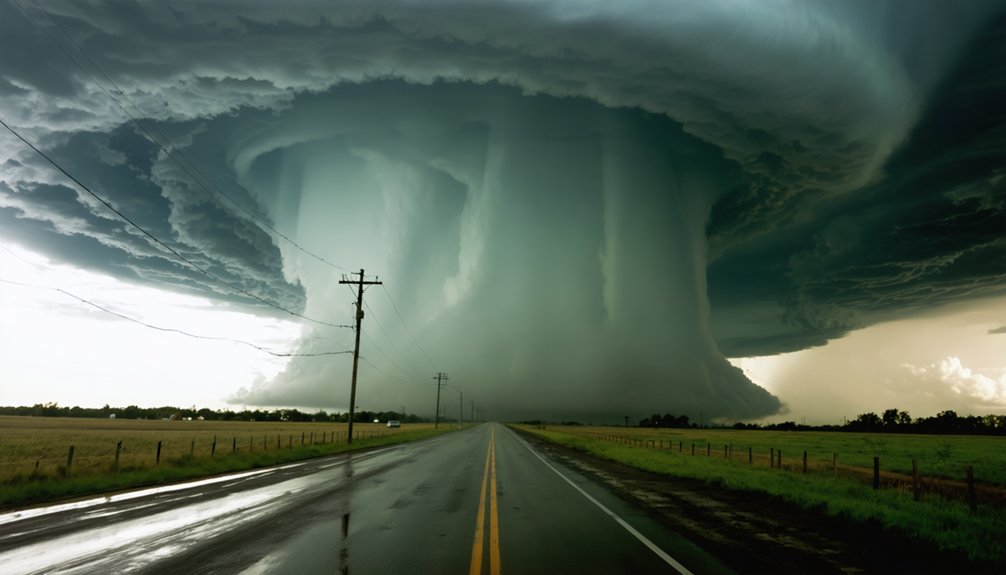
When you chase tornadoes in Dixie Alley, you’ll frequently encounter rain-wrapped tornadoes embedded within high-precipitation supercells, making visual identification nearly impossible until you’re dangerously close.
The Gulf of Mexico’s moisture fuels these obscured storms, stripping away the visual cues that traditional Tornado Alley chasers rely on to track and position safely.
You must adapt your strategy by leaning heavily on radar interpretation, maintaining greater escape route margins, and coordinating with spotters to compensate for the severely reduced visibility these storms produce.
Identifying Rain-Wrapped Tornadoes
Chasing tornadoes in Dixie Alley demands a fundamentally different skill set than anywhere else in the country, largely because the region’s high-precipitation supercells routinely produce rain-wrapped tornadoes that are partially or fully obscured by heavy rainfall.
Understanding tornado morphology becomes critical here — you can’t rely solely on visual confirmation. Instead, you’ll need to interpret storm dynamics through radar, identifying rotation signatures like tight couplings in velocity data before committing to a position.
Watch for hook echoes embedded within dense precipitation cores. Ground-truth your radar interpretation against surrounding environmental cues — power flashes, roaring winds, and debris clouds often betray a tornado’s presence before you see it.
Positioning yourself correctly means staying close enough to detect rotation while maintaining viable escape routes through the region’s dense road networks.
Visibility Challenges For Chasers
Rain-wrapped tornadoes don’t just challenge your identification skills — they actively degrade your ability to operate safely in the field. Dense precipitation walls eliminate visual confirmation, forcing you to rely entirely on radar interpretation and positional awareness.
These visibility obstacles compress your reaction window dramatically, particularly when tornadoes move at elevated speeds during cooler months. Effective chaser strategies here prioritize positioning ahead of movement vectors rather than alongside them.
You’ll need dual-polarization radar feeds updated every 60-90 seconds, combined with strict escape route pre-planning before storms initiate.
Darkness compounds every variable — nighttime HP supercells offer virtually zero visual reference points. Operating in Dixie Alley demands that you treat every rain core as a potential tornado corridor.
Complacency here doesn’t cost time — it costs lives.
Safety Strategies For Chasers
Safety in Dixie Alley chasing hinges on a single principle: never let radar replace positional discipline. Rain-wrapped tornadoes punish complacency instantly. You can’t visually confirm what you can’t see, so your escape routes must be pre-planned before you’re anywhere near the storm.
Tornado preparedness here demands layered decision-making. Cross-reference dual-pol radar, velocity data, and ground-truth reports simultaneously. Don’t rely on a single data stream.
Chase communication isn’t optional—it’s structural. Coordinate with your team and monitor spotter networks continuously. If visibility drops and radar shows rotation tightening, you move. No debate.
Faster storm speeds mean your positioning window collapses quicker than in traditional Tornado Alley. Maintain 90-degree angles to storm movement, keep roads mapped, and never let a blocked paved route become your only exit.
Why Nighttime Tornadoes Are Deadlier in Dixie Alley
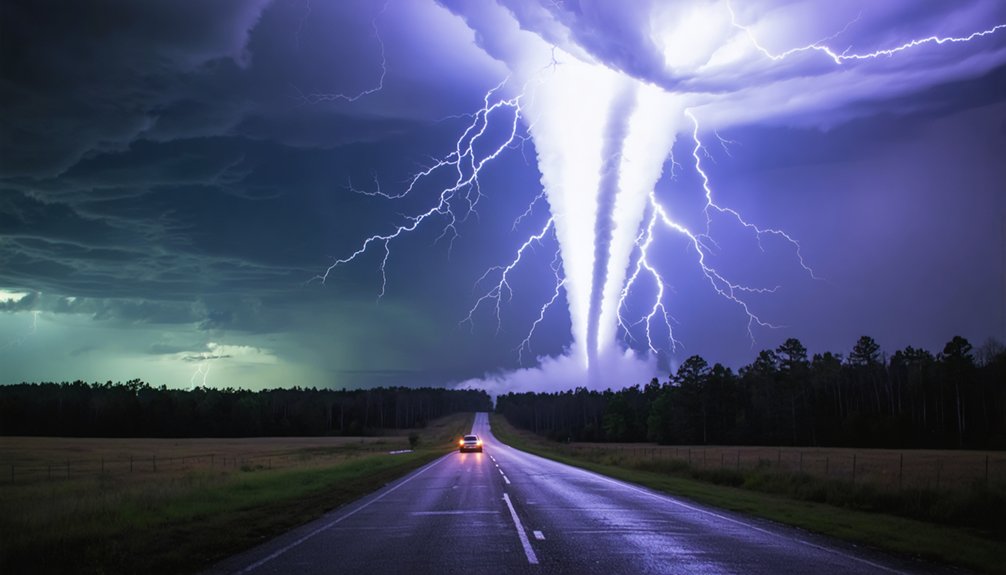
Nighttime tornadoes in Dixie Alley carry a markedly higher fatality risk than their daytime counterparts, largely because the region’s Gulf-driven instability doesn’t dissipate after sunset.
You’re dealing with compounded nighttime hazards that traditional Tornado Alley chasers rarely encounter at this frequency. Rain-wrapped HP supercells already create severe visibility issues during daylight; darkness eliminates your remaining visual detection margin entirely.
These tornadoes move faster than their plains counterparts due to stronger cooler-month wind shear, compressing your reaction window dangerously. Residents frequently sleep through warning sirens, and law enforcement can’t visually confirm rotation they can’t see.
As a chaser, you must rely exclusively on radar interpretation and spotter networks rather than direct observation, demanding sharper analytical discipline and stricter operational protocols when pursuing nocturnal storms across this region.
How Fast-Moving Dixie Alley Storms Change Your Chasing Strategy
When chasing in Dixie Alley, you must account for tornadoes that often move 50–70 mph or faster, leaving little margin for error in your positioning decisions.
You’ll need to continuously reassess your intercept routes, prioritizing forward road options rather than lateral ones, since a storm can outrun a perpendicular approach in minutes.
Anticipating rapid storm movement means you’re scanning road networks ahead of time, committing to earlier repositioning than you’d typically execute in the slower-moving storms of traditional Tornado Alley.
Anticipating Rapid Storm Movement
Storms in Dixie Alley move considerably faster than their Great Plains counterparts, often traveling at 50–70 mph during cooler months when stronger upper-level wind currents dominate the atmosphere.
This speed demands you recalibrate your storm tracking approach entirely. You can’t rely on static positioning tactics that work in slower-moving Plains environments.
Instead, you’ll need to study storm patterns well before initiation, identifying highway networks that run parallel to the anticipated storm track.
Prioritize roads oriented southeast-to-northwest, giving you lateral escape options without crossing the storm’s path.
You’ll also want to update your positioning every few minutes, not every half-hour.
Missing a single exit decision can place you directly in a rain-wrapped tornado’s path with zero visibility and no viable escape route.
Repositioning For Faster Tornadoes
Repositioning in Dixie Alley isn’t simply a faster version of what you’d do on the Plains—it’s a fundamentally different discipline.
Storms here exploit denser road networks less predictably, and faster forward motion compresses your decision window considerably.
You’re reading storm structure continuously, not periodically. Tornado dynamics shift rapidly under stronger wind shear, meaning a storm you’ve correctly positioned on can outpace your escape route within minutes.
Prioritize forward flank positioning over traditional southeast approaches. Faster storms punish rear-flank commitments severely.
You’ll abandon textbook intercept geometry in favor of parallel movement, staying ahead while maintaining visual contact.
Pre-select multiple exit vectors before committing to any position. When a tornado accelerates unexpectedly, hesitation costs you options.
In Dixie Alley, adaptability isn’t a preference—it’s your primary survival mechanism.
Adjusting Intercept Routes Quickly
Fast-moving Dixie Alley storms invalidate your intercept route the moment conditions shift, forcing real-time recalculation rather than incremental adjustment. When a storm accelerates beyond projected forward speed, your original positioning becomes a liability rather than an asset.
Effective storm tracking demands continuous radar interrogation at two to three-minute intervals, not passive monitoring. You’re identifying translational speed shifts, not just storm structure.
When forward motion spikes, you must immediately calculate whether parallel pacing remains viable or whether a forward intercept is your only option.
Chaser communication becomes operationally critical here. Coordinating with teams ahead of the storm’s path provides ground-truth data that radar alone can’t deliver.
Rain-wrapped circulation and reduced visibility compound routing errors. Commit to decisive route changes early, because hesitation in Dixie Alley eliminates your intercept window entirely.
What Gear Do You Actually Need for HP Supercell Chasing?
Chasing HP supercells in Dixie Alley demands gear calibrated to conditions that differ sharply from classic Tornado Alley setups.
Dixie Alley plays by its own rules — and your gear better be ready for all of them.
Rain-wrapped tornadoes and faster storm movement require essential equipment built for low-visibility, high-speed intercepts. Your storm tracking capability lives or dies by what’s mounted in your vehicle.
- A ruggedized laptop running Radarscope or a reliable mobile app for real-time dual-pol radar interpretation
- Forward-facing dashcam with night vision for documenting rain-obscured rotation
- Dedicated GPS unit independent of cell service in rural Mississippi and Alabama corridors
- Handheld weather station measuring wind speed, pressure drops, and temperature shifts
- Backup power bank sustaining all electronics through extended pre-dawn or overnight chases
Redundancy matters here. When visibility collapses inside a high-precipitation core, your gear is your margin.
Top Hotspots Inside Dixie Alley That Chasers Chase Again and Again
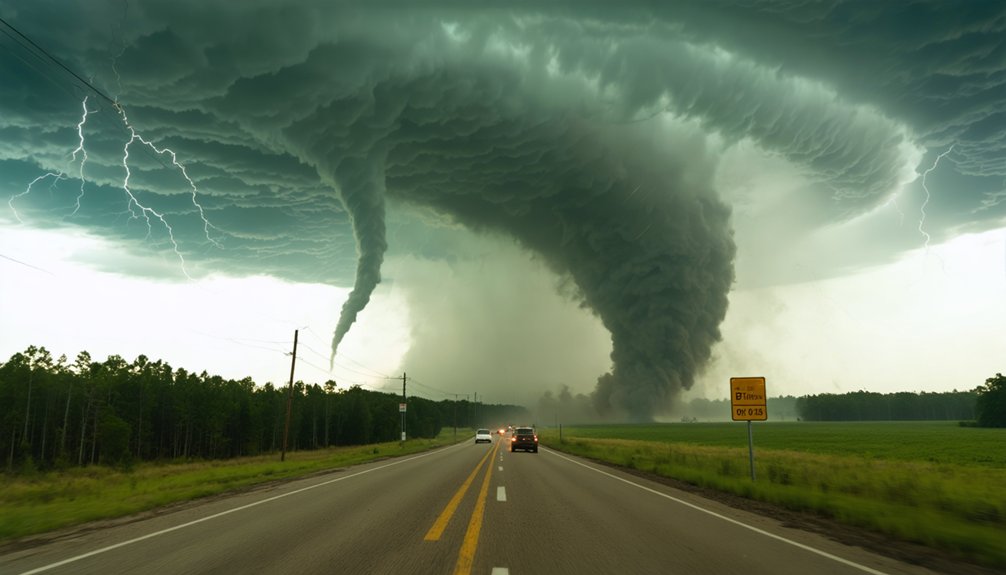
Certain corridors inside Dixie Alley draw chasers back season after season because the terrain, moisture fetch, and storm behavior consistently align to produce high-end events.
Central Mississippi and northern Alabama sit at the top of every serious storm tracking list, delivering long-track violent tornadoes wrapped inside HP supercells. You’ll reposition frequently here because faster storm motion demands aggressive intercept angles.
The Tennessee River Valley funnels Gulf moisture directly into unstable air masses, creating textbook tornado terminology scenarios — strong wind shear, explosive CAPE values, and discrete supercell structures.
Tuscaloosa and Cullman counties in Alabama carry historical weight, both scarred by the 2011 Super Outbreak.
West-central Mississippi offers open sight lines where you can actually observe storm structure before rain wrapping obscures your target completely.
How to Stay Alive Chasing Storms in Dixie Alley
Knowing where to chase inside Dixie Alley is only half the equation — surviving it demands an entirely separate skill set. Rain-wrapped HP supercells eliminate visual margins fast, and faster-moving storms compress your decision window. Lean hard on storm prediction tools and trust your exit routes before you need them.
- Monitor dual-pol radar continuously — rain-wrapped tornadoes appear without warning.
- Pre-drive your escape roads; narrow rural lanes become death traps under pressure.
- Chase with a spotter partner who watches your blind spots independently.
- Honor chaser etiquette — blocking intersections or crowding structure costs lives.
- Stay mobile after dark; nighttime storms in Dixie Alley move faster than instinct.
Your freedom to chase depends entirely on your discipline to retreat when conditions demand it.
Frequently Asked Questions
How Does Dixie Alley Differ From Traditional Tornado Alley for Beginners?
You’ll find Dixie Alley’s tornado frequency peaks in winter and spring, featuring rain-wrapped, fast-moving twisters across unique landscapes of dense forests and hills, unlike traditional Tornado Alley’s open plains and predictable spring afternoon storm windows.
Are Storm Chasing Tours Available Specifically Within Dixie Alley’s Core States?
With over 300 deaths recorded in the 2011 Super Outbreak, Dixie Alley’s stakes are real. You’ll find storm chasing tour companies operating throughout Mississippi and Alabama, though they’re fewer than those servicing traditional Tornado Alley.
What Local Laws Govern Storm Chasing Operations Across Dixie Alley States?
No universal storm chasing regulations exist across Dixie Alley states. You’ll encounter local enforcement varying by county, so you must respect traffic laws, avoid blocking roads, and monitor jurisdiction-specific ordinances while operating freely in the field.
How Do Chasers Coordinate With Emergency Management Agencies During Dixie Alley Outbreaks?
You’re sharing data, you’re relaying positions, you’re saving lives—effective communication strategies and coordination tools like Spotter Network, SKYWARN radio frequencies, and direct NWS contact let you sync seamlessly with emergency management agencies during Dixie Alley outbreaks.
What Photography Techniques Work Best When Documenting Rain-Wrapped Dixie Alley Tornadoes?
When documenting rain-wrapped tornadoes, you’ll want to maximize contrast using lens filters to cut through precipitation. Combine that with long exposure shots to reveal hidden rotation, letting you capture what’s obscured within Dixie Alley’s notorious high-precipitation supercells.
References
- https://go.discovery.com/video/storm-chasers-discovery/dixie-alley-outbreak
- https://en.wikipedia.org/wiki/Dixie_Alley
- https://tornadoalley.com/dixie-alley/
- https://www.stormchasingusa.com/storm-chasing-in-dixie-alley/
- https://www.youtube.com/watch?v=q1wjR_zK548
- https://www.youtube.com/watch?v=sbLsI1pimaE
- https://www.youtube.com/watch?v=vvDAsIw74H0