The best storm shelter locations for boaters include inland marinas like Indiantown Marina and River Forest Yachting Center, natural hurricane holes like Potomac River’s Smith Creek, protected coves, narrow canals, and Cat 5-rated dry-stack facilities. You’ll want to evaluate wind protection, water depth, surge vulnerability, and holding ground before committing to any location. The right choice can mean the difference between saving your vessel and losing it entirely — and each option has critical advantages worth knowing.
Key Takeaways
- Potomac River’s Smith Creek offers exceptional storm shelter, with surrounding trees blocking wind effectively at coordinates 38º 07′ 18.13″N, 76º 24′ 38.82″W.
- Indiantown Marina in Florida shields vessels against tidal surges, offering haul-out services and hurricane-rated infrastructure at $3 per foot nightly.
- River Forest Yachting Center provides Hurricane Club membership, guaranteeing reserved storm storage and reducing last-minute scrambling during hurricane season.
- Well-protected creeks, secluded bays, and inland locations with tall banks naturally buffer wind and minimize surge exposure for anchored vessels.
- Spider-web secure lines, screw anchors, and auger strapping systems distributed across reinforced structures significantly improve vessel survival during major storms.
How to Evaluate Any Hurricane Hole Before a Storm
Before committing to any hurricane hole, you’ll need to assess several critical factors that determine whether a location will protect or endanger your vessel. Effective shelter assessment starts with evaluating wind protection from all directions, water depth at low tide, and surge vulnerability.
Scout your chosen location before storm season begins. Check that surrounding terrain—tall banks, dense trees, or narrow waterways—deflects wind rather than funnels it. Confirm adequate swinging room or available tie-off points like pilings and sturdy trees.
Scout your hurricane hole early—terrain that deflects wind, solid tie-off points, and adequate swinging room can mean everything.
Storm preparedness also means verifying holding ground quality for anchors and identifying escape routes if conditions worsen unexpectedly.
Review historical surge data for the area, and never rely solely on a location’s reputation. Conditions change, and your vessel’s safety depends on current, firsthand intelligence.
Inland Marinas With Guaranteed Hurricane Storage
If you want guaranteed storage when a hurricane threatens, inland marinas offer your best defense against surge, wind-driven waves, and tidal extremes.
Facilities like Indiantown Marina and River Forest Yachting Center provide reserved wet or dry storage space through hurricane club memberships, so you’re not scrambling for a spot when a storm approaches.
Both use screw anchors or augers drilled into the ground to strap your vessel securely, giving you a level of tie-down reliability that open-water anchorages simply can’t match.
Guaranteed Storage Options
When a hurricane threatens, securing guaranteed storage at an inland marina can mean the difference between a salvageable boat and a total loss.
For serious hurricane preparedness, two Florida facilities stand out. Indiantown Marina charges $3 per foot per night with a seven-day minimum, using screw anchors drilled into the ground for secure tie-downs.
River Forest Yachting Center near Stuart offers a Hurricane Club membership, guaranteeing wet or dry storage solutions in buildings rated for vessels up to 90 feet. Both facilities use augers for strapping, providing structural security during violent winds.
Don’t wait until a storm is imminent — membership slots and reserved spaces fill quickly. Booking early keeps your options open and your vessel protected when conditions deteriorate fast.
Inland Protection Benefits
Inland marinas offer a decisive advantage over coastal facilities when hurricanes threaten: they sit beyond the reach of tidal surges and benefit from natural wind buffers that open-water locations simply can’t provide.
When you’re evaluating inland advantages for storm preparedness, consider Indiantown Marina on the Okeechobee Waterway. Its position deep inland shields your vessel from surge damage while surrounding terrain deflects destructive winds.
The marina reinforces protection further by drilling screw anchors directly into the ground, securing hauled boats against even violent gusts. You’ll pay $3 per foot nightly with a seven-day minimum commitment, but that’s a reasonable cost for genuine security.
Choosing an inland facility means you’re not gambling your vessel against unpredictable coastal conditions when a serious storm approaches.
Secure Tie-Down Methods
Beyond choosing an inland location, you’ll need to understand how the best facilities actually lock your boat down when conditions deteriorate.
Top-rated marinas don’t rely on standard dock cleats—they use engineered anchor techniques designed for catastrophic winds.
Here’s what separates serious hurricane storage from basic dockage:
- Screw anchors drilled directly into the ground provide fixed attachment points that standard pilings can’t match.
- Spider-web secure lines distribute load across multiple attachment points, preventing single-point failures during surge or wind shifts.
- Auger strapping systems physically bind hauled vessels to reinforced structures, rated for winds exceeding 157 mph.
Confirm these specific methods before committing to any facility—your boat’s survival depends on the hardware, not just the location.
Top Florida Storm Shelters for Cruising Boaters
Florida’s interconnected waterways make two marinas stand out as premier storm shelters for cruising boaters: Indiantown Marina on the Okeechobee Waterway and River Forest Yachting Center near Stuart.
For storm preparedness, Indiantown Marina’s inland position shields you from tidal surges and wind, offering haul-out services with screw anchors drilled into the ground for secure tie-downs. Expect to pay $3 per foot nightly with a seven-day minimum.
River Forest Yachting Center’s Hurricane Club membership guarantees you wet or dry storage in buildings rated for boats up to 90 feet, with augers for strapping. Its access to the Atlantic, Lake Okeechobee, and Gulf of Mexico gives you flexible routing options.
Both facilities prioritize boat safety with hurricane-rated infrastructure you can genuinely rely on.
Haul-Out Facilities Built to Survive Cat 5 Winds
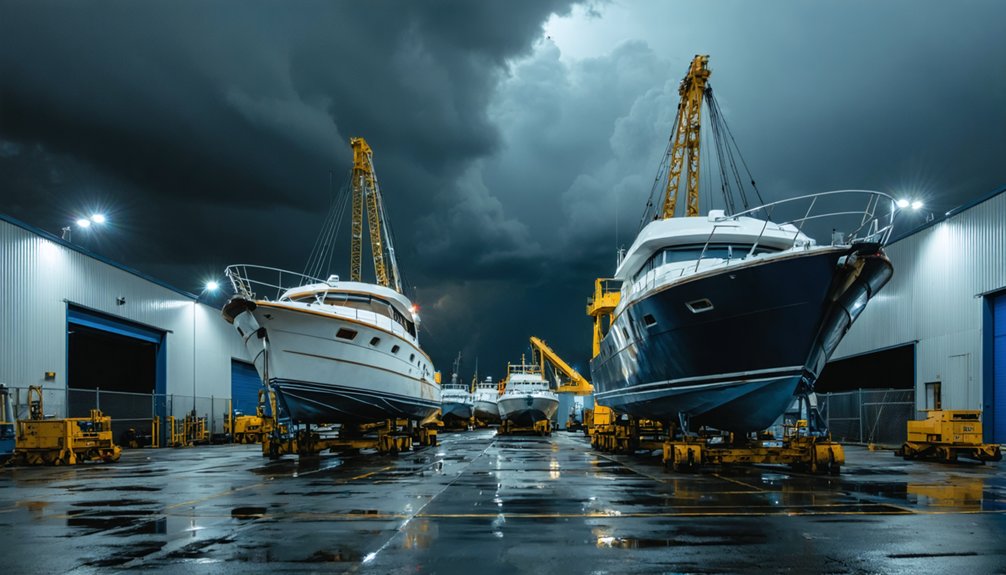
When hauling out before a storm, you’ll want a marina that uses ground anchors—screw-type augers drilled directly into the earth—to strap your boat securely against high winds.
Cat 5-rated facilities withstand sustained winds exceeding 157 mph, giving you the highest level of protection available for your vessel.
If the marina offers indoor dry-stack storage in reinforced, hurricane-rated hangars, take it—that’s your safest option when a major storm threatens.
Ground Anchors Secure Boats
Hauling your boat out of the water before a major storm hits remains one of the most effective ways to protect it from surge, wave action, and collision damage.
However, ground stability matters just as much as elevation. Without proper anchoring, even hauled boats topple in Cat 5 winds.
Top-tier facilities drill screw anchors directly into the ground, maximizing anchor effectiveness by distributing storm loads across multiple secure points.
Here’s what to confirm before committing to a haul-out facility:
- Facility uses drilled screw or auger-style ground anchors
- Strapping connects your hull to multiple anchor points
- Storage areas feature hurricane-rated construction rated above 157 mph
Don’t settle for facilities that simply block your boat without anchoring it down.
Cat 5 Wind Ratings
Ground anchors keep your hauled boat from toppling, but they’re only part of the equation—the structure sheltering your vessel must withstand the same forces those anchors resist.
Cat 5 winds exceed 157 mph, and not every marina facility survives that threshold. Your storm preparedness plan must include verifying a facility’s wind rating before committing to haul-out storage.
Top-tier marinas invest in indoor dry-stack storage, reinforced hangars, and hurricane-rated construction specifically engineered for Cat 5 winds.
These buildings aren’t standard commercial structures—they’re purpose-built to handle catastrophic wind loads.
When you’re evaluating facilities, ask directly about their wind certification. A marina that can’t answer that question clearly isn’t the right place to leave your boat when a major hurricane threatens.
Indoor Dry-Stack Storage
Before committing to a facility, verify these critical factors:
- Reinforced construction — walls and roofing rated for sustained Cat 5 winds
- Positive strapping systems — augers or ground anchors securing your vessel to the structure
- Elevated positioning — racking systems keeping boats above potential flood levels
Don’t assume every dry-stack building qualifies — demand documentation of wind ratings before hurricane season arrives.
Best Hurricane Anchorages From the Chesapeake to Florida
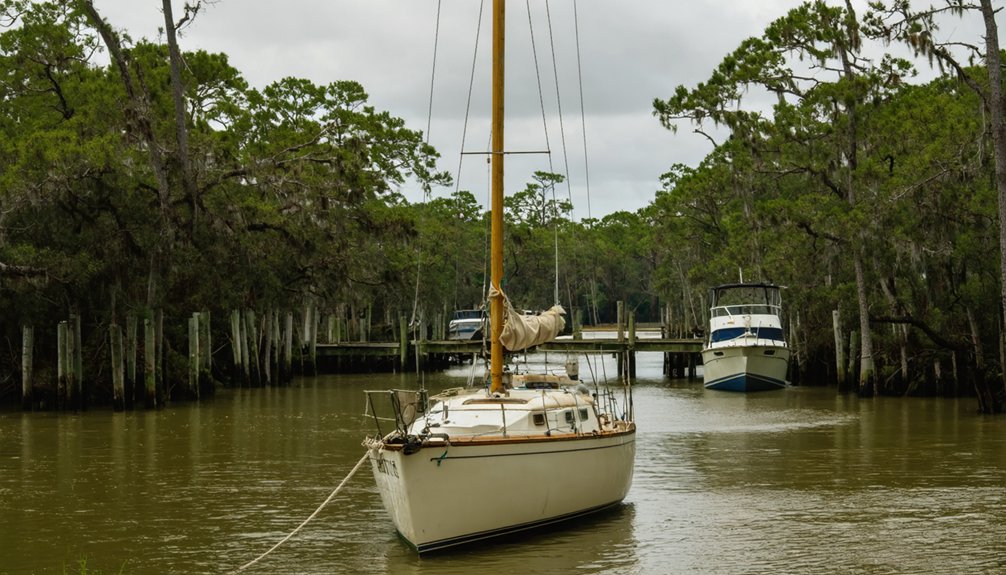
Boaters steering the Eastern Seaboard have several proven hurricane anchorages between the Chesapeake Bay and Florida, each offering distinct protections against surge, wind, and wave action.
Among the top Chesapeake anchorages, Potomac River’s Smith Creek at 38º 07′ 18.13″N, 76º 24′ 38.82″W delivers exceptional shelter. You’ll find protected coves one mile upstream, with the first starboard cove past Jutland Creek offering full tree coverage from all wind directions.
For Florida refuges, Indiantown Marina on the Okeechobee Waterway provides inland positioning that neutralizes tidal surge.
River Forest Yachting Center near Stuart connects you to multiple waterways while guaranteeing hurricane storage. Both locations use screw anchors and augers, securing your vessel against catastrophic wind loads.
Why Canals and Narrow Waterways Are Underrated Storm Shelters
Many boaters overlook canals and narrow waterways as viable storm shelters, yet their confined geometry delivers some of the most reliable wave attenuation and wind buffering available.
Understanding canal advantages sharpens your storm preparedness strategy considerably.
Understanding canal advantages isn’t optional—it’s the tactical edge that separates prepared boaters from vulnerable ones when storms strike.
Position your vessel correctly by following these critical steps:
- Center your boat using spider-web lines secured to both banks, keeping tension balanced from multiple attachment points.
- Face the canal entrance, positioning yourself as far from open water as possible to minimize surge exposure.
- Select spots with tall banks, minimal neighboring vessels, and sturdy trees or pilings negotiated with shoreside property owners.
Wider canals demand combining anchors with lines tied to robust trees.
Choose locations away from main channels where wind-driven chop intensifies. Your freedom depends on disciplined preparation before conditions deteriorate.
Best Natural Hurricane Holes on the East Coast
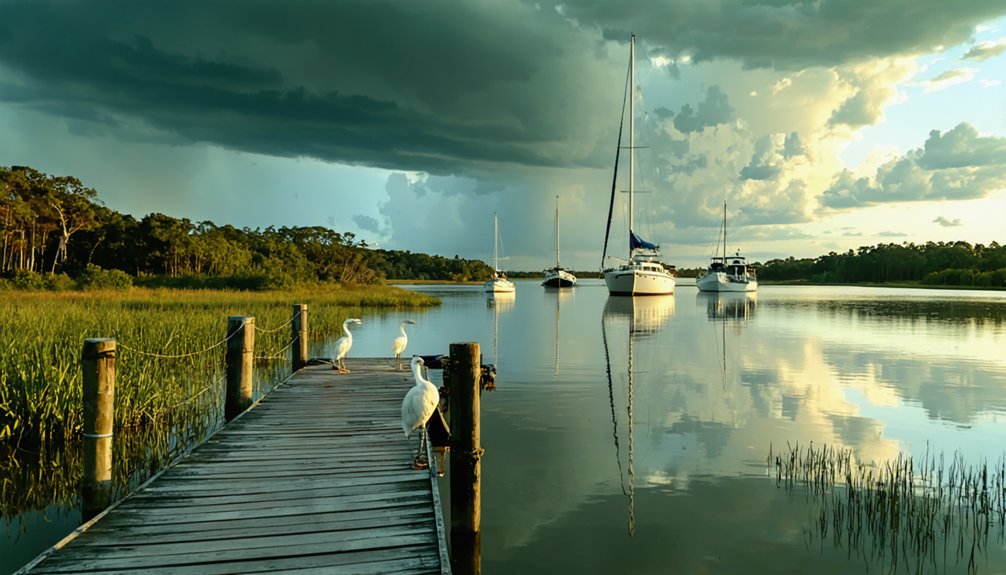
While canals and narrow waterways offer engineered containment, nature’s own geography can outperform them when you’re seeking shelter from a serious storm.
Natural features like well-protected creeks, secluded bays, and inland rivers provide exceptional shelter effectiveness when you choose wisely.
On the East Coast, Potomac River’s Smith Creek stands out. Positioned six miles inside the Potomac on the north shore, it delivers protected anchorages roughly one mile upstream.
You’ll want the first cove to starboard after Jutland Creek—surrounding trees block wind from every direction.
Avoid open-water anchoring entirely; collision risks multiply fast during a storm.
If you must anchor in an emergency, maintain an anchor light and stay vigilant.
Nature offers refuge, but only if you position yourself correctly within it.
Frequently Asked Questions
What Insurance Considerations Should Boaters Address Before Hurricane Season Begins?
Before hurricane season, you’ll want to review your insurance coverage thoroughly. Confirm your policy includes hurricane preparedness provisions, verify agreed-value terms, update your vessel’s appraisal, and make certain your chosen storm shelter location’s documented in your plan.
How Far in Advance Should Boaters Reserve Hurricane Storage at Marinas?
You’ll want to secure hurricane preparedness plans early—reserve marina storage months before season starts. Research marina policies now, as River Forest Yachting Center’s Hurricane Club membership guarantees space, but spots fill fast among freedom-seeking boaters.
Can Liveaboards Remain on Their Boats During a Hurricane at Marinas?
Like a captain abandoning a sinking ship, you shouldn’t stay aboard during a hurricane. For your hurricane preparedness and boat safety, most marinas require you to evacuate — follow their protocols without hesitation.
What Essential Supplies Should Boaters Stock Before Moving to Storm Shelter?
Before heading to your storm shelter, you’ll want to stock emergency kits with food, water, medications, and tools. Establish communication plans with your crew and contacts to guarantee you’re always connected during the storm.
Are There Legal Liabilities if an Unsecured Boat Damages Neighboring Vessels?
Yes, you’re legally liable if your unsecured boat damages others. Negligence claims can devastate your finances, so guarantee your liability insurance covers storm damage and always properly secure your vessel before any hurricane strikes.
References
- https://southernboating.com/destinations/hurricane-hole-along-the-east-coast/
- https://www.boatersworld.com/blog/caught-in-severe-weather-while-boating-heres-your-step-by-step-plan–66807
- https://vesselvanguard.com/where-to-keep-your-boat-during-a-hurricane/
- https://ahoy.insure/blog/cat-5-boat-storage-what-it-is-and-why-you-might-need-it/
- https://havendock.com/blogs/tips/storm-prep-101-how-to-secure-your-boat-s-mooring