No federal law requires you to display special license plates or vehicle markings as a storm chaser. You operate under standard traffic laws, just like any other driver. Oklahoma’s proposed Senate Bill 158 would’ve changed that by mandating licensed vehicles display a license number, sponsor affiliation, and operational markings — but it stalled before enactment. The legal landscape is fragmented, and there’s considerably more to understand about what current and proposed regulations mean for you.
Key Takeaways
- No federal law requires special license plates or vehicle markings for storm chasers; standard registration applies nationwide.
- Oklahoma’s proposed Senate Bill 158 would require licensed vehicles to display license numbers and sponsor affiliation markings.
- Licensed storm chasers under Oklahoma’s bill must carry proof of insurance and maintain active credentials to operate legally.
- Vehicle markings distinguish licensed professionals from amateurs, granting privileges like emergency flashing lights and closed road access.
- Amateur storm chasers face no special vehicle requirements, operating under the same traffic laws as general drivers.
Do Storm Chasers Need a License Plate or Special Markings?
If you’re storm chasing in the United States, no federal law requires you to display special markings or hold a license specific to the activity. Standard vehicle registration applies to your chase vehicle just as it does to any civilian automobile. No national identification requirements exist that distinguish a storm chaser’s vehicle from any other on the road.
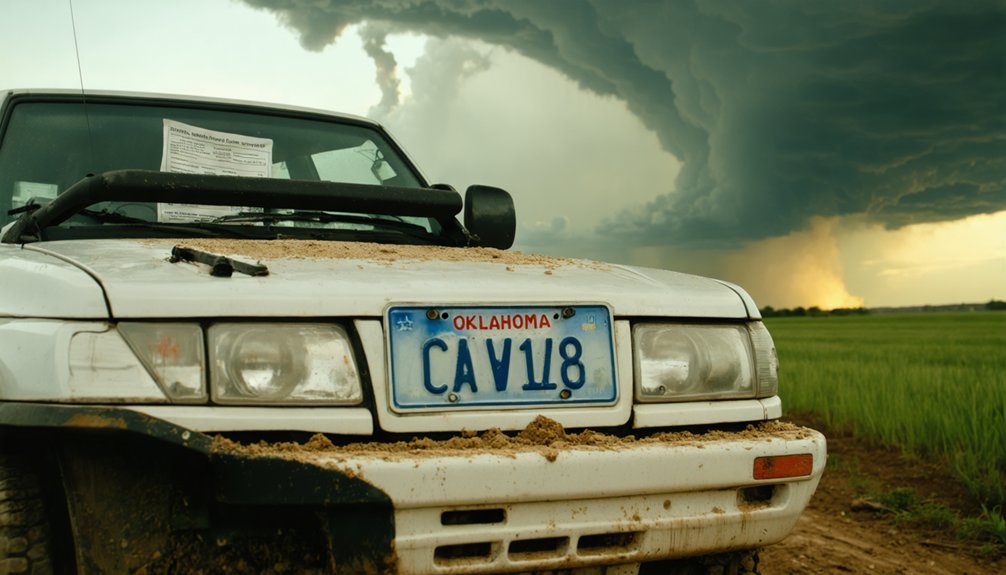
Oklahoma’s proposed Senate Bill 158 represents the most concrete attempt to change that. Under its framework, licensed professional chasers would’ve displayed their license number and sponsor affiliation on their vehicles. Those markings would’ve served as operational identification during severe-weather events.
However, the bill faced strong opposition and stalled before enactment. Currently, you operate under general traffic statutes, not storm-chasing-specific vehicle regulations.
Why Oklahoma Is the Only State Proposing Storm Chaser Licensing
If you’re wondering why storm chasing remains largely unregulated across the U.S., it’s because no federal licensing framework exists, leaving each state to address the activity independently under standard traffic law.
Oklahoma stands alone in pushing formal legislation—specifically Senate Bill 158—which would create a Professional Severe Weather Tracker license administered by Service Oklahoma.
No other state has enacted, or appears close to enacting, a comparable mandatory credentialing system for storm chasers.
Oklahoma’s Legislative Push
Under the proposal, you’d need endorsement from an FCC-regulated media outlet or accredited institution, a clean criminal background check, and proof of vehicle insurance.
Service Oklahoma would manage the licensing process, charging a $500 initial fee and $250 annually for renewal.
The bill faced significant opposition, ultimately prompting its author to order an interim study before advancing further.
It didn’t take effect for the current storm season, leaving Oklahoma’s framework still unresolved and the broader U.S. environment legally undefined.
No Federal Licensing Exists
While Oklahoma has taken a rare legislative step, no federal licensing requirement exists for storm chasing anywhere in the United States. You’re operating in a legal gray area where storm chasing regulations remain minimal and largely uncodified at the national level.
No federal agency governs who can chase, what vehicle identification standards apply, or what equipment you’re permitted to use. Most states defer entirely to standard traffic laws.
Oklahoma stands alone in proposing a structured credentialing framework, and even that bill faced significant opposition before stalling.
For now, you retain broad operational freedom without mandatory licensing, federal oversight, or required vehicle identification markings. That freedom, however, carries legal responsibility — you’re still bound by traffic statutes, property boundaries, and evacuation orders regardless of your chaser status.
How Are Amateur Storm Chasers Treated Under Current Law?
Because no federal licensing requirement exists for storm chasing in the United States, amateur chasers operate almost entirely under standard traffic laws. You’re free to pursue weather monitoring without holding any formal credential, degree, or government-issued permit.
No federal licensing requirement exists for storm chasing — amateur chasers need no formal credential, degree, or government-issued permit.
No state has enacted mandatory licensing targeting hobbyists, meaning your primary legal obligations mirror those of any other driver on public roads.
That freedom carries real responsibility. You must comply with traffic statutes, respect property boundaries, and observe evacuation orders.
Your insurance policies must meet standard state vehicle requirements — no special commercial coverage applies unless your state separately mandates it.
Oklahoma’s proposed licensing framework explicitly excluded amateur chasers from its scope, reinforcing that current law treats you identically to the general driving public during severe-weather operations.
What Does the Professional Severe Weather Tracker License Require?
Oklahoma’s proposed Professional Severe Weather Tracker license sets a structured eligibility threshold that separates credentialed professionals from the general chasing public. To qualify, you must secure endorsement from either an FCC-regulated major media outlet or an accredited institution of higher education.
Service Oklahoma administers the licensing process, which requires a criminal background check, proof of vehicle insurance, a $500 initial fee, and a $250 annual renewal fee.
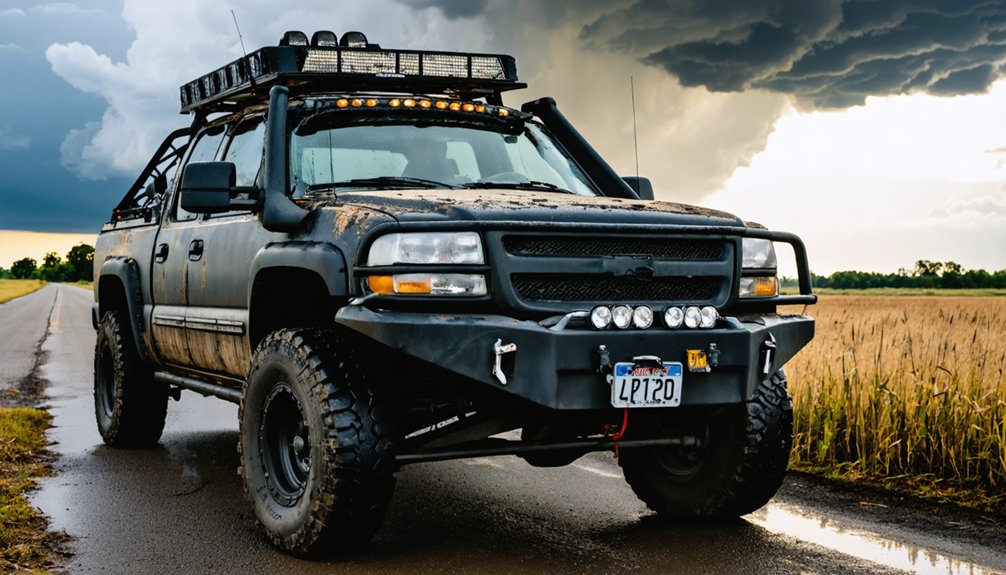
Your chase vehicle must display your license number and sponsor affiliation number, visibly identifying it as a storm monitoring unit during weather safety operations.
Licensed status also grants access to specific operational privileges, including emergency flashing lights and potential access to closed roadways.
Violations can trigger suspension or revocation, meaning your credentials remain contingent on maintaining full legal and traffic-law compliance.
Who Qualifies for Oklahoma’s Storm Chaser License?
Meeting the structural requirements for the license is only part of the picture—you also need to fit within a defined professional profile to be eligible in the first place. Oklahoma’s proposed framework targets professional operators, not hobbyists. You must hold an endorsement from either an FCC-regulated major media outlet or an accredited institution of higher education.
That institutional tie isn’t arbitrary—it anchors your weather data collection activity to an accountable organization and reinforces storm chasing ethics by filtering out unaffiliated operators.
You’ll also pass a criminal background check before receiving approval. The proposal doesn’t accommodate independent chasers without organizational backing. If you’re operating solo without employer or institutional affiliation, you fall outside the eligibility window entirely under this framework.
How Must Licensed Storm Chasers Mark Their Vehicles?
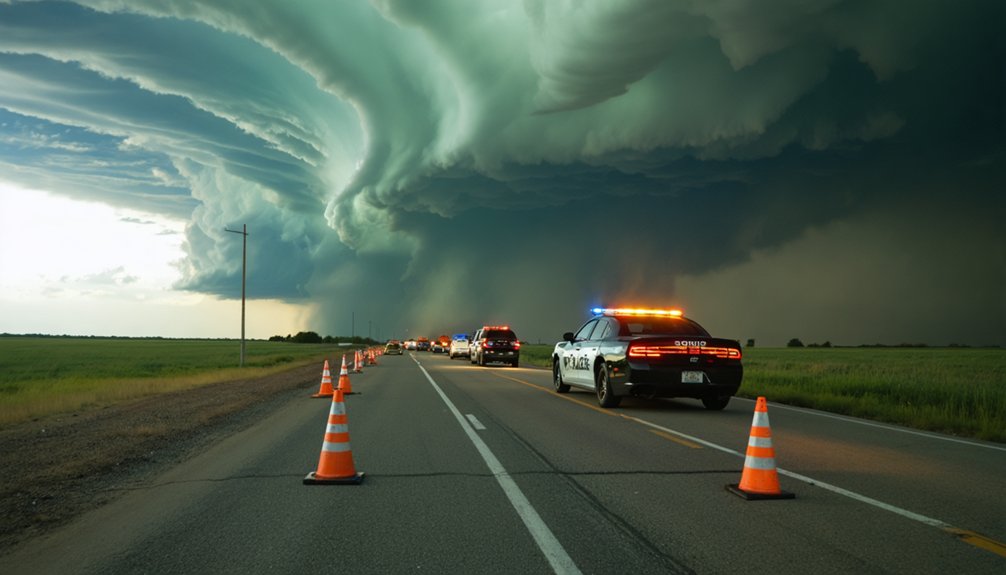
Once you’re licensed under Oklahoma’s proposed framework, your chase vehicle must carry specific identifying markings that make your professional status visible during severe-weather operations. These vehicle branding and identification standards exist to distinguish licensed professionals from the general public on active storm roads.
Licensed storm chasers must display specific vehicle markings, visibly distinguishing professionals from the public during active severe-weather operations.
Your vehicle must display:
- Your license number in a visible location on the exterior
- Your sponsor or employer affiliation number alongside the license identifier
- Storm tracking unit designation marking the vehicle’s operational purpose
- Institutional or media outlet affiliation confirming your credentialing source
These identification standards apply strictly to licensed professionals, not amateur chasers.
The markings also unlock privileges like emergency flashing lights and potential closed-roadway access.
Without proper vehicle branding, you won’t qualify for those operational permissions during significant weather events.
Can Licensed Storm Chasers Use Emergency Lights and Access Closed Roads?
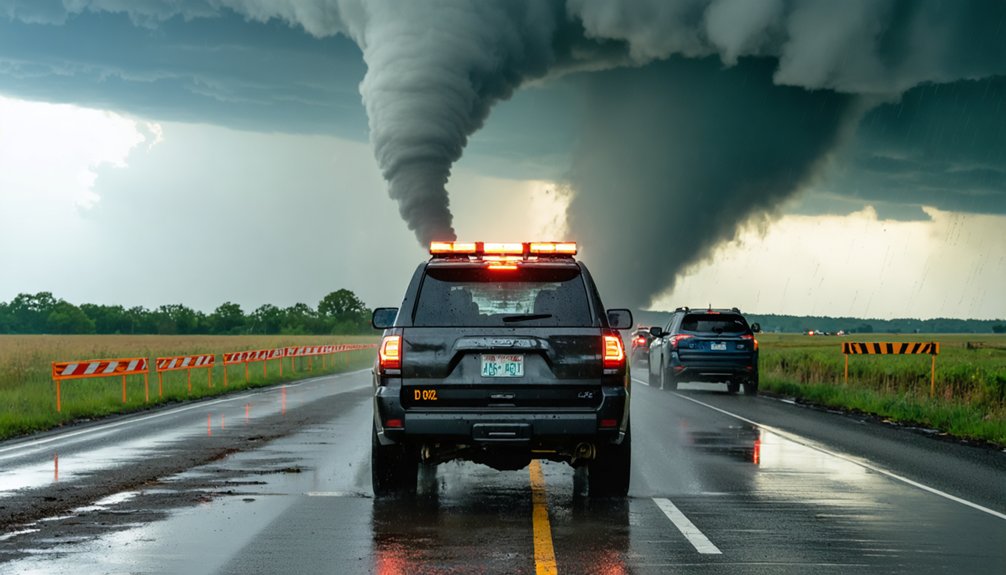
If you hold a Professional Severe Weather Tracker license under Oklahoma’s proposed framework, you can legally operate emergency flashing lights during significant weather events.
Your credentials also potentially grant access to closed roadways that remain off-limits to unlicensed chasers and the general public.
These privileges tie directly to your official license, vehicle identification markings, and institutional affiliation—without those credentials, you can’t legally claim either permission.
Emergency Lights For Chasers
One of the more consequential privileges tied to Oklahoma’s proposed Professional Severe Weather Tracker license is the authorized use of emergency flashing lights during significant weather events. As a licensed chaser, you’d operate similarly to an emergency vehicle, gaining access that unlicensed chasers legally cannot. These privileges connect directly to your credentials and vehicle identification.
The proposal grants licensed chasers four distinct operational advantages:
- Emergency flashing light authorization during active severe weather
- Potential access to closed roadways
- Official identification badges linking you to your sponsoring institution
- Vehicle markings distinguishing you from the general public
Without proper licensing, using emergency-style equipment remains prohibited. This framework separates credentialed professionals from hobbyists, giving you legal standing to operate closer to dangerous weather while maintaining accountability.
Accessing Closed Roads
Beyond the authorization to run emergency flashing lights, Oklahoma’s proposed licensing framework extends a second significant operational privilege: access to roadways closed during severe weather events.
If you hold a valid Professional Severe Weather Tracker license, you’d gain entry to corridors that remain blocked to the general public. This privilege isn’t unconditional. Your vehicle registration must align with the proposal’s identification standards, meaning your chase vehicle displays your license number and sponsor affiliation visibly. Authorities can verify your credentials on-site before granting passage.
You’re still bound by traffic laws, property boundaries, and evacuation orders—your license doesn’t override those obligations. The framework fundamentally creates a tiered access system, separating credentialed professionals from unlicensed chasers who’ve no legal basis to cross closure points.
Credentials Unlock Special Privileges
Under Oklahoma’s proposed licensing framework, holding a Professional Severe Weather Tracker credential grants two operational privileges unavailable to unlicensed chasers: the use of emergency flashing lights and access to closed roadways during significant weather events.
To activate these privileges, you must satisfy four conditions:
- Carry proof of insurance meeting state vehicle requirements
- Display proper vehicle markings showing your license number and sponsor affiliation
- Maintain an active, unsuspended Professional Severe Weather Tracker credential
- Operate during a qualifying significant weather event
These aren’t symbolic distinctions. They separate credentialed professionals from general traffic on dangerous severe-weather roads.
Unlicensed chasers using emergency-style equipment remain outside these permissions entirely.
Your credential, vehicle markings, and insurance requirements work as a unified system, giving you expanded operational freedom while keeping accountability intact.
What Does Oklahoma’s Storm Chaser License Actually Cost?
If Oklahoma’s proposed storm chaser licensing framework had moved forward, you’d have faced a $500 initial licensing fee, followed by $250 annually for renewal.
Beyond licensing fees, the proposal also mandated proof of vehicle insurance before you could operate as a licensed Professional Severe Weather Tracker.
These insurance requirements and recurring costs would’ve applied specifically to professionals affiliated with FCC-regulated media outlets or accredited institutions — not hobbyists.
You’d also have needed to pass a criminal background check and maintain compliance with vehicle marking standards to keep that license active.
For freedom-minded chasers, these financial and regulatory obligations represent exactly the kind of institutional gatekeeping the bill’s opponents criticized.
Ultimately, the proposal stalled, and no comparable mandatory licensing structure currently exists anywhere else in the United States.
Why Did the Oklahoma Storm Chaser Bill Stall?
Those cost and compliance burdens weren’t the only reason Oklahoma’s licensing proposal collapsed under its own weight. Lawmakers and chasers tracking historical weather and storm patterns united against the bill’s structural problems. The author ultimately ordered an interim study, stalling progress entirely. Here’s why:
- Institutional gatekeeping — Only FCC-outlet or university-affiliated chasers qualified, excluding independents.
- Lawmaker opposition — Significant resistance emerged from within the legislature itself.
- Chaser pushback — The community argued the bill restricted access without improving safety.
- Overreach concerns — Granting closed-road access and emergency lighting privileges created legal and liability complications.
You can see why momentum died. The bill never took effect for the current storm season, leaving the U.S. firmly in regulatory gray territory.
The Legal Gray Area Storm Chasers Still Operate In Today
If you chase storms today, you’re operating in a legal gray area where no federal licensing framework governs your activity. Most state statutes say nothing specific about storm chasing.
You remain subject only to standard traffic laws, property boundaries, and evacuation orders, regardless of whether you’re a hobbyist or a professional.
Once you start monetizing your footage or operating under a media contract, though, regulators and lawmakers begin scrutinizing your activity far more closely than they’d an amateur’s.
No Federal Licensing Exists
Although storm chasing draws thousands of enthusiasts and professionals into the field each year, no federal licensing framework governs the activity in the United States. You’re free to chase without federal license compliance obligations. Standard traffic laws remain your primary legal boundary. This absence creates operational flexibility, but also ambiguity.
Here’s what that means practically:
- No federal agency issues storm chasing credentials
- Amateur chasers face no mandatory certification requirements
- Vehicle identification standards aren’t federally mandated for chase units
- Professional and hobbyist chasers operate under identical federal standing
This regulatory gap keeps storm chasing accessible but legally undefined at the national level. State-level proposals, like Oklahoma’s, attempt to fill that void, though none have enacted mandatory licensing yet.
State Laws Remain Vague
Beyond the federal level, state laws offer storm chasers little additional clarity. Most states have no storm-chasing statute, meaning you’re operating under standard traffic laws—nothing more, nothing less.
That absence of regulation cuts both ways: you retain broad operational freedom, but you also lack defined legal protections when things go wrong.
Oklahoma’s proposed licensing framework attempted to address this gray area by introducing insurance requirements and licensing fees—$500 initially, $250 annually—but the bill faced significant opposition and was shelved pending an interim study.
No other state has enacted comparable mandatory legislation.
Until lawmakers act, you’re steering a system where rules vary by jurisdiction, enforcement is inconsistent, and your liability exposure remains poorly defined.
Understanding that ambiguity isn’t optional—it’s essential to operating responsibly.
Professional Operations Face Scrutiny
Professional storm chasers face sharper scrutiny than their amateur counterparts, largely because commercial or media-affiliated operations introduce liability exposure that hobbyist chasing doesn’t.
If you’re operating professionally, four pressure points define your risk:
- Insurance policies must cover weather-related incidents, property damage, and third-party liability.
- Vehicle registration records tie your chase unit directly to your employer or institutional sponsor.
- Emergency equipment use without proper credentials exposes you to immediate legal consequences.
- Closed-roadway access requires verified credentials—your word alone won’t suffice.
Oklahoma’s proposed licensing framework targeted exactly this professional tier.
Without enacted legislation, you’re operating in a legal gray area where traffic law, employer liability standards, and local ordinances govern your conduct simultaneously.
That ambiguity creates real, compounding risk.
Frequently Asked Questions
Can Storm Chaser Vehicle Markings Be Removed Between Active Chasing Seasons?
You’ve got endless flexibility! Current licensing regulations don’t mandate permanent vehicle modification—you can remove storm chaser markings between active seasons, as requirements only apply during licensed professional operations under proposed frameworks.
Do Vehicle Marking Rules Apply on Private Land During Storm Chasing?
Vehicle marking exemptions don’t clearly extend to private land regulations under the proposal. You’d still need to display required markings on licensed vehicles, as rules tie to your credentials, not your location.
Are There Size or Placement Requirements for Storm Chaser License Displays?
The proposed Oklahoma rules don’t specify exact size or placement standards for license plate visibility. You’d display your license number per general vehicle marking regulations, but precise dimensional requirements weren’t defined in the bill’s framework.
Can a Licensed Storm Chaser Use Another Person’s Marked Vehicle Legally?
Like borrowing another pilot’s wings, storm chasing regulations don’t explicitly address this—but vehicle marking visibility requirements tie credentials to *your* affiliated vehicle, so you’d likely be operating outside licensed parameters using someone else’s marked unit.
Do Storm Chaser Vehicle Requirements Apply During Non-Severe Weather Driving?
Vehicle modification markings don’t restrict your freedom during normal driving—requirements activate only during severe weather operations. You’d display your license number and sponsor ID when actively tracking, not during routine, non-weather-safety-related travel.
References
- https://www.reddit.com/r/stormchasing/comments/1l83otq/inevitable_license_much/
- https://abc7amarillo.com/news/local/oklahoma-storm-chasers-oppose-licensing-bill-fear-increased-danger-bary-nusz-house-bill-2426-tornadoes-severe-weather
- https://www.clearhq.org/news/oklahoma-considers-severe-weather-tracker-licensure-2-6-25
- https://crazystormchasers.com/international-storm-chasing-laws-and-regulations-compared/
- https://en.wikipedia.org/wiki/Storm_chasing
- https://crazystormchasers.com/how-storm-chasers-can-stay-legal-during-severe-weather-events/
- https://crazystormchasers.com/storm-chasing-laws-by-state/