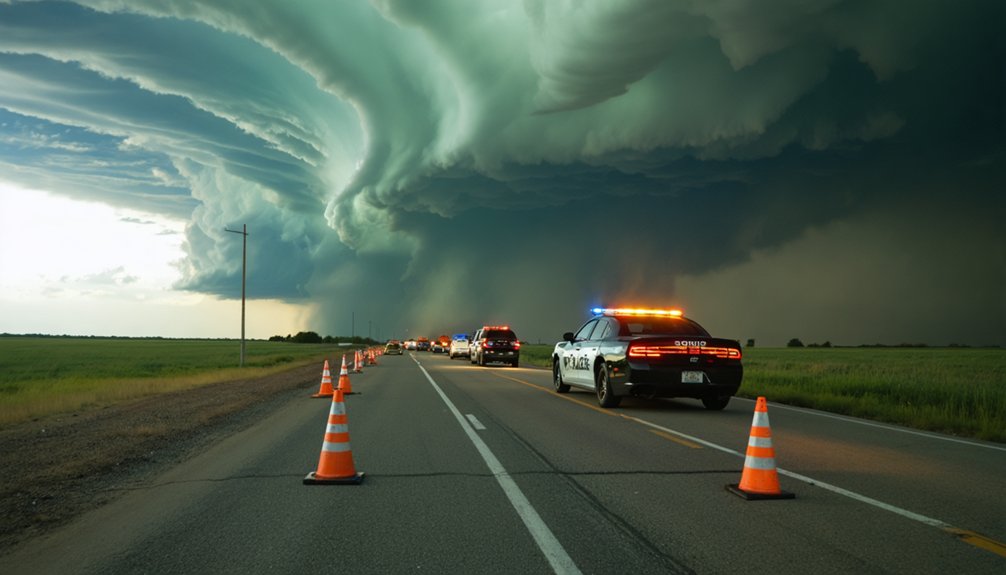
Storm chasing laws vary widely depending on where you operate. In the U.S., there’s no federal regulation, but Oklahoma’s 2025 licensing law requires credentials, vehicle markings, and fees if you work for licensed media or accredited institutions. Canada has no formal licensing system, though general traffic laws still apply. Cross-border operations add another layer of complexity, especially with border station closures. The full picture involves far more critical details you’ll want to know before your next chase.
Key Takeaways
- Storm chasing is federally unregulated in the U.S., requiring only adherence to traffic laws, property boundaries, and evacuation orders.
- Oklahoma’s 2025 licensing law requires credentials for chasers working with FCC-licensed media or accredited meteorology institutions, costing $500 initially.
- Licensed Oklahoma chasers may use flashing lights and sirens and are treated as emergency responders during significant weather events.
- Canada has no formal storm chasing licensing system, with activities governed only by general traffic and wildlife laws.
- Most storm chasers internationally oppose government regulation, favoring self-policing and peer accountability over formal oversight systems.
U.S. Storm Chasing Laws Every Chaser Must Know
Storm chasing isn’t federally regulated, but that doesn’t mean you’re free from legal obligations the moment you hit the road. You must obey all traffic laws, respect private property boundaries, and comply with official evacuation orders — violations can result in arrest or rescue cost liability.
Chasing storms legally means obeying traffic laws, respecting property, and following evacuation orders — no exceptions.
Oklahoma’s 2025 Emergency Response and Regulatory Act specifically targets professional chasers, requiring state-issued licenses for those conducting weather forecasting or storm photography under media or academic employment. Licensing demands background checks, professional recommendations, and a $500 initial fee.
Nationally, self-policing remains the dominant standard. You’re ethically obligated to report severe weather observations to the National Weather Service post-event.
Trespassing, overpass sheltering, and speeding through populated areas aren’t just dangerous — they’re legally and professionally indefensible. Know the rules before you chase.
What Oklahoma’s 2025 Licensing Law Requires
If you’re chasing storms professionally in Oklahoma, you must hold a state-issued license under the Emergency Response and Regulatory Act of 2025.
This license requires you to work for an FCC-licensed media outlet or accredited meteorology institution, pass a background check, and submit a professional recommendation alongside proof of vehicle insurance.
You’ll also need to display your license number and your employer’s FCC number on your vehicle.
You’re authorized to use emergency visual signals—including flashing lights and sirens—during active chase operations.
Fail to comply, and you’re looking at fines up to $500 and potential license revocation by Service Oklahoma.
Licensing Eligibility And Requirements
Oklahoma’s Emergency Response and Regulatory Act of 2025 sets strict eligibility criteria for anyone seeking a professional storm chasing license. You must be employed by an FCC-licensed media outlet or an accredited meteorology institution.
You’ll also need to pass a background check, submit a recommendation from a meteorologist or university official, and provide proof of vehicle insurance.
Historical case studies of unregulated chasing incidents directly shaped these requirements, pushing legislators toward structured accountability.
Technological innovations in vehicle tracking and storm monitoring further influenced what qualifies as professional-grade operation under the law.
The initial licensing fee is $500, with annual renewal at $250.
Violations can result in fines up to $500 and license revocation administered through Service Oklahoma.
Vehicle Marking And Permissions
Once you’re licensed under Oklahoma’s Emergency Response and Regulatory Act of 2025, you must display your license number and your employer’s FCC number on your vehicle. These markings identify you as an authorized storm tracking unit during weather forecasting operations.
In exchange, you gain meaningful operational freedom:
- Emergency vehicle status — During significant weather events, law enforcement treats your marked vehicle like an emergency responder, clearing your path.
- Authorized road access — You may legally navigate roads closed due to adverse weather when law enforcement grants permission.
- Emergency signal authorization — You’re permitted to run flashing lights and sirens during active chase operations.
These permissions exist because clearly marked vehicles protect both you and the public during high-stakes storm tracking situations.
Violations And Penalties
Violating Oklahoma’s Emergency Response and Regulatory Act of 2025 carries real consequences. If you operate as a professional chaser without proper licensing, you’ll face fines up to $500 per violation. Service Oklahoma can revoke your license entirely, stripping your legal authority to chase professionally within the state.
Without valid licensing, you won’t qualify for certain insurance claims tied to storm damage incidents during chase operations, exposing you financially. You must maintain current vehicle insurance proof throughout your licensing period, or you risk immediate suspension.
The $500 initial fee and $250 annual renewal aren’t optional suggestions — they’re enforceable requirements. While most chasers oppose government regulation, operating in Oklahoma means accepting these parameters or pursuing your work outside the state’s jurisdiction entirely.
Vehicle Marking and Emergency Signal Rules for Licensed Chasers
If you hold an Oklahoma storm chasing license, you must display your license number and your employer’s FCC number on your vehicle, clearly marking it as a storm tracking unit.
During active chase operations, you’re authorized to use emergency visual signals, including flashing lights and sirens.
Licensed authorities legally treat your vehicle as an emergency vehicle during significant weather events.
You may also navigate roads closed due to adverse weather, but only when law enforcement explicitly authorizes that access.
Required Vehicle Markings
Under Oklahoma’s 2025 licensing framework, licensed storm chasers must display their assigned license number and their employer’s FCC number visibly on their chase vehicles. These markings confirm your legitimacy during weather forecasting operations and storm photography deployments, distinguishing you from unauthorized chasers on closed roads.
Your vehicle must include three clearly visible elements:
- License number — permanently affixed, readable from 50 feet, on both driver and passenger sides
- Employer’s FCC number — displayed alongside your license number, confirming institutional affiliation
- Storm tracking unit designation — explicit labeling identifying your vehicle as an active tracking unit
Compliance keeps you operating legally, preserves your emergency vehicle privileges, and prevents costly fines reaching $500 or license revocation by Service Oklahoma.
Emergency Signal Permissions
Beyond vehicle markings, Oklahoma’s 2025 licensing framework grants you specific emergency signal permissions that considerably expand your operational capabilities during active chase deployments.
Once licensed, you’re authorized to operate an emergency siren and flashing lights during chase operations, elevating your vehicle’s legal status to that of an emergency vehicle during significant weather events.
This designation isn’t ceremonial — it grants you access to roads closed due to adverse weather conditions, provided law enforcement has authorized your entry.
You’re fundamentally operating with expanded jurisdictional permissions that unlicensed chasers simply don’t possess.
These signal permissions directly support your ability to move efficiently through hazardous environments while maintaining legal compliance, giving you both operational flexibility and the legal protection necessary to execute effective, unimpeded storm tracking.
Licensed Chaser Road Access
When Oklahoma licenses you as a professional storm chaser, you must display your license number and your employer’s FCC number visibly on your vehicle, identifying it as a designated storm tracking unit. These markings aren’t bureaucratic formalities—they’re your legal shield, directly reducing legal liability during high-risk operations.
During significant weather events, your marked vehicle earns emergency vehicle status, granting you three critical operational freedoms:
- Flashing lights and sirens activate legally, cutting through traffic as you position for storm safety documentation.
- Weather-closed roads become accessible when law enforcement authorizes your entry, placing you ahead of evacuation traffic.
- Legal protections attach to your movements, distinguishing professional pursuit from reckless civilian behavior.
These privileges demand disciplined compliance—abuse them, and Service Oklahoma revokes your license permanently.
How Storm Chasing Laws Work Differently in Canada
Canada’s approach to storm chasing regulation differs sharply from Oklahoma’s 2025 licensing framework: no equivalent licensing law exists in Canada as of 2025, leaving chasers without a formal credentialing structure.
You’re free to pursue weather forecasting activities without obtaining state-issued credentials, but you’re still bound by standard traffic laws and wildlife protection statutes when operating near protected habitats.
That freedom carries logistical responsibility, particularly at border crossings. You must return before stations close at 10 p.m. or use designated 24-hour crossings.
If storm danger forces an illegal crossing, you must report it immediately when stations reopen.
Violations aren’t minor—you risk vehicle impoundment, a $5,000 fine, and potential jail time.
Never use closed border stations as escape routes from approaching storms.
Crossing the U.S.-Canada Border During a Storm Chase
Crossing the U.S.-Canada border during an active chase introduces logistical and legal constraints that can compromise your mission if you haven’t planned ahead. Border protocols and storm safety intersect in ways that demand precise decision-making under pressure.
Crossing borders mid-chase demands precision — legal constraints and storm dynamics collide fast when you haven’t planned ahead.
- Return before 10 p.m. — Most border stations close then. Missing that window means finding a 24-hour station or losing your chase window entirely.
- Never use closed stations as storm escape routes — Doing so risks vehicle impoundment, a $5,000 fine, and potential jail time.
- Report illegal crossings immediately — If storm danger forces an unauthorized crossing, report it when stations reopen the next morning to minimize legal consequences.
Plan your cross-border routes before departure. Reactive decisions at the border rarely end well.
Why Most Storm Chasers Oppose Government Regulation
Border logistics represent just one layer of regulatory friction storm chasers navigate—but the broader debate over government oversight cuts much deeper into the culture of the profession.
Most chasers argue that self-policing already addresses public safety more effectively than imposed licensing structures ever could. You’ll find that formal studies on dangerous leisure activities consistently show government regulation delivers limited regulatory effectiveness while burdening experienced practitioners with costly compliance requirements.
Oklahoma’s 2025 licensing mandate drew sharp opposition precisely because it restricts access based on employer type rather than demonstrated competence. Chasers maintain that ethical standards, peer accountability, and National Weather Service reporting obligations create a functional safety framework.
With driving incidents accounting for nearly all recorded deaths over sixty years, they contend bureaucratic oversight won’t meaningfully change those outcomes.
Self-Policing Standards That Keep Storm Chasers Legal
While government licensing frameworks like Oklahoma’s 2025 mandate remain contentious, self-policing standards form the operational backbone that keeps most chasers legally and ethically compliant. You don’t need bureaucratic oversight to chase responsibly — you need discipline. Weather safety and ethical responsibilities aren’t imposed from above; you enforce them yourself.
Follow these three non-negotiable standards:
- Shelter immediately when cloud-to-ground lightning strikes within one mile — hesitation kills.
- Never park under interstate overpasses — wind acceleration through those gaps turns debris into projectiles targeting you directly.
- Report observed severe weather to the National Weather Service after every event — your data protects communities you’ll never meet.
These standards preserve your freedom to chase by demonstrating that chasers self-regulate effectively without government intervention.
Frequently Asked Questions
What Penalties Apply if a Licensed Chaser Causes a Traffic Accident?
Like any driver, you’ll face standard traffic penalties—legal liability falls squarely on you. Your insurance coverage must handle damages; Oklahoma’s licensing laws don’t shield you from civil or criminal consequences from accidents.
Can Amateur Chasers Legally Use Flashing Lights Without an Oklahoma License?
You can’t legally use flashing lights or emergency vehicle lighting without an Oklahoma license. Flashlight regulations and vehicle lighting rules restrict these signals exclusively to licensed trackers during authorized chase operations—protecting your freedom while maintaining road safety.
Are Storm Chasers Required to Carry Specific Medical or Emergency Equipment?
Like a lone wolf in the wild, you’re on your own—no laws mandate specific medical preparedness or storm safety equipment for chasers. You’ll rely on self-policing standards and personal responsibility to stay protected.
How Do Insurance Companies Handle Claims From Storm Chasing Vehicle Damage?
Your insurance coverage won’t explicitly address storm chasing; you’ll need to disclose your activities during claim procedures. Insurers may deny claims if they determine you’ve deliberately entered hazardous conditions, so review your policy’s exclusions carefully.
What Liability Do Chasers Face if Bystanders Are Injured During Operations?
Like Pandora’s box, once harm’s released, you’re liable. If bystanders are injured during your operations, you’ll face civil lawsuits, and your liability insurance must cover damages. You’re responsible for maintaining public safety throughout all chase activities.
References
- https://www.findlaw.com/legalblogs/legally-weird/is-storm-chasing-illegal/
- https://www.reddit.com/r/stormchasing/comments/1if5q3h/a_bill_is_being_proposed_to_require_licensing_to/
- https://www.atms.unca.edu/cgodfrey/courses/swfex/pdf/ChasingSafety.pdf
- https://en.wikipedia.org/wiki/Storm_chasing
- https://www.flame.org/~cdoswell/chasesums/Chase_safety.html
- https://www.flame.org/~cdoswell/chasesums/Chase_FAQ/ChaseFAQ.html