When driving in stormy low visibility, you’ll need to activate your low-beam headlights and fog lights immediately, since high beams create dangerous glare. Drop your speed so you can stop within your visible range, and triple your following distance to a full nine seconds. Roll down your windows to hear surrounding traffic, and use lane markings to stay oriented. The techniques ahead will sharpen your ability to handle every challenging scenario safely.
Key Takeaways
- Use low-beam headlights and fog lights in stormy conditions, as high beams create dangerous glare that further reduces visibility.
- Reduce speed drastically, ensuring you can stop within your visible range, while increasing following distance to nine seconds.
- Roll down windows to improve auditory awareness and use road markings as primary navigational guides when visibility is poor.
- Activate your defroster immediately to prevent interior fogging and maintain a clear windshield for maximum forward visibility.
- If stopping is necessary, pull into parking lots or rest stops, far from active traffic lanes, with hazard lights activated.
Why Fog Changes Everything About How You Drive
Fog doesn’t just reduce visibility — it fundamentally rewires every driving decision you make. Every reflex, every assumption about stopping distance, every judgment call about speed gets recalibrated the moment dense fog surrounds your vehicle.
Standard fog driving strategies exist because fog creates a deceptive, enclosed environment that distorts depth perception and eliminates your ability to judge distance accurately. You can’t rely on your usual reference points.
Visibility challenges compound quickly — what appears to be open road ahead could be a stopped vehicle within seconds of impact. Your margins for error shrink dramatically.
Fog forces you to abandon familiar driving habits and adopt deliberate, methodical decision-making. Understanding exactly how fog disrupts your normal driving cognition is the critical first step toward maneuvering it safely and maintaining your independence on the road.
Turn On Low-Beam Headlights and Fog Lights Immediately
When fog closes in, switch on your low-beam headlights immediately—they project light at an angle that penetrates moisture without bouncing back into your eyes.
High beams reflect directly off suspended water droplets, creating a blinding wall of glare that reduces your effective sight distance.
Pair your low beams with dedicated fog lights, which sit lower on your vehicle and cast a wide, flat beam pattern that illuminates road markings and edges beneath the fog layer.
Low Beams Cut Glare
Stormy, low-visibility conditions demand an immediate response: switch on your low-beam headlights and fog lights.
These headlight adjustments are critical because high beams scatter light against moisture particles, creating intense glare that reflects directly back into your eyes. Low beams project light downward, illuminating the road surface without bouncing off fog, rain, or snow.
Fog lights sit low on your vehicle’s front end, cutting beneath dense precipitation layers to maximize road-level visibility. Together, these two lighting systems provide the clearest possible forward sightlines in deteriorating conditions.
Glare reduction isn’t optional — it’s survival. Activating high beams feels instinctive when visibility drops, but that instinct actively endangers you.
Override it immediately. Keep your beams low, your fog lights engaged, and your attention focused on the road ahead.
Fog Lights Enhance Visibility
Positioned low on your vehicle’s front end, fog lights cut beneath dense precipitation layers where standard headlights lose effectiveness. Their downward-angled beam design projects light directly onto road markings and lane boundaries, giving you critical navigational reference points during near-zero visibility conditions.
Understanding fog light benefits means recognizing their specific engineering purpose: illuminating the road surface without bouncing light back into your eyes from suspended moisture particles. Activate them alongside your low beams immediately when precipitation reduces your sight lines.
These fog driving tips apply directly to your reaction capability — you must see at least 109 feet ahead to maintain safe stopping distance. Fog lights extend that usable visual range precisely where you need it most, keeping your lane positioning accurate and your vehicle under complete control.
How Fast Should You Drive in Fog?
Fog demands a considerable reduction in speed, as your stopping distance must never exceed the distance you can actually see ahead.
In fog, never drive faster than your ability to stop within the distance you can see ahead.
Essential fog driving tips require maintaining speeds that allow you to stop within your visible range — ideally seeing at least 109 feet ahead at minimum.
Visibility challenges intensify on wet or slick roads, where stopping distances extend considerably beyond dry conditions. You’ll need to reduce speed further to compensate.
Follow these critical speed guidelines:
- Never outrun your headlights — match speed to visible distance
- Account for wet pavement — increase stopping distance calculations
- Anticipate sudden stops — maintain extra following distance
- Avoid abrupt braking — gradual deceleration prevents rear-end collisions
Your control of speed directly determines your survival margin in dense fog.
How Far Back Should You Follow in Heavy Fog?
Beyond controlling your speed, you’ll need to dramatically increase the gap between your vehicle and the car ahead when driving in heavy fog.
Fog depth perception deteriorates considerably, making distances appear shorter than they actually are — a dangerous optical illusion that catches drivers off guard.
Standard following distance rules don’t apply here. Triple your normal gap under clear conditions. If you typically maintain a three-second following distance, extend it to at least nine seconds in dense fog.
This buffer accounts for reduced stopping visibility, wet road surfaces extending braking distances, and sudden traffic pattern changes ahead.
Your following distance must always exceed your visible stopping range. If you can’t see far enough to stop safely, you’re already driving too close.
Roll Down Your Windows to Hear Traffic Around You
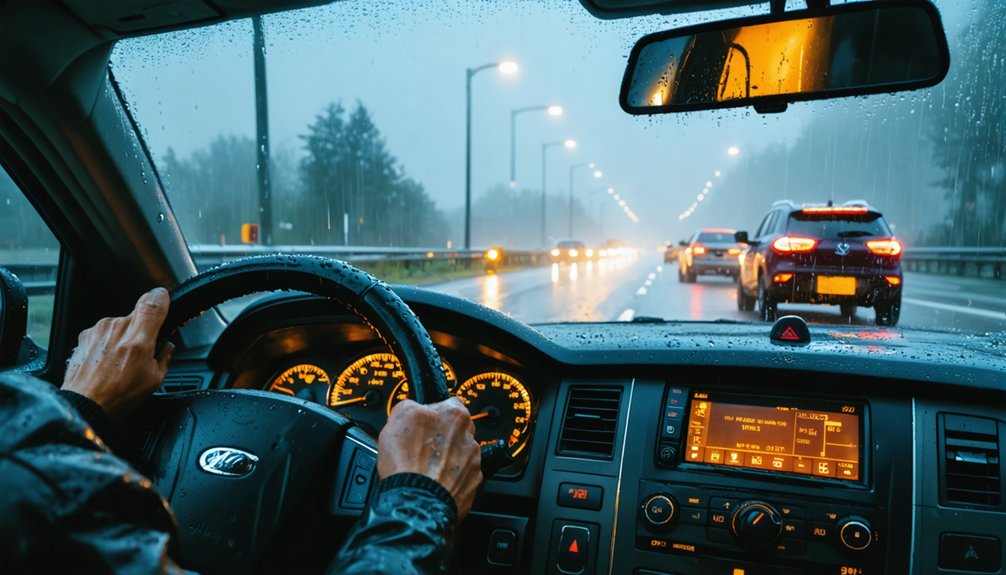
Cut your music and roll down your windows when fog reduces your visibility to dangerous levels. Your ears become critical navigation instruments when your eyes can’t gather enough information. Auditory cues like approaching engines, tire noise on wet pavement, and warning horns tell you exactly what your headlights can’t reveal.
Environmental awareness expands dramatically once you eliminate interior noise. You’ll detect vehicles approaching from intersections, identify road edges by sound reflection, and hear emergency vehicle sirens far earlier than you’d spot their lights. This additional sensory input compensates directly for what fog steals from you visually.
Rolling down windows costs you nothing but comfort. In dangerous low-visibility conditions, that small discomfort purchases you critical seconds of reaction time that could prevent a serious collision.
Use Road Markings to Stay in Your Lane During Low Visibility
While your ears compensate for reduced visibility, your eyes still have work to do—specifically, tracking the road markings directly in front of you. In stormy conditions, lane awareness depends almost entirely on these visual cues when road edges disappear into fog or heavy rain.
Fix your eyes on the center line or lane markings and follow them continuously. Don’t scan the horizon—there’s nothing useful there when visibility collapses. The markings directly ahead define your navigable space and keep you from drifting into opposing traffic or off the road entirely.
White edge lines mark your right boundary; yellow center lines mark your left. Use both.
When storm conditions strip away every other reference point, these painted lines become your primary navigational instrument—treat them accordingly.
When Fog Gets Too Dense to Drive: How to Pull Over Safely
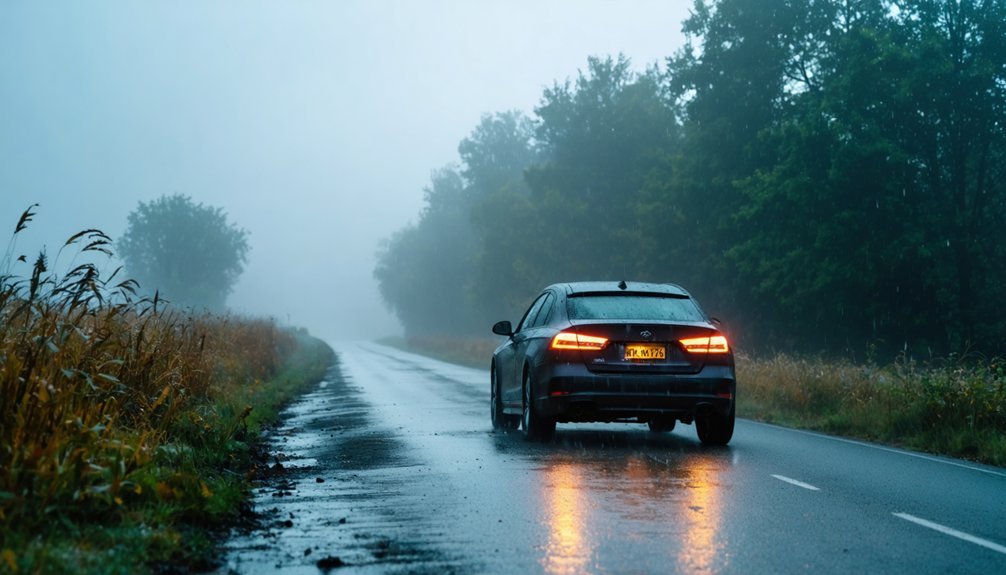
When fog becomes too dense to drive safely, you must pull completely off the road into a parking lot, business area, or other location far from active traffic lanes.
Once stopped, turn off your headlights immediately, since brake lights and running lights can mislead other drivers into following your vehicle directly off the road.
Activate your hazard lights before pulling over to alert approaching traffic of your intentions, then shut them off once you’re fully stationary and positioned well away from driving lanes.
Finding Safe Pullover Spots
If fog becomes too dense to drive safely, you’ll need to find a secure location to pull over immediately. Target parking lots, business areas, or designated rest stops rather than highway shoulders.
These locations position your vehicle as far from active traffic lanes as possible, reducing collision risk considerably.
Activate your hazard lights before pulling over to alert approaching drivers of your intentions. Once stopped, turn off your headlights completely — leaving brake lights on may mislead following drivers into your position.
Use this downtime productively. Contact roadside assistance if your situation requires support, and access your emergency kits to address any immediate needs.
Stay inside your vehicle with doors locked until visibility improves sufficiently to resume driving safely and confidently.
Lights Management When Stopped
Once you’ve pulled off the road and stopped safely, your lights require immediate attention. Turn your headlights completely off. This counterintuitive step prevents other drivers from mistaking your stopped vehicle’s light visibility for active traffic, which could cause them to follow directly into your position.
Activate your hazard lights instead. Emergency flashers communicate a critical message to approaching drivers: a stationary vehicle occupies this space. The distinction matters enormously in dense fog conditions.
Don’t rely on brake lights alone. Brake lights signal movement to other drivers, creating dangerous confusion about your actual status.
Your goal is clear communication through precise light management. A stopped vehicle must broadcast its position accurately without misleading approaching traffic into making fatal navigational errors based on misread lighting signals.
Where to Stop and How to Stay Safe Off the Road
Choosing the right stopping location in near-zero visibility can mean the difference between safety and a secondary collision. Roadside safety depends entirely on your positioning decisions.
Don’t just pull onto the shoulder—commit to a complete exit from traffic lanes using these visibility techniques:
- Pull into parking lots, business driveways, or designated rest areas entirely off the roadway
- Position your vehicle as far from active traffic lanes as physically possible
- Activate hazard lights before stopping to warn approaching drivers of your deceleration
- Turn headlights off once stopped; active brake lights may cause following drivers to inadvertently track your position
Remaining stationary in a traffic lane dramatically increases your collision risk. Move deliberately, stop strategically, and stay protected.
Use Your Defroster and Wipers to Maintain Clear Sightlines
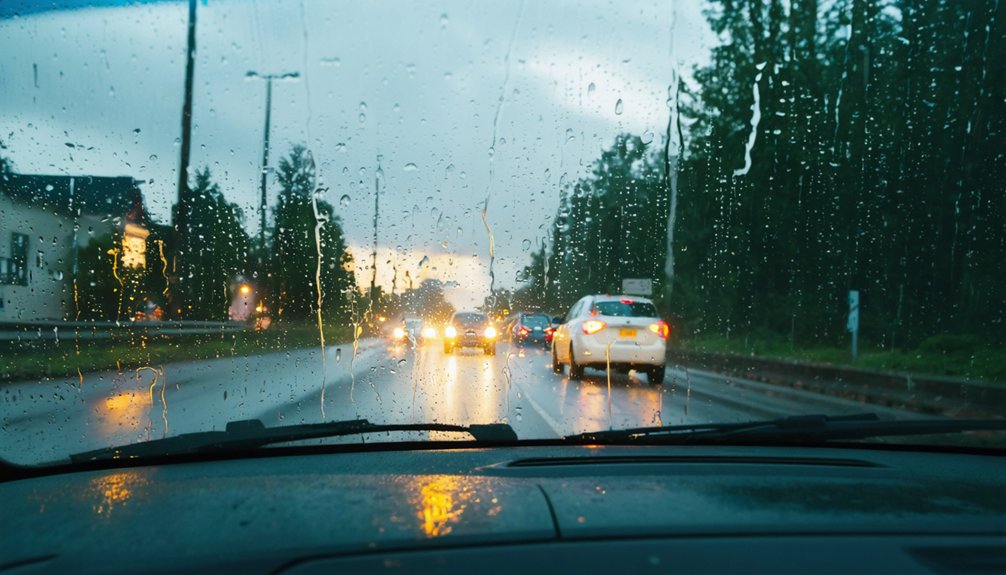
While managing stormy conditions, your windshield is your primary interface with the road—keep it clear at all times. Activate your defroster immediately when interior fog or condensation builds up, preventing dangerous blind spots before they develop. Proper defroster usage eliminates moisture-driven obstruction without requiring you to split your attention from the road.
Wiper maintenance is equally critical. Replace blades every six to twelve months, and consider curved beam designs for more uniform windshield contact during heavy rain. Worn blades streak rather than clear, dramatically reducing your forward visibility precisely when you need it most.
Keep a dedicated towel in your vehicle for rapid interior glass clearing. Every second of compromised visibility is a second where you’re operating blind—that’s a risk you control entirely.
Frequently Asked Questions
Should You Use High Beams When Fog Suddenly Thickens During Night Driving?
Don’t use high beams when fog thickens—they’ll reflect off moisture and worsen your vision. Switch to fog lights immediately for ideal visibility tips, as they cut through fog without creating dangerous glare that compromises your driving freedom.
How Often Should Windshield Wipers Be Replaced Before Stormy Driving Seasons?
Before storms strike, you can’t afford failure—replace your wipers every six to twelve months. Consistent wiper maintenance and regular visibility checks guarantee curved blades maintain uniform windshield contact, giving you clear sightlines when dangerous conditions demand it most.
Can Honking Your Horn Help Alert Nearby Drivers During Extremely Dense Fog?
Yes, you should honk occasionally as part of your fog precautions — horn usage alerts nearby drivers to your vehicle’s position, compensating for severely reduced visibility and ensuring surrounding traffic remains aware of your presence on the road.
Should Headlights Stay on When You Pull Over and Stop Completely?
When you pull over completely, turn your headlights off. Activate your hazard signals before stopping to warn approaching traffic, then kill the lights — flashing lights can mislead drivers into following you directly into your parked vehicle.
Is It Safer to Keep Moving Slowly or Stop in a Traffic Lane?
Though stopping feels safer, you shouldn’t halt in a traffic lane — it’s more dangerous. Keep moving slowly, using visibility techniques and reading road conditions, since stationary vehicles are harder for approaching drivers to detect.
References
- https://getdriversed.com/blog-details/low-visibility-driving-techniques
- https://www.aceable.com/blog/low-visibility-driving-techniques/
- https://www.boldmethod.com/blog/lists/2025/08/eight-tips-for-flying-and-navigating-around-thunderstorms-this-summer/
- https://www.sail-world.com/-88478/
- https://aviationsafetymagazine.com/safety_analysis/storm-avoidance-101/
- https://www.statefarm.com/simple-insights/auto-and-vehicles/can-you-drive-safely-in-every-type-of-severe-weather
- https://www.weather.gov/safety/fog-driving
- https://drvnapp.com/weathering-the-storm-practice-in-rain-snow-and-low-visibility-conditions/