Driving safely in severe weather during a storm chase starts before you leave home. You’ll need to inspect your vehicle thoroughly, plan multiple escape routes, and monitor radar continuously. Reduce your speed when conditions deteriorate, disable cruise control, and never drive into floodwater of unknown depth. If visibility drops to zero, pull completely off the roadway immediately. The protocols below cover every critical safety layer you’ll need to chase confidently and survive it.
Key Takeaways
- Reduce speed immediately in severe weather, disable cruise control, and maintain a six-to-eight-second following distance for safer vehicle control.
- Never drive into standing or rising water; just six inches can stall an engine and two feet can sweep your vehicle away.
- If visibility drops to zero, pull completely off the roadway, activate hazard lights, and wait until conditions improve before driving.
- Always identify multiple escape routes before chasing and reposition immediately if storm conditions change or situational awareness drops.
- Never shelter under bridges or overpasses during tornadoes; locate a hard-sided structure and exit perpendicular to the tornado’s track.
Storm Chaser Vehicle Checks Before You Leave the Driveway
Before you leave the driveway, a thorough vehicle inspection can mean the difference between a controlled chase and a dangerous breakdown in the middle of a storm.
Apply consistent vehicle maintenance tips by checking fluid levels, tire pressure, and brake function before departure. Verify that headlights, hazard lights, and rear warning lights all operate correctly—you’ll need full visibility and signaling capability once conditions deteriorate.
Keep your fuel tank topped off to avoid getting stranded far from shelter. Confirm your essential gear is loaded and secured, including communications equipment, first aid supplies, and navigation tools.
Address any mechanical concerns before you’re committed to a route. A vehicle that fails mid-chase removes your most critical asset: the ability to move away from danger on your own terms.
How To Plan Your Route and Escape Strategy Before the Chase
Before you commit to a chase route, you need to identify at least two or three viable escape routes that keep you ahead of the storm’s projected path.
Track the storm’s motion continuously so you can recognize immediately when your position becomes compromised and an escape route needs to change.
Check your state’s road condition and closure resources before you leave, because a blocked highway mid-chase can eliminate your best exit option entirely.
Identifying Multiple Escape Routes
Planning your escape routes before you approach the storm is one of the most critical steps in chase preparation. Relying on a single road leaves you vulnerable if traffic, flooding, or a rapidly shifting tornado blocks your path.
Effective escape route planning requires identifying at least two or three alternative exits from every position you anticipate occupying.
Study road maps and GPS data before departure, noting road types, directions relative to storm motion, and potential chokepoints. Paved perpendicular routes that angle away from the storm’s projected track are your strongest alternative exits.
Avoid dead-end roads, low-water crossings, and routes that funnel you back into the storm’s path. Reassess your options continuously as conditions evolve, and commit to leaving before your routes become compromised.
Monitoring Storm Motion Continuously
Effective route planning depends on your ability to monitor storm motion continuously, not just at the start of the chase but throughout every stage of it.
Storm tracking isn’t a one-time task you complete before departure. Conditions shift rapidly, and your position relative to the storm changes every minute you’re moving.
Use real-time radar interpretation to assess storm speed, direction, and intensification.
Watch for hook echoes, velocity couplets, and mesocyclone signatures that indicate rotation and potential tornado development.
Cross-reference radar data with your current road position to identify whether your escape routes remain viable.
If the storm accelerates, changes direction, or your situational awareness drops, reposition immediately.
Don’t wait for conditions to deteriorate before updating your route.
Continuous monitoring keeps your options open and your margins wide.
Checking Road Closure Information
Road closures can collapse your escape strategy in seconds, so check state DOT websites, 511 services, and navigation apps for current closure and construction data before you leave.
Road closure apps like Waze, Google Maps, and state-specific DOT platforms deliver real-time rerouting data that static planning can’t provide.
Pull local updates from county emergency management pages and National Weather Service social feeds, since local responders often post closures faster than centralized databases reflect them.
Cross-reference at least two sources before committing to a primary route and a backup.
If a closure surfaces mid-chase, don’t improvise blind—execute your pre-planned alternate immediately.
Waiting to react costs positioning time and, more critically, narrows your exit window when the storm accelerates or shifts direction unexpectedly.
Speed, Following Distance, and Control in Storm Chasing Conditions
When severe weather hits, you need to reduce your speed immediately—heavy rain, high winds, and hail all degrade traction and extend your stopping distance.
Maintain a following distance of at least six to eight seconds behind the vehicle ahead, giving yourself adequate time to react to sudden hazards.
Disable cruise control in storm conditions so you retain direct, hands-on control of throttle and braking response.
Reducing Speed In Storms
Severe weather demands an immediate reduction in speed the moment conditions deteriorate. Heavy rain, strong crosswinds, and reduced visibility all compromise your vehicle’s handling and your reaction time. Maintaining your normal highway speed during a storm isn’t confidence—it’s liability.
Drop your speed progressively as storm speed intensifies around you. Don’t wait for conditions to become dangerous before adjusting; weather awareness means anticipating hazards before they’re directly in front of you. Slower speeds give you more control, more stopping distance, and more time to evaluate rapidly changing road conditions.
Turn on your low-beam headlights immediately when visibility drops. Disable cruise control entirely—you need direct throttle control at all times.
Keep both hands firmly on the wheel and stay fully engaged with every second of your approach.
Maintaining Safe Following Distance
Slowing down buys you time, but that time means nothing if you’re riding the bumper of the vehicle ahead. In severe weather, extend your following distance to at least six to eight seconds — double the dry-road standard.
That buffer gives you the safe braking margin you need when roads are slick, visibility drops suddenly, or debris appears without warning.
Apply these visibility tips to judge your gap accurately: pick a fixed roadside marker, watch when the vehicle ahead passes it, then count until you reach the same point. If you’re not hitting six seconds, back off immediately.
Heavy rain, hail, and wind compress your reaction window fast. Maintaining that distance isn’t cautious driving — it’s tactical control over your position in a dynamic, dangerous environment.
How Storm Chasers Stay in Control Through Rain, Wind, and Hail
Rain, wind, and hail demand an immediate reduction in speed and a shift in full driving attention. When conditions deteriorate, switch on your low-beam headlights, disengage cruise control, and keep both hands firmly on the wheel.
Your storm chaser gear should already include reliable weather monitoring tools so you’re reading real-time data without distraction.
Extend your following distance to six to eight seconds minimum. Heavy rain reduces braking efficiency, and hail can cause sudden evasive reactions from other drivers. Avoid sharp steering inputs, abrupt braking, or aggressive swerving around road debris.
Wind gusts create unpredictable lateral forces. Grip the wheel at opposing positions for maximum control.
Staying disciplined in your inputs—smooth, deliberate, and controlled—keeps you mobile and in command when conditions push hard against you.
Flood Hazards Every Storm Chaser Must Recognize on the Road
Controlling your vehicle through rain, wind, and hail is only part of the challenge—flooding introduces an entirely different category of risk that catches even experienced chasers off guard. Flooding awareness isn’t optional; it’s a core survival skill.
Never drive into rising or standing water when depth is uncertain—six inches can stall your engine, and two feet can sweep your vehicle off the road entirely.
Hydroplaning risks increase dramatically on rain-saturated pavement, particularly at higher speeds. Ease off the accelerator, avoid abrupt steering corrections, and stay clear of low-lying areas where water accumulates fast.
If lane markings disappear or water begins surrounding your vehicle, pull to high ground immediately. Don’t gamble on depth assessments—that freedom to chase another day depends entirely on the decision you make right now.
How To Handle Zero-Visibility Conditions During a Storm Chase
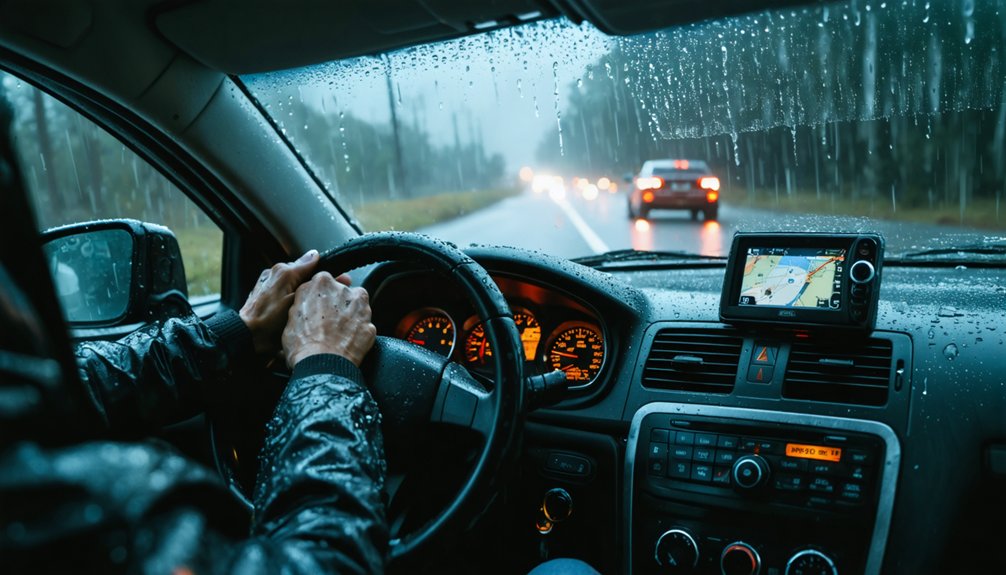
When visibility drops to near zero, your margin for error collapses instantly. Activate your low-beam headlights immediately — high beams reflect off precipitation and reduce your effective sight distance further.
When visibility collapses, your margin for error vanishes. Switch to low beams — high beams blind you faster.
Switch on hazard lights to signal your position to trailing vehicles. Your next priority is exiting the roadway completely.
Don’t stop in a travel lane. Pull fully onto the shoulder or beyond the right-of-way, confirm you’re clear of traffic, and engage your hazard lights.
Zero visibility techniques demand that you stay stationary until conditions improve enough to distinguish lane markings and surrounding vehicles.
Hazard recognition means anticipating threats before they’re visible. If you can’t confirm road geometry, your escape route is compromised.
Trust your pre-planned alternatives, and don’t resume driving until situational awareness is fully restored.
Tornado on the Road: How Storm Chasers Find Shelter Fast
A tornado closing on your position demands one immediate action: locate the nearest hard-sided indoor structure and drive to it now.
Tornado safety depends on decisive movement, not hesitation. Scan for emergency shelters—concrete buildings, reinforced structures, or any solid interior room away from windows.
Never stop under a bridge or overpass. These structures channel wind, accelerating debris and eliminating any protection you think you have. They’re death traps, not refuges.
If no emergency shelters are reachable, reassess your escape route immediately. You should’ve identified alternatives before approaching the storm. Exit perpendicular to the tornado’s track when road options exist.
Keep situational awareness constant. Monitor the rotation’s position, stay off the roadway unless moving, and commit fully to your shelter decision without delay.
How To Park and Stop Safely During a Storm Chase
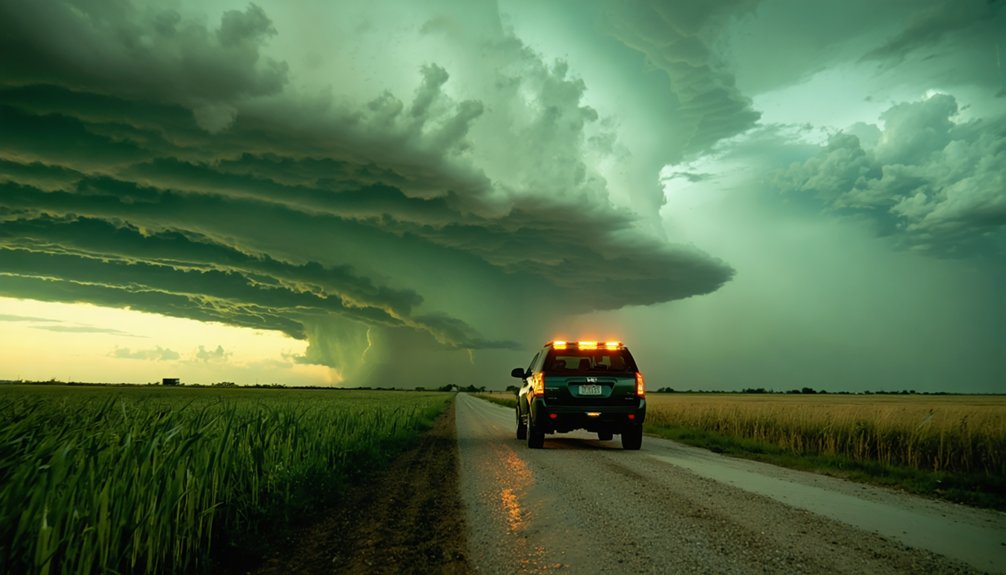
Stopping during a storm chase introduces immediate roadside hazards that demand the same discipline as your driving decisions. When you need to stop, pull fully off the roadway — not partially. Your tires should clear the travel lane completely, and you must confirm the stop is legal and outside the right-of-way.
Effective parking strategies keep you and other drivers safe. Activate your hazard lights or rear-mounted warning lights immediately upon stopping. Never rely on shoulder markings alone; verify you’re on stable ground before exiting the vehicle.
Safe stopping also means staying alert to traffic while standing near the road. Keep your distance from moving vehicles, and avoid nighttime stops whenever possible — reduced visibility cuts your reaction window markedly and raises exposure risk considerably.
Why Nighttime Storm Chasing Demands a Higher Safety Standard
Nighttime storm chasing compresses your safety margins in ways that daylight operations simply don’t. Reduced nighttime visibility eliminates your ability to read terrain, spot standing water, or identify debris fields before you’re already on top of them.
Storm navigation becomes exponentially harder when you can’t visually track rotation, wall clouds, or precipitation cores without continuous radar cross-referencing.
You’ll need fully functional headlights, hazard lights, and rear warning lights before you leave. Keep your speed down, disable cruise control, and increase your following distance beyond daylight standards.
Your reaction window shrinks considerably after dark, and road hazards appear with almost no warning.
If your escape route becomes uncertain at night, exit immediately. The freedom to chase another storm depends entirely on getting home from this one.
Frequently Asked Questions
What Communication Devices Should Storm Chasers Carry During a Chase?
You should carry two-way radios, satellite phones, GPS devices, and mobile apps for real-time storm tracking. These tools keep you connected, guarantee precise navigation, and maintain critical communication when cell networks fail during intense chase conditions.
How Do Storm Chasers Coordinate Safely With Other Chasers on the Road?
Over 100 chasers often target the same storm. You’ll maintain chaser etiquette by broadcasting your position via radio, avoiding clustered parking, and prioritizing road safety so you’re never blocking escape routes for others.
Should Storm Chasers Carry Emergency Supplies or Survival Kits While Chasing?
You should always carry emergency preparedness supplies and essential gear, including first aid kits, water, food, flashlights, and communication tools. They’ll keep you self-sufficient if you’re stranded, injured, or cut off from help during unpredictable chase conditions.
What Legal Requirements Apply to Storm Chasers Operating on Public Roads?
You must follow standard traffic laws, storm chaser regulations, and public safety laws on all public roads. Obey posted speed limits, parking rules, and signage—you’re not exempt from any legal driving requirement simply because you’re chasing.
How Do Storm Chasers Document Storms Without Compromising Their Driving Safety?
You’ll capture nature’s spectacle safely by mounting cameras externally, letting technology handle storm tracking while you apply disciplined driving techniques — keeping both hands on the wheel, maintaining focus, and never manually operating recording devices while moving.
References
- https://www.flame.org/~cdoswell/chasesums/Chase_safety.html
- https://stormchaser.com/Storm-Chasing-Safety.pdf
- https://www.youtube.com/watch?v=8URVclWia0o
- https://will.illinois.edu/weatherrealness/episode/storm-chasing-can-be-deadly-heres-how-to-stay-safe
- https://www.mas.law/blog/2026/may/what-to-do-when-a-storm-hits-while-driving/
- https://www.weather.gov/safety/tornado-during
- https://www.youtube.com/watch?v=h28hru7UhY8
- http://www.stormeyes.org/tornado/chasing/FAQ/
- https://midweststormchasers.org/safety-tips/
- https://www.youtube.com/watch?v=RonYD0qoY4Q