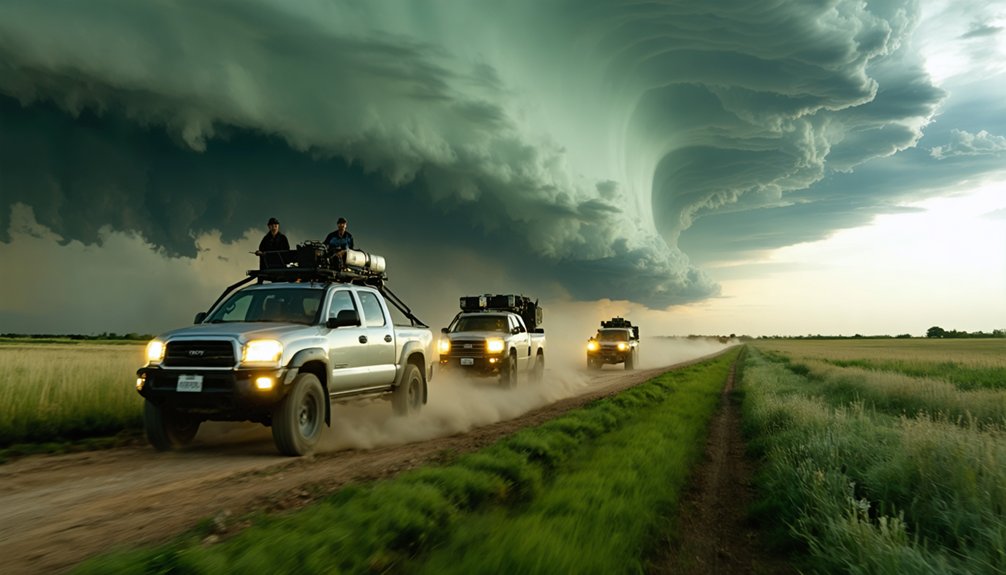
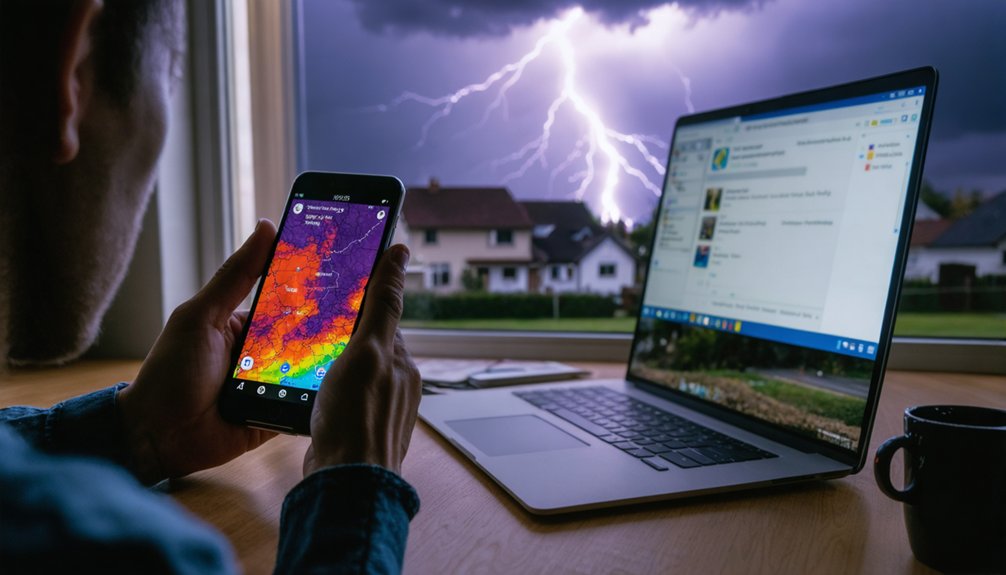
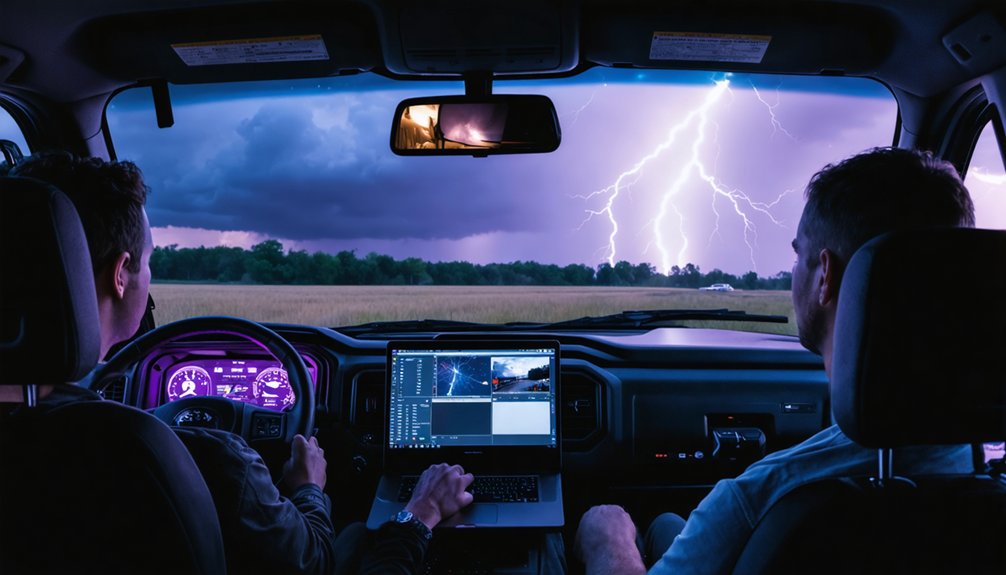
When choosing top storm chaser gear, you’ll need a reliable AWD or 4WD vehicle with high ground clearance, mud tires, and locally sourced parts availability. Pair it with radar apps like RadarScope Pro or Baron Mobile Threat Net, field instruments for ground-truth measurements, and cameras like the Sony A7S III for low-light performance. Don’t neglect safety kits and communication tools. Your specific budget tier determines which combination of gear keeps you both effective and alive out there.
Key Takeaways
- AWD or 4WD vehicles with high ground clearance, mud tires, and off-road capability are essential for reliable storm chasing operations.
- RadarScope Pro and Baron Mobile Threat Net provide high-refresh radar data and dual-pol interpretation for precise storm tracking.
- Sony A7S III and Canon EOS R5C are top camera choices, offering superior low-light performance and 4K video capability.
- Safety kits must include spare tires, first aid supplies, defibrillators, and reflective vests for night operations.
- Budget tiers range from entry-level GoPro setups to advanced Nikon Z9 platforms, balancing safety gear with equipment upgrades.
Storm Chaser Vehicles Built for Any Terrain
When you’re chasing storms across unpaved back roads, flooded fields, and hail-scarred highways, your vehicle isn’t just transportation—it’s your most critical piece of equipment.
Prioritize AWD or 4WD with genuine off-road capabilities, mud tires, and high ground clearance for maximum terrain adaptability.
Vehicle reliability demands you choose models serviceable with locally sourced parts—breakdowns in rural Kansas aren’t negotiable.
Mid-size AWD SUVs balance storm readiness with fuel efficiency, giving you extended range without constant refueling stops.
Equipment integration requires sufficient interior space for laptop mounts, radios, and weather instruments.
Don’t overlook comfort features; fatigue kills decision-making on multi-day chases.
Address maintenance concerns proactively—inspect brakes, tires, and suspension before every deployment.
Your vehicle’s performance directly determines your freedom to operate anywhere storms develop.
Weather Tracking Tools That Actually Work in the Field
Once you’ve sorted your vehicle setup, your next priority is equipping yourself with tools that deliver accurate, real-time storm data when conditions deteriorate fast.
For live tracking, Baron Mobile Threat Net and RadarScope Pro give you granular storm cell data, velocity readings, and mesocyclone detection directly on your device.
In the field, you’ll also want direct atmospheric measurements from anemometers, barometers, and portable lightning detectors like Thor Guard or StrikeAlert HD to validate what your apps are showing.
Real-Time Storm Tracking
Real-time storm tracking hinges on two categories of tools: radar applications and in-situ instruments. Your storm tracking software suite should prioritize data refresh rates, tilt-scanning capability, and dual-pol interpretation.
Mobile radar apps give you independence from fixed workstations, letting you operate deep in remote terrain.
Three tools define operational effectiveness:
- Baron Mobile Threat Net – delivers commercial-grade radar with lightning overlay integration and storm cell attributes
- RadarScope Pro – provides Level 3 NEXRAD data with velocity products, ideal for mesocyclone identification
- Thor Guard or StrikeAlert HD – portable lightning detectors that give you ground-truth atmospheric electrical data independent of radar
Cross-referencing radar-derived storm motion with real-time sensor readings sharpens your positioning decisions and reduces your exposure to rapidly evolving hazards.
Field Measurement Tools
Field instruments close the gap between radar abstraction and ground-truth atmospheric conditions.
You’re verifying what algorithms suggest by placing portable sensors directly inside evolving environments. A quality anemometer quantifies wind speed and direction independently of distant radar estimates. Your barometer confirms pressure gradient shifts that precede structural changes in storm organization.
A sling psychrometer delivers dew point and relative humidity readings with field measurement accuracy that digital forecasting models simply can’t replicate at your exact position.
The Thor Guard and StrikeAlert HD lightning detectors add critical proximity warnings, giving you the freedom to operate without constant radar consultation.
These instruments aren’t redundant—they’re ground-truth validation. When your portable sensors contradict model output, trust your instruments. Real atmospheric data always outranks theoretical projections.
Storm Chaser Cameras for Video and Stills
When selecting cameras for storm chasing, you’ll need to evaluate separate bodies for video capture and still photography, since each discipline demands different technical trade-offs.
For video, the Sony A7S III and Canon EOS R5C lead the field with weather sealing, 4K capability, and robust frame rate options suited to fast-moving storm systems.
Low-light performance is non-negotiable—full-frame and APS-C sensors greatly reduce noise when you’re shooting in the dim, chaotic conditions that precede and follow severe weather.
Top Video Camera Picks
Choosing the right camera separates usable storm footage from broadcast-quality documentation. You need camera features that handle extreme conditions without sacrificing image clarity.
Video stabilization becomes critical when wind buffets your setup and you’re shooting handheld during rapid repositioning.
Three cameras consistently outperform the competition:
- Sony A7S III – Superior low-light sensitivity and 4K120fps capture dynamic storm structure even at dusk.
- Canon EOS R5C – Weather-sealed body with Cinema RAW Light recording delivers broadcast-ready files straight from the field.
- Sony FDR-AX700 – Dedicated handycam design offers fast deployment, optical stabilization, and reliable 1080p60fps without complex menus.
Each option gives you the flexibility to document severe weather on your own terms, without compromising technical output.
Best Cameras For Stills
Still photography demands different hardware priorities than video, so your camera selection shifts toward high-resolution sensors, fast burst rates, and robust weather sealing.
The Nikon Z9, Sony A7S III, and Canon EOS R5C deliver exactly those camera features, combining full-frame resolution with professional-grade environmental protection you’ll need during active storm encounters.
Full-frame and APS-C sensors dramatically reduce low-light noise, keeping your shots clean during dark, rain-heavy supercells.
For lens types, ultra-wide anamorphic optics like the SIRUI Venus Full-Frame Anamorphic Cinema Lens capture expansive storm structure, while telephoto options isolate distant rotation and wall cloud detail.
The Sony A7RII remains a solid mirrorless alternative offering exceptional resolution.
Prioritize bodies with dual card slots, fast autofocus, and sealed magnesium alloy construction to survive field conditions.
Low-Light Performance Matters
Supercells frequently develop in low-light conditions—pre-dawn tornadoes, dusk wall clouds, and night-time lightning displays all demand sensors that perform when light drops.
Your sensor comparison should prioritize these three capabilities:
- High ISO tolerance — Full-frame and APS-C sensors reduce low-light noise considerably; the Sony A7S III excels here, delivering clean footage at ISO 12800+.
- Dynamic range retention — You’ll need shadow detail in storm structure without blown highlights from lightning strikes; the Nikon Z9 handles this well.
- Low-light techniques — Use wide-aperture lenses, manual exposure locks, and noise-reduction profiles built into your camera body.
Choosing the right sensor isn’t optional—it’s tactical. Inferior low-light performance costs you irreplaceable footage during the chase’s most critical moments.
Lenses, Mounts, and Tripods for Storm Chasing
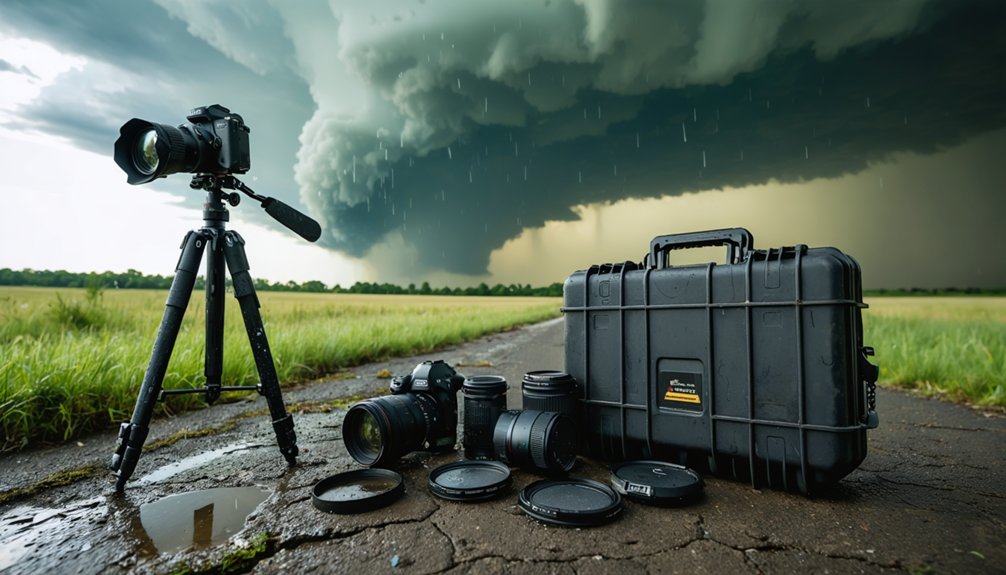
When shooting storms, your lens and mounting setup directly determine image stability and field coverage under chaotic conditions.
The SIRUI Venus Full-Frame Anamorphic Cinema Lens delivers exceptional lens versatility for ultra-wide storm documentation. Its advanced lens coatings minimize flare during lightning sequences, while lens sizes accommodate varying sensor formats.
Mount stability depends heavily on mount types you deploy. Windshield mounts and RAM laptop systems offer mount durability across multiple vehicles using universal bases, eliminating redundant hardware costs.
Tripod portability becomes critical when conditions shift rapidly. Manfrotto leads among tripod brands, offering lightweight carbon fiber and aluminum models with fluid heads enabling precise tripod adjustment.
The MT055CXPRO3 and TR654C-36 deliver fast deployment without sacrificing lens compatibility across your entire camera system.
How to Stay Safe and Connected While Chasing
Capturing usable footage means nothing if you don’t make it back safely, so your safety and communication loadout deserves the same systematic approach as your camera kit.
Integrate these safety protocols and communication devices into every chase:
- Emergency kits should include a full-size spare, fix-a-flat, air pump, road flares, first aid kit, and a defibrillator.
- Visibility gear and vehicle maintenance require an ANSI reflective vest for night operations and regular mechanical checks before deployments.
- Communication devices and navigation tools mean running a handheld ham radio for SKYWARN reports, a WeBoost cellular booster, Starlink Mini, and Speedify simultaneously.
Weather alerts through Baron Mobile Threat Net keep your situational awareness sharp.
Teamwork strategies demand pre-chase briefings, designated roles, and clear exit routes before intercept.
Which Storm Chaser Gear Setup Fits Your Budget?
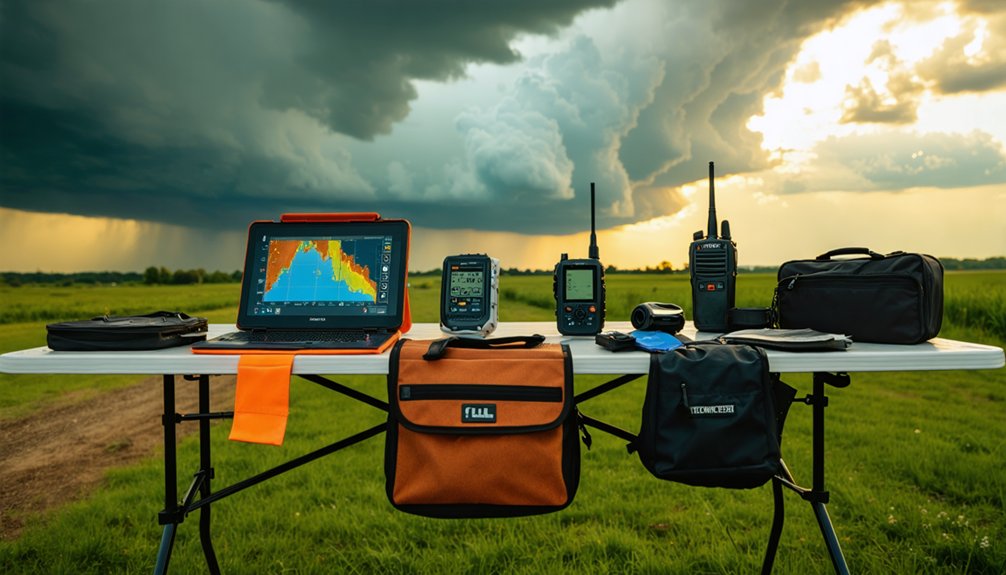
Whether you’re chasing your first supercell on a shoestring or upgrading a seasoned kit, your budget dictates where you make trade-offs across vehicles, cameras, and weather tracking tools.
Budget-friendly options start with a front-wheel-drive sedan, a GoPro Hero 7, and free radar apps like RadarScope. These essential gear choices cover mobility, documentation, and situational awareness without financial strain.
Entry-level storm chasing starts with a reliable sedan, a GoPro, and free radar apps — no financial strain required.
Mid-range chasers should prioritize an AWD SUV, a Sony FDR-AX700, and paid tools like Baron Mobile Threat Net for sharper storm analysis.
Advanced setups justify the Nikon Z9 or Sony A7S III, a purpose-built 4WD platform, and full connectivity stacks including Starlink Mini and WeBoost.
Each tier demands honest self-assessment — overspending on cameras while neglecting vehicle reliability or safety gear creates dangerous operational gaps.
Frequently Asked Questions
What Licenses or Certifications Are Recommended Before Starting Storm Chasing?
You’ll want to pursue SKYWARN spotter certification and ham radio licensing as core certification options. Prioritize safety training through emergency first aid courses to guarantee you’re equipped to chase responsibly and independently.
How Do Storm Chasers Handle Extreme Fatigue During Multi-Day Chasing Expeditions?
You’ll combat fatigue management through strategic rest rotations, high-protein meals, and controlled caffeine cycles. Apply energy strategies like power naps between chase windows, hydration protocols, and co-driver systems to maintain sharp decision-making across brutal multi-day expeditions.
Are There Legal Restrictions on Where Storm Chasers Can Operate?
You’ll face storm chasing regulations like road closures, emergency zones, and trespassing laws. Legal liability applies if you block traffic or ignore official orders, so you’ve got to respect jurisdictional boundaries while chasing freely.
How Do Storm Chasers Coordinate With Emergency Responders During Active Disasters?
You’ll coordinate with emergency responders using handheld ham radios for SKYWARN reports and real-time updates. Deploy communication strategies like two-way radios and WeBoost cellular boosters to relay critical storm data directly to local authorities during active disasters.
What Insurance Coverage Do Professional Storm Chasers Typically Carry?
Like armor in battle, storm chaser insurance shields you from financial ruin. You’ll typically carry coverage types including commercial auto, liability, and equipment policies to protect your gear, vehicle, and actions in the field.
References
- https://store.sirui.com/blogs/guides/essential-equipment-for-storm-chasing-guide-for-2025
- https://stormtrack.org/threads/recommended-chaser-equipment-list.23013/
- https://www.benholcomb.com/storm-chasing/equipment/
- https://www.stormchase.us/Articles/gear.html
- https://petapixel.com/2020/10/16/the-best-gear-for-storm-photography/
- https://www.youtube.com/watch?v=Sr2lz72ZYwM