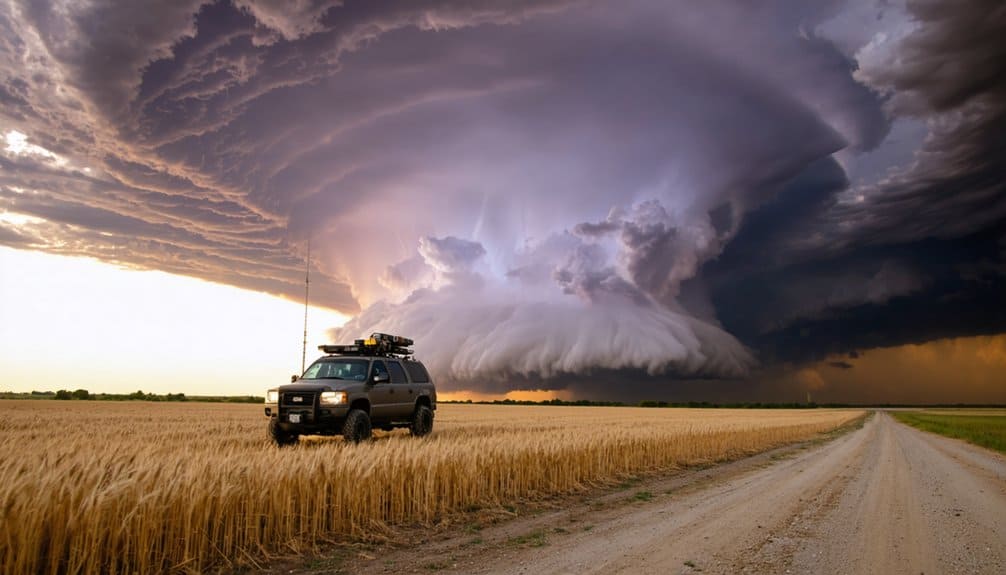
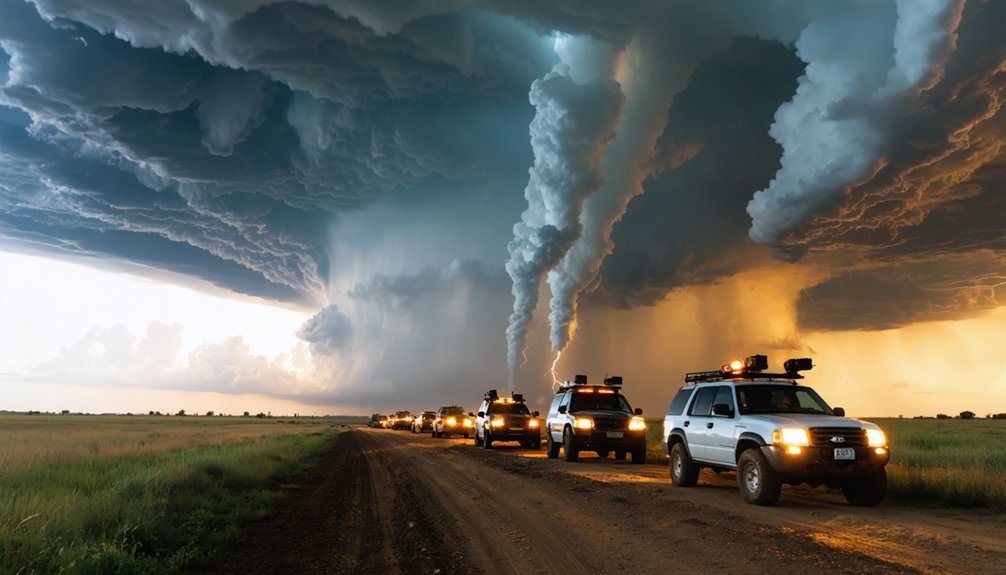
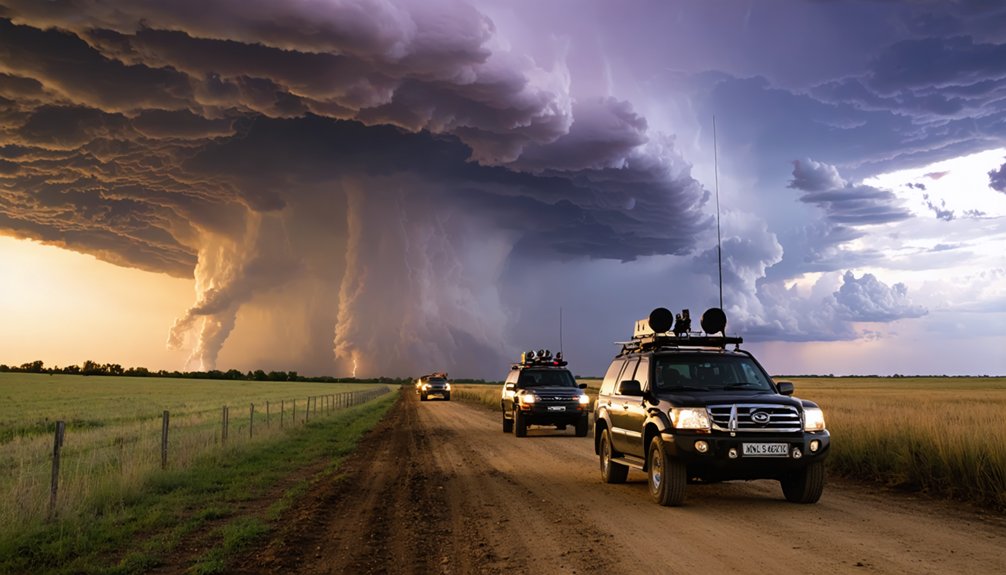
If you’re chasing violent supercells across Tornado Alley, you’ll want expert-guided operators like Tempest Tours, Silver Lining Tours, and Extreme Tornado Tours leading the way. These companies deploy credentialed meteorologists who analyze live radar, adjust intercept routes in real time, and position you safely near the most intense storm activity. Tours typically run 5–11 days and cost between $1,500–$3,500. Everything you need to choose the right operator, season, and package is covered ahead.
Key Takeaways
- Tempest Tours, Silver Lining Tours, and Extreme Tornado Tours are top operators offering expert-guided storm chasing trips across the central U.S.
- Expert guides include credentialed meteorologists who analyze live radar, monitor storm rotation, and make real-time intercept decisions.
- Tours typically last 5–11 days, departing from Oklahoma City, Denver, or Norman, targeting supercells across Oklahoma, Kansas, and Colorado.
- Trip costs range from $1,500 to $3,500, covering meteorologist expertise, real-time forecasting, safety protocols, and sometimes field equipment.
- Peak storm chasing season runs April through June; early booking for 2026–2027 is strongly recommended to secure prime chase windows.
Top Storm Chasing Tour Operators in Tornado Alley
Several established operators dominate guided storm chasing in Tornado Alley, each offering distinct strengths depending on your priorities.
Tempest Tours deploys heavy-duty vans, enforces rigorous safety protocols, and runs trips from five to eleven days out of Oklahoma City and Denver.
Tempest Tours runs five to eleven-day expeditions from Oklahoma City and Denver, prioritizing safety without sacrificing proximity to severe weather.
Silver Lining Tours suits you best if storm photography and visual documentation drive your interest.
Extreme Tornado Tours keeps groups small, bases operations out of Norman, Oklahoma, and puts credentialed meteorologists up front to interpret shifting weather patterns in real time.
StormTours and Tornadic Expeditions round out your options, with the latter specializing in private, personalized expeditions.
All five operators intercept active severe weather systems across the central United States, giving you direct access to supercell environments while maintaining structured safety protocols throughout each chase.
Which Companies Have the Most Experienced Guides?
When guide credentials matter most to your decision, Extreme Tornado Tours and Silver Lining Tours stand out.
Extreme Tornado Tours deploys three veteran guides, including a degreed University of Oklahoma severe-weather meteorologist, giving you direct access to professional storm guide credentials supported by rigorous safety training. Their small-group format ensures you’re never far from expert oversight during active intercepts.
Silver Lining Tours pairs storm photography expertise with seasoned field leadership, including Roger Hill, a recognized name in operational chasing circles. Both companies use professional meteorologists who make real-time positioning decisions, not reactive ones.
If you want guides who’ve built their reputations intercepting violent supercells rather than simply observing them, these two operators give you the most defensible choice when conditions turn dangerous.
Where Do Storm Chasing Tours Depart From?
Oklahoma City anchors the departure network for most major operators, with Tempest Tours, Silver Lining Tours, Extreme Tornado Tours, and StormTours all listing it as a primary launch point. Its central position in Tornado Alley gives you direct access to the most storm-active corridors in the country.
Denver serves as a secondary departure point for Tempest Tours and Silver Lining Tours, expanding your range into Colorado’s volatile spring systems.
Extreme Tornado Tours operates out of Norman, Oklahoma, while Extreme Chase Tours bases out of Tulsa.
These multi-city options let you position strategically based on real-time weather updates and evolving storm patterns. Operators coordinate departure logistics around storm safety protocols, ensuring you’re launching from the most tactically sound location relative to active severe weather systems.
When Is Peak Storm Chasing Season?
April through June defines the prime storm-chasing window, when atmospheric instability peaks across Oklahoma, Kansas, and Colorado. During this period, clashing air masses generate supercell thunderstorms with maximum frequency and intensity.
You’ll encounter the highest probability of significant tornadoes, large hail, and dangerous lightning—making lightning safety protocols absolutely non-negotiable in the field.
Some operators extend their season from March through August, but spring remains statistically dominant. Expert guides leverage advanced weather forecasting tools to track developing systems 24–48 hours out, positioning your group ahead of active storm cells with precision.
Booking during peak season means faster intercepts, more dynamic conditions, and greater photographic opportunities.
If you’re serious about experiencing Tornado Alley at its most powerful, target April through June without hesitation.
How Long Are Most Guided Storm Chasing Tours?
When you book a guided storm chasing tour, you’ll typically commit to a trip lasting five to eleven days, depending on the operator and the intensity of experience you’re seeking.
Extreme Tornado Tours, for example, structures its packages into five-, seven-, and ten-day options, while Tempest Tours spans the full five-to-eleven-day range.
You’ll want to align your tour dates with the April-to-June peak window, when supercell activity is most concentrated across Oklahoma, Kansas, and Colorado.
Typical Tour Duration Range
Most guided storm-chasing tours run between five and eleven days, giving you enough time in the field to intercept multiple severe-weather events across Tornado Alley. Operators like Tempest Tours offer that full five-to-eleven-day window, while Extreme Tornado Tours structures its packages into five-, seven-, and ten-day options. That flexibility lets you choose the commitment level that fits your schedule without sacrificing access to peak weather phenomena.
Tours typically operate from March through August, with April through June delivering the highest concentration of supercell activity across Oklahoma, Kansas, and Colorado.
Regardless of trip length, you’ll travel with credentialed meteorologists who enforce strict safety protocols throughout every chase. Longer tours simply increase your statistical odds of witnessing significant tornadoes, making them the preferred choice for serious enthusiasts.
Peak Season Timing
Spring delivers the most concentrated severe-weather activity across Tornado Alley, with April through June representing the prime window for supercell development in Oklahoma, Kansas, and Colorado. Atmospheric instability peaks during these months, maximizing your chances of intercepting active tornado-producing systems.
Some operators extend their season from March through August, giving you broader scheduling flexibility without sacrificing storm exposure. Booking during peak season also ensures you’re traveling alongside guides carrying full meteorologist credentials, since operators deploy their most qualified staff when severe-weather potential runs highest.
You’ll benefit from tightly structured safety protocols during this window, as tour companies execute their most rigorous field procedures when storm intensity escalates. Choosing peak-season timing means you’re positioned where conditions are most dynamic and expert guidance is most critical.
Photography-Focused vs. Extreme Storm Chasing Tours
If you’re drawn more to capturing dramatic imagery than to raw adrenaline, Silver Lining Tours is your strongest match, offering photography-focused expeditions led by experienced field guides like Roger Hill.
Extreme Tornado Tours, by contrast, puts you in small groups with veteran meteorologists to intercept high-intensity severe weather systems head-on.
Your choice between these two styles ultimately hinges on whether you prioritize the shot or the experience.
Photography Tour Highlights
Whether you’re chasing dramatic imagery or raw severe-weather intensity, the type of tour you book will shape your entire experience. For storm photography, Silver Lining Tours stands out as the top operator. Roger Hill’s guide expertise brings decades of field experience directly to your lens, positioning you ideally for supercell structure shots, lightning captures, and wall cloud documentation.
These tours prioritize visual access over proximity, keeping you mobile and strategically placed as storms develop. You’ll work alongside meteorologists who understand light, storm anatomy, and safe positioning simultaneously.
April through June in Oklahoma and Kansas delivers the most photogenic supercell activity.
If capturing frame-worthy severe weather drives your trip, a photography-focused tour gives you the technical edge and field positioning that solo chasing rarely replicates.
Extreme Chasing Experiences
For storm chasers who want maximum intensity over ideal framing, Extreme Tornado Tours delivers the raw, high-proximity severe-weather experience that photography-focused operators deliberately avoid.
Based in Norman, Oklahoma, they run five-, seven-, and ten-day trips led by veteran guides, including a degreed University of Oklahoma severe-weather meteorologist.
You’re not chasing for the shot—you’re chasing for the encounter. Small group sizes keep you mobile and positioned aggressively near active supercells.
Weather safety remains non-negotiable, but the threshold for proximity is markedly higher than what Silver Lining Tours pursues.
Come prepared with proper storm gear, including eye protection, sturdy footwear, and weather-rated outerwear.
If you want freedom from cautious positioning and sanitized distances, this is the tour built for you.
What Do Guides Actually Do During a Storm Chase?
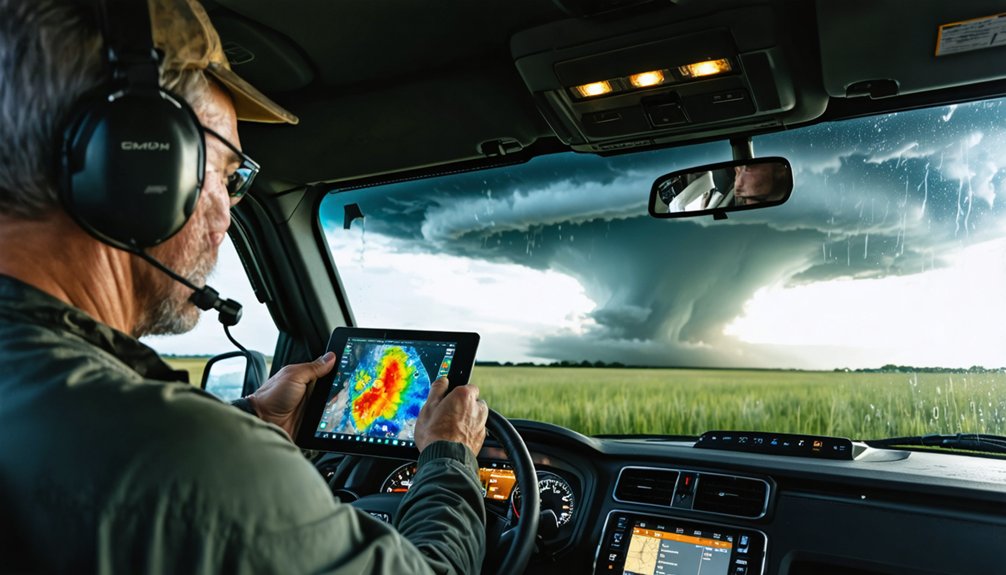
When you’re out in the field with a guided storm-chasing tour, the guides are doing far more than driving toward dark skies. They’re continuously analyzing live radar, running storm-relative velocity data, and applying advanced storm chase techniques to position your vehicle in the ideal observation zone—close enough for an unobstructed view, far enough to maintain an exit route.
Weather forecasting doesn’t stop at the morning briefing. Guides reassess atmospheric data in real time, adjusting intercept routes as storm cells evolve, merge, or collapse. They’re reading wind shear, monitoring wall cloud rotation, and communicating with field networks simultaneously.
You’re not just a passenger—you’re following a disciplined operational protocol managed by credentialed meteorologists who make split-second decisions that balance maximum storm exposure with non-negotiable safety margins.
How Much Does a Storm Chasing Tour Cost?
Storm-chasing tours typically run between $1,500 and $3,500, depending on trip length, group size, and operator specialization. Longer expeditions—like Tempest Tours’ eleven-day packages—sit at the higher end, while five-day options from operators like Extreme Tornado Tours cost less.
You’re paying for credentialed meteorologists, real-time forecasting, and proven storm safety protocols built into every chase day.
Some packages factor in weather equipment access, including communication tools and field gear. Others encourage you to bring your own.
Operators like Silver Lining Tours cater to photographers, which can influence what’s included.
Many companies now offer 2026–2027 advance bookings, so you can lock in early.
Budget accurately, confirm what’s covered, and choose the operator whose structure matches how you want to chase.
How to Book a Storm Chasing Tour for 2026 or 2027
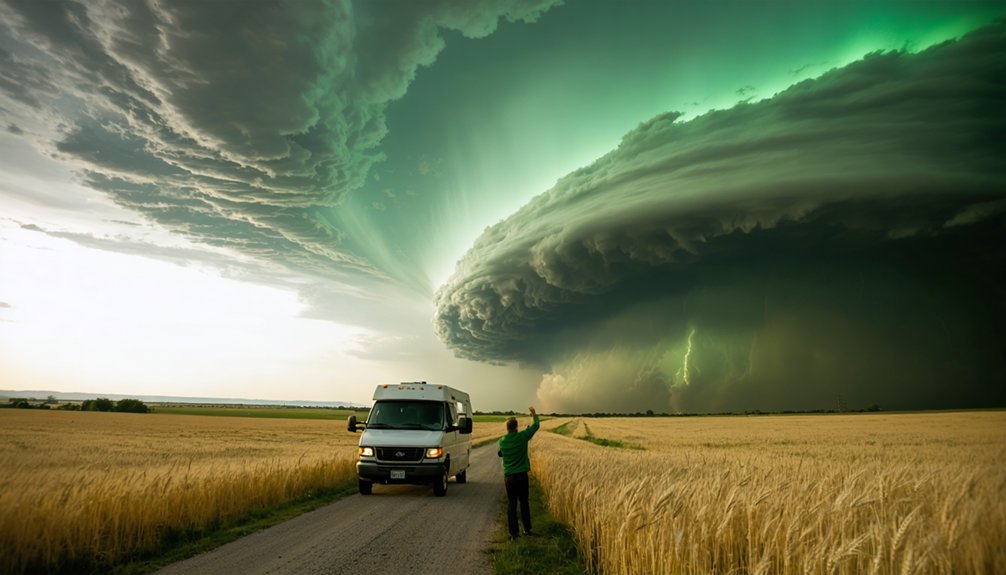
Booking a storm-chasing tour for 2026 or 2027 starts with identifying which operators have opened their advance reservation windows. Several top companies already accept bookings for both seasons, so act early to secure your preferred dates.
Follow these steps to lock in your spot:
- Research operators like Tempest Tours, Silver Lining Tours, and Extreme Tornado Tours for available 2026–2027 slots.
- Confirm tour customization options, including trip length, departure city, and group size preferences.
- Review each operator’s weather safety protocols and guide credentials before committing.
- Submit your deposit early—prime April-through-June windows fill quickly.
Cross-reference meteorologist qualifications, vehicle safety standards, and cancellation policies before finalizing.
Choosing the right operator means balancing personal risk tolerance with the freedom to chase on your terms.
Frequently Asked Questions
What Physical Fitness Level Is Required to Join a Storm Chasing Tour?
You don’t need elite athleticism, but you’ll need solid physical endurance and storm safety awareness. You’re walking, waiting, and moving fast—so stay mobile, stay alert, and stay ready for unpredictable, demanding conditions.
Are Storm Chasing Tours Suitable for Children or Minors?
Most operators don’t publish minimum age policies, but you’ll need to prioritize storm safety and guarantee adequate child supervision at all times. Confirm age restrictions directly with your chosen tour operator before booking with minors.
What Should First-Time Storm Chasers Pack or Bring Along?
Like a soldier heading into battle, you’ll need to pack smart. Bring weather gear—sturdy boots, rain layers, sunscreen—plus emergency supplies: first aid kit, water, snacks, and a fully charged phone for unpredictable conditions.
Is Travel Insurance Recommended or Required for Storm Chasing Tours?
You’ll want travel insurance for storm chasing tours. While operators enforce strict safety precautions, unpredictable severe weather creates real risk. Secure a policy covering trip cancellation, emergency evacuation, and medical expenses before you chase.
Can Participants With Weather Anxiety Still Enjoy a Storm Chasing Tour?
You can manage weather anxiety through emotional preparedness—expert meteorologists lead every trip, explain each developing storm system, and maintain strict safety protocols, so you’ll stay informed, in control, and confident throughout the chase.
References
- https://crazystormchasers.com/top-storm-chaser-groups-in-your-area/
- https://www.stormchasingusa.com/storm-chasers/
- https://www.twisterhunter.com/
- https://midlandusa.com/blogs/blog/storm-chasing-tours
- https://www.themanual.com/travel/extreme-tornado-tours/
- https://www.gonomad.com/209494-storm-chasing-erik-burns-tornadic
- https://www.reddit.com/r/stormchasing/comments/1cndsqh/storm_chasing_tours/