To sharpen your edge as a seasoned storm chaser, build your own GFS and HRRR forecasts before consulting others, and form conclusions independently to accelerate instinct development. Target storm boundaries—fronts, drylines, outflow zones—rather than SPC risk areas, since initiation happens at the edges. Map multiple contingency routes, keep fuel above half, and trust visual sky cues when radar falls short. There’s much more to unpack across forecasting, positioning, gear, and field ethics ahead.
Key Takeaways
- Build your own GFS and HRRR forecasts independently before consulting others to sharpen instincts and form unbiased conclusions.
- Focus positioning on storm boundaries like fronts and drylines, not SPC risk areas, since initiation happens at edges.
- Map a primary corridor plus two contingency routes before deployment, avoiding single-path commitments as conditions shift rapidly.
- Minimize tech distractions while chasing and trust trained visual sky observations to complement radar and velocity data.
- Always secure required permits, respect private property, and follow traffic laws to preserve long-term community credibility.
Advanced Forecasting Techniques Seasoned Storm Chasers Swear By
Seasoned storm chasers don’t rely on pre-digested forecasts—they build their own. Before reading anyone else’s analysis, run GFS and HRRR models independently, form your conclusions, then compare. This discipline sharpens your forecasting instincts faster than any shortcut.
Build your own forecast before reading anyone else’s. Independent analysis sharpens instincts faster than any shortcut ever will.
Master satellite analysis to track moisture boundaries, capping inversions, and convective initiation signals in real time. Visible and water vapor loops reveal what models often miss.
Pair that with ensemble forecasting to quantify uncertainty across multiple model runs, identifying where solutions cluster and where they diverge wildly.
Target storm boundaries—fronts, drylines, outflow zones—rather than the bullseye of SPC risk areas. The edge is where initiation happens.
Own your forecast, trust your process, and you’ll position yourself where others won’t.
Route Strategies That Keep You Ahead of the Storm
Positioning yourself ahead of a storm isn’t luck—it’s deliberate route architecture. Before you deploy, map your primary corridor alongside at least two route contingency options. Conditions shift fast, and a single-path commitment gets you trapped.
Target storm boundaries—fronts, drylines, outflow zones—rather than chasing the dense SPC risk center. Approach from the west, south, or east. Never cross north of a storm’s forward track; that’s how chasers lose their exit window.
Monitor the storm path continuously and recalculate positioning every few minutes as the cell evolves. Keep your fuel topped, your engine running when parked, and your exits mentally rehearsed.
Freedom on the plains comes from preparation, not improvisation—your route architecture is what keeps options open when everything accelerates.
Vehicle and Gear Upgrades Serious Chasers Actually Use
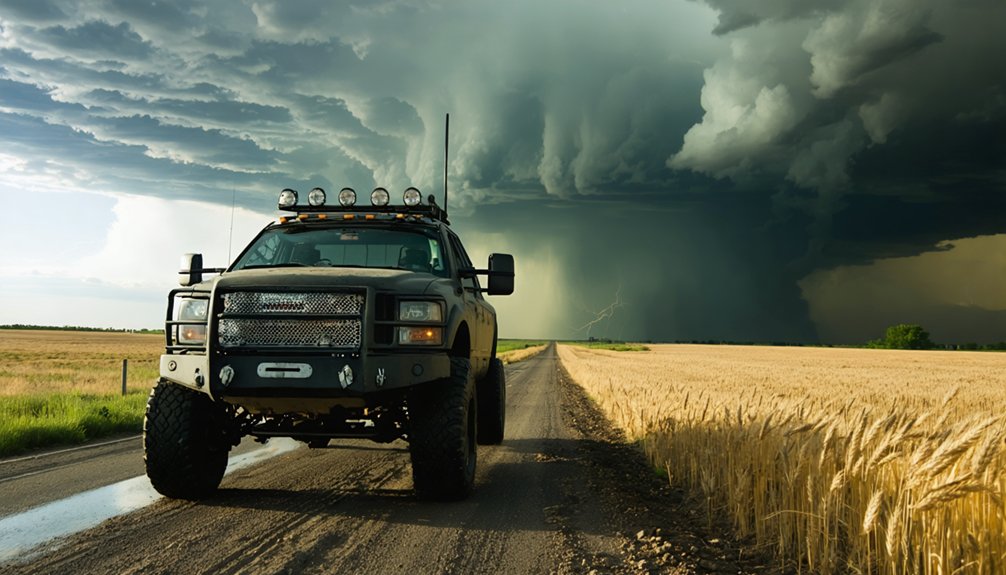
Your vehicle isn’t just transportation—it’s your command center and your escape pod. Upgrade it accordingly. Start with all-terrain tires, a reinforced suspension, and a full skid plate—storm proofing equipment that handles deteriorating roads without hesitation.
Keep a dedicated GPS unit mounted separately from your phone. Install a CB or ham radio for emergency communication when cell towers fail in remote corridors.
Carry a weather-rated dashcam, a portable power station, and a handheld anemometer for real-time wind readings. Stock emergency supplies: a first-aid kit, water, and a charged backup battery.
Keep your gas tank above half—always. Serious chasers don’t improvise gear mid-chase; they pre-configure everything before leaving. Your setup should let you move, observe, and communicate without breaking focus from the sky.
Reading the Sky When Radar Lets You Down
Gear gets you there, but your eyes keep you alive. Radar updates lag several minutes behind reality, so you can’t afford to stare at a screen when conditions are evolving fast. Read cloud formations directly — a rotating wall cloud, a lowering base, or rapid inflow tells you more than any delayed scan.
Study weather patterns until recognizing storm structure becomes instinctive. Watch for the storm’s growth, maturation, and decay phases in real time. Velocity and correlation coefficients help confirm ground tornadoes, but visual cues often precede that data entirely.
Keep your head on a swivel. Scan overhead, behind you, and laterally. The sky communicates constantly — your job is listening. Minimize tech distractions and trust what you’ve trained your eyes to see.
How to Chase Storms Legally Without Burning Bridges in the Field
Chasing legally isn’t just about avoiding fines — it’s about preserving access to the roads, farms, and landowners that make chasing possible long-term. If you’re operating in jurisdictions requiring a storm permit, secure it before you deploy. Don’t assume rural areas have no enforcement — local sheriffs notice unfamiliar vehicles during severe weather events.
Property permissions matter equally. Never pull onto private land without explicit consent. If you need a vantage point on someone’s field, ask first. Most landowners respect chasers who demonstrate courtesy, and that reputation compounds over time across entire regions. One trespassing incident poisons access for every chaser who follows.
Stay on public roads, obey traffic laws, and treat every interaction with locals as a long-term investment in the chasing community’s credibility.
Frequently Asked Questions
How Do Seasoned Storm Chasers Handle Extreme Fatigue During Multi-Day Chasing Trips?
You’ll combat fatigue by scheduling mandatory rest stops, rotating drivers, and prioritizing sleep over storm tracking techniques. Don’t let exhaustion compromise your weather prediction accuracy or split-second safety decisions during critical multi-day chasing operations.
What Mental Health Challenges Do Experienced Storm Chasers Commonly Face Over Time?
Like a storm that erodes the landscape, chasing tests your mental resilience over time. You’ll face emotional burnout, decision fatigue, and trauma from witnessing destruction—challenges that demand deliberate psychological recovery strategies between deployments.
How Do Veteran Chasers Manage Costs Associated With Long-Distance Storm Chasing Expeditions?
You’ll cut costs by mastering weather forecasting to target high-probability days, skipping low-risk chases. Maintain your storm chasing gear meticulously to avoid expensive failures. Carry extra fuel, split expenses with trusted partners, and plan efficient routes.
What Insurance Coverage Do Serious Storm Chasers Typically Carry for Their Vehicles?
You’ll need storm chase insurance that covers everything short of surviving the apocalypse. Vehicle coverage policies must include all-encompassing, high-liability, and specialty endorsements—because standard coverage won’t touch tornado-adjacent risks you’re actively courting.
How Do Experienced Chasers Build Reliable Networks With Other Chasers in the Field?
You’ll build reliable networks through consistent communication strategies—share forecasts, coordinate positions via radio, and cross-verify radar data. Prioritize equipment maintenance so your gear’s always field-ready, ensuring teammates trust your reliability during rapidly evolving severe weather situations.
References
- https://www.wiu.edu/SevereWeather/images/presentations/How_to_Effectively_Storm_Chase.pdf
- https://www.livingskytours.com/storm-chasing-101/
- https://www.youtube.com/watch?v=nxPSFg2R8YY
- https://www.reddit.com/r/stormchasing/comments/1boanfg/how_do_i_get_started_storm_chasing/
- https://www.youtube.com/watch?v=6otZLjSZvPU&vl=en
- https://www.reddit.com/r/stormchasing/comments/1ditn4z/if_there_was_one_tip_you_could_give_about_storm/
- https://www.foxweather.com/learn/storm-chasing-advice-from-the-pros
- https://www.atms.unca.edu/cgodfrey/courses/swfex/pdf/ChasingSafety.pdf