When you’re chasing tornadoes, standard outdoor gear won’t cut it. You need fully waterproof, windproof shells rated for winds exceeding 200 mph, moisture-wicking base layers, and insulated mid-layers rated 20–30°F below expected temperatures. Impact-resistant goggles, hard hats rated for baseball-sized hail, and reinforced boots are non-negotiable. Pair these with redundant GPS and communication tools to maintain situational awareness. There’s far more to assembling a field-ready kit that keeps you safe and operational.
Key Takeaways
- Tornado chasing gear must withstand winds exceeding 200 mph, far surpassing standard outdoor equipment designed for recreational activities.
- Moisture-wicking base layers, insulated mid-layers, and fully waterproof outer shells form the essential weatherproof layering system for chasers.
- Impact-resistant goggles, baseball-rated hard hats, and reinforced gloves protect against high-velocity debris and hailstones.
- Outer shells require a minimum 10,000mm hydrostatic head rating and fully taped seams to prevent water infiltration.
- GPS systems, weather radios, and satellite phones provide redundant communication and navigation during rapidly evolving storm conditions.
What Makes Tornado Chasing Gear Different From Regular Outdoor Gear?
While standard outdoor gear prioritizes comfort and moderate weather resistance, tornado chasing gear withstands wind speeds exceeding 200 mph, golf ball-sized hail, and airborne debris that can penetrate conventional clothing. You’re operating in an environment where tornado safety isn’t optional—it’s engineered into every layer you wear and every tool you carry.
Regular hiking jackets lack the reinforced, fully waterproof shells that block wind-driven rain at extreme velocities. Standard boots don’t provide the grip required on debris-covered terrain. Everyday sunglasses won’t protect against projectile fragments traveling at triple-digit speeds.
Storm forecasting demands precision equipment beyond comfort gear—GPS navigation systems, weather radios, and satellite phones replace casual maps and smartphones. You need gear built for survival, not recreation, giving you the freedom to chase without compromising your safety.
Weatherproof Clothing Every Tornado Chaser Needs in the Field
Your base layer does the critical work of pulling sweat away from your skin, preventing dangerous heat loss during rapid temperature swings common in storm environments.
Over that, you’ll want an insulated mid-layer specifically rated for wind-driven cold, as gusts near a tornado’s outer circulation can drop apparent temperatures well below ambient readings.
Your outermost shell must be fully waterproof, windproof, and breathable—a non-negotiable combination that keeps you dry and mobile when torrential rain and debris-laden winds hit simultaneously.
Moisture-Wicking Base Layers
When you’re spending hours exposed to the unpredictable thermal swings near a supercell, a moisture-wicking base layer is your first line of defense against sweat accumulation on the skin. Unlike standard thermal underwear, modern moisture-wicking fabrics actively pull perspiration away from your body, maintaining ideal skin temperature during rapid weather shifts.
This matters because trapped moisture accelerates hypothermia risk when temperatures drop suddenly beneath storm outflow boundaries.
You’ll want synthetic polyester or merino wool constructions offering at least 150 GSM fabric weight for durability. Pair your base layer directly beneath rain gear to create an effective moisture-management system.
Prioritize flatlock seam construction to eliminate chafing during extended field operations. Compression-fit designs also improve circulation during prolonged sedentary vehicle positioning between storm intercepts, keeping you operationally ready when conditions demand rapid deployment.
Insulated Mid-Layer Options
Once your moisture-wicking base layer manages perspiration at skin level, an insulated mid-layer locks in retained body heat against the sharp temperature drops that accompany storm outflow boundaries.
You’ll want insulated jackets rated for temperatures 20–30°F below your anticipated chase environment, as outflow boundaries can drop ambient temperatures 30°F within minutes. Synthetic insulation outperforms down in high-humidity storm environments because it retains thermal efficiency when wet.
Pair your jacket with thermal leggings featuring at least 200-weight fleece construction, which balances warmth-to-weight ratio without restricting mobility during rapid vehicle exits. Avoid cotton mid-layers entirely—they trap moisture and accelerate heat loss.
Prioritize mid-layers with articulated patterning, allowing unrestricted movement when you’re deploying equipment or orchestrating rough terrain under rapidly deteriorating conditions.
Waterproof Outer Shell Essentials
The outermost shell you select functions as your primary barrier against wind-driven rain, hail, and debris—so material specifications matter enormously. Rain resistant fabrics and wind blocking materials define your operational limits in the field.
Prioritize these shell specifications:
- Waterproof rating: Minimum 10,000mm hydrostatic head pressure for sustained storm exposure
- Breathability: 10,000g/m²/24hr moisture vapor transmission prevents internal condensation buildup
- Wind resistance: Laminated membranes block gusts exceeding 60mph without structural compromise
- Seam construction: Fully taped seams eliminate water infiltration at stitch points
- Packability: Compressible designs allow rapid deployment when conditions escalate unexpectedly
Your shell’s breathable membrane lets you move aggressively without trapping heat. Don’t compromise on certified waterproofing—you’re operating where weather becomes genuinely dangerous, and substandard materials cost you your safety margin.
How to Layer Your Tornado Chasing Gear for Changing Conditions
Layering your tornado chasing gear correctly can mean the difference between staying functional in the field and cutting a chase short due to heat exhaustion or hypothermia. Start with a moisture-wicking base layer that pulls sweat away from your skin, preventing dangerous heat loss during temperature drops.
Your layering techniques should prioritize adaptability — conditions shift rapidly in storm alleys, demanding quick adjustments. Add an insulated mid-layer using synthetic or wool clothing materials that retain thermal efficiency even when wet.
Your outer shell should remain fully waterproof and windproof while allowing breathability to prevent internal moisture buildup. Strip or add layers as barometric pressure and temperatures fluctuate throughout the chase.
Efficient layering keeps you mobile, alert, and in control of your pursuit without compromising personal safety.
Protective Gear That Could Save Your Life in a Storm
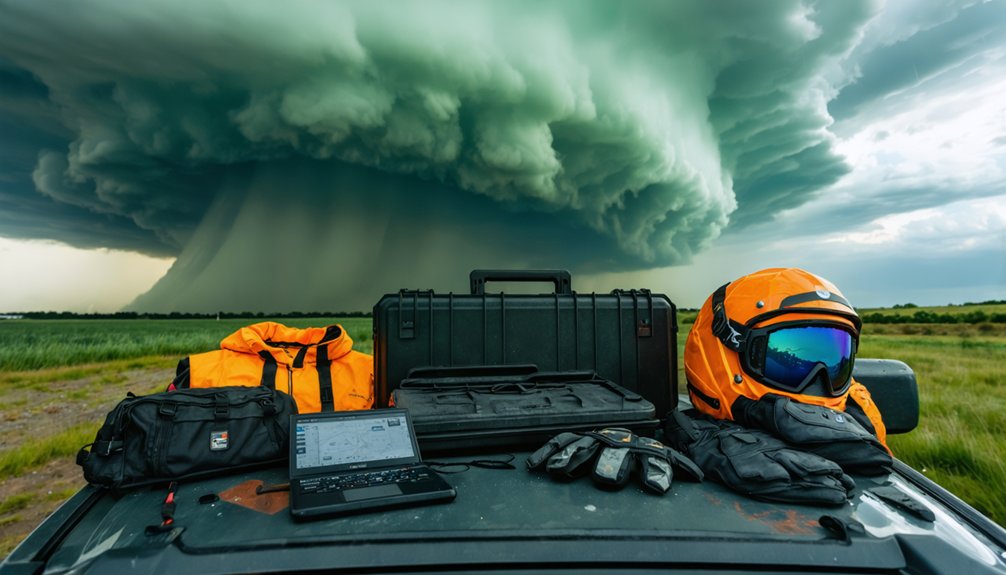
When debris becomes airborne in tornado-force winds, you’re facing projectiles that can exceed 100 mph, making head and eye protection non-negotiable.
You’ll need a hard hat rated to withstand hailstones larger than baseballs, paired with sturdy goggles that seal tightly against your face to block high-velocity fragments.
Don’t rely on standard sunglasses—only impact-resistant goggles provide the debris shielding that keeps you operational in a live storm environment.
Shielding Against Storm Debris
Shielding yourself from storm debris requires gear engineered to absorb impact, deflect sharp objects, and maintain structural integrity under extreme wind loads. Effective storm tracking demands you’re protected before lightning safety becomes critical.
Essential debris protection includes:
- Hard hat rated against hailstones exceeding baseball size, reducing blunt-force head trauma
- Sturdy goggles creating a sealed barrier against high-velocity projectiles during peak wind events
- Thick gloves blocking sharp fragmented debris while retaining dexterity for equipment operation
- Waterproof outer shell with reinforced fabric resisting tearing from airborne materials
- Waterproof boots providing ankle stability on debris-scattered terrain post-impact
Each piece serves a precise mechanical function. You’re not just chasing storms — you’re operating in a dynamic hazard zone where every gear decision directly determines your margin of survivability.
Essential Head and Eye Protection
Protecting your head and eyes in tornado conditions isn’t optional — it’s a calculated survival decision backed by measurable impact data.
During storm observation, hailstones exceeding baseball diameter travel at speeds surpassing 100 mph, generating impact forces that standard headgear can’t absorb. You need a hard hat rated for high-velocity projectile resistance.
For eye protection, standard sunglasses won’t cut it. Sturdy goggles create a sealed barrier against debris-laden winds, while high-quality sunglasses handle solar glare and smaller airborne particles during perimeter observation.
Tornado safety demands you layer both solutions depending on proximity and wind intensity.
Don’t compromise on fit — loose gear becomes a projectile itself. Certified, properly secured head and eye protection keeps your senses operational when precise decision-making determines whether you drive out safely.
Reliable navigation and communication tools can mean the difference between a successful chase and a life-threatening situation. You’ll need systems running advanced navigation algorithms and redundant communication protocols to stay ahead of rapidly evolving storm systems.
- GPS navigation system – delivers real-time tracking through volatile storm alleys
- Weather radio – streams live emergency alerts and atmospheric updates instantly
- Satellite phone – maintains connectivity where cellular networks completely fail
- Two-way radios – coordinates precise vehicle positioning across multiple chase units
- Police scanner – monitors emergency crew frequencies near post-storm impact zones
Each tool serves a distinct operational function. Redundancy isn’t optional—it’s critical. When one system fails, another must immediately compensate.
Your survival and data integrity depend entirely on maintaining uninterrupted situational awareness throughout every chase deployment.
How to Keep Your Tornado Chasing Vehicle Field-Ready
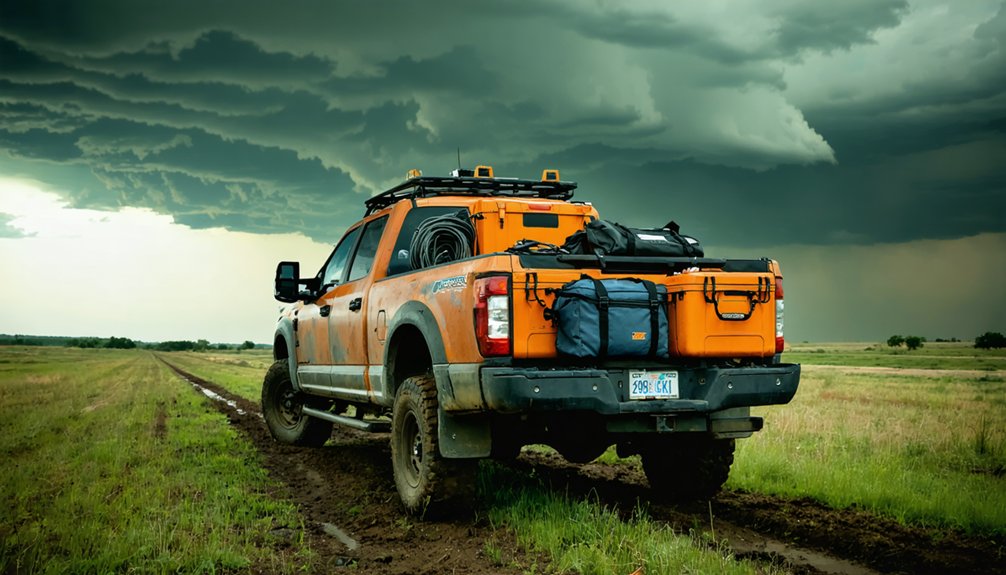
Beyond communication systems, your vehicle’s mechanical readiness determines whether you reach ideal positioning—or get stranded miles from the action. Tornado safety depends heavily on your ability to reposition fast when weather forecasting models shift storm tracks unexpectedly.
Carry a full-size spare tire—not a compact donut—since rough terrain destroys sidewalls quickly. Pair it with a tire plug kit and portable air compressor for field repairs under two minutes.
A lithium-ion jump starter eliminates dependence on other vehicles during isolated pursuits.
Your recovery strap handles mud extractions without outside assistance, preserving your freedom to operate independently.
Store a mechanics toolkit covering ratchets, sockets, and screwdrivers for roadside fixes.
Every component you maintain proactively keeps you mobile, autonomous, and positioned exactly where the storm demands your presence.
Cameras and Tech Serious Storm Chasers Actually Use
Capturing storm data accurately requires hardware built for punishment and precision. You’ll need tools that document, transmit, and analyze storm data in real time without failing under pressure.
- Video camera – Records high-definition footage for documentation and drone footage integration
- Digital camera – Captures still images revealing storm details video misses
- Laptop computer – Maintains live internet access for storm mapping and weather modeling
- Amateur ham radio – Pulls real-time SkyWarn member field observations instantly
- Digital ruler – Measures hail size precisely for scientific and insurance reporting
Each piece of equipment serves a distinct data-collection function. You’re not hauling gear for aesthetics — you’re building a mobile field station capable of surviving the same environment you’re chasing.
Survival Supplies Built for Long Days in Storm Alley
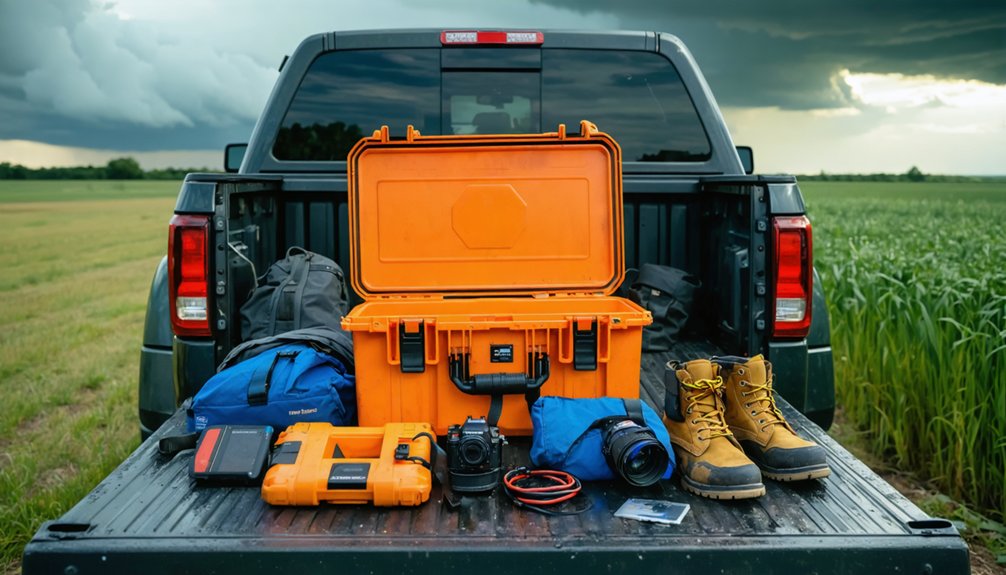
Storm chasing shifts last eight to twelve hours, and you can’t afford to let fatigue or hunger compromise your situational awareness when conditions deteriorate fast. Pack high-calorie sandwiches, coffee, and sufficient water reserves to sustain focus during extended tornado safety protocols and rapid repositioning.
A flashlight or headlamp becomes critical near downed power lines after dark. Carry antiseptic wipes, adhesive tape, and a digital thermometer for managing minor field injuries without abandoning your weather forecasting post.
A recovery strap handles vehicle extractions from saturated terrain quickly. Whataburger spicy ketchup packets and trash bags keep your cab organized and morale functional.
Every item earns its space by serving a precise operational purpose, cutting dead weight while maximizing your response capacity when severe weather demands split-second decisions.
How to Build a Tornado Chasing Kit on Any Budget
Building a complete tornado chasing kit doesn’t require a meteorologist’s budget—it requires prioritization. Start with affordable rain ponchos and windbreakers before upgrading to full shell systems.
Allocate funds strategically across critical categories:
- Safety first: Hard hat, thick gloves, and sturdy goggles protect against debris and hail
- Navigation: A reliable GPS and weather radio deliver real-time storm tracking data
- Communication: Two-way radios coordinate movement without requiring cellular coverage
- Documentation: A mid-range video camera captures usable storm footage at minimal cost
- Vehicle readiness: A plug kit, recovery strap, and jump starter prevent field failures
You don’t need premium gear on day one. Build incrementally, prioritizing life-safety equipment first, then communication tools, then documentation.
Freedom in storm alley demands preparation, not perfection.
Frequently Asked Questions
Can Tornado Chasing Gear Double as Hurricane or Flood Response Equipment?
Yes, much of your tornado chasing gear doubles as hurricane or flood response equipment. Your storm preparedness tools—waterproof shells, GPS, satellite phones, and emergency equipment like first aid kits—transfer directly, giving you operational freedom across multiple disaster scenarios.
Are There Age or Physical Fitness Requirements for Tornado Chasing Activities?
Like a pilot needing a license before flight, you’ll find no universal age restrictions for tornado chasing, but safety precautions demand you’re physically fit, mentally sharp, and capable of handling high-stress, rapidly evolving conditions independently.
Do Professional Storm Chasers Require Special Licenses or Government Permits?
You don’t need special licenses or government permits to chase storms, but you must follow safety protocols and legal regulations, including traffic laws and restricted zone boundaries, ensuring you’re operating within your freedom responsibly.
How Often Should Tornado Chasing Gear Be Inspected or Replaced Entirely?
After Reed Timmer’s vehicle sustained shell degradation mid-chase, you’d understand why gear maintenance demands monthly inspections. Replace critical safety equipment every two years to maximize equipment longevity, keeping you autonomous and field-ready without bureaucratic delays slowing your chase.
Is Tornado Chasing Gear Tax-Deductible for Certified Meteorologists or Researchers?
Yes, you can deduct tornado chasing gear if it’s strictly research-related. Maintain precise tax documentation of every purchase, and explore insurance benefits to offset costs. Consult a tax professional to maximize your legitimate deductions confidently.
References
- https://www.stormtours.com/information/must-bring-items/
- https://stormtrack.org/threads/recommended-chaser-equipment-list.23013/
- https://www.benholcomb.com/storm-chasing/equipment/
- https://www.youtube.com/watch?v=mX7zibHsOo4
- https://www.netweather.tv/weather-forecasts/news/9783-what-to-pack-for-storm-chasing-a-kit-list-for-tornado-alley-the-usa-or-canada
- https://crazystormchasers.com/best-protective-gear-for-storm-chasers/
- https://www.reddit.com/r/stormchasing/comments/1hjxvuy/suggestions_for_supplies_for_my_first_chase/
- http://www.ndtornado.com/primary/equipment.htm
- https://tacessentials.com/blogs/tactical-gear-talk/tactical-gear-for-tornado-preparedness-how-to-protect-yourself-and-your-family
- https://www.benholcomb.com/storm-chasing/equipment/items-in-my-storm-chase-vehicle/