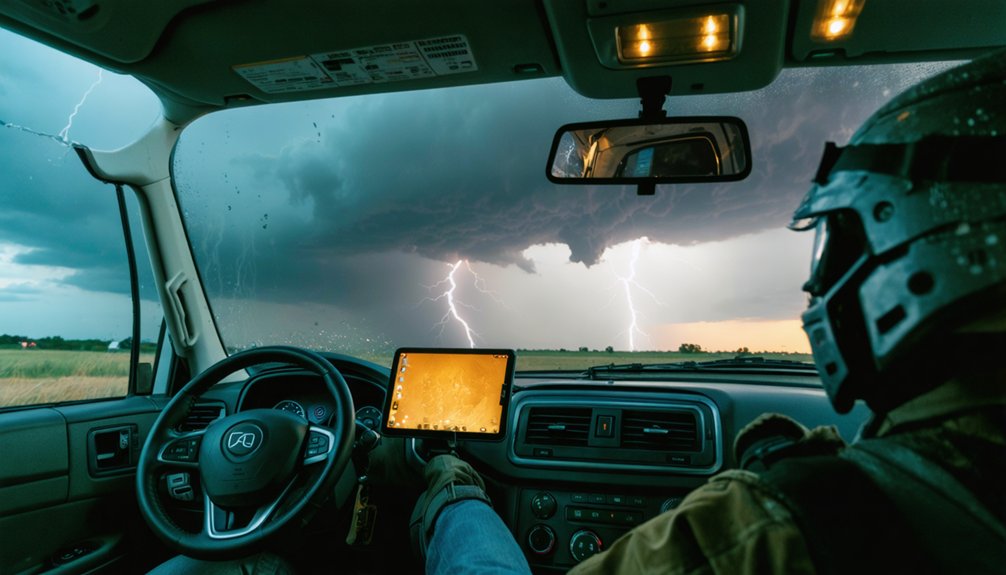
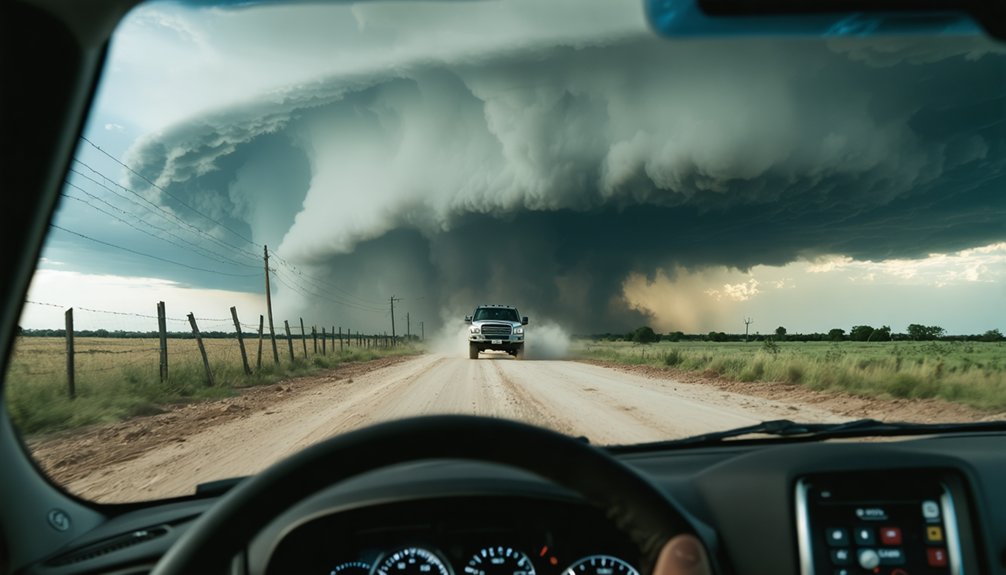
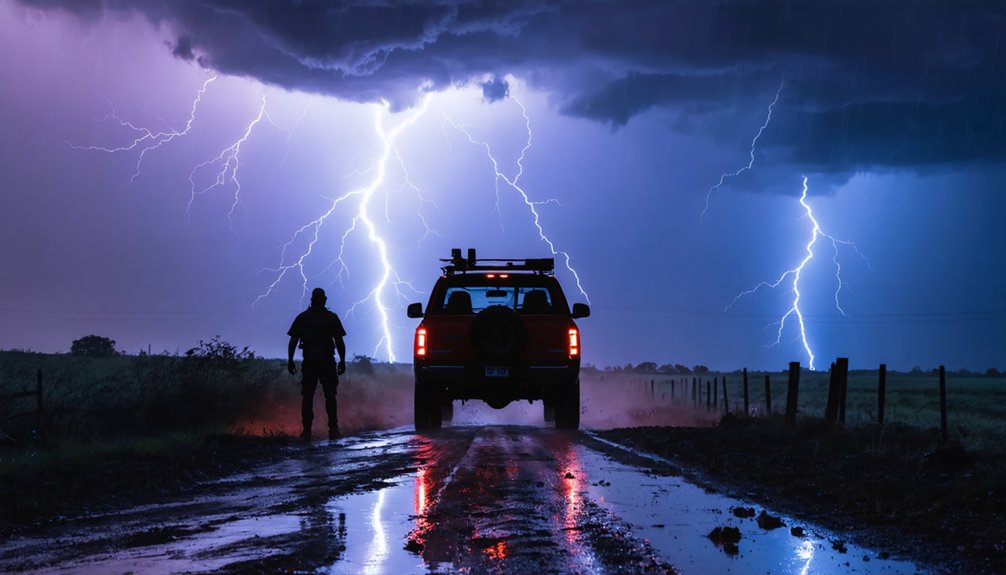
During tornado intercepts, you can’t rely on a single safety measure—you need layered protection. Position yourself southeast of the projected track with at least a 1-mile lateral buffer, and pre-map two exit routes before the storm closes in. Wear debris-rated helmets, reinforced clothing, and eye protection. Keep your NOAA radio and GPS active at all times. The protocols covering gear, positioning, and escape execution go far deeper than these fundamentals.
Key Takeaways
- Establish a safety zone southeast of the tornado’s projected track, maintaining at least a 1-mile lateral buffer from the storm’s path.
- Pre-map two exit routes before storm approach and avoid low-lying areas, overpasses, and locations that funnel dangerous debris.
- Wear protective gear including a high-velocity debris-rated helmet, reinforced jacket, gloves, and eye protection during all intercept operations.
- If threatened, pull off-road, activate hazard lights, exit the vehicle, and lie face-down on low ground with arms covering your head.
- Carry a go-bag with a first aid kit, NOAA weather radio, GPS unit, and backup power for critical communication devices.
The Real Dangers Experts Face During Tornado Intercepts
When tornado researchers and storm chasers position themselves near an active funnel, they’re operating within one of the most volatile and unpredictable environments on Earth. You’re dealing with rapid directional shifts, multiple vortices, and debris fields traveling at 200+ mph.
Positioning near an active funnel means operating inside Earth’s most volatile, unpredictable environment—where rapid shifts and multi-vortex chaos rule.
Tornado prediction models carry inherent margins of error, meaning a projected path can deviate within seconds, eliminating your escape window entirely.
You’re also contending with public evacuation traffic on critical exit routes, which compounds your operational risk during active intercepts.
Flying debris remains the primary cause of fatalities—glass, lumber, and metal fragments become ballistic projectiles with no predictable trajectory.
Communication blackouts, sudden pressure drops, and instrument failures further compromise your situational awareness.
Understanding these layered dangers isn’t optional—it’s the foundational requirement before any intercept mission begins.
Gear Every Tornado Interceptor Needs in the Field
Because the field environment offers zero margin for equipment failure, you’ll need gear that’s been selected with the same rigor you’d apply to intercept positioning itself.
Your tornado safety equipment loadout should include a NOAA weather radio, GPS unit, and a helmet rated for high-velocity debris impact.
Don’t underestimate protective clothing — reinforced jackets, gloves, and eye protection reduce injury risk when conditions deteriorate faster than anticipated.
Keep a go-bag stocked with a first aid kit, emergency blanket, and backup power for all communication devices.
Your vehicle should carry road flares and a fire extinguisher.
Every piece of gear must be tested before deployment, not during it.
When you control your equipment reliability, you control your decision-making capacity — and that’s what keeps you operational in the field.
How to Choose and Hold a Safe Intercept Position
Gear selection sets you up for survivability, but positioning is what determines whether you’re observing the storm or becoming part of it. Interceptor positioning requires calculating the tornado’s forward speed, direction of travel, and potential path deviation before committing to any location.
For safety zone selection, establish your position southeast of the storm’s projected track, maintaining a minimum 1-mile lateral buffer. Keep two exit routes pre-mapped before the tornado closes within your operational range. Avoid low-lying areas that restrict sightlines and overpasses that funnel debris at lethal velocities.
Monitor storm motion continuously. If the tornado shifts toward your position, execute your exit route immediately — don’t negotiate with the math. Your vehicle should always face your escape direction, engine running, ready to move.
How to Handle Your Vehicle During an Active Tornado Intercept
When intercepting an active tornado, don’t attempt to outrun it, as erratic storm movement makes speed-based escape unreliable and statistically dangerous.
If the tornado’s path threatens your position, pull your vehicle safely off the road, set the handbrake, and activate your hazard lights immediately.
Exit only when conditions allow, then move quickly to the nearest low-lying ground to minimize exposure to debris and wind forces.
Avoiding Tornado Outrunning Attempts
Attempting to outrun a tornado in a vehicle is one of the most dangerous decisions you can make during an active intercept. Tornadoes shift direction unpredictably, and without real-time tornado tracking data, you’re fundamentally guessing against a system that can exceed 200 mph.
Weather radar updates every 2-6 minutes, meaning the tornado’s position has already changed before you react. Your vehicle provides minimal structural protection and becomes a projectile risk the moment debris fields engage.
Instead, park safely off the road, set the handbrake, and activate your hazard lights. If exiting is viable, move immediately to low-lying ground. Your freedom to navigate depends on disciplined decision-making, not speed.
Outrunning a tornado statistically fails — positioning and terrain awareness are your actual survival advantages.
Safe Vehicle Parking Steps
Once a tornado closes within your threat window, your vehicle becomes a liability — handle it systematically. Pull completely off the roadway, selecting a position that doesn’t obstruct emergency communication routes or active evacuation lanes. Set the handbrake immediately and activate your hazard lights — these two steps take under five seconds but prevent secondary collision risks.
Maintain weather monitoring through your device or emergency radio while executing your exit decision. If surrounding terrain offers accessible low-lying ground, exit the vehicle and move there directly.
If conditions outside present greater risk, your parked vehicle still outperforms a moving one statistically. Don’t leave your engine running — it’s an unnecessary fire hazard.
Every action you take here follows a deliberate sequence, not impulse. Precision saves lives; hesitation doesn’t.
Exiting Toward Low Ground
Parking the vehicle resolves one hazard — now you address the next. Once you’ve safely stopped, exit immediately if conditions allow.
Your target is low ground — a ditch, ravine, or depression running perpendicular to the tornado’s path. Ground level positioning considerably reduces your exposure to airborne debris and wind-load pressure.
Don’t waste time gathering gear; every second of hesitation narrows your survival margin.
Move away from the vehicle, as it can become a projectile.
Once you’ve reached low ground, lie face down, arms covering your head, keeping your profile as flat as possible.
Avoid culverts and underpasses — they create dangerous wind tunnels.
You’re exercising your right to make calculated, independent decisions under pressure.
Stay disciplined, stay low, and stay protected until the threat passes.
What to Do If a Tornado Cuts Off Your Escape Route
When a tornado cuts off your escape route, your immediate priority shifts to finding the lowest possible ground or the most protective structure available. Don’t panic — execute your contingency plan decisively.
- Abandon your vehicle and move to a ditch or ravine, lying flat with both arms covering your head.
- Establish emergency communication before conditions deteriorate, alerting your team to your coordinates and alternative shelter options nearby.
- Identify alternative shelter immediately — a sturdy building, interior room, or low-lying terrain away from trees, overpasses, and vehicles.
Stay face-down on low ground if no structure exists. Keep walls between you and the exterior whenever possible. Your survival depends on swift, calculated decisions — not hesitation.
Surviving Flying Debris on a Tornado Intercept

Even after you’ve secured low ground or found shelter from a blocked escape route, flying debris remains your most immediate physical threat during a tornado intercept. Deploy debris shields—mattresses, sleeping bags, or heavy blankets—to cover your body and reduce penetration risk from airborne projectiles.
Flying debris is your most immediate threat. Deploy mattresses, blankets, or sleeping bags to shield your body from airborne projectiles.
Protective eyewear prevents ocular damage from particulate matter traveling at high velocity. Position yourself face-down, arms covering your head, keeping solid walls between your body and the tornado’s path.
Avoid wide-span roof areas and glass-enclosed spaces, where structural collapse amplifies debris concentration. Every layer of protection you add statistically reduces injury severity.
Your physical integrity determines whether you walk away from the intercept with usable data—or don’t walk away at all.
Frequently Asked Questions
Should Interceptors Ever Seek Shelter Inside a Mobile Home During Tornadoes?
Never shelter in a mobile home during tornadoes. Mobile home vulnerabilities make them extremely dangerous; they offer minimal protection. Follow tornado safety protocols—you must immediately evacuate to the nearest sturdy building or designated shelter, prioritizing your survival above all else.
What Should Interceptors Do if Caught Outside Without Vehicle Access?
75% of tornado fatalities occur outdoors. If caught outside, you’ll lie flat in a ditch, cover your head with both arms, maintain emergency communication, and guarantee first aid preparedness while staying away from trees and vehicles.
How Can Interceptors Protect Themselves From Debris Without Specialized Equipment?
Cover your body with a mattress or sleeping bag as improvised debris shields. You’ll want protective clothing layered thick, stay away from glass, and keep solid walls between yourself and the outside at all times.
Is It Ever Safe for Interceptors to Shelter Under Highway Overpasses?
A death trap awaits you there—overpass dangers are extreme, amplifying wind speeds and debris. Never shelter under overpasses. Pursue shelter alternatives: lie flat in low-lying ditches, covering your head, maximizing your survival odds efficiently.
What Interior Building Features Provide the Best Protection for Interceptors?
You’ll find the best protection in the smallest interior room, behind reinforced interior doors, away from storm resistant windows. Choose a sturdy bathroom or closet on the lowest floor, positioning yourself under solid furniture immediately.
References
- https://www.stormresearch.com/projects/vortex/OpsPlan/Ch7_Safety.html
- https://www.weather.gov/media/owlie/TornadoSafety-OnePager-2-27-19.pdf
- https://imba.missouri.edu/how-to-chase-a-tornado-1321580904.html
- https://www.weather.gov/bmx/sps_torsafetyrules
- https://www.ttuhsc.edu/emergency/documents/eag-tornado-10-23.pdf
- https://police.mercer.edu/safety-resources/severe-weather-procedures/tornado-safety-measures/
- https://www.canada.ca/en/services/policing/emergencies/preparedness/get-prepared/hazards-emergencies/tornados/how-prepare.html
- https://www.youtube.com/watch?v=9MXy1iA5GHc
- https://www.weather.gov/ama/SEVERESAFETYTIPS
- https://www.redcross.org/content/dam/redcross/get-help/pdfs/tornado/MY_Tornado-Safety-Checklist.pdf