Storm chasing transforms how you process risk by forcing real-time decisions where hesitation has measurable consequences. You’ll learn to pre-map escape routes, triage threats during supercell intensification, and recalibrate environmental perception under pressure. Safety protocols shift from conscious checklists to instinctive responses through repeated exposure. Crisis management becomes anticipatory rather than reactive, and your cognitive bandwidth expands to monitor multiple variables simultaneously. The deeper lessons waiting ahead will sharpen every instinct you’re building now.
Key Takeaways
- Storm chasing rewires the brain neurologically, transforming how chasers perceive and rapidly process environmental threats in real time.
- Crisis management becomes anticipatory rather than reactive, as repeated exposure converts conscious safety checklists into instinctive, automatic responses.
- Genuine freedom in dangerous environments requires disciplined preparation, turning raw danger into calculated, manageable variables.
- Escape route planning builds a tactical survival foundation, teaching chasers to pre-map multiple exits before chaos demands them.
- Emotional resilience developed through high-pressure situations enhances analytical clarity, improving decision-making speed and accuracy under extreme conditions.
What Storm Chasing Actually Teaches You About Risk?
Ultimately, crisis management isn’t reactive—it’s anticipatory.
Storm chasing teaches you that genuine freedom requires disciplined preparation, transforming raw danger into calculated, manageable variables you can confidently navigate.
Storm Chasing Tools and Resources That Build Real Confidence
Confidence in storm chasing isn’t built on instinct alone—it’s built on the right tools, training resources, and data systems working together.
Mastering your storm tools transforms raw curiosity into calculated decision-making. Resource confidence develops when you consistently train, analyze, and verify before entering the field.
Start building your foundation with these essential resources:
- COMET MetEd SKYWARN modules — structured meteorological education covering supercell anatomy, positioning, and radar interpretation
- NWS SKYWARN spotter training — free annual classes delivering foundational storm science directly from professional meteorologists
- Live radar platforms and multi-chaser streams — real-time data cross-referencing that sharpens your situational awareness before committing to a target
When your tools and knowledge align, you’re not reacting blindly—you’re operating with precision, autonomy, and measurable confidence earned through deliberate preparation.
How Preparation Becomes Second Nature for Storm Chasers?
As you log more chases, your pre-chase routines — radar analysis, route mapping, and escape planning — shift from deliberate checklists to automatic protocols executed with minimal cognitive load.
You develop instinctive safety habits by repeatedly stress-testing decisions under real atmospheric conditions, where each supercell interaction recalibrates your risk thresholds and situational awareness.
Over time, that accumulated field data rewires your response patterns, so you’re not thinking through procedures but executing them while your attention stays locked on the storm’s evolving structure.
Building Instinctive Safety Habits
When preparation becomes deeply ingrained through repetition and deliberate practice, safety protocols shift from conscious checklists to automatic responses. You’ll develop instinct development through consistent exposure to storm environments, radar analysis, and route planning. Your brain begins processing threats faster, reducing reaction delays when conditions deteriorate rapidly.
Key habits that become instinctive include:
- Scanning escape routes before positioning near any supercell, ensuring multiple exit options remain viable.
- Monitoring radar continuously to detect rotation signatures, velocity couplets, and debris signatures without prompting.
- Assessing road networks instinctively against potential flash flooding or hail accumulation blocking retreat paths.
These automated responses free your cognitive bandwidth for critical decision-making. You’re no longer managing checklists—you’re reading the atmosphere dynamically, adapting instantly, and operating with disciplined autonomy that keeps you alive and mobile.
Mastering Pre-Chase Routines
Target slight-risk or enhanced-risk days initially, building pattern recognition without outbreak-level chaos.
Your preparation compounds over time, converting conscious checklists into instinctive responses that protect both your data collection goals and your survival margins.
Adapting Through Repeated Experience
Repeated exposure to storm environments converts deliberate checklist execution into automatic pattern recognition. Through experience reflection, you’ll internalize supercell anatomy, escape route logic, and positioning adjustments without conscious calculation. Each chase sharpens your adaptability insights, compressing decision cycles under pressure.
- Pattern calibration: You’ll recognize wall cloud rotations and inflow signatures faster, reducing reaction lag during critical positioning windows.
- Risk recalibration: Prior near-miss scenarios rewire your threat-assessment algorithms, improving escape route selection and debris-field avoidance instinctively.
- Task-load compression: Simultaneous radar monitoring, navigation, and hazard evaluation become cognitively streamlined, minimizing dangerous task saturation.
Your mental models evolve from rigid protocols into dynamic frameworks that flex with atmospheric unpredictability.
You’re not just executing procedures anymore—you’re fluently reading the storm’s behavioral language in real time.
Hard Lessons Seasoned Storm Chasers Learn in the Field
Seasoned storm chasers accumulate hard-won knowledge that no classroom module or YouTube video can fully replicate.
You’ll discover that chaser dynamics shift unpredictably when multiple vehicles converge on a single storm, creating communication breakdowns and dangerous road congestion. Risk perception recalibrates sharply after your first near-miss with a rain-wrapped tornado or a flash flood swallowing your escape route.
You’ll learn that task saturation kills decision-making speed. When you’re simultaneously maneuvering, reading radar, and monitoring storm structure, critical judgments deteriorate fast.
Prioritize ruthlessly.
You’ll also recognize that supercells don’t follow textbook behavior. Tornadoes appear considerably closer than actual distance, a perceptual bias that consistently draws chasers into lethal proximity.
Trust instrumented data over instinct until your field experience calibrates both simultaneously.
How Reading the Sky Sharpens Storm Chasing Judgment?
When you train your eyes on the sky consistently, atmospheric patterns stop looking like chaos and start revealing structured, readable data.
Sky interpretation becomes your sharpest decision-making tool, translating weather patterns into actionable intelligence before radar confirms anything.
Sky reading is your earliest warning system—turning visible atmospheric data into decisions before any technology catches up.
You’ll notice:
- Anvil cloud spread indicates upper-level wind direction and storm maturity, signaling repositioning needs.
- Wall cloud rotation tightens predictably before tornado formation, giving you critical evacuation seconds.
- Inflow bands reveal a storm’s organizational strength, helping you assess intercept positioning versus escape priority.
Reading these visual cues builds analytical judgment that no app replicates.
You’re processing real-time atmospheric data with your own perception, reducing reaction lag during rapidly evolving situations.
That independence—decoding nature directly—is what separates calculated chasers from reactive ones.
Why Escape Routes Define Safe Storm Chasing?
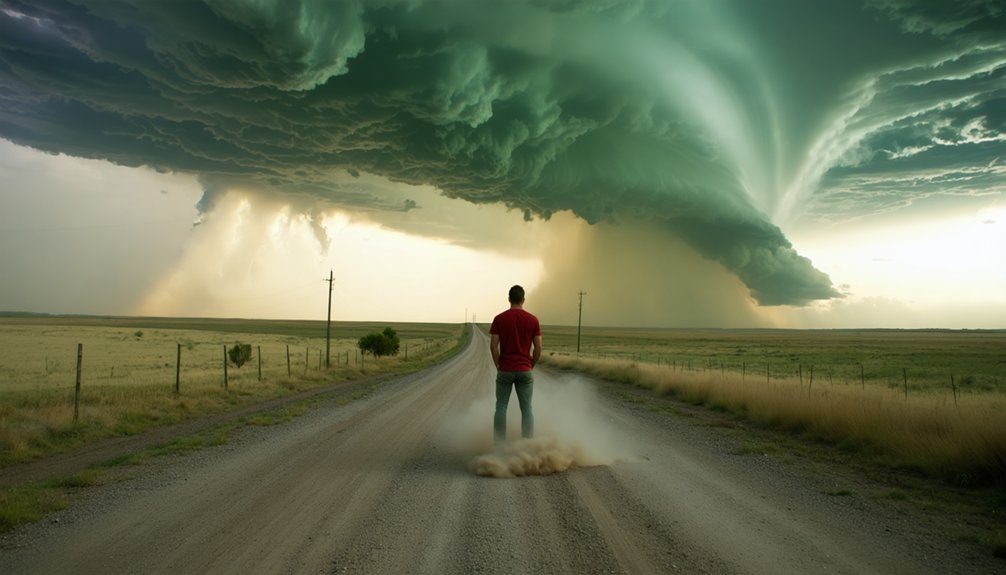
When you’re positioning near a supercell, you must pre-map at least two exit routes that account for perpendicular road grids, low-water crossings, and potential debris fields.
Road network traps—dead-end rural roads, single-lane bridges, or areas flanked by terrain—can eliminate your margin of safety within minutes as a storm shifts track.
You’ll also need to adapt instantly when sudden hail fog drops visibility or flash flooding converts a known escape path into an impassable hazard, requiring you to execute a pre-planned alternative without hesitation.
Planning Escape Routes Strategically
Planning your escape routes before a chase isn’t optional—it’s the tactical foundation that separates survivable encounters from fatal ones. Effective escape planning demands studying road networks before deployment, identifying directional options that move you perpendicular to a storm’s tracked path.
Route flexibility keeps your options open when conditions shift violently:
- Pre-map multiple exits using county road grids, prioritizing paved routes with east or north vectors away from storm movement.
- Identify terrain traps including dead-end roads, low-water crossings, and bridge choke points that flash flooding can neutralize instantly.
- Establish trigger thresholds—predetermined conditions like encroaching wall clouds or rain-wrapped rotation that automatically activate your exit sequence.
Storms don’t negotiate. Your escape infrastructure must already exist before chaos demands it.
Avoiding Road Network Traps
Road networks near supercell thunderstorms aren’t neutral terrain—they’re dynamic threat multipliers that can trap you faster than the storm itself.
Supercells move unpredictably, turning familiar routes into dead ends within minutes. You need pre-analyzed road grids identifying multiple exit vectors before positioning near any storm.
Integrate navigation tools like Spotter Network overlays and county road atlases into your chase setup. Cross-reference real-time radar with physical road layouts to anticipate where flash flooding or debris will sever your options.
Your road closure strategies must account for paved-to-gravel shifts, low-water crossings, and single-lane bottlenecks.
Freedom means mobility. If your route collapses to one option, you’ve already lost tactical control.
Identify three viable escape corridors before committing to any intercept position—then stay disciplined enough to use them.
Adapting To Sudden Hazards
Escape routes aren’t a contingency—they’re the operational spine of every chase decision you make. Hazard recognition demands constant reassessment—fog from hailstone evaporation, flash flooding, and debris fields materialize within seconds. Weather adaptability isn’t optional; it’s survival arithmetic.
Your pre-chase route analysis must account for:
- Road network vulnerabilities: Identify dead-end rural roads, low-water crossings, and single-exit corridors that supercells can seal instantly.
- Dynamic threat sequencing: Tornadoes, lightning strikes, and hail cores shift your escape window from minutes to seconds without warning.
- Real-time radar integration: Cross-reference storm motion vectors against your current position to maintain a viable exit bearing continuously.
Chasers who survive outlast their decisions because they build exit logic before entering proximity—not after the atmosphere forces their hand.
How Experienced Storm Chasers Think Differently Under Pressure?
When a supercell intensifies within minutes, experienced chasers don’t freeze—they triage. Pressure decision making becomes instinctual through repeated exposure, pattern recognition, and disciplined pre-chase planning.
You’re not reacting emotionally—you’re executing a mental hierarchy: escape routes first, storm position second, documentation third.
Emotional resilience separates survivable situations from catastrophic ones. Veteran chasers compartmentalize fear, maintaining analytical clarity while processing radar data, road geometry, and storm motion simultaneously.
They’ve trained their minds to distinguish manageable risk from irrational exposure.
You build this capacity incrementally. Chase smaller storms first. Study live radar feeds obsessively. Absorb decision frameworks from experienced mentors like Reed Timmer.
Over time, your cognitive load decreases because preparation absorbs uncertainty. Freedom in storm chasing isn’t recklessness—it’s the confidence earned through rigorous, methodical readiness.
How Storm Chasing Permanently Builds Situational Awareness?
Beyond sharpening pressure-based decision-making, storm chasing rewires how you perceive and process your environment on a permanent, neurological level.
Repeated exposure to rapidly evolving supercells accelerates Awareness Development by forcing continuous environmental scanning, pattern recognition, and real-time threat recalibration. You’re no longer passively observing — you’re actively processing atmospheric data, road network geometry, and escape vector availability simultaneously.
Situational Adaptability becomes neurologically embedded through:
- Multi-variable monitoring: Tracking wind shifts, radar signatures, and terrain obstacles concurrently sharpens cognitive bandwidth.
- Threat prioritization: Distinguishing immediate dangers from background risks reduces decision latency under extreme conditions.
- Environmental recalibration: Sudden hail fog or flash flooding demands instant mental map reconstruction, training your brain for rapid perceptual updating.
These neurological adaptations transfer directly into everyday environments, permanently elevating your baseline awareness capacity.
Frequently Asked Questions
What Age Requirements Exist for Joining Organized Storm Chasing Tours?
Like a storm’s minimum threshold, age restrictions typically require you’re 18+. Girls Who Chase confirms this standard. If you’re younger, parental consent may permit participation, so check each tour’s specific requirements before committing.
How Does Storm Chasing Experience Translate Into Everyday Career Opportunities?
You’ll find storm chasing builds transferable skills—risk management sharpens your analytical decision-making, while teamwork dynamics enhance collaboration under pressure. These competencies translate directly into meteorology, emergency management, data analysis, and logistics careers, empowering your professional freedom.
Can Storm Chasing Negatively Impact Mental Health Over Extended Periods?
Yes, extended storm chasing can trigger anxiety triggers and stress management challenges. You’ll need emotional resilience and effective coping strategies to counteract cumulative psychological strain from repeated high-risk exposures, decision fatigue, and trauma-induced responses documented in field data.
What Physical Fitness Level Is Recommended Before Attempting Storm Chasing?
You’ll need solid cardiovascular endurance to sustain prolonged field deployments and strength training to manage equipment under high-stress conditions. Prioritize aerobic capacity, core stability, and rapid-response agility before attempting any chase operations.
How Do Storm Chasers Manage Fatigue During Multi-Day Chasing Expeditions?
With chasers logging 500+ miles daily, you’ll manage fatigue management by rotating driving shifts, leveraging team dynamics for shared navigation duties, maintaining hydration schedules, and prioritizing strategic rest stops between storm intercepts to sustain peak operational performance.
References
- https://www.girlswhochase.com/education
- https://www.youtube.com/watch?v=nxPSFg2R8YY
- https://www.foxweather.com/learn/storm-chasing-advice-from-the-pros
- https://www.reddit.com/r/stormchasing/comments/1ooimws/does_anyone_have_tips_for_a_storm_chasing/
- https://www.loveexploring.com/gallerylist/67349/reallife-storm-chasers-share-their-experiences
- https://www.livingskytours.com/storm-chasing-101/
- https://www.youtube.com/watch?v=w-5nJ61umeA
- https://www.stormchasingusa.com/blog/learning-the-basics-about-storm-chasing/
- https://stormtrack.org/threads/basic-storm-chasing-process.29691/
- https://www.youtube.com/watch?v=Ky-Qr9LwiS4