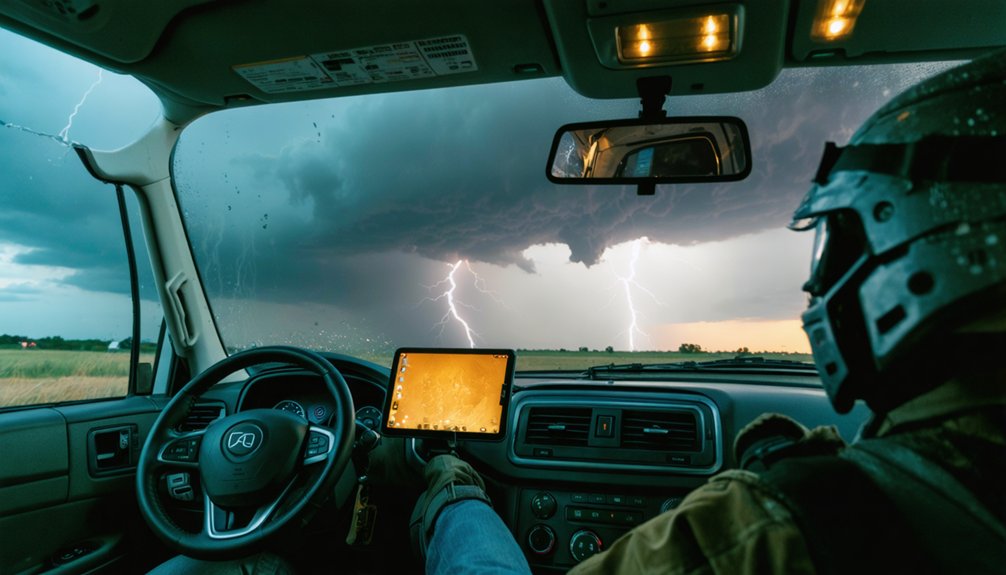
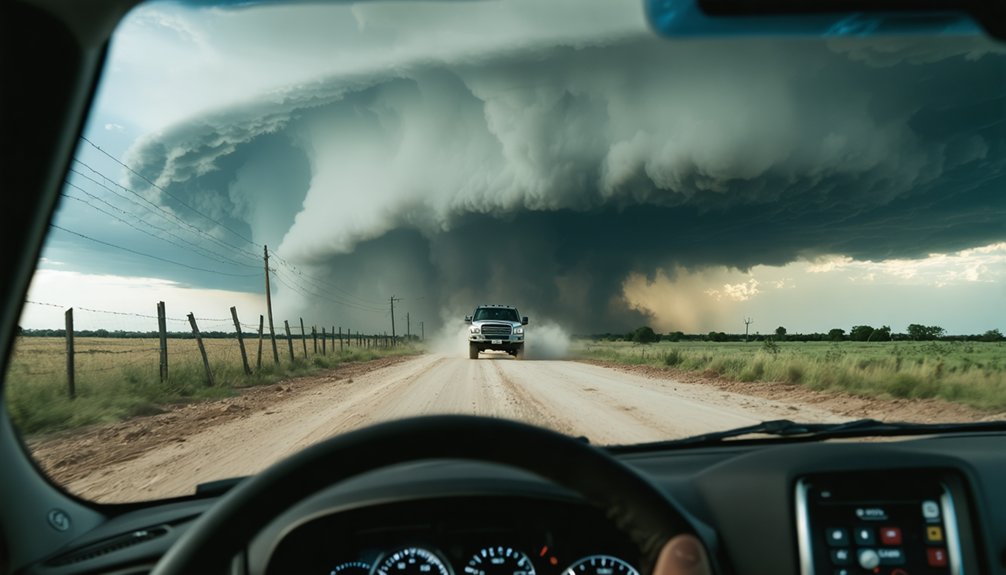
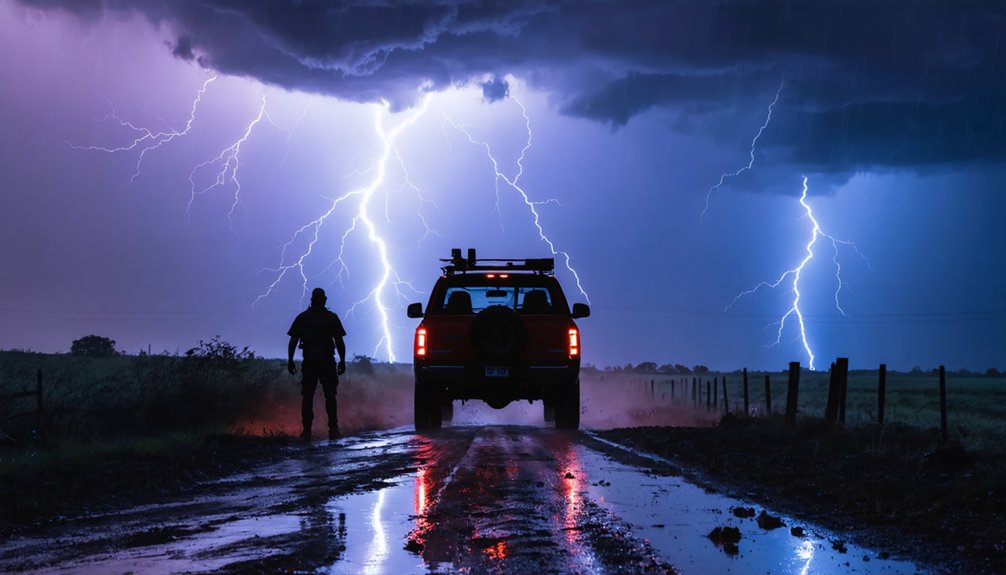
If a tornado appears stationary or its funnel keeps widening, it’s heading straight toward you. Stop moving immediately and don’t try to outrun it. Get to a basement or underground storm cellar fast. If you’re driving, cut the engine and find the nearest solid structure. No building nearby? Locate a low ditch and lie flat, shielding your head. Each scenario carries specific risks you’ll want to understand before the next storm hits.
Key Takeaways
- If a tornado appears to be enlarging without moving sideways, it is heading toward you — act immediately.
- Stop moving and locate the nearest solid shelter, prioritizing a basement or underground storm cellar.
- If no structure is available, lie flat face-down in a low ditch, shielding your head and neck.
- Avoid remaining in a vehicle, as lightweight cars can become airborne in high tornado winds.
- After the tornado passes, wait for official NOAA or EAS clearance before exiting your shelter.
How Can You Tell a Tornado Has Changed Direction Toward You?
Recognizing a tornado’s directional shift toward you requires reading several physical cues simultaneously. If the tornado appears stationary or grows larger without moving laterally, it’s tracking directly toward your position.
Watch for a persistent, widening condensation funnel — that’s a critical tornado warning sign. Debris cloud expansion at ground level confirms an approaching vortex even when the funnel isn’t fully visible.
Apply basic storm tracking techniques by monitoring the storm’s movement against fixed landmarks like tree lines or structures. A tornado moving left or right indicates a non-threatening trajectory. One holding a fixed position against your sightline means immediate danger.
You’ll also notice a continuous, deep roar replacing intermittent wind noise — your final physical confirmation that the storm has redirected toward your location.
What Should You Do the Moment a Tornado Changes Direction?
The instant a tornado changes direction toward you, stop all vehicle or foot movement immediately—hesitation costs critical seconds.
Don’t attempt to outrun the storm; instead, identify the nearest solid structural shelter and move there without delay.
Your first priority is reaching a basement, storm cellar, or interior ground-floor room with maximum walls between you and the shifting storm’s new path.
Stop All Movement Immediately
When a tornado abruptly shifts direction, stop all vehicle movement immediately — this single action can determine whether you survive the event.
Tornado behavior is unpredictable, and a storm that’s altered its path has eliminated your calculated escape route. Continuing to drive wastes critical seconds you can’t recover.
Your emergency preparedness plan must treat sudden vehicle immobility as non-negotiable. Cut the engine, assess your surroundings within seconds, and identify your next protective position.
Movement creates false confidence — the tornado’s rotational speed and erratic trajectory mean you can’t outmaneuver it on open roads.
Stopping gives you the clearest possible situational awareness. From a stationary position, you can accurately judge the tornado’s new vector, locate nearby shelter, and execute your next survival decision with precision.
Seek Shelter Right Away
Once you’ve stopped moving, your next action must be immediate shelter acquisition — every second of hesitation increases your exposure to the tornado’s altered path.
Prioritize shelter types in this order: underground storm cellar, basement, then a small interior room on the lowest floor. Each additional wall between you and the storm statistically reduces injury risk.
Avoid windows, exterior walls, and large open rooms entirely. If you’ve prepared emergency kits in advance, retrieve them only if they’re immediately accessible — don’t sacrifice positioning for supplies.
In a vehicle with no nearby structure, exit and move to a low ditch. Your freedom to act decisively right now determines survivability.
Commit to your shelter choice instantly and don’t relocate unless the structure itself becomes compromised.
Where Should You Go When a Tornado Changes Direction?
If a tornado shifts direction toward your position, your first priority is reaching a basement or storm cellar immediately. These shelter types offer maximum protection against wind-driven debris and structural collapse.
Tornado shifting toward you? Get to a basement or storm cellar immediately — your safest defense against debris and collapse.
If no basement exists, move to the smallest interior room on the lowest floor. Bathrooms, closets, and hallways work best. Stay away from windows, exterior walls, and doors at all times. Place as many walls as possible between yourself and the storm.
Follow these safety tips without hesitation: avoid gymnasiums, auditoriums, and open-span structures entirely. Their roofs fail first under tornado-force winds.
If you’re caught outdoors with no reachable structure, lie flat in a ditch, face down, and cover your head with both arms until the storm passes.
Is It Safe to Stay in Your Car When a Tornado Shifts Course?
Staying in your car during a tornado is one of the most dangerous decisions you can make, as vehicles offer virtually no structural protection against winds exceeding 100 mph.
If a tornado shifts course toward your position, you should immediately park out of traffic flow, fasten your seatbelt, and crouch below window level to minimize exposure.
Exit the vehicle only if a low ditch or ravine is immediately accessible, since abandoning your car without a clear, low-lying destination increases your risk of direct wind impact.
Car Safety Risks
A car offers almost no structural protection when a tornado shifts course unexpectedly. Its lightweight frame can become airborne at wind speeds exceeding 100 mph, turning your vehicle into a projectile. You’re exposed to flying debris, shattered glass, and violent rollovers the moment conditions intensify.
Proper car safety during a tornado demands quick, decisive action. If a sturdy building is within immediate reach, abandon the vehicle and move inside.
Tornado preparedness experts consistently warn against sheltering inside a stationary car, as its profile catches wind force far more dangerously than low ground does. If no shelter exists, exit the vehicle, move to a low ditch, lie flat, and cover your head.
Never remain seated waiting for the storm to pass.
When To Exit
Knowing when to exit your car during a tornado’s path shift can mean the difference between survival and catastrophe. Monitor tornado signals constantly — if the funnel shifts toward your position, act immediately.
Your exit strategies depend on two critical conditions: available shelter and terrain. Exit your vehicle only when a sturdy building or a low-lying ditch is immediately accessible. Never abandon your car for open ground without a destination.
If you’re exiting, fasten your seatbelt first, then assess your path. A ravine or depression below road grade is your best outdoor option.
If no shelter exists, stay inside, crouch below window level, and cover your head. Remaining stationary in a parked vehicle is safer than sprinting across exposed terrain toward an uncertain refuge.
What to Do If You’re Caught Outside With No Shelter Nearby?

Being caught outside with no shelter during a tornado puts you at maximum risk, so you’ll need to act fast and follow proven survival protocols.
For outdoor survival, locate the nearest ditch, ravine, or low-lying ground immediately. Lie flat, face downward, and use both arms to shield the back of your head and neck.
Don’t hide under your vehicle or inside a culvert — both create serious flooding risks. Avoid tree groves and elevated terrain like overpasses, which amplify wind velocity and debris impact.
Simultaneously, prioritize emergency communication by keeping your phone accessible for EAS alerts and NOAA Weather Radio updates.
Stay flat until official confirmation signals the storm has fully passed. Every second of hesitation increases your exposure to life-threatening wind speeds and projectile debris.
How Do You Monitor a Shifting Tornado in Real Time?
Monitoring a shifting tornado in real time requires layering multiple data streams simultaneously. You can’t rely on a single source when a storm’s trajectory changes within seconds.
Tune your NOAA Weather Radio to your county’s designated frequency for continuous, unfiltered tornado tracking updates. Simultaneously, monitor your local NWS office’s official social media feeds for real time alerts tied to confirmed radar data.
Enable Wireless Emergency Alerts on your phone so EAS signals push directly to you without requiring active monitoring. Cross-reference multiple inputs — broadcast news, official apps, and radio — to identify trajectory patterns quickly.
Don’t wait for a single confirmation. When data streams converge on a new approach vector toward your position, that convergence itself is your actionable signal to move immediately.
When Is It Safe to Move Again After the Tornado Passes?

Once the tornado appears to have passed, you can’t treat visual silence as a clearance signal — erratic storms frequently produce secondary vortices or loop back on a shifted path within minutes.
Wait a minimum of several minutes before initiating any movement.
For safe evacuation, verify official clearance through NOAA Weather Radio or the Emergency Alert System before exiting shelter.
Don’t rely on personal judgment alone.
During tornado aftermath assessment, check roads for structural damage, downed power lines, and compromised bridges before driving.
Turn hazard lights on and reduce speed considerably.
Never enter buildings showing visible structural stress.
Avoid open flames entirely — use battery-powered flashlights exclusively.
Your freedom to move safely depends on confirmed data, not assumptions.
Official clearance is your only legitimate green light.
Frequently Asked Questions
Can a Tornado Change Direction More Than Once During a Single Storm?
Yes, a tornado can change direction multiple times. You must track tornado dynamics continuously, as storm forecasting confirms erratic path shifts occur. Don’t assume predictability—stay alert, monitor NOAA updates, and react instantly to each new directional change.
How Fast Can a Tornado Shift Its Path Toward a New Direction?
Like a spinning top gone rogue, tornado dynamics can shift direction in seconds. You can’t rely on path prediction—a tornado’s heading can change within 1–2 minutes, demanding your immediate, decisive response.
Should You Warn Others Nearby if a Tornado Suddenly Changes Course?
Yes, you must alert others immediately when a tornado changes course. Shout, honk, or signal to activate community safety. Don’t delay issuing tornado warnings—every second counts. You’re protecting lives by acting fast and decisively.
Does Tornado Direction Change More Often in Certain Geographic Regions?
Yes, you’ll find tornado patterns shift more erratically in the central U.S. “Tornado Alley,” where geographic factors like flat terrain, Gulf moisture, and clashing air masses create unpredictable directional changes more frequently than other regions.
Can Buildings Lose Structural Integrity Faster When a Tornado Shifts Direction?
Like a wrecking ball, yes — shifting tornadoes can accelerate structural damage unpredictably. When tornado intensity fluctuates during directional changes, you’ll face rapidly evolving wind loads that compromise a building’s integrity faster than standard storm conditions allow.
References
- https://www.weather.gov/spotterguide/safetyfirst
- https://www.lincolnu.edu/police/safety-resources/tornado-safety.html
- https://www.weather.gov/safety/tornado-during
- https://www.mercuryinsurance.com/resources/weather/seven-safety-tips-for-tornadoes-you-must-know.html
- https://www.astribe.com/resources/pdf/newsletter/TORNADO_SAFETY.pdf
- https://www.ready.gov/tornadoes
- https://www.redcross.org/get-help/how-to-prepare-for-emergencies/types-of-emergencies/tornado.html
- https://www.lonestarsaferooms.com/tornado-safety-tips-while-driving-what-to-do-before-during-and-after-a-tornado/
- https://www.youtube.com/watch?v=p-eYzA55icg
- https://www.weather.gov/mqt/tornadotips