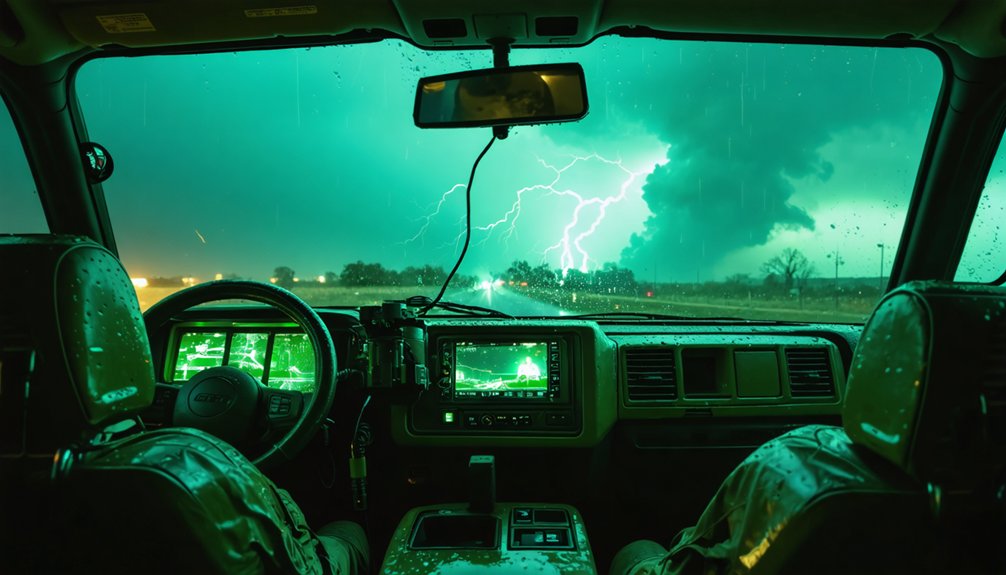
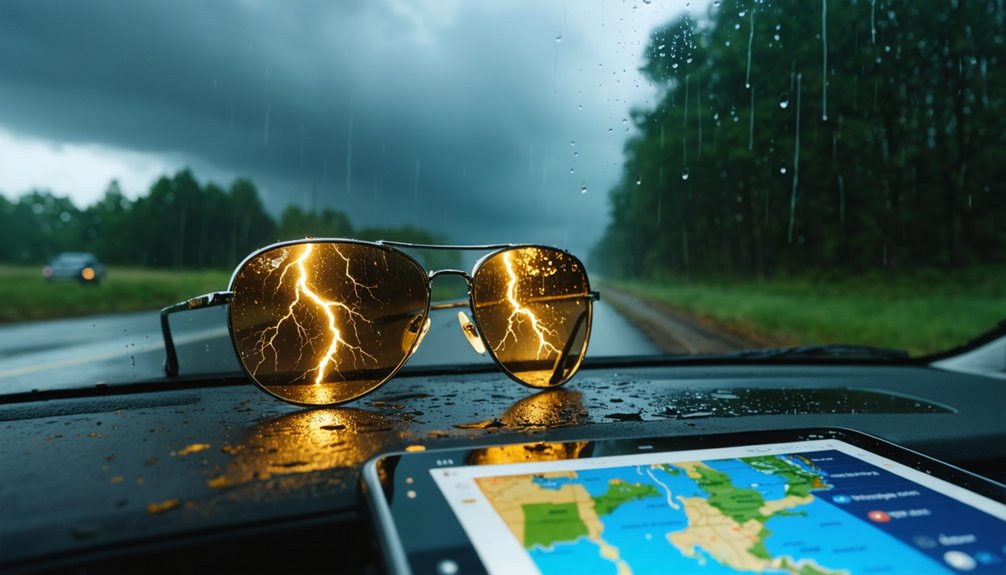
Essential storm chasing equipment keeps you mobile, safe, and operationally effective when conditions deteriorate fast. Without recovery straps, medical kits, and jump starters, you risk immobilization or worse. Navigation and communication tools like GPS units and ham radios maintain coordination during outages. Documentation instruments and environmental sensors sharpen your accuracy in the field. Storm chasers who skip this gear face a 73% higher risk of mission failure — and there’s far more to unpack about building a capable kit.
Key Takeaways
- Safety and recovery gear prevents life-threatening immobilization, ensuring chasers escape dangerous situations involving mud, debris, dead batteries, or medical emergencies.
- Navigation and communication tools maintain real-time storm tracking accuracy and team coordination when infrastructure fails during severe weather events.
- Vehicle repair and fuel management equipment eliminates mechanical single-points of failure, extending operational range far beyond standard gas station accessibility.
- Documentation instruments like barometers, wind sensors, and HD cameras capture critical storm data essential for accurate severity assessment and research.
- Prioritizing gear by life safety, mobility, and mission operability ensures chasers carry only equipment that directly impacts survival and effectiveness.
Storm Chaser Safety and Recovery Gear That Prevents Immobilization
When chasing severe weather, your vehicle’s mobility is your primary lifeline. Without it, you’re stranded in a potentially lethal environment. High-tension recovery straps deliver proven recovery strap effectiveness by extracting vehicles trapped in mud, debris fields, or unstable terrain. You can’t afford immobilization prevention failures when a storm wall’s bearing down on your position.
Pair your recovery straps with a multipurpose medical kit, insulated water containers, and a battery-powered jump starter. These tools collectively eliminate single points of failure that compromise your operational independence.
Redundant systems save lives—medical kit, water reserves, and jump starter eliminate the failures that ground you permanently.
Emergency flashlights restore situational awareness during post-storm blackouts, letting you assess damage quickly and decisively.
Every piece of safety gear you carry directly extends your operational range and protects your freedom to move, react, and survive unpredictable storm conditions.
Precision navigation separates successful chasers from stranded ones. When you’re tracking rotating supercells across unmarked rural terrain, storm navigation failures cost you data—or your life.
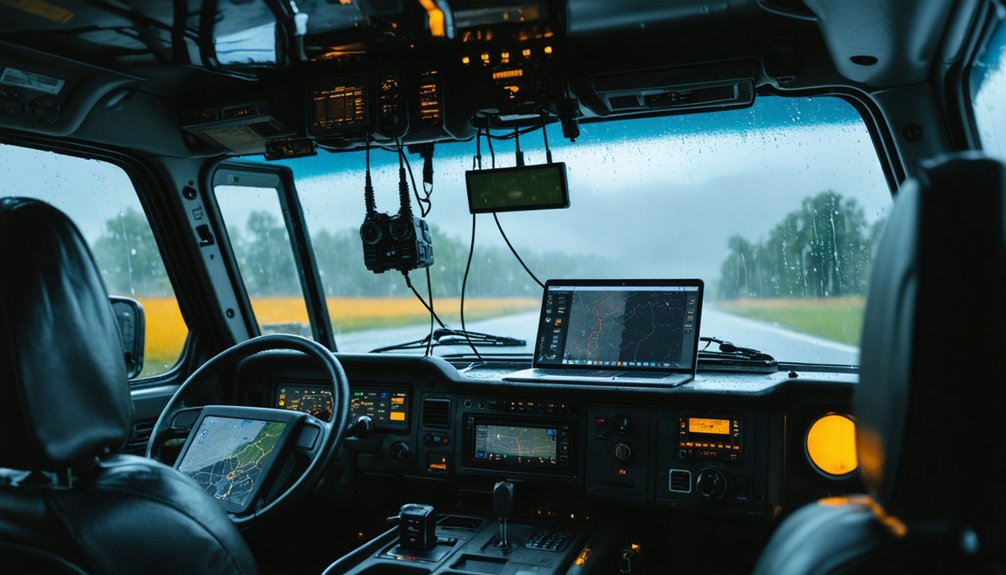
You’ll need GPS units with backup battery cells to maintain GPS accuracy during signal disruptions caused by electromagnetic interference near intense storm cores. Don’t rely solely on digital weather apps; cross-reference multiple platforms to confirm storm paths and intensity shifts in real time.
Ham radios let you coordinate positioning across multiple chase vehicles simultaneously, while CB radios pull road condition intelligence directly from trucker networks covering your target corridor.
Police scanners monitor emergency frequencies, feeding you critical aftermath updates before you enter compromised zones. Redundancy isn’t optional—it’s your operational backbone.
Stack your communication layers, verify your coordinates continuously, and you’ll stay mobile when conditions deteriorate fast.
Communication Gear That Keeps Chase Teams Connected
When you’re operating across multiple chase vehicles in deteriorating conditions, you can’t afford communication failure—ham radios deliver reliable signal transmission even when cellular networks collapse under storm interference.
You’ll want each team member equipped with a dedicated device, since CB radios, police scanners, and ham units each serve distinct coordination functions that a single tool can’t replicate.
Assigning specific frequencies to specific vehicles before deployment keeps your team’s data flow structured, reducing response latency when storm conditions force rapid repositioning.
Real-Time Signal Reliability
Signal loss during a tornado intercept isn’t just inconvenient—it’s operationally fatal. You’re tracking a wedge tornado at 60 mph, and your real time connectivity drops—you’ve lost your data feed, your team’s position, and your escape route simultaneously. That’s an unacceptable operational gap.
GPS units with backup cells maintain signal strength when primary networks saturate or collapse under storm interference. Ham radios operate independently of cellular infrastructure, keeping your multi-vehicle team coordinated across miles of compromised terrain.
Police scanners pull emergency frequency traffic continuously, feeding you critical aftermath intelligence without depending on internet availability.
You can’t afford single-point communication failures in dynamic storm environments. Layer your systems—cellular, radio, and scanner—so redundancy eliminates your vulnerability.
Independent communication channels aren’t optional equipment; they’re your operational lifeline.
Multi-Device Team Coordination
Redundancy keeps your communication alive—but coordination keeps your team operational. Multi-device setups demand clear role assignments before wheels roll.
Designate one operator per device—ham radio, CB, scanner, and weather app—to eliminate cross-talk and decision delays. Your team dynamics collapse when two members chase the same data stream while critical frequencies go unmonitored.
Assign your navigator to GPS and digital weather apps, your communications officer to ham and CB radios, and your safety lead to the police scanner. Each operator feeds consolidated updates to a single decision-maker.
Establish check-in intervals—every ten minutes minimum during active rotation. Discipline in role assignments transforms separate devices into one unified intelligence network.
Your team moves faster, reads conditions accurately, and exits danger zones before circumstances force the decision.
Vehicle Repair Kits That Stop Storm Chasers From Getting Stranded
When debris-littered roads puncture your tires, tire sealing gels and air pumps restore pressure fast, keeping your vehicle mobile without waiting for roadside assistance.
Your multi-tool set handles mechanical failures on the spot, from loose bolts to damaged wiring, cutting downtime that storm conditions can’t afford.
Spare fuel cans extend your operational range beyond the nearest gas station, ensuring you don’t lose a storm system because your tank ran dry in a remote corridor.
Tire Repair Prevents Stranding
Debris-littered storm corridors shred tires at rates that’ll strand unprepared chasers miles from assistance. You can’t afford downtime when a tornado’s path shifts unexpectedly, so prioritize tire maintenance before every deployment.
Carry portable air pumps capable of restoring pressure within minutes after debris impact compromises your tires.
Tire sealing gels deliver rapid puncture repair without requiring a full tire swap, keeping you mobile when road safety demands immediate action. These compounds inject directly into punctured rubber, sealing gaps up to 6mm in diameter while maintaining drivable pressure levels.
You’re operating in environments where gas stations don’t exist and rescue response times exceed hours. Redundant repair systems, including backup sealant canisters and compact inflators, eliminate single-point failures that’d otherwise terminate your chase operation permanently.
Multi-Tools Fix Mechanical Failures
Mechanical failures strand storm chasers faster than any weather event, so your vehicle repair kit needs multi-tools capable of handling bolt adjustments, wiring repairs, and component replacements within minutes.
Multi-tool versatility eliminates the need for carrying separate instrument sets, compressing dozens of functions into one compact unit you can deploy instantly.
Mechanical troubleshooting demands precision under pressure. Your multi-tool should cover:
- Bolt adjustments — pliers and drivers handling multiple fastener sizes across engine and chassis components
- Wiring repairs — wire cutters and strippers restoring electrical connections to critical navigation and communication systems
- Component replacements — blade attachments cutting damaged belts, hoses, or zip ties blocking mechanical function
Every second a vehicle sits disabled costs positioning advantage. Your multi-tool keeps you mobile and operationally independent.
Fuel Cans Extend Range
Fuel depletion strands storm chasers faster than mechanical failure, particularly during high-speed repositioning across rural corridors where gas stations sit 50 to 100 miles apart.
Carrying two to four approved 5-gallon fuel cans extends your operational radius by 100 to 200 miles, eliminating forced retreats during critical intercept windows.
You’ll want NATO-style jerry cans with sealed venting systems to prevent vapor loss and contamination.
Mount them externally using locking rack systems to preserve interior workspace.
Fuel efficiency drops 15 to 20 percent during aggressive storm pursuit due to high RPM driving and electrical load from equipment.
Factor that into your emergency refueling calculations before departure.
Proper fuel management keeps you mobile, independent, and positioned where the storm demands—not stranded at an empty pump 80 miles behind it.
Documentation Equipment Built for Extreme Storm Conditions
When documenting extreme storms, you’ll need gear engineered to withstand the same conditions you’re capturing.
Documentation techniques demand equipment durability that matches the field’s brutal realities.
Documentation isn’t forgiving. Your equipment must endure exactly what the storm delivers — nothing less will survive.
Your core documentation arsenal should include:
- HD video cameras that record storm development with high-resolution clarity, capturing rotation and wall cloud formation in real time
- Digital still cameras that lock in fine structural details video footage often compresses or loses
- Dashcams that continuously document your entire chase route, creating an unbroken record from deployment to extraction
Laptops maintain live weather mapping connectivity, while tripods stabilize cameras during extended observation windows.
Every piece serves a precise function. You’re not carrying luxury items — you’re deploying instruments that translate raw atmospheric violence into actionable, shareable data.
Choose gear that performs when conditions punish.
Personal Protection Gear for Storm Chasers Facing Severe Weather
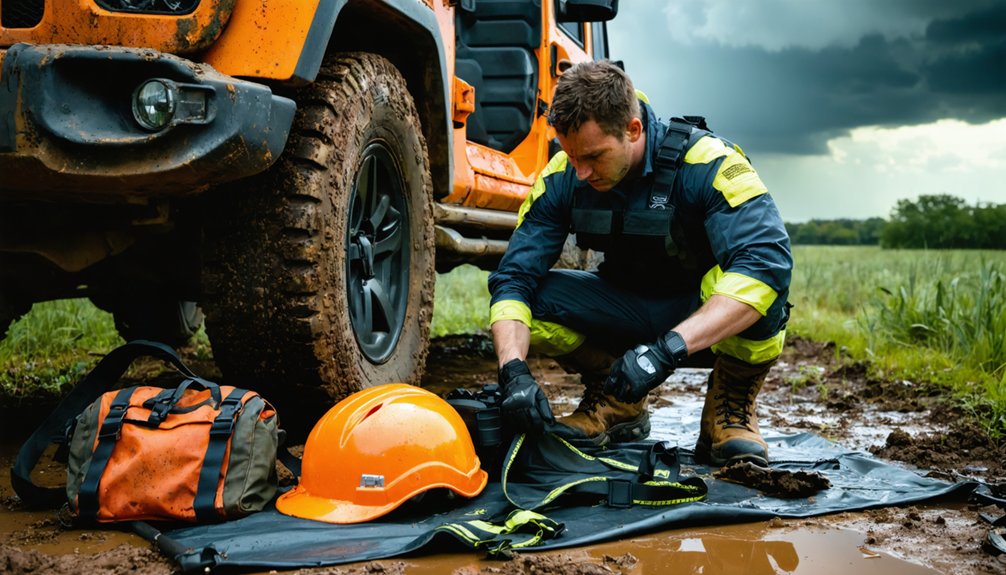
Surviving a storm chase depends as much on what you’re wearing as what you’re driving. Your layering system isn’t optional — it’s operational.
Start with moisture-wicking base layers that pull sweat away during high-intensity movement. Add insulated middle layers to counter rapid temperature drops behind severe storm fronts. Seal everything with a waterproof outer shell rated against wind penetration and heavy rain exposure.
Sturdy waterproof boots keep you mobile on debris-littered, muddy terrain where footing determines safety. High-visibility safety vests guarantee emergency crews identify you fast in chaotic post-storm environments.
Pair your weather resistant clothing system with emergency food supplies to sustain energy during extended deployments.
When you’re operating independently in remote corridors, your gear isn’t comfort — it’s survival infrastructure you control completely.
Environmental Instruments That Make Storm Chasers More Accurate
Protective gear keeps you operational in the field, but accurate environmental instruments keep you informed before conditions turn lethal. When you’re tracking storms independently, real-time atmospheric conditions data isn’t optional—it’s your decision-making foundation.
Three instruments you can’t afford to skip:
- Barometers detect rapid pressure drops, signaling imminent tornado development before visual confirmation.
- Wind sensors measure gust speeds precisely, giving you objective severity data rather than visual estimates.
- Sling psychrometers calculate humidity levels that directly indicate tornado formation potential.
Each instrument feeds you actionable numbers during storm tracking operations. You’re not guessing atmospheric conditions—you’re measuring them.
Each instrument delivers real numbers. You’re not guessing atmospheric conditions during storm operations—you’re measuring them precisely.
That distinction separates chasers who position correctly from those who get caught in dangerous locations. Own your data, own your decisions.
How to Prioritize Your Storm Chasing Gear List
How do you cut through the noise when every piece of gear claims to be essential? Start with survivability, then operability, then data capture.
Your gear prioritization framework should stack safety equipment first — recovery straps, medical kits, jump starters. Without those, you don’t finish the chase.
Next, layer in communication and navigation tools. GPS units and ham radios keep you mobile and informed, preserving your freedom to reposition fast.
Storm chasing essentials in the documentation and research categories come last. HD cameras and barometers matter, but they’re useless if you’re stranded or injured.
Audit your load by asking one question per item: does removing this risk your life, your mobility, or your mission? If none of the three, cut it.
What Separates Beginner Storm Chasing Kits From Professional Setups?
Three core gaps define the difference between beginner and professional storm chasing kits: redundancy, precision instrumentation, and real-time data integration. Beginner differences typically involve single-use tools and consumer-grade gear. Professional setups layer backup systems across every critical function.
You’ll notice professionals operate with:
- Dual GPS units paired with ham radios, eliminating single-point navigation failure
- Calibrated sling psychrometers and barometers replacing basic weather apps for field-accurate readings
- Integrated radar scopes and laptop mapping systems delivering synchronized storm data simultaneously
Where beginners rely on one dashcam and a smartphone, professionals run redundant HD cameras, dashcams, and tripod-mounted rigs.
Every instrument serves a measurable function. You’re not carrying more gear—you’re carrying smarter, interconnected systems that keep you mobile, informed, and operationally independent when conditions deteriorate rapidly.
Frequently Asked Questions
How Much Does a Complete Storm Chasing Equipment Setup Typically Cost?
You’ll spend $5,000–$50,000+ on equipment essentials, depending on your budget considerations. A basic setup runs ~$5K, while professional-grade gear—GPS, HD cameras, weather instruments, and vehicle systems—can exceed $50K.
Where Can Storm Chasers Legally Operate Without Requiring Special Permits?
You can operate freely on public roads and open highways within storm chasing zones across Tornado Alley states, where legal regulations don’t require special permits, giving you unrestricted access to prime chase territory.
How Do Storm Chasers Transport Fragile Equipment Across Rough Terrain Safely?
You’ll master transport techniques by securing gear with ratchet straps, cushioning fragile equipment in foam-lined cases, and using tire sealing gels post-impact—ensuring equipment protection across debris-laden, high-wind terrain without compromising your operational freedom.
What Insurance Coverage Do Professional Storm Chasers Typically Carry for Equipment?
With 73% of chasers reporting gear losses, you’ll need specialized insurance types covering equipment protection. Carry inland marine, commercial auto, and liability policies—they’re your financial safety net when storms destroy thousands in gear.
How Long Does It Take Beginners to Learn Using Storm Chasing Instruments Effectively?
You’ll typically need 6–12 months to master equipment familiarity and instrument calibration across barometers, wind sensors, and radar scopes. Consistent field practice accelerates your proficiency, letting you interpret real-time storm data independently and confidently.
References
- https://www.benholcomb.com/storm-chasing/equipment/items-in-my-storm-chase-vehicle/
- https://www.benholcomb.com/storm-chasing/equipment/
- https://stormtrack.org/threads/recommended-chaser-equipment-list.23013/
- https://store.sirui.com/blogs/guides/essential-equipment-for-storm-chasing-guide-for-2025
- https://science.howstuffworks.com/nature/climate-weather/storms/storm-chaser3.htm
- http://www.ndtornado.com/primary/equipment.htm
- https://www.reddit.com/r/stormchasing/comments/1hjxvuy/suggestions_for_supplies_for_my_first_chase/
- https://www.youtube.com/watch?v=Sr2lz72ZYwM
- https://www.stormtours.com/information/must-bring-items/
- https://www.reddit.com/r/stormchasing/comments/1ccqg2e/storm_chasing_as_a_hobby_what_equipment_do_i_use/