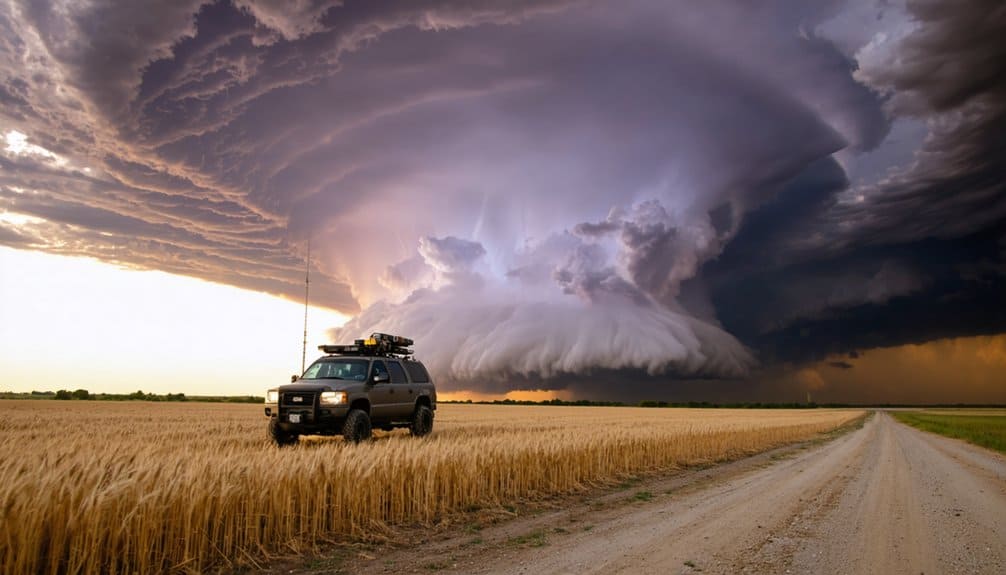
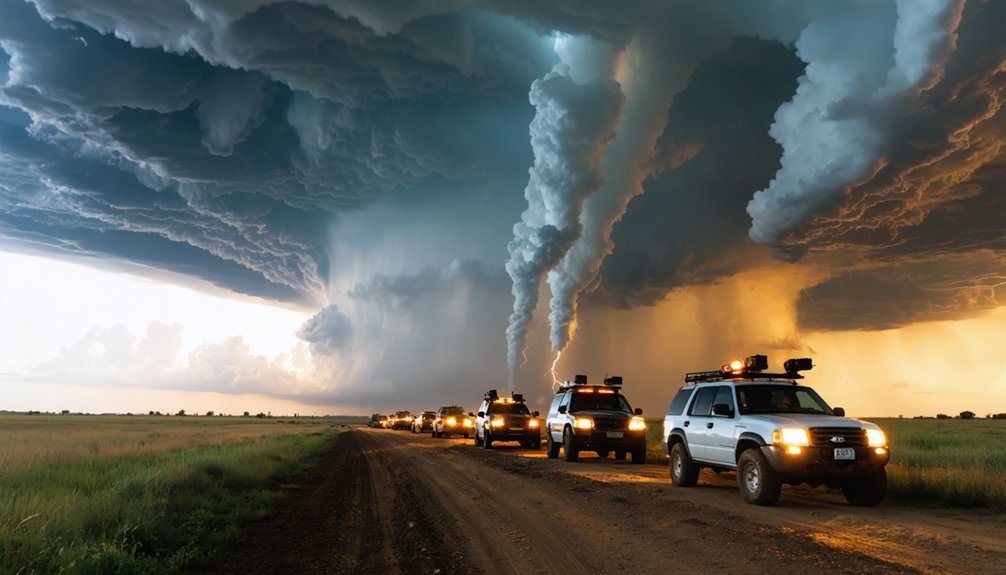
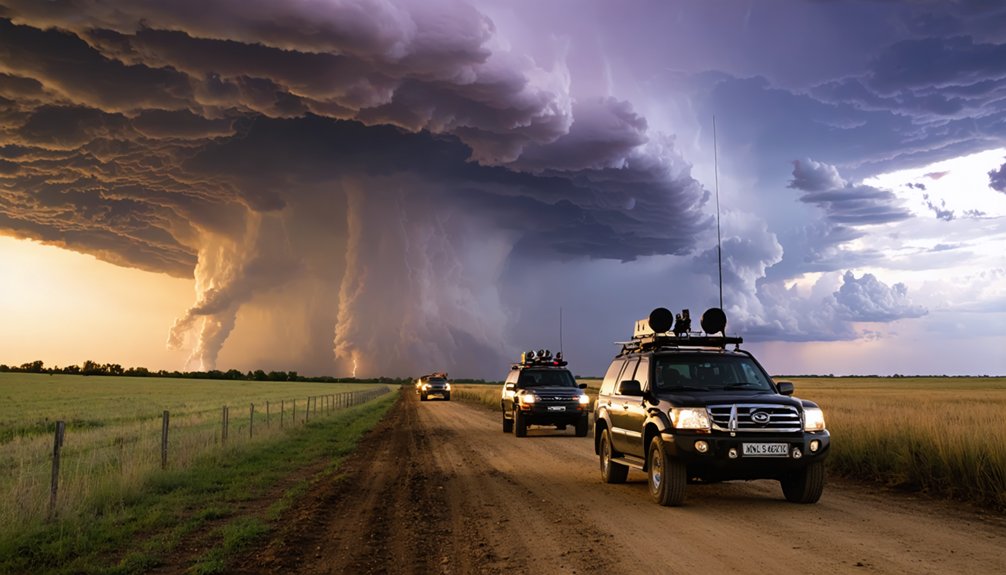
No storm chasing tour can guarantee you’ll see a tornado. Multiple atmospheric variables must align simultaneously, and no guide, forecaster, or algorithm can control that. Reputable operators explicitly state this in their FAQs, so you should enter any tour with calibrated expectations. That said, your odds improve markedly based on timing, tour length, and operator expertise — factors that separate a frustrating trip from an unforgettable one.
Key Takeaways
- No storm chasing tour guarantees a tornado sighting, as reputable operators explicitly state this in their FAQs.
- Tornado formation requires multiple atmospheric variables to align simultaneously, making certainty impossible.
- Even without tornadoes, guests witness dramatic supercell thunderstorms spanning 20 to 50 miles in diameter.
- Longer tours and May bookings statistically improve your chances of witnessing a tornado.
- Mother Nature ultimately controls tornado occurrence, regardless of guide expertise or forecasting technology.
Do Storm Chasing Tours Guarantee a Tornado?
While storm chasing tours deliver extraordinary access to severe weather, no tour operator guarantees you’ll see a tornado. Every major company explicitly states this in their FAQs, and dismissing that disclaimer is one of the most persistent tornado myths among first-time chasers.
No storm chasing tour guarantees a tornado sighting — and every reputable operator will tell you exactly that.
Tornado formation requires multiple atmospheric variables to align simultaneously — wind shear, instability, moisture, and lift must all converge perfectly. That precision isn’t controllable or predictable with certainty, regardless of your chase preparation or your guide’s expertise.
What operators do guarantee is positioning you within striking distance of supercell thunderstorms during peak season. You’ll witness severe weather structures, lightning events, and dynamic atmospheric conditions.
But tornadoes? Mother Nature controls that variable entirely, and no amount of forecasting technology changes that fundamental reality.
Supercells, Lightning, and Storm Structure You Will See
Even without a tornado, you’ll witness supercell thunderstorms featuring dramatic rotating wall clouds, defined inflow bands, and structured mesocyclones that represent some of the most visually striking atmospheric phenomena on Earth.
You’ll track storm dynamics in real time, watching as skilled guides interpret radar data, wind shear indices, and updraft behavior to position you ideally relative to the storm’s most active regions.
Lightning displays within and around supercell structures produce continuous, high-intensity electrical activity that adds measurable visual and scientific value to every chase day.
Supercell Structures Worth Witnessing
Though a tornado may never materialize on your tour, the supercell thunderstorms you’ll chase are atmospheric phenomena worth the trip alone.
Supercell formations develop rotating mesocyclones that produce visually dramatic wall clouds, mammatus formations, and anvil structures you won’t witness anywhere else. These organized convective systems can span 20 to 50 miles in diameter, generating inflow bands and beaver tail clouds that signal intense atmospheric instability.
For storm photography, supercells deliver extraordinary compositional opportunities—structured updraft towers against open plains skies, lightning strikes illuminating rotating wall clouds, and rear-flank downdraft clear slots carving through precipitation curtains.
You’ll position yourself miles from these systems with unobstructed sightlines across flat terrain. The visual architecture of a mature supercell rivals any natural spectacle, tornado or not.
Lightning And Storm Dynamics
Beyond the visual architecture of supercell structure, the electrical activity embedded within these systems delivers its own category of spectacle. Supercells generate continuous lightning displays that illuminate rotating wall clouds, precipitation cores, and anvil formations simultaneously.
You’ll watch intracloud lightning propagate across tens of miles of storm canopy while ground strikes discharge through the forward flank downdraft region.
Storm dynamics inside a supercell operate on a scale most people never witness firsthand. Rear-flank downdraft wrapping, mesocyclone intensification, and RFD clear slots represent atmospheric mechanics that unfold directly in front of you.
These processes drive tornado formation when conditions align. Even without a tornado, you’re observing organized convective systems producing wind shear, hail, and electrical output that most meteorologists study only through radar data.
When to Book Storm Chasing Tours for the Best Tornado Odds?
If you want the highest statistical probability of seeing a tornado, book your tour in May, when atmospheric conditions across the southern Plains most frequently produce supercell activity.
Tour duration matters greatly — a 7-day tour yields far better odds than a 3-day tour simply by multiplying your exposure to active weather setups.
You can stretch those odds even further by booking consecutive multi-tour packages, which most operators discount and which keep you in the field during critical pattern shifts.
Peak Season Booking Tips
When you book your storm chasing tour matters as much as where you go. Peak season runs mid-April through mid-July, but your booking strategies should target May specifically — statistically, it delivers the highest tornado frequency across the central Plains.
April tours concentrate activity across Oklahoma, Texas, and southern Kansas, while July shifts focus north toward Montana and Wyoming. You’ll maximize your odds by selecting longer tour durations; more chase days mean more opportunities for atmospheric conditions to align.
Joining consecutive tours further compounds your probability. Multi-tour packages also typically reveal discounted pricing, improving your overall value.
Book early — May tours fill quickly. Prioritize operators offering flexible itineraries, since guides must reposition daily based on evolving forecast data to keep you in the most active zones.
Tour Duration Matters
Booking in May gets you into peak season, but the length of your tour determines how much of that season you actually exploit. Tornado development requires precise atmospheric alignment, and that alignment doesn’t happen on demand. Shorter tours compress your window, statistically reducing your odds.
Longer tour length expands your exposure to multiple storm cycles, giving you more opportunities to intercept active setups.
Multi tour benefits amplify this further. Joining consecutive tours keeps you mobile across the Plains during the most active weeks, and most operators offer discounts for back-to-back bookings.
You’re not locked into a rigid schedule—guides continuously adjust targets based on daily forecasts. More days in the field means more chances that conditions align in your favor.
Where Tour Guides Actually Take You
The geographic targets on any given chase day aren’t fixed — guides analyze atmospheric data each morning to pinpoint the highest-probability zones for storm development.
Tour locations shift dynamically across the Plains based on seasonal patterns and synoptic-scale setups.
In April, chasing routes concentrate across Oklahoma, Texas, and southern Kansas, where early-season moisture and wind shear align most frequently.
By July, targets migrate north toward Montana, Wyoming, and the Dakotas as the jet stream retreats poleward.
Southern Kansas, northern Texas, and central Oklahoma consistently produce the highest tornado density throughout peak season.
You’re not locked into a fixed itinerary — after day one, tours become deliberately itinerant, positioning you wherever atmospheric ingredients converge.
That flexibility is your biggest tactical advantage for maximizing storm exposure.
What Storm Chasing Tours Really Cost
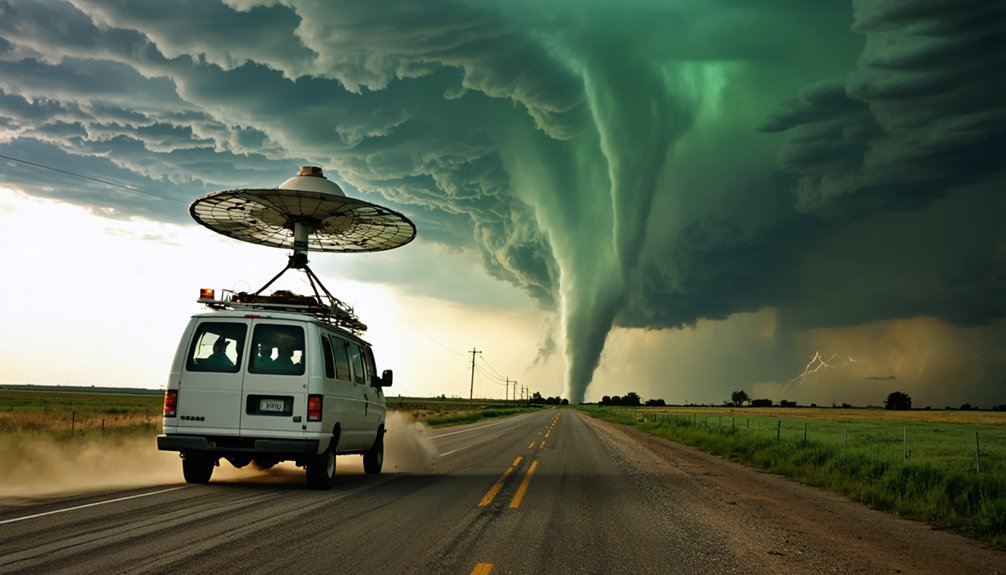
That flexibility across thousands of miles of Plains terrain comes at a measurable price. Multi-day storm chasing packages typically run several thousand dollars per person, covering transportation, hotel accommodations, and expert forecasting services.
Tour comparisons across major operators reveal similar cost structures, with longer durations commanding higher rates. A cost breakdown usually shows you’re funding daily meteorological analysis, experienced guides, and continuous itinerary adjustments — not a guaranteed tornado.
Joining consecutive tours often opens up multi-tour discounts, lowering your per-day expense while statistically improving your odds.
Booking back-to-back tours frequently unlocks discounted rates while maximizing your statistical chances of witnessing a tornado.
You’re fundamentally buying access to professional infrastructure and decision-making, not a specific outcome. If you value autonomy and calculated risk, understanding exactly what your dollars fund helps you evaluate whether the investment aligns with your expectations before committing.
How Close Do Storm Chasing Tours Get to Tornadoes?
How close you’ll actually get depends on several converging variables — storm individuality, available road networks, and real-time conditions all factor into the guide’s positioning decision.
Tornado proximity ranges from several miles out to under one mile, and that range isn’t arbitrary. Guides calculate approach vectors dynamically, reading storm motion, escape routes, and terrain simultaneously.
Chase safety isn’t passive — it’s a continuous, real-time calculation your guide executes throughout every intercept. You won’t find a fixed distance written into any itinerary because no two tornadoes behave identically.
Road grids across the plains vary dramatically, sometimes limiting or expanding your intercept options within minutes.
What you can expect is disciplined, data-informed positioning that maximizes your viewing experience without compromising the margin your guide maintains between you and the storm.
Frequently Asked Questions
What Should I Pack for a Multi-Week Storm Chasing Tour?
Pack your “atmospheric adventure essentials”: durable storm gear for multi-week travel across the Plains, layers for shifting climates, and personal safety measures like medications. You’ll navigate weeks itinerantly, so pack light but strategically.
Are Storm Chasing Tours Suitable for Children or Families?
Storm chasing tours can accommodate families, but you’ll need to verify each operator’s age restrictions carefully. Family safety remains paramount, as you’re exposed to severe weather environments requiring maturity, physical endurance, and quick responsiveness to rapidly changing atmospheric conditions.
How Physically Demanding Are Storm Chasing Tours for Participants?
Storm chasing tours aren’t intensely physically demanding, but you’ll spend long hours in vans crossing vast plains. Storm preparedness matters more than fitness requirements — you need mental endurance, flexibility, and readiness to move quickly when conditions shift.
Can Solo Travelers Join Storm Chasing Tours With Other Guests?
Yes, solo travelers can join storm chasing tours, integrating into group dynamics with other participants. You’ll share van transportation, hotel accommodations, and expert forecasting services, making it a cost-effective, adventurous way to chase severe weather across the Plains.
What Happens if Severe Weather Cancels or Interrupts a Tour?
Tour operators don’t publicly detail severe weather policies or tour cancellation options, but safety’s always the priority—guides continuously adjust targets, reposition vehicles, and modify itineraries daily to maximize your experience while keeping you protected throughout.
References
- https://www.youtube.com/watch?v=7kQSOXHwiTU
- https://www.silverliningtours.com/resources/faq/
- https://stormchasing.com/faq.html
- https://www.reddit.com/r/stormchasing/comments/w3grna/what_are_storm_chasing_tours_really_like/
- https://www.tornadicexpeditions.com/info-faq
- https://stormchasingtour.com/faq/
- https://www.silverliningtours.com
- https://vortexvoyages.com
- https://extremetornadotours.com
- https://www.reddit.com/r/stormchasing/comments/1cndsqh/storm_chasing_tours/