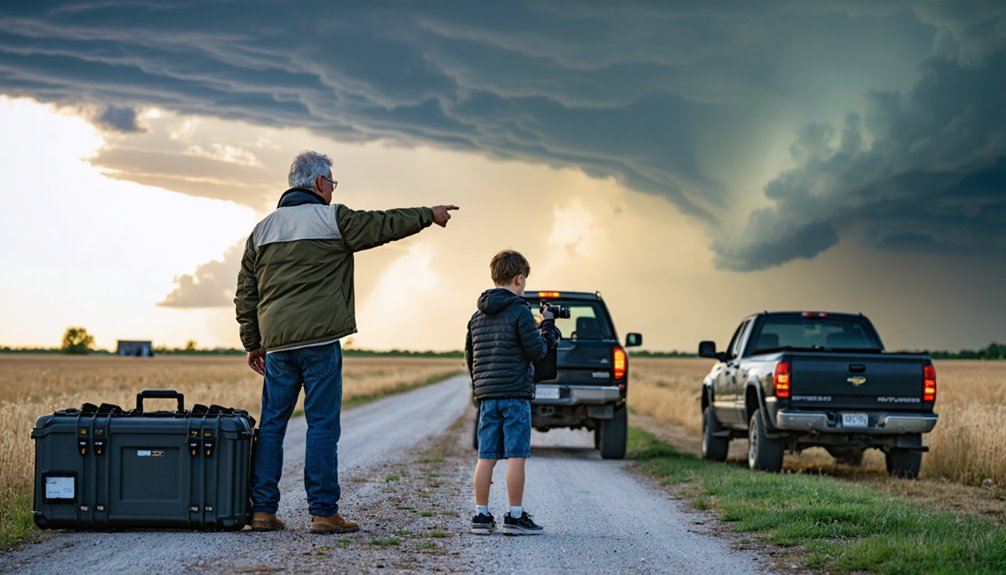
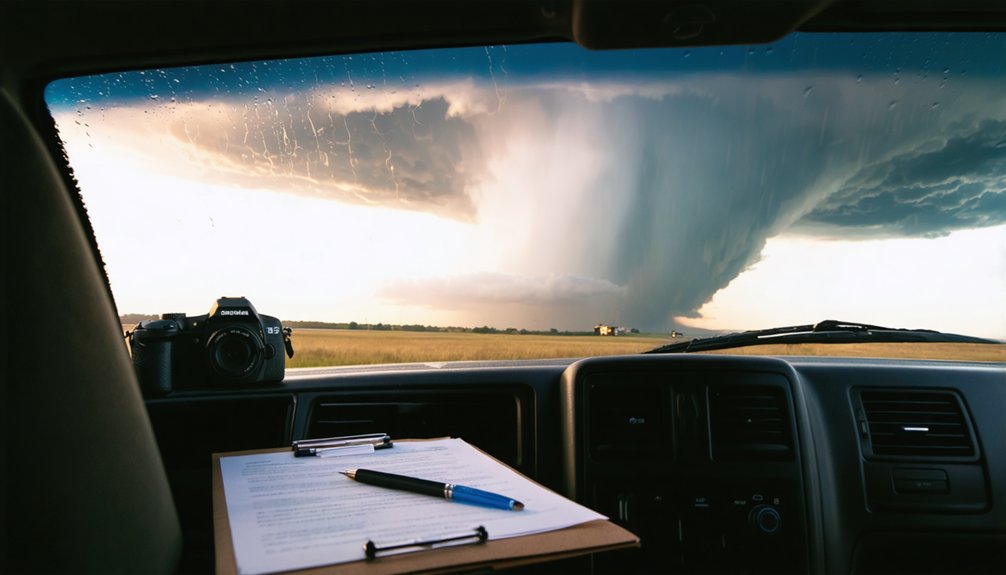
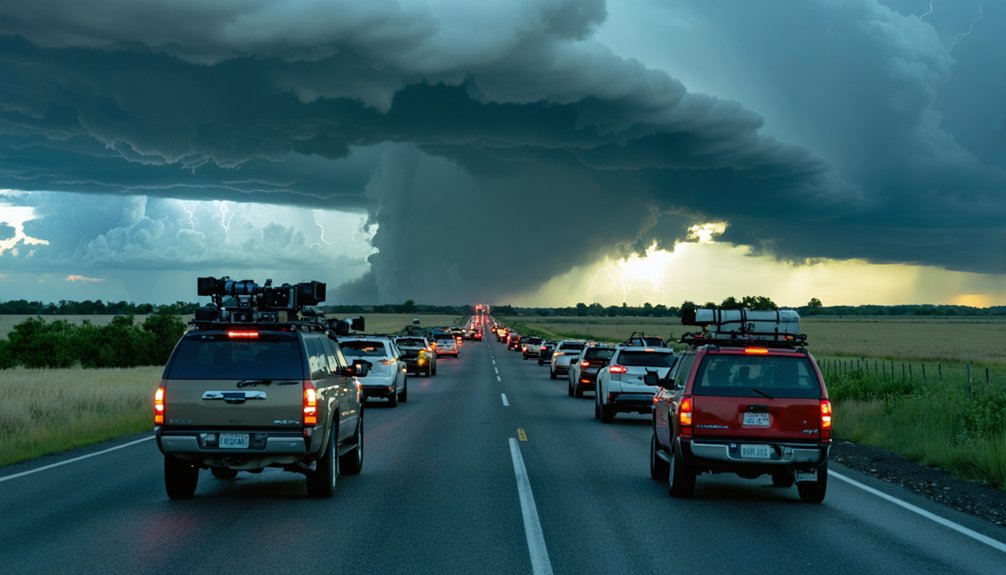
Teamwork is essential in storm chasing championships because you can’t manage radar interpretation, vehicle control, and real-time data coordination simultaneously without cracking under pressure. Cognitive overload hits fast, and when it does, your precision collapses and your risk spikes dangerously. Defined roles distribute that mental load across specialists, cutting reaction times and eliminating critical blind spots. Structured communication protocols prevent deadly assumptions. The strategies that separate winning teams from compromised solo operators go much deeper than you’d expect.
Key Takeaways
- Defined roles distribute cognitive load, allowing drivers, navigators, and meteorologists to focus on specialized tasks without dangerous multitasking.
- Real-time radar coordination among team members cuts reaction times by 30% during rapid weather shifts.
- Trust enables split-second decision-making, with team members confidently executing critical calls under extreme pressure.
- Communication protocols with verbal confirmations prevent dangerous assumptions and errors during deteriorating storm conditions.
- Collective analysis of storm patterns eliminates blind spots, increasing precision and reducing incident risks significantly.
How Teamwork Cuts Storm Chasing Risks by 30
Emergency preparedness means supplies and spare tires are distributed strategically among members.
Trust building and team resilience guarantee that when atmospheric chaos peaks, your team executes decisively, maintaining freedom of movement and operational control throughout every chase.
The Roles Every Storm Chasing Team Needs to Fill
Every high-performing storm chasing team runs on clearly defined roles that eliminate confusion when conditions deteriorate fast. You need storm roles assigned before you leave the staging area, not during a tornado intercept.
Your meteorologist owns data responsibilities, synthesizing radar and atmospheric readings in real time. Your driver maintains situational awareness while a dedicated navigator manages positioning relative to the storm core.
Your meteorologist reads the sky. Your driver reads the road. Your navigator reads the gap between both.
Establish a communication hierarchy so critical alerts move instantly without bottlenecks. Designate safety leadership to one experienced member who holds authority to abort when conditions exceed acceptable risk.
Assign equipment management to someone tracking cameras, sensors, and emergency gear at all times.
Role clarity builds team synergy that directly sharpens your reaction speed and decision quality when the atmosphere turns violent without warning.
Why Communication Speed Saves Lives on a Storm Chase
When you’re tracking a supercell, real-time radar coordination lets your team synthesize live storm data instantly, cutting reaction times by 30% during rapid weather shifts.
You must run ham radios with signal boosters to maintain contact when cell networks fail in remote chase corridors.
Always use verbal confirmations when relaying GPS coordinates or storm positioning—one miscommunication can place your team directly in a tornado’s path.
Real-Time Radar Coordination
Real-time radar coordination isn’t just a tactical advantage—it’s a lifeline. When you’re deep in a chase, conditions shift in seconds. You need precise, actionable data—not guesswork.
Real-time tracking gives your team the situational awareness to reposition before a storm intensifies unexpectedly. You’re pulling live radar feeds, synthesizing movement patterns, and relaying coordinates across every channel simultaneously. That’s storm analysis in motion.
Your navigator interprets radar loops while your driver executes immediate course corrections. Nothing gets lost in translation because your communication protocols are tight and deliberate. Verbal confirmations keep everyone synchronized.
Ham radios and signal boosters guarantee you maintain contact even when cell networks fail. You don’t get to choose when conditions turn dangerous—but coordinated radar communication assures you’re never caught unprepared.
Ham Radio Signal Boosters
Radar coordination only works if your communication infrastructure holds—and in remote storm corridors, cell networks fail fast. That’s where ham radio with signal boosters becomes your operational lifeline.
You can’t afford communication barriers when tornadoes shift trajectories within seconds. Signal interference degrades network reliability precisely when conditions demand real-time coordination.
Signal boosters cut through that interference, maintaining consistent signal strength across your entire team. You’ll integrate these systems into your emergency protocols before you ever leave the staging area.
Equipment maintenance matters here—a neglected antenna costs lives. Tech advancements have made modern ham radio units lighter and more powerful, strengthening your backup systems considerably.
Prioritize operational efficiency by testing every unit before deployment. Your communication chain only performs as well as your weakest link.
Verbal Confirmation Prevents Errors
Even a split-second miscommunication during a tornado intercept can cost your team its positioning—or its lives. Verbal clarity isn’t optional—it’s your operational backbone. Confirmation protocols eliminate dangerous assumptions when conditions deteriorate fast.
Execute these four non-negotiables:
- Repeat coordinates back immediately after receiving them to confirm accuracy before repositioning.
- Acknowledge every directional command verbally—silence never counts as confirmation.
- Call out hazards explicitly—standing water, downed lines, and blocked routes require immediate verbal broadcast.
- Confirm escape route availability before committing to any storm intercept position.
Your freedom to chase aggressively depends entirely on disciplined communication. When your navigator calls a position change, you respond, confirm, and execute—no hesitation, no guessing.
Verbal confirmation keeps your team sharp, coordinated, and alive.
How Storm Chasing Teams Stay Connected When Cell Service Fails
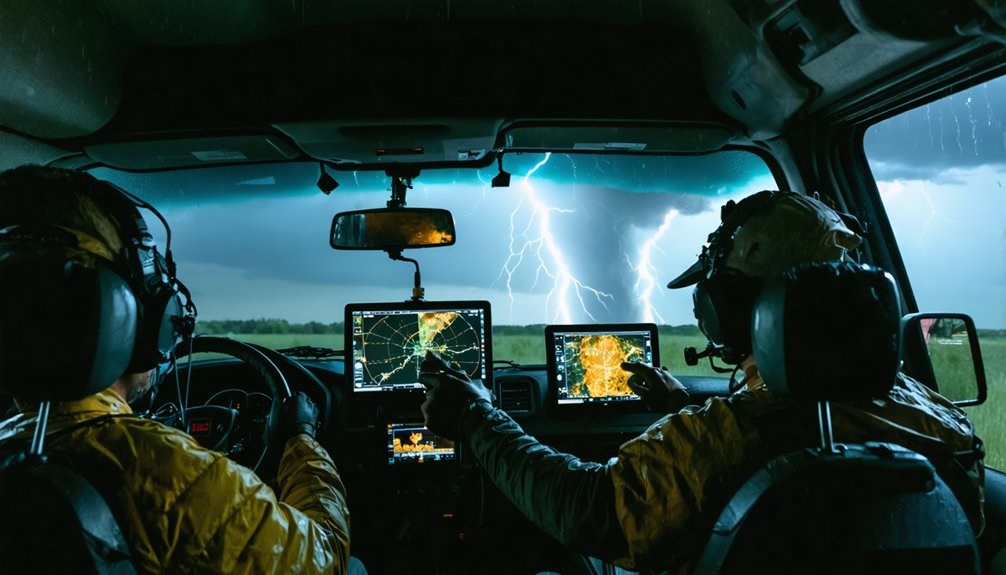
When cell service fails mid-chase, your team’s ability to stay connected determines whether you maintain tactical advantage or lose critical coordination. Dead zones aren’t obstacles—they’re tests of your storm survival infrastructure.
Equip your vehicles with ham radios as your primary fallback. These aren’t optional accessories; they’re non-negotiable connectivity solutions that operate independently of cellular towers. Pair them with signal boosters on your cell phones to maximize every available signal fragment before coverage disappears entirely.
Designate specific radio frequencies before deployment, and never deviate without verbal confirmation across all channels. Every team member must know the protocol cold.
When atmospheric chaos surrounds you, disciplined communication equipment and pre-established procedures keep your convoy coordinated, your data flowing, and your decision-making sharp under pressure.
Smarter Storm Positioning Through Collaborative Team Planning
Staying connected keeps your team alive, but knowing where to position your vehicles relative to the storm is what wins championships.
Collaborative mapping transforms raw radar data into strategic routes your entire team executes with precision. When everyone contributes their expertise, positioning decisions become sharper and faster.
Here’s what cooperative planning delivers:
- Optimal storm core access – meteorologists identify the safest, most data-rich entry points before deployment.
- Fuel efficiency – strategic routes eliminate unnecessary mileage, extending your operational range.
- Role clarity – drivers focus on roads while navigators monitor atmospheric shifts in real time.
- Escape path identification – teams pre-map alternative corridors before hazardous conditions develop.
Don’t chase blind. Plan collaboratively, position strategically, and you’ll dominate every championship scenario you encounter.
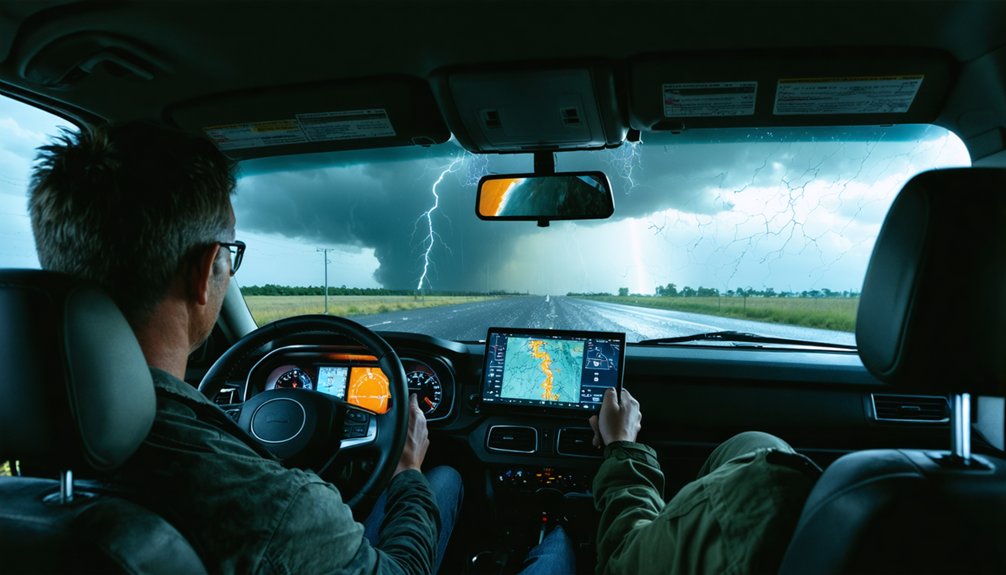
Dividing meteorology and navigation roles within your team directly sharpens data collection accuracy by eliminating the cognitive overload that compromises both tasks when handled by one person.
Role specialization lets your meteorologist focus entirely on meteorological collaboration—analyzing wind speed, precipitation, and atmospheric shifts—while your navigator maintains navigation synergy, tracking GPS coordinates and road conditions simultaneously.
This division drives accuracy enhancement across every data point you’re collecting. You’re not splitting attention; you’re multiplying capability.
Team dynamics strengthen when each member owns a defined function, reducing errors and accelerating data interpretation.
Your meteorologist feeds real-time insights to weather forecasters while your navigator keeps the vehicle positioned effectively near storm cores.
Data precision isn’t accidental—it’s the direct result of structured, disciplined role separation executed under pressure.
Why No Single Chaser Can Process Live Storm Data Alone
When you’re tracking a live storm solo, cognitive overload isn’t a possibility — it’s a certainty, as radar interpretation, GPS navigation, and real-time atmospheric analysis simultaneously compete for your attention.
You can’t split your focus across multiple data streams without sacrificing accuracy, which is why collaborative roles aren’t optional but operationally critical.
Cognitive Overload Limits Solo Chasers
Storm chasing demands simultaneous execution of tasks that overwhelm a single person’s cognitive capacity: traversing unpredictable roads, interpreting live radar data, monitoring GPS coordinates, and communicating positional changes—all within seconds of each other.
Solo limitations aren’t just inconvenient—they’re dangerous. Decision fatigue degrades mental clarity fast, and without focus techniques or shared cognitive strategies, your risk assessment collapses under pressure.
Here’s what overloads solo chasers:
- Radar interpretation requires unbroken concentration while driving actively.
- GPS rerouting demands instant spatial reasoning during storm shifts.
- Risk assessment needs continuous atmospheric data synthesis.
- Communication pulls attention away from immediate hazard detection.
You can’t split your focus across all four without compromising each one. Teamwork isn’t optional—it’s the only viable cognitive solution.
Real-Time Data Demands Collaboration
Cognitive overload breaks solo chasers before the storm ever peaks—and that collapse accelerates the moment live data starts flooding in. You can’t simultaneously interpret radar shifts, monitor GPS coordinates, track wind shear, and navigate hazardous roads alone. The data volume overwhelms single-operator capacity within minutes.
Real-time coordination eliminates that bottleneck. Your team distributes cognitive load across specialized roles—one member synthesizes radar, another monitors ground conditions, another drives. Each person owns their domain completely.
Collaborative forecasting sharpens your predictive accuracy because multiple trained minds cross-reference incoming data simultaneously. One analyst catches what another misses. Errors get corrected before they become fatal positioning mistakes.
Live storm data doesn’t wait for you to catch up. Collaboration isn’t a convenience—it’s the only operational structure that matches the storm’s pace.
Divided Roles Enhance Data Accuracy
Divided roles don’t just reduce workload—they eliminate the single point of failure that collapses solo chasing operations the moment data complexity spikes.
Role synergy transforms your team into a precision instrument:
- Driver maintains vehicle control and road hazard awareness exclusively.
- Navigator cross-references live GPS coordinates against real-time radar shifts.
- Meteorologist interprets atmospheric data, identifying rotation signatures and pressure drops.
- Data Analyst manages data sharing across platforms, transmitting ground-level readings to forecasters instantly.
You can’t monitor wind speed, document precipitation, track storm positioning, and drive simultaneously—physics won’t allow it.
When each member owns a defined role, collective output exceeds what any solo chaser could generate.
Divided responsibilities mean nothing gets missed, nothing gets compromised, and your operation stays mission-ready under maximum atmospheric pressure.
How Storm Chasing Teams Build the Trust That Holds Under Pressure
When lives depend on split-second decisions beside a rotating supercell, trust isn’t optional—it’s structural. You build it deliberately, long before storm season begins.
Trust building exercises simulate high-pressure scenarios, forcing your team to communicate under stress, assign roles without ego, and execute without hesitation.
Trust building exercises don’t simulate comfort—they simulate chaos, so your team executes flawlessly when chaos arrives.
Emotional support isn’t weakness—it’s operational. After grueling chases, debriefing honestly strengthens psychological resilience and sharpens future decision-making. You acknowledge fear, process it collectively, and return sharper.
Mental conditioning techniques train your mind to stay focused when instinct screams retreat. Mutual respect, earned through repeated preparation and transparency, becomes your team’s most durable asset.
When atmospheric conditions shift violently, you don’t freeze—you execute. That execution traces directly back to the trust your team built deliberately, systematically, and without shortcuts.
How Storm Chasing Teams Use Mental Conditioning to Stay Sharp Together
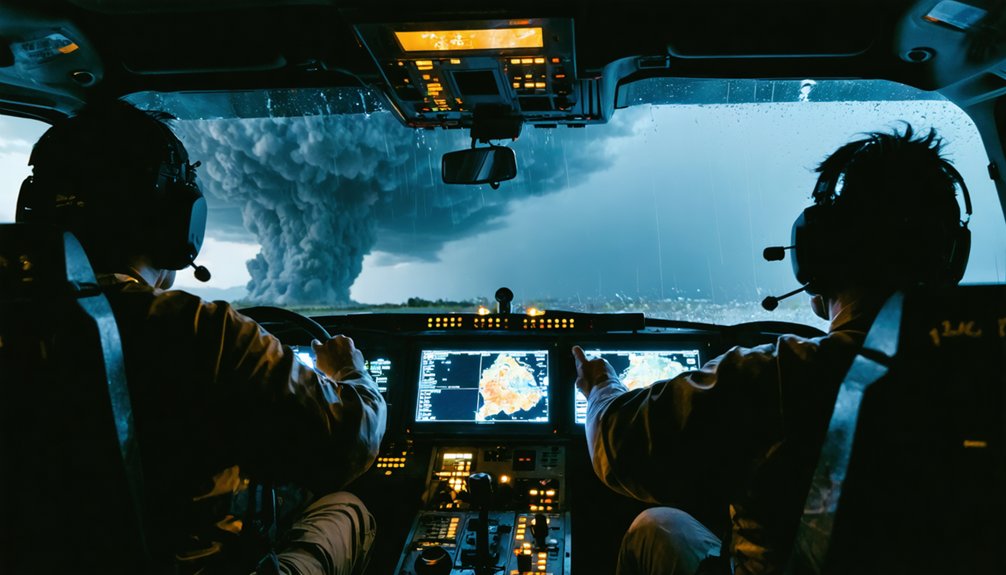
When you chase storms competitively, you can’t afford mental breakdowns under pressure, so your team must train psychological resilience the same way you rehearse technical protocols.
You’ll use structured stress-management techniques—controlled breathing, scenario visualization, and post-chase debriefs—to sharpen collective focus and prevent panic-driven errors during rapid atmospheric shifts.
Shared conditioning builds a deeper layer of trust, because when you’ve trained your mind alongside your teammates, you move and decide as a unified unit when it matters most.
Building Collective Mental Resilience
Collective mental resilience separates championship storm chasing teams from those who crack under pressure. You can’t dominate storm chasing championships without conditioning your team’s mind as rigorously as your equipment.
Collective mindfulness keeps every member grounded when atmospheric chaos escalates rapidly.
Build resilience through these proven strategies:
- Simulate high-pressure scenarios during training to sharpen decision-making under genuine stress.
- Practice emotional support protocols so teammates recognize and address psychological strain immediately.
- Establish pre-chase mental routines that synchronize focus and eliminate individual distraction.
- Debrief after every chase to extract lessons and reinforce psychological adaptability.
Trust your team’s mental conditioning to sustain clarity when storms intensify unpredictably. Resilient teams embrace uncertainty, adapt instantly, and execute precisely—transforming psychological pressure into competitive advantage during championship-level storm chasing events.
Stress Management Techniques Together
Stress hits fast in storm chasing championships, and your team’s mental conditioning determines whether you execute or collapse. You can’t afford hesitation when a tornado shifts direction unexpectedly.
Structured stress relief protocols — controlled breathing, pre-chase visualization, and deliberate debrief cycles — keep your crew sharp and decisive under pressure.
Team bonding isn’t optional; it’s operational. When you’ve trained alongside your crew in simulated severe weather scenarios, trust becomes automatic. You read each other’s signals without wasted words. That familiarity eliminates panic-driven errors during rapid atmospheric changes.
Assign mental check-ins as defined roles, just like navigation or data monitoring. Your team’s psychological stability directly impacts strategic positioning and split-second decisions.
Resilience isn’t individual — it’s built collectively, reinforced through every chase, debrief, and shared high-pressure experience.
Trust Through Shared Conditioning
Mental conditioning doesn’t just manage stress — it builds the shared trust that holds your team together when a supercell reorganizes faster than your models predicted.
Through resilience training and adaptive learning, your crew develops group cohesion that performs under real pressure.
Strengthen teamwork dynamics through these collaborative strategies:
- Simulate high-stakes scenarios — shared experiences in controlled drills build mutual respect and confidence boosting responses before actual deployments.
- Debrief every chase — collective review sharpens adaptive learning and reinforces trust building across all roles.
- Establish emotional support protocols — teammates who acknowledge stress openly maintain sharper decision-making during unpredictable events.
- Rotate leadership responsibilities — shifting command builds cross-functional confidence and deepens group cohesion under shifting atmospheric conditions.
Your team’s mental unity is your most decisive competitive advantage.
Five Habits That Separate Expert Storm Chasing Teams From Solo Operators
While solo storm chasers rely on instinct and individual bandwidth, expert teams operate through five disciplined habits that consistently outperform one-man operations.
First, they analyze storm patterns collectively, catching variables a solo operator misses.
Collective storm pattern analysis catches critical variables that a solo operator will always miss.
Second, they execute proven teamwork strategies, assigning roles that eliminate blind spots.
Third, they enforce strict safety protocols, reducing incident rates through shared vigilance.
Fourth, they prioritize data sharing in real time, feeding meteorologists ground-level intelligence radar can’t capture.
Fifth, they conduct continuous risk assessment, cross-checking navigation techniques against live atmospheric shifts.
You’ll also notice expert teams dismantle communication barriers through verbal confirmation drills, sustain collaborative learning after every chase, and provide emotional support that keeps decision-making sharp.
Understanding storm dynamics becomes exponentially more precise when multiple disciplined minds are locked in together.
Frequently Asked Questions
What Certifications Do Storm Chasers Need Before Joining Championship Competitions?
You’ll need to meet rigorous certification processes and training standards before competing. Complete meteorology courses, first aid training, and severe weather simulation programs to sharpen your skills and prove you’re ready for championship-level storm chasing.
How Do Storm Chasing Teams Handle Insurance and Liability During Championships?
You’ll secure team insurance and sign liability waivers before competing. Collaborative planning guarantees every member understands risk distribution, protecting your freedom to chase while maintaining legal and financial accountability across the entire team.
What Are the Entry Requirements for Storm Chasing Championship Events?
Like a storm demanding respect, you’ll need to meet strict entry criteria—proving your team dynamics, safety protocols, communication efficiency, and technical expertise before championships grant you the freedom to chase nature’s most powerful forces.
How Are Storm Chasing Championship Winners Scored and Judged?
You’re judged on scoring criteria like data accuracy, safety protocols, and storm proximity. Judging methods evaluate your team’s coordination, real-time decisions, and meteorological contributions, rewarding precise, data-driven performance that demonstrates mastery over unpredictable atmospheric conditions.
What Is the Average Cost of Assembling a Storm Chasing Team?
Budgeting boldly, you’ll spend $50,000–$150,000 assembling a storm chasing team. Your storm equipment, vehicles, and technology drive costs, while strong team dynamics streamline resource allocation, ensuring you’re maximizing every dollar toward chasing freedom and atmospheric mastery.
References
- https://crazystormchasers.com/the-role-of-teamwork-in-storm-chasing-championships/
- https://time.com/7317970/storm-chasing-weather-leadership-lessons/
- https://en.wikipedia.org/wiki/Storm_chasing
- https://science.howstuffworks.com/nature/climate-weather/storms/storm-chaser5.htm
- https://crazystormchasers.com/storm-chasing-competition-rules-and-regulations/
- https://www.popsci.com/science/real-storm-chasers-tornadoes/
- https://www.youtube.com/watch?v=JGZKIPSc4jI
- https://crazystormchasers.com/how-storm-chasing-changed-lives/
- https://www.atms.unca.edu/cgodfrey/courses/swfex/pdf/ChasingSafety.pdf
- https://www.psu.edu/news/academics/story/weathering-storm