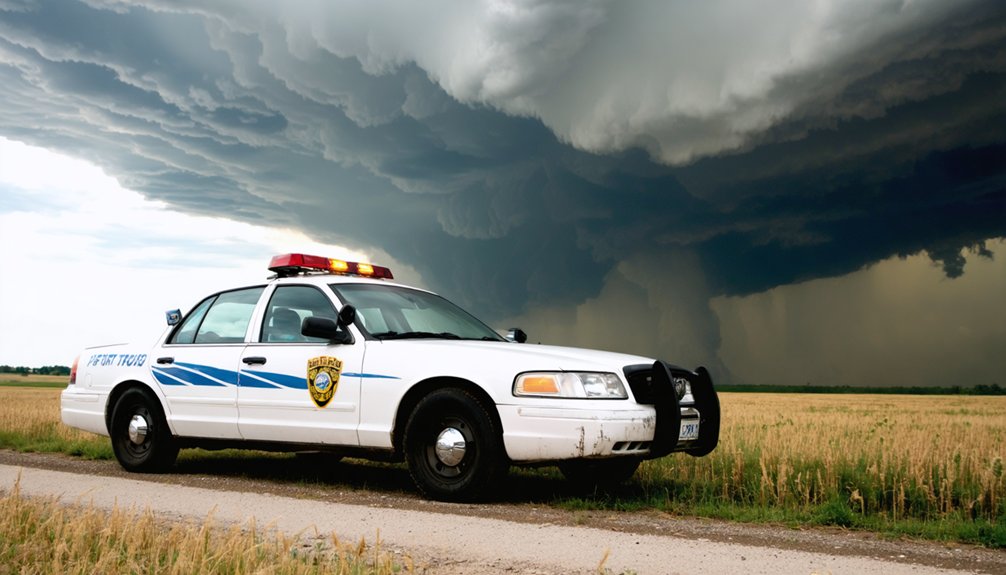
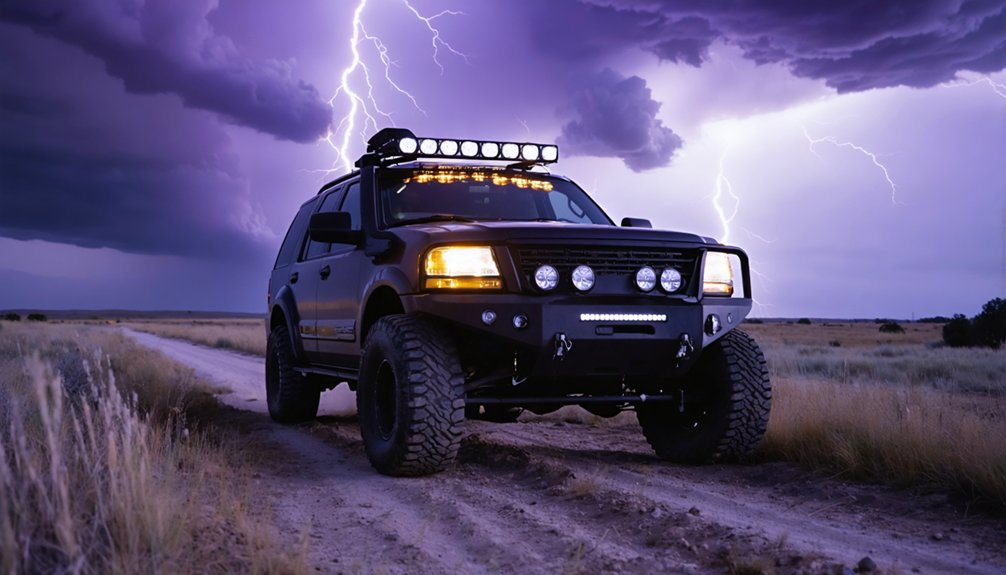
Your storm chasing truck must combine reinforced steel frames, armor plating, heavy-duty suspension, and all-terrain tires to survive violent weather encounters. Purpose-built platforms like the T.I.V.-2 and Dominator 3 set the gold standard, while modified commercial trucks like the Ford F-150 offer viable alternatives for lower-threat missions. You’ll need to match your vehicle’s capabilities directly to your operational risk level and budget—and what follows breaks down exactly how to do that.
Key Takeaways
- Top storm chasing trucks like T.I.V.-2 and Dominator 3 feature reinforced steel frames, armor plating, and storm sensor integration for maximum safety.
- High ground clearance and heavy-duty suspension systems are essential for navigating debris fields, floodwaters, and unstable storm-affected terrain safely.
- All-terrain tires with aggressive tread patterns provide reliable traction across the challenging surfaces encountered during active storm chasing operations.
- Match vehicle armor, structural modifications, and safety features to your specific mission profile, threat level, and operational budget requirements.
- Commercial trucks like the Ford F-150 can perform effectively with proper lifted configurations, welded roll cages, and storm-grade modifications installed.
What Makes a Storm Chasing Truck Actually Worthy?
When you’re pushing a vehicle into the path of a rotating supercell, it’s got to meet a precise set of structural and mechanical standards to keep you alive. Storm safety isn’t optional — it’s engineered into every component.
You need high ground clearance for traversing floodwaters, reinforced steel frames for surviving debris impact, and all-terrain tires for traction on unstable surfaces.
Heavy-duty suspension keeps your rig stable under high-velocity winds, while armor plating prevents cabin penetration.
Consistent vehicle maintenance is equally non-negotiable — a failing component during intercept equals catastrophic risk. You’re operating in environments where EF-1 gusts escalate to full tornado destruction within seconds.
Every system must function flawlessly. Your truck either meets these standards completely, or it doesn’t belong near a storm.
The Best Storm Chasing Trucks Ranked: TIV-2 to Dominator 3
When you’re ranking storm chasing trucks, the T.I.V.-2 stands alone at the top, engineered with reinforced steel framing and armor plating capable of withstanding full tornado intercept conditions.
You’ll find the Dominator 3 securing the second position, having executed high-profile intercepts with proven debris resistance and structural durability under extreme wind loads.
Both vehicles set the performance benchmark against which every other storm chasing platform gets measured.
TIV-2 Top Dominance
Among all storm chasing vehicles ever built, the T.I.V.-2 holds the undisputed top ranking globally, and it’s easy to see why. You’re looking at a machine engineered for maximum storm safety, combining reinforced steel framing, armor plating, and all-terrain mobility into one dominant platform.
Its vehicle aesthetics aren’t just visual — every angular surface and low-profile design element serves a functional purpose, reducing wind resistance during direct tornado intercepts. You get ground clearance optimized for debris fields, heavy-duty suspension absorbing violent instability, and a chassis built to withstand EF-5 destruction.
The T.I.V.-2 doesn’t compromise between protection and performance — it delivers both simultaneously. For serious chasers who demand unmatched structural integrity and proven field dominance, no other vehicle currently rivals its position.
Dominator 3 Performance
Sitting just behind the T.I.V.-2 in global rankings, the Dominator 3 delivers serious performance credentials that make it a legitimate contender for any extreme intercept mission. You’re looking at reinforced armor plating, heavy-duty suspension, and all-terrain capability engineered to handle EF-1 through EF-5 wind loads without structural compromise.
What separates the Dominator 3 from standard intercept platforms is its advanced storm sensor integration, allowing you to collect precise atmospheric readings at dangerously close range. That raw data feeds directly into weather data analysis systems, giving your team actionable intelligence during active tornado intercepts.
Its debris-resistant cabin and high ground clearance let you push deeper into storm corridors where lesser vehicles fail. For serious chasers demanding both survivability and scientific output, the Dominator 3 consistently delivers.
Top Commercial Storm Chasing Trucks Worth Buying
If you’re serious about storm chasing, selecting the right commercial truck is a foundational decision that directly impacts your safety and operational effectiveness. Like wildlife conservation efforts demanding specialized field equipment, storm chasing requires purpose-built platforms engineered for extreme conditions.
The Ford F-150, particularly the “Flash” operated by the Tornado Hunters, demonstrates reliable performance across EF-1 through EF-5 environments.
You’ll want lifted configurations that maximize ground clearance, enabling navigation through debris fields and floodwaters without compromising mobility.
Overbuilt SUVs paired with modified pickup chassis give you tactical flexibility during rapid deployments.
Prioritize reinforced frames, all-terrain tires, and heavy-duty suspension systems.
Accurate weather forecasting integration enhances your positioning strategy, keeping you safely ahead of the storm while collecting critical intercept data efficiently.
5 Features Every Storm Chasing Truck Must Have
When building or selecting your storm chasing truck, you’ll need wrapping armor plating capable of withstanding EF-1 gusts up to Twister-level conditions. Along with this, reinforced steel frames engineered to survive extreme structural overbuilding scenarios.
Your vehicle’s all-terrain tires must deliver consistent traction across debris fields, floodwaters, and unstable storm-impacted surfaces where standard tires fail catastrophically.
Pair those tires with a heavy-duty suspension system, and you’ve established the core mobility foundation your truck needs to remain stable under high-velocity wind loads.
Essential Structural Armor Requirements
Storm chasing trucks don’t just need power—they need structural integrity engineered to survive direct contact with extreme weather forces. You’re operating in environments where debris becomes lethal projectiles and wind pressure can crush standard vehicle frames instantly.
Wrapping armor plating must withstand EF-1 gusts through Twister-level conditions without compromising cabin integrity. Reinforced steel frames prevent catastrophic structural collapse during high-velocity impacts, while debris-resistant panels stop penetration before it reaches you.
Your truck’s armor system directly supports remote sensing equipment mounted externally, protecting instruments critical for real-time weather prediction accuracy. Without hardened structural protection, your data collection mission fails entirely.
Prioritize vehicles engineered with tested armor integrity ratings, not aftermarket modifications built without verified performance standards. Your survival depends on purpose-built structural engineering, not improvised solutions.
All-Terrain Mobility Systems
Moving through tornado alley’s saturated ground, debris fields, and washed-out roads demands mobility systems engineered far beyond factory specifications. You’ll need all-terrain tires delivering consistent traction across unstable, storm-compromised surfaces where standard rubber fails immediately.
Heavy-duty suspension systems keep your platform stable against high-velocity lateral wind loads, preventing dangerous handling failures during active intercepts. High ground clearance lets you push through floodwaters and debris fields without catastrophic undercarriage damage.
These mobility systems also support aerial reconnaissance integration, allowing drone deployment from any terrain position without requiring paved staging areas. Your ability to execute real-time storm data analysis depends directly on reaching ideal intercept coordinates fast.
Without purpose-built mobility systems, your truck becomes stationary equipment rather than a functional storm chasing platform capable of operating in genuinely extreme conditions.
How to Modify Your Pickup for Tornado-Level Conditions
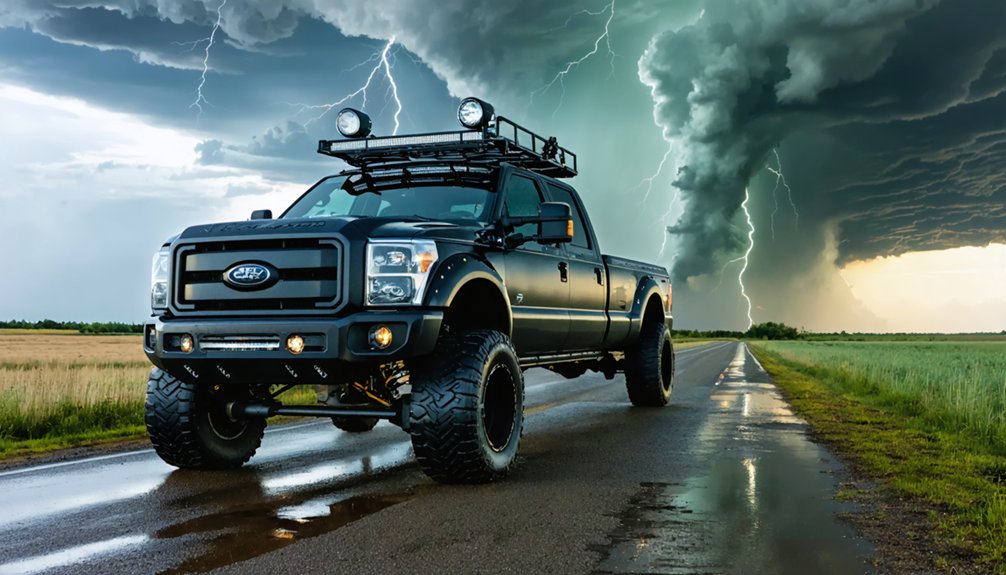
Transforming your pickup into a tornado-capable intercept vehicle requires targeting four core systems: frame reinforcement, armor plating, suspension, and tires.
Start with a reinforced steel frame—it’s your foundation against catastrophic wind loads. Weld integrated roll-cage structures directly to the chassis for maximum torsional rigidity.
Next, apply wrap-around armor plating to shield crew safety without compromising vehicle aesthetics through custom-fitted panel designs.
Upgrade to heavy-duty suspension components rated for violent terrain displacement caused by debris fields and floodwaters.
Install all-terrain tires with aggressive tread patterns for traction on storm-compromised surfaces.
Additionally, seal all cabin penetration points with reinforced gaskets and storm-grade materials.
Each modification you make compounds your survivability margin, turning a standard pickup into a machine capable of operating at tornado intercept distances.
Which Storm Chasing Truck Matches Your Mission?
Choosing the right storm chasing truck depends entirely on your mission profile, budget, and the threat level you’re intercepting.
If you’re collecting weather data near violent EF-4 or EF-5 tornadoes, you’ll need a fully armored platform like the T.I.V.-2 or Dominator 3. These vehicles prioritize crew safety above all else, featuring reinforced steel frames and debris-resistant cabins.
For moderate intercepts or documentary work, a lifted, modified Ford F-150 like the Tornado Hunters’ “Flash” delivers reliable performance without extreme overbuilding costs.
If you’re running mobile radar operations, a purpose-built unit like Doppler on Wheels fits that mission precisely.
Match your vehicle’s capabilities directly to your operational risk. Don’t overspend on armor you won’t need, and never underbuild when lives depend on your decision.
Frequently Asked Questions
What Insurance Coverage Do Storm Chasers Typically Need for Their Vehicles?
Charging into roaring walls of debris, you’ll need specialized insurance types like commercial auto and equipment coverage. Push your coverage limits high — standard policies won’t protect your armored, storm-modified vehicle against tornado-level destruction.
How Much Does It Cost to Professionally Armor a Storm Chasing Truck?
You’ll typically spend $20,000–$80,000 on professional vehicle customization for storm chasing armor, covering reinforced steel frames, debris-resistant plating, and emergency communication systems—costs vary based on protection level and structural overbuilding complexity you require.
Are Storm Chasing Trucks Street-Legal After Extreme Modifications Are Completed?
Like a medieval knight armoring up for battle, your storm chasing vehicle customization must still comply with legal regulations — you’ll need proper inspections, lighting, and DOT certification to keep your modified truck street-legal.
What Training Certifications Are Required Before Operating Tornado Intercept Vehicles?
You’ll need meteorology credentials covering weather forecasting and safety protocols before operating tornado intercept vehicles. Pursue storm spotter certification through SKYWARN, emergency vehicle operation training, and hands-on field experience with licensed intercept teams to guarantee competent, independent operation.
How Do Storm Chasers Fund the Purchase of Specialized Tornado Chasing Trucks?
You’ll fund specialized tornado intercept vehicles through university research grants, crowdfunding, media sponsorships, and government contracts tied to weather data analysis programs that prioritize storm chasing safety, ensuring you maintain operational independence while pursuing extreme meteorological fieldwork.
References
- https://www.liftedtrucks.com/blog/2025/march/20/trucks-that-can-survive-a-tornado.htm
- https://www.youtube.com/watch?v=oiZW37YZBbY