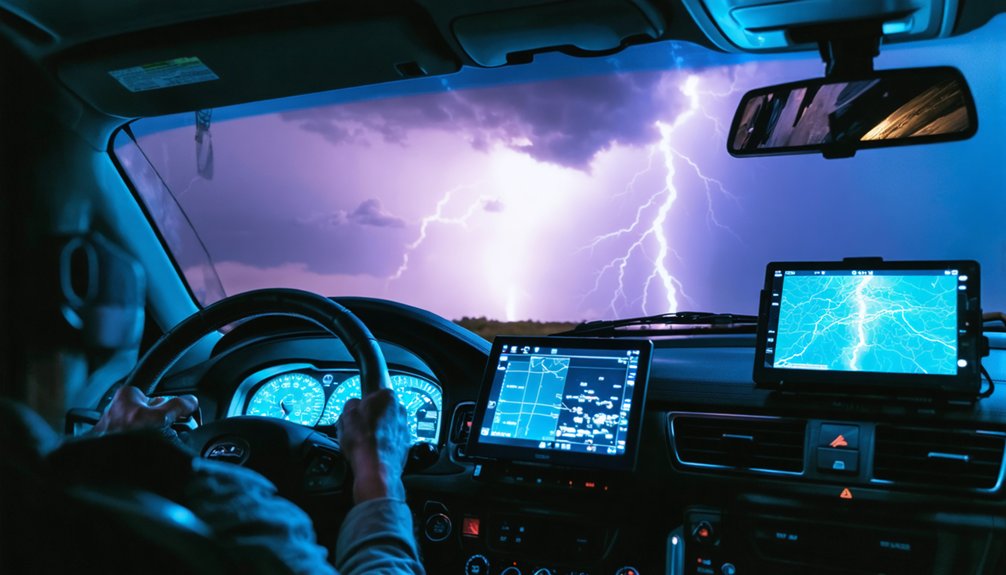
Media shapes storm chasing culture in ways you can’t ignore. Live broadcasts democratized access to real-time storm data, while documentaries turned scientific curiosity into obsession. Viral videos bypass traditional gatekeepers, amplifying raw footage to global audiences instantly. Celebrity chasers like Reed Timmer made storm science compelling and accessible. Meanwhile, sensationalism distorts risk perception, and social media algorithms reward dangerous engagement. Together, these forces transform curious viewers into aspiring chasers—and there’s far more to unpack about each influence.
Key Takeaways
- Live broadcasts democratize storm chasing by providing real-time Doppler radar and weather data, eliminating institutional gatekeeping and fostering informed public participation.
- Viral storm videos on YouTube and social media bypass traditional gatekeepers, transforming isolated weather events into globally shared spectacles.
- Documentaries featuring celebrity chasers like Reed Timmer convert scientific curiosity into cultural obsession, legitimizing storm chasing as a career path.
- Social media algorithms reward high-engagement storm content, amplifying emotional responses and reshaping community risk perceptions through real-time validation.
- Media sensationalism distorts risk assessment by prioritizing spectacle over accuracy, creating operational vulnerabilities for chasers who consume dramatized content uncritically.
How Live Broadcasts Put Storm Chasing on the Map
Live broadcasts transformed storm chasing from a niche scientific pursuit into a cultural phenomenon. When you watch real-time storm tracking unfold across your screen, you’re experiencing broadcast technology that’s democratized access to extreme weather events.
Live broadcasts turned storm chasing into a cultural phenomenon, democratizing access to extreme weather for everyday viewers.
Networks like The Weather Channel didn’t just report storms — they invited you into the chase itself, delivering minute-by-minute data that was previously restricted to meteorologists and field researchers.
This direct access reshaped public understanding considerably. You can now interpret Doppler radar overlays, wind rotation patterns, and precipitation data alongside professional chasers.
Broadcast technology eliminated institutional gatekeeping, empowering independent audiences to engage critically with storm science. The result wasn’t passive viewership — it was an informed, participatory culture where you actively connect with atmospheric phenomena previously considered too technical for mainstream consumption.
How Storm Chasing Documentaries Built a Cultural Obsession
That narrative resonated with you because it mirrored a deeper desire — freedom from conventional boundaries.
Documentaries didn’t just explain storm dynamics; they constructed identity.
Celebrity chasers like Reed Timmer became archetypes, blending scientific credibility with rebellious pursuit.
The data confirms this cultural shift: documentary viewership consistently spikes public interest in chasing careers and amateur participation.
You’re not simply watching weather — you’re consuming a worldview.
Documentaries weaponized storytelling, converting scientific curiosity into obsession and making storm chasing a legitimate cultural movement rather than a fringe pursuit.
Why Viral Storm Videos Dominate Storm Chasing Culture Online
When you scroll through platforms like YouTube, Facebook, or Twitter, you’ll notice that viral storm videos consistently generate millions of views, proving that raw, real-time footage captivates audiences more effectively than traditional media.
You’re watching a cultural shift unfold, as social media’s algorithmic amplification pushes storm content to broader audiences faster than any documentary or broadcast ever could.
This real-time sharing dynamic has fundamentally restructured storm chasing culture, transforming what was once a niche scientific pursuit into a globally consumed spectacle driven by engagement metrics and viral momentum.
Viral Videos Drive Engagement
Viral storm videos have fundamentally reshaped how storm chasing culture spreads and grows online, turning isolated extreme weather events into globally shared spectacles within hours. Raw storm footage now drives viewer engagement at unprecedented scales, connecting you directly to chasing culture without geographic limitations.
Platforms like YouTube, Facebook, and Twitter amplify distribution instantly, giving you real-time access to content that once required television networks. Here’s what makes viral storm content so powerful:
- Authentic footage creates immediate emotional connections
- Real-time sharing eliminates traditional media gatekeepers
- Algorithm-driven platforms prioritize high-intensity weather content
- Community sharing transforms passive viewers into active participants
You’re no longer dependent on broadcast schedules. Viral content hands you direct access to storm chasing culture, accelerating community growth and public awareness simultaneously.
Social Media Amplifies Reach
Beyond raw footage capturing attention, social media’s structural mechanics actively supercharge how storm chasing content spreads. Platforms like Facebook, Twitter, and YouTube deploy algorithmic systems that reward high audience engagement, pushing dramatic storm footage into millions of feeds simultaneously. You’re not just watching content—you’re participating in its distribution every time you share, comment, or react.
Content virality isn’t accidental here. Storm chasing videos trigger emotional responses that social platforms are specifically engineered to amplify. Real-time updates create urgency, compelling you to share before the moment passes.
Independent chasers now bypass traditional media gatekeepers entirely, broadcasting directly to global audiences within seconds.
This democratization fundamentally reshapes storm chasing culture, giving you unprecedented access to raw, unfiltered meteorological events while simultaneously expanding community participation beyond geographic limitations.
Real-Time Sharing Transforms Culture
Real-time sharing doesn’t just distribute storm content—it actively restructures how chasing culture forms and sustains itself. When you post footage instantly, you’re shaping collective risk perception and community norms simultaneously.
Viral storm videos dominate online culture because they deliver:
- Immediate situational awareness that empowers independent decision-making
- Community validation through engagement metrics that reinforce chasing behaviors
- Ethical reporting standards that separate credible chasers from reckless content creators
- Data privacy considerations that protect location intelligence from dangerous copycat chasers
Platforms like YouTube and Twitter don’t passively host this content—they algorithmically amplify it, accelerating cultural shifts.
You’re not just a viewer; you’re a participant in a feedback loop that continuously redefines what storm chasing means, who participates, and what standards the community ultimately upholds.
Celebrity Storm Chasers Who Reshaped Public Perception
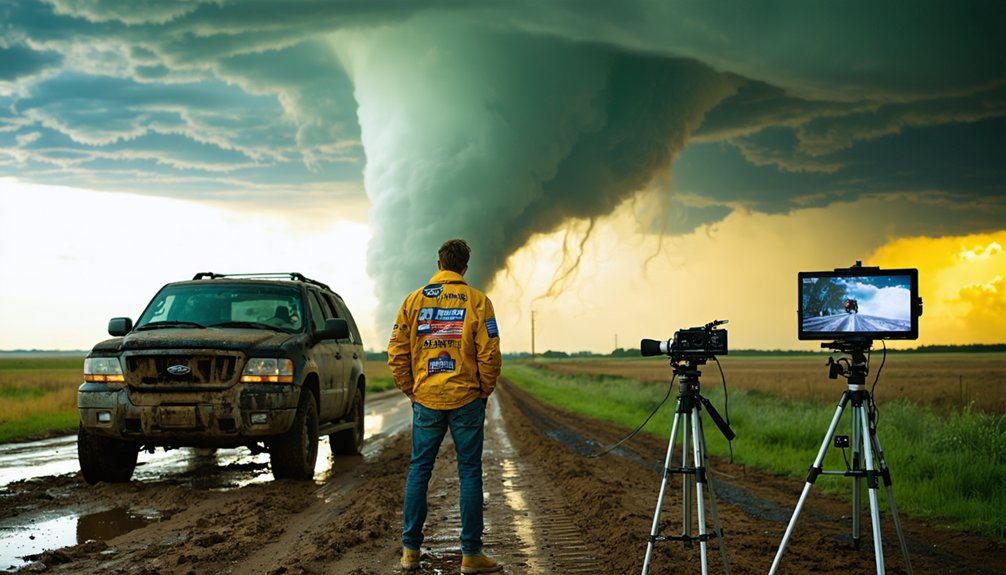
When you examine storm chasing culture, you can’t ignore how celebrity chasers like Reed Timmer and Tim Samaras fundamentally shifted public perception by making storm science both accessible and compelling.
Their high-profile pursuits attracted massive audiences, transforming niche meteorological fieldwork into mainstream entertainment.
You’ll find that their influence measurably expanded public awareness, driving interest in storm chasing well beyond the scientific community.
Famous Chasers’ Cultural Impact
Few figures have shaped storm chasing culture as profoundly as Reed Timmer and Tim Samaras, whose high-profile careers transformed public perception of what it means to chase severe weather. Their historical narratives carry deep cultural symbolism, positioning chasers as both scientific pioneers and fearless adventurers. You can trace today’s chasing culture directly to their influence.
Their cultural impact includes:
- Inspiring independence by proving individuals can pursue storm science outside institutional frameworks
- Elevating credibility through data-driven fieldwork that earned mainstream scientific respect
- Democratizing access by making chasing knowledge widely available through media platforms
- Redefining risk by demonstrating calculated, informed decision-making under extreme conditions
Their legacies continue shaping how you understand storm chasing’s intersection of science, freedom, and personal responsibility.
Celebrity Influence On Awareness
Celebrity storm chasers like Reed Timmer and Tim Samaras didn’t just chase storms—they reshaped how you perceive the entire field. Their celebrity endorsements of scientific tools, safety protocols, and meteorological research transformed niche expertise into mainstream fascination. You’re not simply watching dramatic footage; you’re absorbing credible scientific advocacy delivered through compelling personalities.
Their social influence extended beyond entertainment. Reed Timmer’s high-energy broadcasts and Tim Samaras’s precision-driven research demonstrated that chasing demands both courage and discipline. These figures gave you direct access to storm science, bypassing traditional institutional barriers.
Their visibility attracted funding, inspired careers, and elevated public safety awareness simultaneously.
When celebrity chasers communicate risk accurately, you’re empowered to make informed decisions. Their cultural authority drives engagement while reinforcing that responsible chasing requires rigorous knowledge, not reckless thrill-seeking.
How Real-Time Media Coverage Changed What Chasers Risk in the Field
Real-time media coverage has fundamentally restructured the risk calculus that storm chasers face in the field. You’re now operating under pressure that didn’t exist before—cameras rolling, audiences watching, engagement metrics climbing.
That visibility distorts your risk assessment, pushing decisions that prioritize spectacle over safety protocols.
Here’s what real-time coverage has changed for chasers like you:
- Pressure to stay closer to storms for better footage
- Delayed retreats when audiences are actively engaged online
- Confirmation bias reinforced by viral validation of reckless behavior
- Misinformed positioning driven by sensationalized broadcast expectations
You’ve gained unprecedented situational awareness through minute-by-minute data, but you’ve also inherited new psychological pressures. Balancing public engagement with disciplined field judgment isn’t optional—it’s survival.
How Sensationalism Gets Storm Chasing Risk Dangerously Wrong
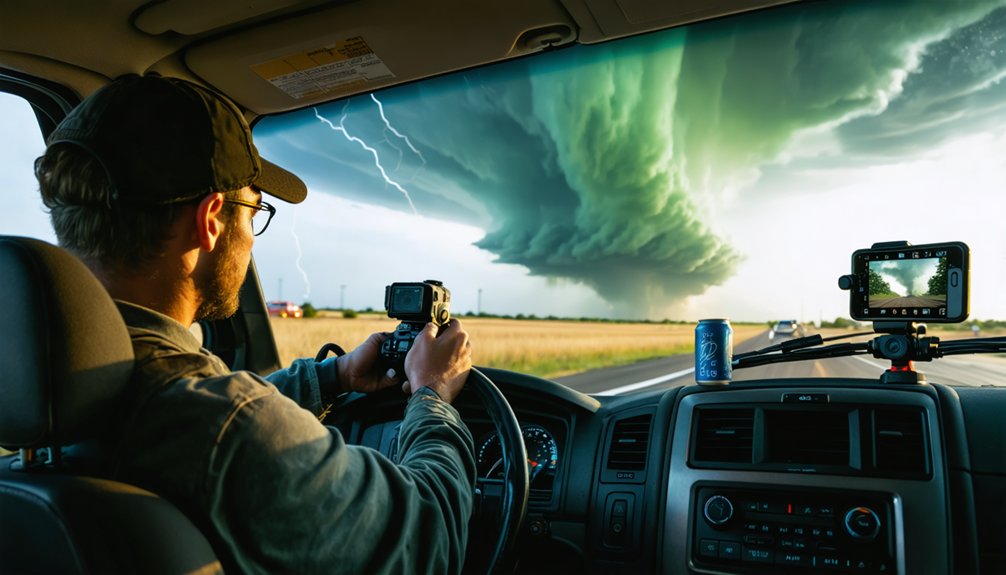
When media sensationalism distorts storm chasing coverage, it doesn’t just mislead casual viewers—it warps the risk perception of active chasers in measurable ways. Sensational headlines prioritize spectacle over accuracy, stripping critical context from storm data you need to make sound decisions.
Emotional exaggeration amplifies perceived storm intensity, triggering confirmation bias that pushes you toward preexisting beliefs rather than objective analysis. You start filtering incoming data through a distorted lens, favoring dramatic narratives over meteorological evidence.
This cognitive drift increases your field vulnerability profoundly. Studies in risk communication consistently show that exaggerated media framing reduces accurate threat assessment among experienced practitioners.
When you consume sensationalized content uncritically, you’re not just misinformed—you’re operationally compromised. Reclaiming accurate risk assessment means actively cross-referencing sensational reports against verified meteorological agency data.
How Media Turns Curious Viewers Into Aspiring Storm Chasers
Media consistently drives recruitment through:
- Cinematic storytelling that makes chasing appear accessible and heroic
- Viral social media videos delivering real-time storm engagement directly to you
- Celebrity chasers who blend scientific credibility with adventure-driven narratives
- Live broadcasts providing unprecedented access to storm events previously unavailable
Recognizing these influences matters. Media shapes your perception before you ever enter the field.
Understanding what’s authentic versus dramatized guarantees you pursue storm chasing with accurate knowledge, not manufactured mythology.
Frequently Asked Questions
What Legal Regulations Govern Media Coverage During Active Tornado Emergencies?
You’re steering through uncharted territory—no federal laws explicitly govern media coverage during active tornadoes. You must balance media ethics with public safety, following FCC emergency broadcast guidelines and local authority directives to protect communities effectively.
How Do Storm Chasing Media Teams Obtain Permission to Film on Private Property?
You’ll typically secure verbal or written landowner consent before filming. Storm chase permits and drone regulations further govern your access, ensuring you’re operating legally while capturing critical, data-driven storm documentation on private property.
What Mental Health Resources Exist Specifically for Storm Chasers Experiencing Trauma?
You chase wild storms, yet face inner ones alone. Mental health support and trauma counseling resources remain scarce specifically for chasers, but you’ll find relevant help through EMDR therapists, first-responder mental health programs, and AMS community networks.
How Do Insurance Companies Assess Risk for Media-Affiliated Storm Chasing Crews?
When you’re media-affiliated, insurance companies conduct rigorous risk assessment by analyzing your safety protocols, equipment standards, and chase history. Your insurance policies reflect data-driven evaluations of storm proximity, crew experience, and real-time communication tools you’ve implemented.
What Ethical Guidelines Do Networks Follow When Broadcasting Dangerous Storm Footage?
When broadcasting dangerous footage, you’ll find networks prioritize storm safety by enforcing viewer discretion warnings, restricting graphic content, collaborating with meteorological agencies for accuracy, and applying real-time editorial oversight to prevent sensationalism from distorting your risk perception.
References
- https://www.youtube.com/watch?v=PHcQu8L5nMw
- https://www.meteor.iastate.edu/~mairah/mrmair/culture/chasers.html
- https://www.stormchasingusa.com/blog/how-do-you-determine-the-skill-of-a-storm-chaser/
- https://crazystormchasers.com/media-influence-on-storm-chasing-culture/
- https://hull-repository.worktribe.com/preview/4415817/Hunter_ Nicolle – Storm Chasing in Contemporary American Society and Culture.pdf
- https://crazystormchasers.com/media-influence-on-storm-chaser-decision-making/