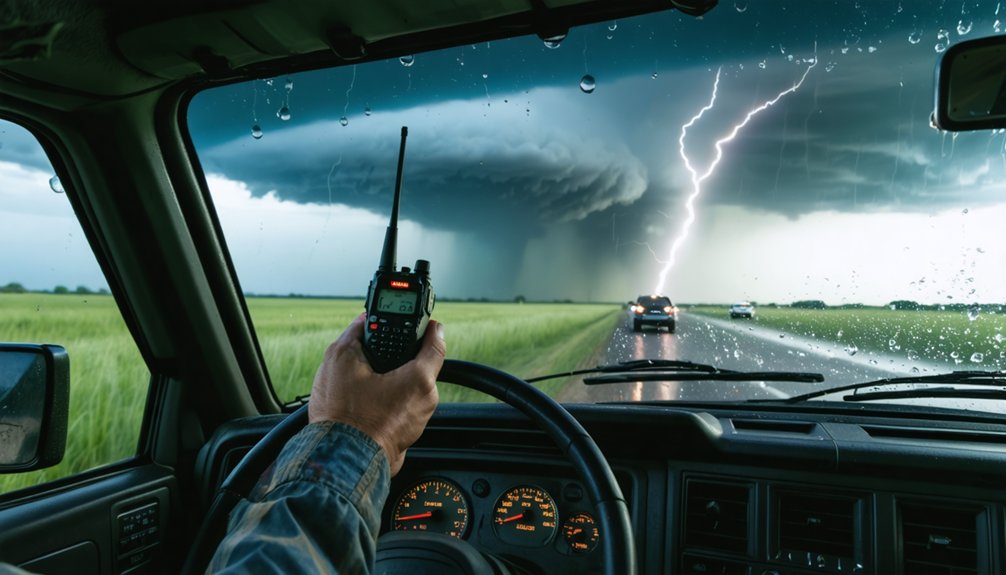
Optimizing storm shelter locations as a chaser means ditching static thinking entirely. You can’t rely on fixed underground bunkers when you’re moving at highway speeds alongside an evolving supercell. Position yourself southeast of the storm in the forward-flank downdraft boundary, maintain a 3-to-5-mile separation, and continuously recalculate escape routes perpendicular to the storm’s track. Structural standards, floodplain restrictions, and real-time satellite monitoring all factor into every decision you make—and there’s considerably more strategy involved than most chasers initially expect.
Key Takeaways
- Stay southeast of supercells in the “notch” position, maintaining a strict 3-to-5-mile distance for safety and visibility.
- Select shelters meeting FEMA Pub-320 standards, avoiding floodplains and locations near trees, power lines, or unstable structures.
- Map multiple escape routes perpendicular to the storm’s projected path, avoiding roads under power lines or large trees.
- Continuously recalculate escape routes every few minutes using satellite imagery and real-time storm trajectory data.
- Conduct regular shelter drills simulating real conditions, debriefing afterward to identify failures and improve emergency response procedures.
Why Generic Shelter Advice Fails Storm Chasers
Generic shelter advice assumes you’re stationary, but storm chasers operate in a constantly shifting threat environment where fixed-location guidance breaks down fast. Standard recommendations prioritize underground basements and reinforced structures — options that simply don’t exist roadside at 60 mph.
Historical tornado data confirms that tornadoes shift track unpredictably, meaning a shelter that’s safe one minute can fall directly into a storm’s path the next. Generic advice doesn’t account for your dynamic position relative to a supercell.
Shelter material selection matters when you’re improvising in the field. Concrete overpasses, for example, are widely misunderstood as safe options but actually funnel and accelerate wind.
You need location-specific, mobility-aware strategies — not one-size-fits-all protocols designed for homeowners who never move during a storm.
How to Read a Supercell Before You Commit to a Position
Before you commit to any position, you’ve got to read 3 critical structural features of the supercell: the wall cloud, the forward-flank downdraft boundary, and the rear-flank downdraft.
Each element tells you where the tornado is likely to develop and where you’ll be trapped if you misread it.
Monitor cloud rotation intensity within the wall cloud — accelerating rotation signals rapid tornado development.
Accelerating rotation within the wall cloud is your earliest warning — when it spins faster, a tornado is imminent.
Use satellite imagery to track the supercell’s broader motion vector and identify organizational changes before they’re visible at ground level.
The forward-flank downdraft boundary defines your safest approach corridor, typically from the southeast.
The rear-flank downdraft wraps around the back — crossing it puts you directly in the danger zone.
Position yourself to the southeast, keep your escape routes open, and never let the storm dictate your movement.
Where to Position Yourself Around a Tornadic Storm
Reading the supercell’s structure tells you what the storm is doing — but your position around it determines whether you stay safe or get trapped.
In the northern hemisphere, position yourself to the southeast of the supercell — the “notch” — to maintain visual contact while avoiding the primary damage path. Never cross north of a tornadic storm; approach exclusively from the west, south, or east.
When you’re forced to shelter, prioritize structures with engineered concrete or steel shelter material that meets FEMA Pub-320 standards. Confirm emergency signage is visible and unobstructed so you’re not wasting critical seconds locating access points.
Always maintain multiple escape routes running perpendicular to the storm’s track, and never let a single route become your only option.
How Far From the Tornado Is Actually Safe?
Maintaining a distance of 3 to 5 miles from the storm gives you enough reaction time when a tornado shifts direction unexpectedly. At closer ranges, you’re surrendering your freedom to maneuver, leaving little margin for error if the storm accelerates or pivots.
Underground placement of your designated shelter reinforces this buffer strategy. If you’re operating near a staging area, your shelter’s subsurface position reduces exposure to debris traveling at extreme velocities. Structural reinforcement of any above-ground components further protects your equipment and personnel when proximity is unavoidable.
Never assume a tornado’s path stays predictable. Storms evolve rapidly, and distance is your most reliable safety variable. Treat the 3-to-5-mile threshold as a hard operational limit, not a suggestion, and you’ll preserve both your safety and your ability to collect data effectively.
What to Look for in a Field-Accessible Storm Shelter
Keeping your distance from a tornado only works if you’ve got a reliable place to go when conditions deteriorate faster than expected.
When scouting field-accessible storm shelters, prioritize soil stability first — unstable or saturated ground compromises structural integrity and can flood underground entries fast.
Avoid sites near dense vegetation that attract wildlife interference, which can block access or damage shelter seals over time.
Confirm the shelter meets FEMA Pub-320, ICC 500, and NSSA standards.
You need unobstructed walkable routes, multiple escape vectors, and zero overhead hazards like power lines or trees.
Position the shelter away from structures that could collapse onto the entry point.
Check it regularly, keep it stocked, and ensure every team member knows exactly how to reach it under pressure.
Where Never to Place Your Storm Shelter
Avoid placing your storm shelter in a 100-year floodplain or any area where water accumulates, since flooding can render it inaccessible or dangerous when you need it most.
You should also keep your shelter clear of large trees, power lines, and other structures that could collapse and block your entry during high winds.
Both hazards—flood exposure and falling debris—can compromise your shelter’s effectiveness before you ever reach its door.
Flood-Prone Zone Risks
Where you place your storm shelter can mean the difference between life and death—so you must never install an underground shelter within a 100-year floodplain or in any area prone to flooding. Floodwaters can infiltrate underground shelters rapidly, trapping occupants inside with no viable escape route.
Effective flood mitigation starts with your site selection. Before installation, verify local zoning laws and building codes regarding floodplain restrictions, and consult topographical maps to assess your property’s water drainage patterns.
Low-lying areas, regions near rivers, and zones with poor soil absorption rates all present unacceptable risk.
If underground placement isn’t feasible due to flooding concerns, shift to an engineered above-ground concrete or steel safe room that meets FEMA Pub-320, NSSA, and ICC 500 safety standards.
Falling Hazard Proximity
Flood risk isn’t the only placement threat that can turn your shelter into a death trap—falling hazards above and around your shelter demand equal scrutiny.
Tree impact is a critical threat; a mature tree’s root system and canopy spread can extend far beyond its trunk, making proximity dangerous even at moderate distances. Position your shelter clear of any tree capable of collapsing onto its entrance or structure.
Utility line proximity compounds this risk markedly—downed electrical lines during a tornado create electrocution hazards that block safe access entirely. Survey your proposed shelter site for overhead power infrastructure and maintain clearance accordingly.
Additionally, avoid placing your shelter within the collapse zone of nearby outbuildings or fencing.
Every surrounding hazard you eliminate now preserves your escape route when seconds determine survival.
How to Build Escape Routes Before the Storm Moves
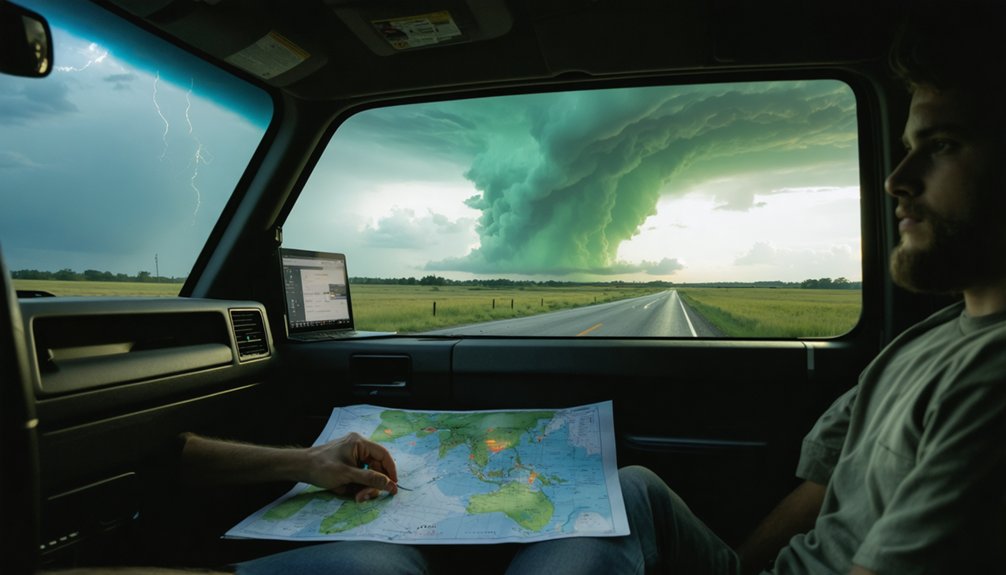
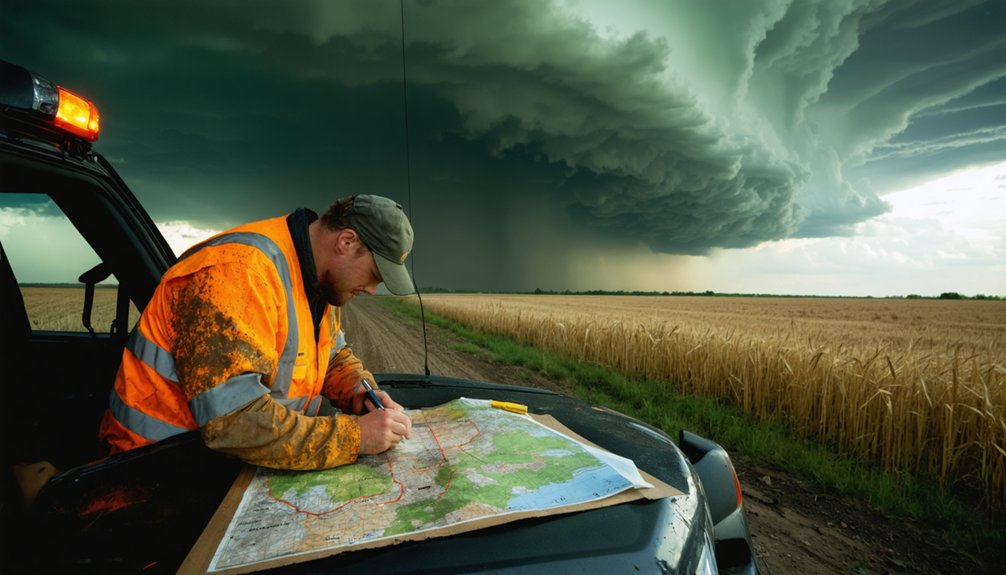
Before a storm closes in, you need to map at least two or three distinct exit paths that route away from the storm’s projected track.
You should time each route against the storm’s estimated speed, keeping yourself 3 to 5 miles ahead to maintain a critical reaction buffer.
Never rely on a single escape corridor—if the storm shifts, a blocked or compromised route can trap you with no alternatives.
Mapping Multiple Exit Paths
Planning your escape routes before a storm develops is one of the most critical steps in storm shelter preparation. Shelter durability means nothing if you can’t reach it safely. Prioritize access point placement and map multiple exit paths now, not when the storm is bearing down.
Follow these four steps to build reliable escape routes:
- Identify at least three directional exits moving away from the storm’s projected path.
- Avoid routes that pass under power lines, large trees, or unstable structures.
- Mark alternate roads on both digital and physical maps as backups.
- Establish multiple escape routes that avoid the storm’s path to prevent being trapped.
Review your routes regularly and adjust them as local infrastructure or terrain conditions change.
Timing Routes With Storm
Timing your escape routes to the storm’s movement is what separates a functional plan from a dangerous one. You’ll need to analyze weather pattern analysis data continuously, cross-referencing storm trajectory with your predetermined exit corridors. Never commit to a single route; supercells shift unpredictably, and static plans get people killed.
Use satellite imagery to monitor storm organization and forward speed before you’re ever in the field. Build your escape routes perpendicular to the tornado’s projected path, positioning yourself southeast of the supercell while keeping southern and eastern corridors fully open.
Maintain 3 to 5 miles of separation, and recalculate your exits every few minutes as conditions evolve. Your freedom to move depends entirely on your preparation before the storm forces your hand.
What Your Chase Emergency Kit Must Contain
Whether you’re pursuing a supercell or sheltering in place, your chase emergency kit can determine whether you survive a rapidly deteriorating situation. Keep your tank above half-full and your kit stocked with precision-selected essentials that support both mobility and shelter security.
Your kit must include:
- Emergency food and water — minimum 72-hour supply, compact and calorie-dense
- First aid supplies — trauma-grade bandages, tourniquets, and prescription medications
- Navigation tools — paper maps, charged GPS device, and backup batteries
- Shelter security gear — reinforced tarps, zip ties, and a portable weather radio
Inspect your kit before every chase. Expired supplies and dead batteries compromise your survival margin when conditions deteriorate faster than your escape route allows.
How to Run Tornado Shelter Drills That Stick
Run drills unannounced to simulate real conditions. Afterward, debrief immediately and document what failed. Update your procedures based on those lessons, not assumptions.
Check indoor ventilation inside your shelter during drills to confirm airflow remains functional under sealed conditions. A compromised ventilation system becomes a serious hazard during extended shelter use.
Track who enters the shelter using a prepared roster. Test your alarm system regularly.
Freedom-minded preparedness means you control the outcome—don’t leave that to chance.
Frequently Asked Questions
What Legal Permits Are Required for Installing a Storm Shelter on Private Land?
You’ll need local building permits and zoning approvals before installing a storm shelter. Verify floodplain regulations, meet FEMA and ICC 500 standards, and integrate emergency communication systems. Prioritize shelter maintenance compliance to satisfy all jurisdictional requirements.
How Do Local Zoning Laws Affect Underground Shelter Placement in Floodplains?
You must verify local zoning compliance before installing underground shelters, as floodplain restrictions often prohibit placement within 100-year floodplains. Don’t assume approval—check municipal codes directly to protect your shelter investment and maintain legal standing.
Can a Storm Shelter Legally Be Shared Between Neighboring Properties or Landowners?
You can legally share storm shelter access across property boundaries, but you’ll need formal easement agreements and must verify local zoning laws to guarantee shared access complies with building codes and safety standards.
What Structural Certifications Must a Storm Shelter Meet for Insurance Coverage?
Your shelter must meet NSSA, ICC 500, and FEMA Pub-320 standards to qualify for insurance coverage. These certifications confirm shelter durability and validate your emergency preparedness, ensuring you’re protected structurally and financially when it matters most.
How Does Soil Type Affect the Safety of an Underground Storm Shelter?
Soil stability seriously shapes your shelter’s safety. Sandy or saturated soils shift, compromise structural integrity, and create drainage concerns that flood underground spaces. You’ll need geotechnical assessments before installation to guarantee your shelter withstands pressure and remains reliably secure.
References
- https://www.weather.gov/eax/stormanxiety-shelter
- http://www.osha.gov/tornado/preparedness
- https://jtserviceco.com/finding-the-ideal-spot-for-your-storm-shelter/
- https://www.youtube.com/watch?v=Jpa6H_eNlC4
- https://www.youtube.com/watch?v=6otZLjSZvPU
- https://www.youtube.com/watch?v=fABwvj0rP_A