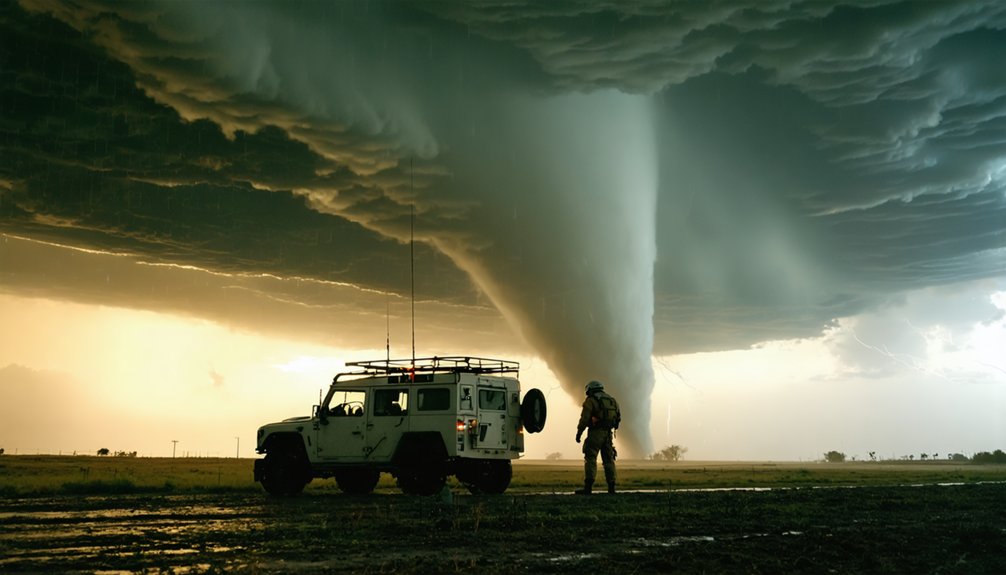
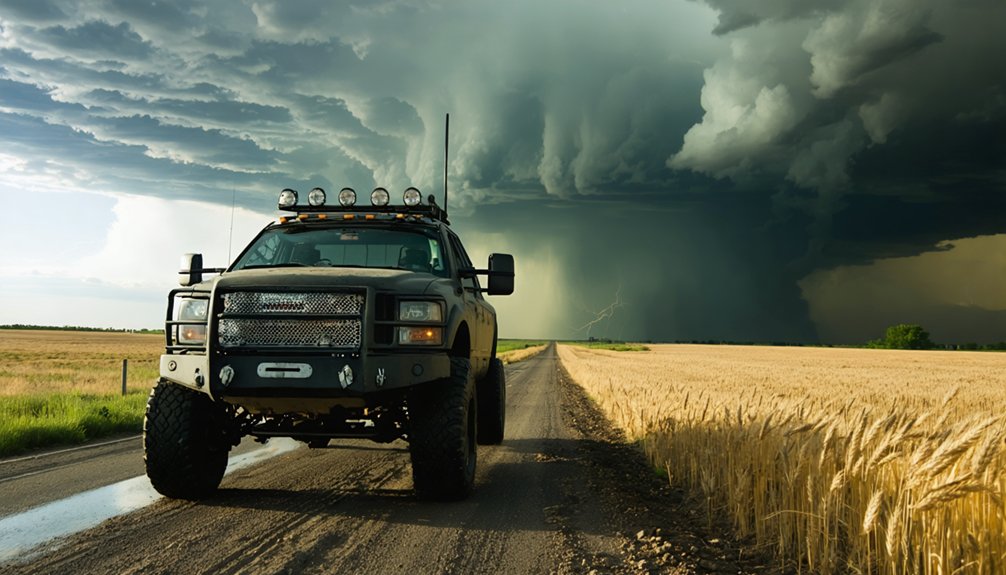
Mastering Tornado Alley’s 500+ annual tornadoes demands a layered strategy. You’ll need to monitor the Storm Prediction Center’s daily outlooks, assemble a rapid-deploy safety kit, and pre-identify FEMA-compliant shelters along your route. During a tornado, abandon your vehicle immediately and seek low-lying ground—never shelter under overpasses. Post-storm, rely on battery-operated radios for official updates. Combine these tactics with family drills and communication protocols, and the strategies ahead will sharpen your preparedness even further.
Key Takeaways
- Monitor Storm Prediction Center outlooks and install real-time alert apps like StormWatch+ before driving through Tornado Alley.
- Pack a quick-grab safety kit with water, first-aid supplies, helmets, blankets, and a battery-powered radio.
- Identify FEMA-compliant shelters and underground basements along your route before departing.
- If caught outdoors, abandon your vehicle, find low-lying ground, lie flat, and protect your head and neck.
- Never shelter under highway overpasses, as wind tunnel effects dramatically increase debris speed and fatality risk.
Read These Tornado Warning Signs Before You Drive
Before you drive through Tornado Alley, check the Storm Prediction Center’s daily outlooks and mesoscale discussions for active severe weather risks. Review your local National Weather Service forecasts, watches, and warnings before departure. Install StormWatch+ or similar location-based apps to receive real-time tornado warning sounds and push alerts while mobile.
Monitor weather pattern changes carefully — rapidly rotating wall clouds, greenish skies, large hail, and sudden atmospheric pressure drops signal imminent tornado development. These indicators demand immediate action, not hesitation.
Identify public storm shelter locations along your entire route using map overlays before you leave. If forecasts indicate severe weather targeting your corridor, postpone or reroute without compromise. Your freedom to move depends on making calculated, data-informed decisions before conditions eliminate your options entirely.
Pack a Tornado Safety Kit Before You Leave Home
Assembling a tornado safety kit before departure isn’t optional — it’s a logistical requirement that directly affects your survival margin if conditions deteriorate mid-route. Proper emergency kit organization means packing bottled water, canned food, a first-aid kit, helmets, heavy blankets, flashlights, extra batteries, and a battery-operated radio into durable, easy-to-carry containers.
A tornado safety kit isn’t optional — it’s the logistical backbone of your survival margin on the road.
Keep medications and your cell phone immediately accessible — not buried beneath gear.
Shelter accessibility depends on how fast you can deploy your supplies once you’ve reached a safe location. Store everything in a single container you can grab within seconds.
Pre-organized kits eliminate decision fatigue during high-stress scenarios, cutting critical response time. Every item you pack serves a specific protective function — dead weight compromises mobility, so prioritize only what directly increases your survivability.
Know Which Shelters Actually Protect You From Tornadoes
Not all shelters offer equal protection, and choosing the wrong one can be fatal. Underground basements and FEMA-compliant storm shelters with reinforced shelter construction provide maximum survivability during direct tornado strikes.
Interior rooms on the lowest floor, away from windows and exterior walls, offer secondary protection when basements aren’t available.
Never shelter under highway overpasses—wind tunnel effects dramatically increase debris velocity and fatality risk.
Mobile homes and vehicles offer virtually zero protection regardless of how secure they feel.
Before traveling through Tornado Alley, review community tornado plans for your route using NWS map overlays identifying certified public shelters.
Knowing pre-approved shelter locations eliminates dangerous decision-making under pressure.
Your survival depends on choosing structurally verified protection, not convenient or familiar-looking spaces.
Tornado Safety Steps When You’re Caught in Your Car
Being caught in your car during a tornado is one of the most dangerous positions you can be in—vehicles offer minimal structural resistance and can be displaced by winds as low as 100 mph.
Your vehicle navigation priority should be reaching a substantial building immediately. If that’s impossible, abandon the vehicle entirely.
Exit and locate the nearest low-lying ditch or ground depression. Lie flat, covering your head and neck with both arms.
Never shelter under highway overpasses—they create lethal wind tunnel acceleration.
Maintain emergency communication by keeping your phone accessible for NWS alerts and real-time storm tracking.
Avoid attempting to outrun tornadoes via vehicle; their path shifts unpredictably.
Treat every downed power line post-storm as an active electrical hazard requiring complete avoidance.
How to Stay Safe Inside a Tornado Shelter
Once you’ve reached a tornado shelter, your actions inside determine survival outcomes as much as the shelter itself. Position yourself strategically and stay disciplined until authorities confirm the all-clear.
Follow these critical in-shelter protocols:
- Get low immediately — crouch against interior walls, maximizing barriers between you and outside structural exposure
- Cover your head and neck using helmets, heavy blankets, or mattresses to reduce debris injury risk
- Monitor shelter ventilation — avoid blocking air circulation points, which prevents dangerous pressure buildup
- Locate emergency exit routes before the storm intensifies so you’re never trapped post-event
Keep your battery-operated radio active for official updates. Don’t open doors or windows during the storm. Movement outside prematurely kills — wait for verified confirmation before exiting.
Build a Family Tornado Safety Plan Before Storm Season
When tornado season arrives, your family’s survival odds increase considerably with a pre-established emergency plan rather than improvised decisions under pressure. Communication planning forms the backbone of effective tornado preparedness.
A pre-established emergency plan dramatically increases your family’s survival odds when tornado season strikes.
Designate an out-of-area contact your family members can independently reach if you’re separated during an event.
Shelter location mapping is equally critical. Identify multiple shelter points along your regular travel routes and neighborhood, not just your home. Mark these locations explicitly so every family member knows them without GPS dependency.
Schedule drills at the start of each severe weather season. Practice moving to your designated shelter quickly, accounting for pets and mobility needs. Establish clear roles so no one wastes time debating responsibilities when sirens activate.
Preparation eliminates hesitation, and hesitation costs lives.
Pre-Trip Tornado Drills That Prepare Your Whole Family

Drills don’t stop at your front door. Before driving through Tornado Alley, run location-specific scenarios with your family. Practice emergency communication protocols so everyone knows who to contact and how when cell networks are congested. Test shelter accessibility along your planned route by identifying real structures in advance.
Include these drill components before departure:
- Simulate a roadside tornado event and practice exiting toward a solid structure
- Designate an out-of-area contact and confirm every member has the number memorized
- Walk through your emergency kit contents so everyone operates it independently
- Practice low-position sheltering techniques using blankets and helmets at home first
Repeating these drills builds automatic responses. When a tornado warning activates mid-trip, your family executes, not hesitates.
Frequently Asked Questions
What Time of Year Does Tornado Season Typically Peak in Tornado Alley?
Perilous peak periods pummel Tornado Alley from April through June. You’ll face the greatest tornado safety risks during these months, so storm preparedness must intensify as spring’s volatile atmospheric conditions collide, maximizing severe weather threats.
How Long Does the Average Tornado Last Before It Dissipates Completely?
Most tornadoes you’ll encounter last under 10 minutes, though some persist over an hour. Understanding tornado formation and applying storm tracking techniques lets you monitor dissipation patterns and make precise, data-driven decisions about your safety and movement.
Can Tornado Damage Be Covered Under Standard Auto Insurance Policies?
Yes, your extensive auto insurance coverage typically covers tornado damage claims. You’ll need to file promptly, document all damage thoroughly, and confirm your deductible amount, as liability-only policies won’t protect your vehicle from storm-related losses.
What States Are Officially Included Within the Tornado Alley Region?
Tornado Alley typically includes Texas, Oklahoma, Kansas, Nebraska, South Dakota, and Iowa. You’ll want to prioritize tornado safety and emergency preparedness when traveling through these high-risk states, as they’re statistically prone to frequent, violent tornado activity.
How Do Meteorologists Officially Classify Tornado Strength and Wind Speed?
Meteorologists classify tornado strength using the Enhanced Fujita (EF) Scale, rating EF0–EF5 based on wind speeds from 65–200+ mph. You’ll find storm tracking techniques and tornado safety decisions rely heavily on this precise, data-driven classification system.
References
- https://everything-everywhere.com/traveling-in-tornado-alley-a-guide-for-visitors/
- https://www.mercuryinsurance.com/resources/weather/seven-safety-tips-for-tornadoes-you-must-know.html
- https://www.facebook.com/groups/rvlifepro/posts/2480426792367579/
- https://iowastartingline.com/community/staying-safe-iowas-tornado-alley/
- https://stormtrack.org/threads/storm-chasers-guide-to-navigating-tornado-alley.31471/
- https://www.kcur.org/podcast/up-to-date/2021-03-24/how-to-survive-living-in-tornado-alley
- https://steemit.com/travel/@winstonwolfe/7-tips-to-survive-in-tornado-alley-severe-weather-preparedness-week-2018
- https://www.ankersolix.com/blogs/home-power-backup/tornado-alley-safety-guide
- https://www.cannon.af.mil/News/Article/208071/tornado-safety-key-to-surviving-severe-weather-season/
- https://www.reddit.com/r/AskAnAmerican/comments/u123d9/redditors_from_the_tornado_alley_how_do_you_live/