If you’re storm chasing, both trucks bring serious capability, but they excel in different areas. The F-150 edges ahead with superior suspension architecture, higher payload capacity, better fuel efficiency, and stronger weather resistance through its aluminum body. The Silverado counters with mechanical simplicity and cheaper repair costs when panels take a beating. Your best choice ultimately depends on whether you prioritize long-range operational performance or field-maintainable durability—and there’s much more to unpack on both fronts.
Key Takeaways
- The F-150 leads in payload (2,440 lb) and towing (14,000 lb), offering superior capacity for hauling heavy storm-chasing equipment.
- F-150’s PowerBoost hybrid achieves 25 mpg combined, reducing fuel costs during high-mileage storm-chasing seasons.
- F-150 Raptor and Tremor provide Fox Racing shocks and 13-inch ground clearance for superior off-road performance.
- Ford Co-Pilot360’s pre-collision system offers faster brake intervention, enhancing safety in rapidly deteriorating storm conditions.
- Silverado’s steel body allows simpler, cheaper repairs, while F-150’s aluminum construction provides better corrosion resistance.
What Makes a Truck Good for Storm Chasing?
Storm chasing demands a truck that can handle punishing conditions without compromising safety or capability.
Storm chasing demands a truck engineered for punishment — where safety and raw capability are never up for negotiation.
You need a platform built around reinforced frames, high-torque engines, and real-time hazard detection to stay ahead of rapidly evolving threats. High ground clearance and advanced all-wheel-drive systems keep you moving across waterlogged roads and debris fields where lesser vehicles stall out.
Storm preparedness also depends on towing and payload capacity.
You’ll carry sensor sleds, generators, and video gear, so the chassis must absorb that load without strain. Equipment storage solutions, including secure tie-down points and robust bed configurations, let you organize cameras, computers, and portable weather stations efficiently.
Fuel range matters too — fewer stops mean more time tracking storms across sparse rural terrain where gas stations aren’t guaranteed.
Can the F-150 or Silverado Handle Storm-Chasing Gear?
Both the Ford F-150 and Chevy Silverado 1500 meet the towing and payload demands that serious storm-chasing rigs require.
The F-150 edges ahead with up to 14,000 lb towing and a payload capacity reaching 2,440 lb, giving you more flexibility when loading storm gear like sensor sleds, generators, and radar equipment.
The Silverado 1500 delivers up to 13,300 lb towing and roughly 2,260 lb payload—still capable, but marginally behind Ford’s peak figures.
Both trucks offer robust bed tie-downs, four-wheel drive, and trailer-sway control, which are critical when you’re hauling heavy equipment at highway speeds through crosswinds.
If you’re running maximum storm gear configurations, the F-150’s higher payload capacity gives you a measurable operational advantage in the field.
Which Truck Is Safer on Storm-Chasing Roads?
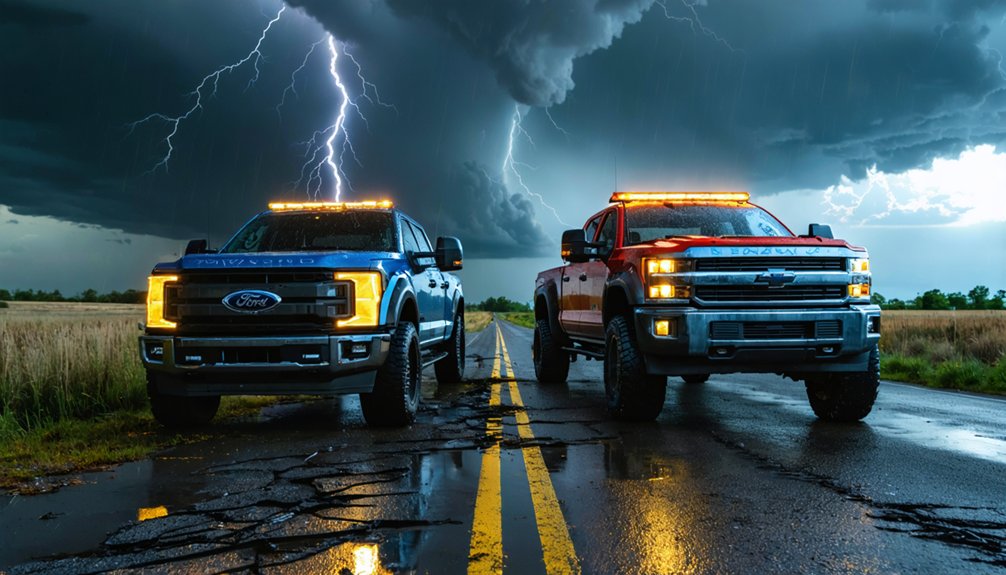
When you’re traversing flooded roads and debris fields at speed, both trucks offer lane-keeping assist, adaptive cruise control, and automatic emergency braking.
However, you’ll find the F-150’s Ford Co-Pilot360 suite more extensively standard across trims than Silverado’s Safety Package II, which requires higher configurations.
For off-road stability, the F-150 Raptor and Tremor trims edge out the Silverado Trail Boss with superior suspension travel and additional skid-plate coverage, reducing underbody vulnerability on rutted chase roads.
You’ll also benefit from both trucks’ terrain-management modes and locking differentials, though the F-150’s broader powertrain options let you optimize traction response more precisely under high-wind and crosswind conditions.
Advanced Safety Technology Comparison
Traversing flooded roads, debris-strewn highways, and near-zero visibility demands that your truck’s safety systems perform as reliably as its drivetrain.
Both the F-150 and Silverado 1500 pack meaningful safety innovations, but their collision avoidance execution differs. Ford’s Co-Pilot360 suite delivers automatic emergency braking, lane-keeping assist, blind-spot monitoring, and adaptive cruise control as standard across most trims.
Chevy’s Safety Assist package mirrors those features but reserves certain automated functions for higher trim levels, requiring closer configuration scrutiny. Ford’s pre-collision system responds with slightly faster brake intervention according to independent testing, a measurable edge when a debris wall appears suddenly at highway speed.
Both systems support trailer sway control, critical when crosswinds destabilize your equipment load.
Choose your trim carefully—feature availability varies greatly between base and upgraded packages.
Off-Road Stability Features
Storm-chasing roads don’t forgive mechanical hesitation—flooded creek crossings, rutted dirt paths, and hail-strewn highways demand trucks engineered for instability.
Both trucks deliver credible off-road performance, but their approaches differ meaningfully.
The F-150 Raptor and Tremor trims deploy specialized long-travel suspensions, extended skid-plate coverage, and terrain-management modes that actively redistribute torque during traction loss.
Stability control intervenes precisely, letting you maintain momentum without sacrificing directional authority.
The Silverado Trail Boss counters with raised suspension, off-road-tuned calibration, and aggressive skid plates engineered for mud, rock, and water crossings.
Its stability control system reads wheel slip aggressively, correcting understeer before it compounds.
Edge: F-150. Its suspension architecture and terrain-mode granularity give you finer control when conditions deteriorate fastest—exactly when precision matters most.
How Do These Trucks Handle Off-Road Chase Conditions?
When you’re pushing through flooded roads and debris-scattered terrain, both trucks offer purpose-built off-road trims—the F-150 Raptor/Tremor and the Silverado Trail Boss—that deliver raised suspensions, skid plates, and locking differentials to keep you moving through rough chase conditions.
You’ll find the F-150 edges ahead with slightly greater ground clearance and terrain-management modes tuned for waterlogged surfaces, while the Silverado’s Trail Boss counters with off-road-specific tuning proven on mud, rocks, and water crossings.
Higher-trim packages on both platforms also include weather-sealed wiring and water-resistant electronics, which you’ll depend on heavily when driving rain and hail threaten your onboard instrumentation.
Off-Road Suspension Capabilities
Off-road suspension capability can determine whether your chase vehicle pushes through flooded backroads or gets stranded mid-pursuit. Both trucks offer serious off-road tuning, but differ in execution:
- F-150 Raptor/Tremor: Fox Racing shocks with longer suspension travel absorb severe impacts, keeping you planted on rutted terrain.
- Silverado Trail Boss: Rancho shocks with a 2-inch lift deliver capable off-road tuning for mud crossings and uneven surfaces.
- Ground Clearance: Raptor leads with approximately 13 inches; Trail Boss delivers around 11 inches, affecting water-crossing confidence.
- Terrain Management: Both platforms offer selectable drive modes that actively adjust throttle, braking, and differential engagement for loose or waterlogged surfaces.
The F-150’s suspension travel advantage gives you a measurable edge when conditions deteriorate fastest.
Traction On Rough Terrain
Suspension travel sets the stage, but traction systems determine whether that suspension advantage actually keeps you moving when grip disappears beneath your tires.
Both trucks deploy active traction control with terrain-management modes, but their execution differs meaningfully.
The F-150 Raptor and Tremor deliver terrain grip through selectable drive modes—Baja, Rock Crawl, Mud/Sand—that independently adjust throttle mapping, differential locking, and stability intervention.
You’re getting granular control when chase roads deteriorate fast.
The Silverado Trail Boss counters with an automatic locking rear differential and off-road-calibrated traction control that prioritizes mechanical grip over electronic correction.
That bias toward hardware suits drivers who prefer raw, predictable response.
Both systems perform competently, but the F-150’s broader mode selection gives you more adaptive options when terrain conditions shift unpredictably mid-chase.
Weather-Sealed Component Reliability
Traction systems keep you moving, but weather-sealed components determine whether your truck stays operational through sustained hail, driving rain, and debris impacts.
Both trucks offer weather resistance on higher trims, but differences in component durability matter when you’re deep in chase territory.
- Wiring protection: F-150’s aluminum body reduces corrosion risk; Silverado’s steel construction demands more diligent moisture management.
- Electronics sealing: Both trucks seal critical modules on off-road trims, though F-150 Raptor and Silverado Trail Boss lead their lineups.
- Underbody shielding: Skid plates on both off-road trims block debris from damaging sealed components underneath.
- Sensor reliability: F-150’s advanced driver-assistance sensors maintain better calibration consistency in heavy precipitation across documented field conditions.
Choose your trim strategically—weather resistance degrades fast without proper factory sealing.
Which Engine Gives Storm Chasers More Power and Range?
When choosing an engine for storm chasing, you’ll find the Ford F-150’s powertrain lineup edges out the Silverado 1500’s in both efficiency and versatility.
The F-150’s PowerBoost hybrid delivers 25 mpg combined, giving you measurably better fuel efficiency than the Silverado’s best gasoline option, the 2.7L turbo, which tops out at 23 mpg. That gap translates directly into extended range between rural fuel stops during active chase days.
For raw engine performance, the F-150’s six available powertrains—including the high-output 3.5L EcoBoost V6 and 5.0L V8—give you more configuration flexibility than the Silverado’s four options.
The Silverado’s 3.0L Duramax diesel offers strong torque, but the F-150’s hybrid system balances power and economy without sacrificing towing capacity, making it the sharper tool for prolonged, high-mileage chasing operations.
Which Truck Costs Less to Own Over Time?
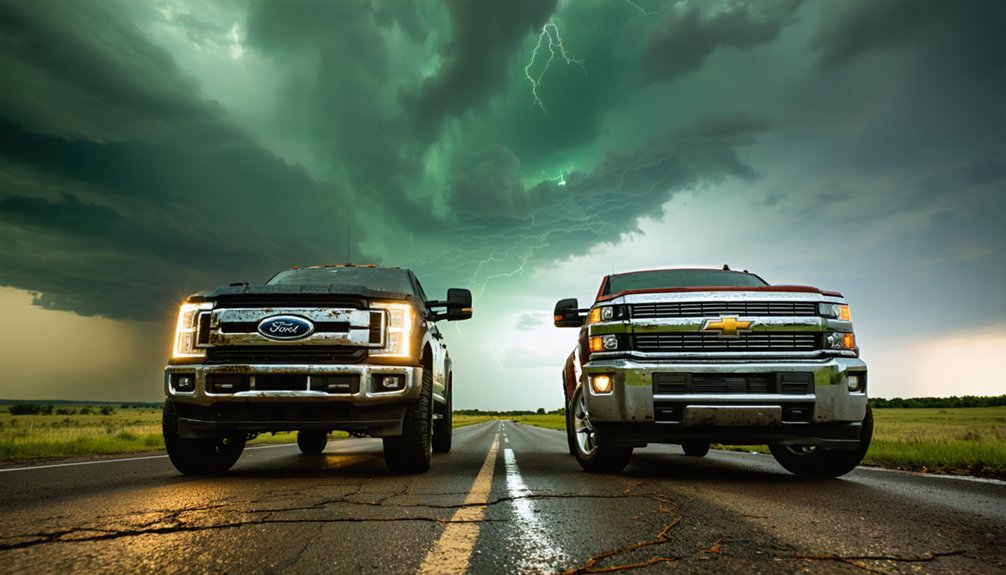
Engine performance and range matter on chase day, but long-term ownership costs shape which truck makes financial sense across a full season or career. Cost analysis and ownership trends favor the F-150 in several measurable categories:
- Fuel efficiency: The F-150 PowerBoost hybrid achieves 25 mpg combined versus the Silverado’s 23 mpg, reducing fuel expenditure across high-mileage chase seasons.
- Resale value: F-150 retains roughly 63% value compared to Silverado’s 61%, delivering a stronger trade-in return.
- Residual advantage: ALG data show F-150 holds approximately 4% higher residual value after three years, translating to thousands saved.
- Repair complexity: Silverado’s steel body offers simpler, cheaper panel repairs versus F-150’s aluminum construction.
You’ll weigh efficiency gains against repair simplicity based on your operational priorities.
Which Truck Should Storm Chasers Actually Buy?
Both trucks clear the bar for storm chasing, but the better buy depends on how you weight capability trade-offs against long-term costs.
Both trucks are capable storm chasers, but the smarter buy hinges on balancing capability trade-offs against long-term costs.
If fuel efficiency and resale value matter to your budget, the F-150 PowerBoost hybrid‘s 25 mpg combined and roughly 4% stronger residual value give it a measurable financial edge over extended campaigns. Its higher payload ceiling also accommodates heavier sensor arrays without margin anxiety.
Choose the Silverado if you prioritize diesel torque for towing radar trailers, prefer steel-body repairability in the field, or favor the Trail Boss’s proven off-road tuning.
Both platforms support four-wheel drive, skid plates, and terrain management. Your decision ultimately hinges on whether operational range and resale returns outweigh the Silverado’s mechanical simplicity and torque delivery.
Frequently Asked Questions
Can Storm Chasers Legally Modify These Trucks for Radar Equipment?
Yes, you can make legal modifications for radar installations—though permits vary by state. Both trucks’ robust frames support professional-grade equipment mounts, letting you chase storms freely without compromising structural integrity or violating transportation regulations.
How Do F-150 and Silverado Perform in Large Hail Impacts?
Both trucks face hail damage risks differently: you’ll find the Silverado’s steel body dents but repairs easily, while the F-150’s aluminum construction resists corrosion yet requires specialized truck durability-focused repair techniques after significant impacts.
Do Professional Storm Chasers Prefer Manual or Automatic Transmissions?
Modern automatics dominate storm chasing transmission preferences because they’ll adapt faster to rapidly changing driving conditions. You’ll gain quicker gear responses, better torque management, and reduced cognitive load when maneuvering flooded roads or debris-covered terrain simultaneously.
Which Truck Handles Better When Driving Toward a Tornado?
The F-150’s lighter aluminum body gives you better tornado maneuverability, while both trucks’ stability control systems keep you grounded. However, the Raptor’s specialized suspension edges out the Silverado Trail Boss when you’re pushing hard toward rotating storms.
Are There Storm-Chasing Communities That Favor One Truck Brand?
You’ll find brand loyalty splits community preferences, but many professional chasers favor Ford’s F-150 for its hybrid efficiency and higher payload, while grassroots crews often trust Silverado’s steel-body durability and straightforward repairability in remote areas.
References
- https://www.youtube.com/watch?v=2kl-DyODrcY
- https://www.facebook.com/groups/1939836749567520/posts/3606121066272405/
- https://www.edmunds.com/car-news/ford-f150-tremor-ram-1500-rebel-chevy-silverado-trail-boss-comparison-test-video.html
- https://www.wallacefordofkingsport.com/ford-f-150-vs-chevy-silverado-1500.html
- https://www.capitalfordofwilmington.com/research/ford-f-150-vs-chevy-silverado-1500-comparison
- https://www.autonationfordarlington.com/research/comparison-ford-f150-vs-chevrolet-silverado-1500.htm
- https://www.youtube.com/watch?v=E28JKr69_YY
- https://www.sneedford.com/blogs/5049/ford-f-150-vs-chevy-silverado-which-truck-wins
- https://crazystormchasers.com/best-vehicles-for-chasing-supercell-storms/
- https://www.hookeroad.com/blogs/news/ford-f-150-vs-chevy-silverado-the-ultimate-showdown-for-the-american-truck-crown