For storm chasers, the Midland WR400 tops the list because it supports up to 25 SAME county codes, delivers a 90+ dB alarm that cuts through vehicle noise, and runs on battery backup when the grid fails. You can’t rely on cellular networks when storms intensify — you need a dedicated device that doesn’t. Pair it with the right gear and strategy, and your situational awareness improves dramatically in the field.
Key Takeaways
- The Midland WR400 supports 25 SAME county codes, enabling route-specific alerts that reduce irrelevant warnings during storm chases.
- A minimum 90+ dB alarm output ensures warnings cut through vehicle noise and ambient chaos effectively.
- Battery backup is essential, maintaining continuous alerts when grid power fails during severe weather events.
- SAME filtering technology allows storm chasers to program multiple counties, ensuring targeted and relevant weather warnings.
- Layering weather radios with scanners and satellite apps creates redundant alert systems for safer storm chasing.
Why Storm Chasers Need a Dedicated Weather Radio
When you’re actively chasing severe weather, cellular networks frequently fail under the same conditions you’re trying to monitor. Tower congestion, physical damage, and power outages eliminate your primary alert source precisely when emergency preparedness matters most.
A dedicated weather radio operates independently on NOAA frequencies, giving you reliable signal amplification and reception regardless of carrier infrastructure status.
SAME technology lets you filter alerts by county code, so you’re only receiving warnings relevant to your current chase route rather than every broadcast in range. The Midland WR400 supports up to 25 county codes simultaneously, covering a moving path efficiently.
Pair that with 90+ dB alarm output to cut through vehicle noise, and you’ve got a purpose-built monitoring tool that keeps you informed without depending on systems that fail when storms intensify.
The Best Weather Radios for Storm Chasers
For storm chasers prioritizing reliable alert reception, the Midland WR400 stands out as the top dedicated weather radio pick in 2026. It combines precise SAME county-code filtering with practical field features that keep you informed when cellular networks fail.
Key specifications driving this recommendation:
The WR400’s specs aren’t arbitrary — they’re field-tested features engineered to keep storm chasers reliably informed when it matters most.
- 25 SAME county codes — program your entire chase route for targeted alerts without irrelevant broadcasts.
- 90+ dB alarm output — cuts through vehicle noise, wind, and ambient chaos during active pursuits.
- Battery backup — maintains reception through power disruptions common in severe weather zones.
Beyond tornado warnings, the WR400 also receives broadcasts covering aviation emergencies and marine safety, expanding your situational awareness across multiple hazard types. You’re getting a focused, reliable alerting tool rather than a cluttered multi-service scanner.
Why the Midland WR400 Tops the List
The Midland WR400 earns its top ranking by supporting up to 25 SAME county codes, letting you program your entire chase route in advance rather than filtering alerts manually on the fly.
Its 90+ dB alarm cuts through engine noise and road wind, ensuring you won’t miss a warning during active pursuit.
When grid power fails in a storm corridor, the onboard battery backup keeps the unit operational so your alert coverage stays continuous.
Superior County Code Programming
Because storm chasing puts you across multiple counties in hours, county-code filtering isn’t a convenience—it’s a core operational requirement. The Midland WR400 supports up to 25 SAME county codes, giving you the flexibility to pre-program your entire chase route before you leave.
That capacity translates directly into operational freedom:
- Route-wide coverage — Program every county along your projected path using satellite imaging and cloud analysis to anticipate storm movement.
- Noise reduction — You’ll only receive alerts relevant to your corridor, eliminating distracting warnings from distant counties.
- Instant reprogramming — As conditions shift, you can update county codes quickly without rebuilding your entire alert profile.
That’s 25 counties of targeted situational awareness running independently from your cellular connection.
Loud Alarm Output
When vehicle noise competes with your alert system, a weak alarm becomes a liability. Wind, rain gear rustling, and engine noise create an acoustic environment that swallows low-output alarms whole.
The Midland WR400 delivers a 90+ dB alarm, cutting through that interference without signal boosters or auxiliary speakers.
That output level isn’t arbitrary. At highway speeds with windows down, ambient cabin noise routinely exceeds 75 dB. A 90+ dB alarm maintains a meaningful signal-to-noise margin, ensuring you don’t miss a tornado warning during an active chase.
You’re operating in conditions where every second of reaction time counts. The WR400’s alarm volume is a measurable, field-relevant specification—not a marketing claim—making it a technically sound choice for serious storm chasers prioritizing reliable audible alerting.
Reliable Battery Backup
Severe weather doesn’t wait for a convenient power source. When the grid fails mid-chase, your WR400 keeps running on battery backup—no interruption, no missed alerts. Battery longevity directly determines how long you stay informed when external power sources disappear. The Midland WR400 addresses this with a reliable backup system built for field conditions.
Three reasons battery backup matters on a chase:
- Grid failure is common during severe weather events, cutting AC power without warning.
- Cellular networks degrade under storm conditions, making your weather radio your primary alert source.
- Extended deployments demand sustained battery longevity across hours, not minutes.
You can’t afford gaps in alert coverage. The WR400’s backup capability keeps you operational when power sources aren’t guaranteed.
SAME Alerts, Volume, and Battery: What Actually Matters
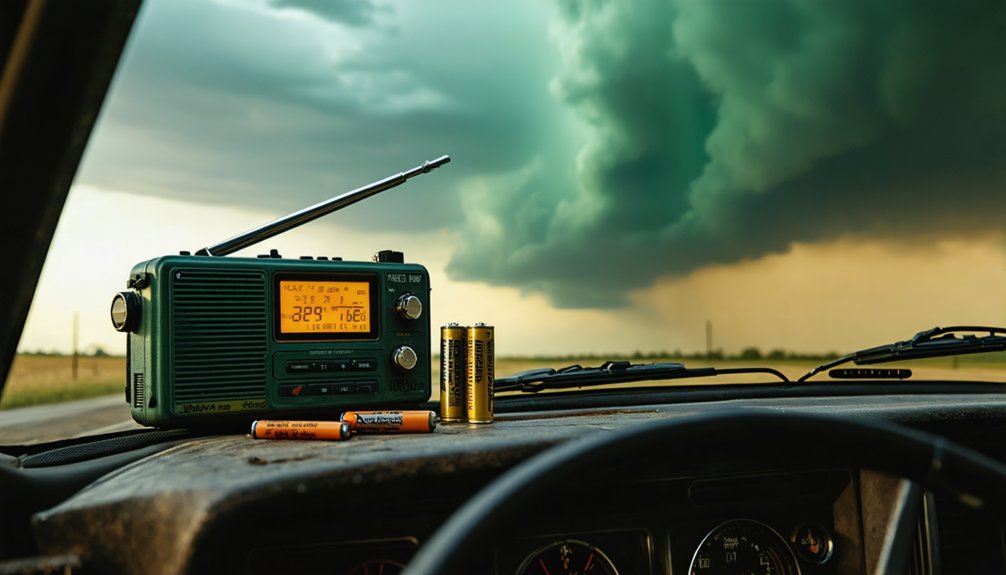
Three features separate a functional storm-chasing weather radio from a liability: SAME alert filtering, output volume, and battery backup. Don’t let aesthetic design or brand reputation drive your purchase—specs do.
SAME filtering lets you program up to 25 county codes, keeping alerts relevant to your actual route instead of flooding you with warnings from adjacent regions. The Midland WR400 supports exactly that capacity.
Volume matters because road noise and storm acoustics compete directly with your alarm. You need 90+ dB output—anything less risks a missed warning at highway speed.
Battery backup ensures continuity when grid power fails, which happens frequently during severe events. These three criteria aren’t preferences; they’re operational requirements. Prioritize them over every other spec on the sheet.
What Else Storm Chasers Use for Real-Time Alerts
A weather radio covers NOAA broadcasts, but it won’t catch everything you need on a chase. Cellular networks fail in active storm zones, so redundancy matters. Most experienced chasers layer their alert systems:
- Scanner (Uniden SDS100) — monitors P25 Phase I/II and DMR public-safety traffic with built-in GPS for automatic location-based programming as you move.
- Satellite imagery via dedicated apps — delivers real-time radar and mesoscale data independent of ground-based tower coverage.
- Internet streaming via mobile hotspot or satellite connection — keeps you linked to NWS data feeds and spotter networks when local infrastructure collapses.
No single device owns your situational awareness. You build a stack where each tool covers another’s blind spot, and you stay informed regardless of what the storm knocks out.
The Best Gear to Pair With Your Weather Radio
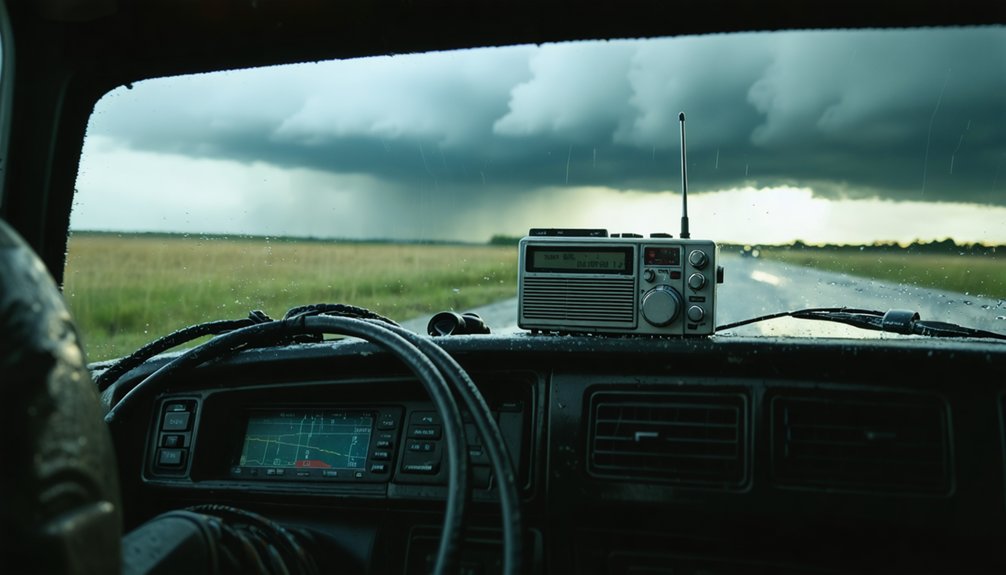
Once you’ve built your alert stack, the next step is choosing the communication gear that works alongside your weather radio when conditions deteriorate. The Midland MXT575 MicroMobile delivers 50W output for reliable repeater access across shifting chase routes.
For broader range, the Yaesu FT-991A covers HF/VHF/UHF, giving you flexible band options when infrastructure fails. Pair either radio with the Uniden SDS100 scanner, which uses built-in GPS to auto-program location-based public-safety feeds.
Round out your emergency kits with a tablet running live satellite imagery for mesoscale tracking between alerts. The StrikeAlert HD adds dedicated lightning detection, keeping you informed of strike proximity independent of NOAA broadcasts.
Each device serves a distinct function, eliminating single points of failure when cellular networks collapse mid-chase.
Frequently Asked Questions
Can a Weather Radio Replace a Cellular Alert App During Storms?
Yes, it can. When cellular networks fail during storms, your weather radio delivers uninterrupted SAME-coded county alerts. For true emergency preparedness, weather radio’s technology reliability outperforms app-dependent systems when infrastructure collapses around you.
How Many County Codes Can the Midland WR400 Store Simultaneously?
You can store up to 25 SAME county codes simultaneously on the Midland WR400, giving you precise weather alert coverage across your entire chase route — a critical edge in your emergency preparedness arsenal.
Does the WR400 Work Without an External Power Source in the Field?
Want true independence in the field? The WR400’s battery backup lets you receive alerts without external power, supporting your emergency preparedness and solar power setups, keeping you free and informed during unpredictable storm-chasing scenarios.
What Decibel Level Alarm Is Loud Enough for Vehicle Storm Chasing?
You’ll want a 90+ dB alarm to cut through vehicle noise during active chasing. The Midland WR400 hits that threshold, giving you sufficient volume sensitivity and alarm duration to catch every critical alert independently.
Do Storm Chasers Need a Ham Radio License to Use Recommended Gear?
Surprise—bureaucracy follows you into tornado alley. If you’re transmitting on amateur radio frequencies with gear like the Yaesu FT-991A, you’ll need to meet licensing requirements. Receive-only devices like the Midland WR400 don’t require one.
References
- https://cazatormentas.com/strikealert-hd-el-mejor-detector-de-rayos-para-un-cazatormentas/
- https://estaciondemeteorologia.com/el-kit-de-un-cazatormentas/
- https://www.amazon.com/-/es/Los-más-vendidos-Radios-Meteorológicas/zgbs/electronics/6893245011
- https://store.sirui.com/es/blogs/guides/essential-equipment-for-storm-chasing-guide-for-2025
- https://policeradioencryption.com/learn/storm-chaser-gear-guide
- https://crazystormchasers.com/best-ham-radio-setup-for-storm-chasers-and-spotters/
- https://www.reddit.com/r/stormchasing/comments/18k1dne/poc_radios/
- https://willowhavenoutdoor.com/what-is-the-best-ham-radio-for-preppers/
- https://crazystormchasers.com/ham-radio-for-storm-spotters-equipment-and-frequency-guide/