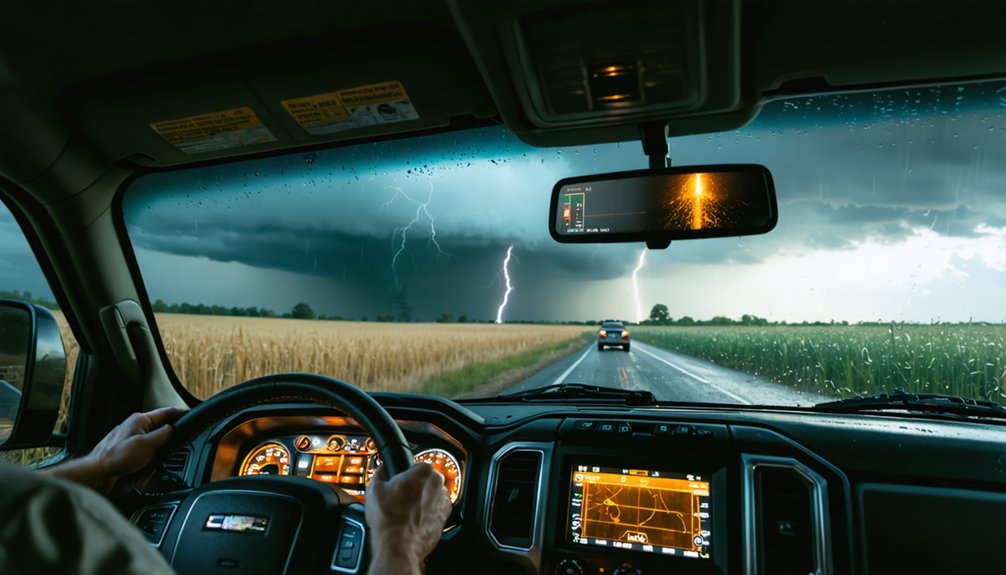
Chasing severe thunderstorms across the Midwest means you’ve got to master four core ingredients: lift, instability, moisture, and wind shear. You’ll want to identify boundary intersections like drylines and cold fronts two days out, then commit to an intercept point before storms force reactive decisions. Assess road networks for escape routes perpendicular to storm motion, and recognize rotation indicators like descending wall clouds. The systematic approach outlined ahead sharpens every phase of your intercept strategy.
Key Takeaways
- Severe storms form where lift, instability, moisture, and wind shear overlap, often triggered by drylines, cold fronts, and outflow boundaries.
- Two days before chasing, identify two or three candidate regions where storm ingredients converge without locking in a specific point.
- Commit to an intercept point by early afternoon, prioritizing locations with multiple exit routes and favorable road networks.
- Look for tornado indicators like a descending wall cloud, low-level rotation, inflow bands, and ground-level dust or debris.
- Always map two perpendicular escape routes before intercepting, avoiding dead-end roads and marking nearby shelter locations.
Where Midwest Severe Storms Actually Form
Midwest severe storms don’t form randomly—they develop where four key ingredients overlap: lift, instability, moisture, and wind shear.
Understanding severe storm formation means recognizing where these ingredients converge geographically.
Your primary trigger zones are drylines, cold fronts, warm fronts, and outflow boundaries.
Where two boundaries intersect—say, a dryline meeting a warm front—lift and shear concentrate, creating a high-probability intercept location.
Geographic factors matter greatly.
The central and southern Plains dominate spring severe weather activity, offering flat terrain and road grids that support maneuvering.
You can begin identifying ingredient alignment two to three days out using surface maps, upper-air soundings, and forecast guidance, then tighten your target as the morning analysis sharpens into early afternoon.
Read the Forecast Two Days Before You Chase
Once you’ve identified where storm ingredients tend to converge geographically, your next move is working the forecast window two days out. Surface and upper-air data at this range let you map where lift, instability, moisture, and shear are trending toward alignment—before the window closes.
Pull weather maps, upper-air soundings, and model guidance to assess storm dynamics across the target region. You’re not locking in a chase point yet; you’re narrowing the corridor where atmospheric conditions look most favorable.
Pull the maps. Work the soundings. Let model guidance narrow your corridor before you commit to anything.
Watch how boundaries—drylines, warm fronts, cold fronts—are forecast to shift. Their intersection points often define where initiation concentrates.
Two days out, your job is probabilistic: identify two or three candidate regions, then continue monitoring as the forecast sharpens toward a specific intercept zone.
Pick Your Intercept Point Before the Storm Forces Your Hand
By early afternoon, your forecast window is closing—commit to an intercept point before storm development forces a reactive decision.
Analyze storm dynamics early: identify where lift, instability, moisture, and wind shear converge most tightly. That overlap defines your anchor point.
Cross-reference boundary positions—drylines, warm fronts, outflow boundaries—against road networks. Your chase strategies should prioritize positions that give you multiple exit options while keeping the storm’s projected path in view.
Don’t chase terrain into a corner.
Once you’ve selected your intercept point, hold it unless data clearly demands repositioning. Reactive repositioning under storm pressure degrades your margin.
Commit early, adjust deliberately, and keep escape routes mentally mapped. Freedom on the chase comes from disciplined pre-positioning, not last-minute improvisation.
Spot Rotation Signs and Storm Features That Signal a Tornado
With your intercept point locked in, your attention shifts from positioning to reading the storm itself. Focus on storm structure first—a well-organized supercell will show a distinct wall cloud lowering beneath the rain-free base, often with visible inflow and rapid vertical motion.
Watch rotation indicators closely. A rotating wall cloud that tightens and descends signals intensifying mesocyclone circulation. Look for a collar cloud, persistent low-level spin, and inflow bands wrapping into the updraft base.
A tightening, descending wall cloud means one thing: the mesocyclone is intensifying. Watch it closely.
When the funnel isn’t visible, a rotating cloud of dust and debris reaching the ground confirms a tornado.
Don’t chase small scud fragments—they move independently of the parent storm and distort your read. Track the full storm structure to make accurate, timely decisions before conditions deteriorate.
Plan Your Escape Route Before the Storm Wraps Around You
Before the storm tightens its circulation, you need your exit routes mapped and verified. Rain-wrapped circulations and debris fields close roads fast, so your escape strategies must be locked in before you’re committed to a position.
Safety protocols aren’t optional—they’re the margin between a clean retreat and a blocked exit.
Evaluate these before closing in:
- Identify two perpendicular exit roads that move you away from storm motion
- Avoid dead-end rural roads where turnaround is impossible under pressure
- Track storm motion continuously—a northeast-moving storm cuts off southward escapes quickly
- Mark shelter locations along your route before intercept begins
- Reposition early, not when the wall cloud is already overhead
Freedom means staying mobile. Commit to movement before the storm decides for you.
Frequently Asked Questions
What Should I Pack in a Basic Storm Preparedness Kit?
You’ll want to pack storm essentials like water, non-perishable food, a weather radio, flashlights, and batteries. Include safety gear such as first aid supplies, medications, and a charged power bank for backup communication during outages.
How Do I Accurately Report a Tornado I Have Spotted?
Over 1,200 tornadoes strike annually. You’ll nail emergency reporting protocols by describing what you see, where it’s located, and its movement. Use tornado identification techniques like spotting rotating debris clouds confirming ground contact when funnels aren’t visible.
When Should I Communicate With Dispatch During a Chase?
You should communicate with dispatch whenever storm motion, positioning, or conditions change. Follow chase communication and dispatch protocols continuously — don’t wait for emergencies. You’ll maintain situational awareness, support nearby spotters, and preserve your freedom to reposition safely.
How Do I Secure My Home Before a Severe Storm Arrives?
Beat the clock: secure loose outdoor items, install storm shutters, inspect your roof and gutters, shut off utilities if needed, and activate your emergency plan before severe weather arrives at your doorstep.
What Backup Warning Tools Work Best During a Power Outage?
Keep emergency radios, charged battery packs, and smartphone apps active before outages hit. They’ll deliver real-time alerts independently of grid power. Add alternative lighting to maintain situational awareness while you monitor evolving storm threats effectively.
References
- https://www.energy.gov/sites/default/files/2016/06/f32/Midwest_Wx_Best_Practices_May_2007.pdf
- https://www.weather.gov/mkx/skywarn-spotters
- https://repository.library.noaa.gov/view/noaa/26823/noaa_26823_DS1.pdf
- https://stormhighway.com/tornadoes-midwest.php
- https://www.weather.gov/rev/Reporting_Guidelines
- https://www.midwestsstrcdarkskies.org
- https://www.youtube.com/watch?v=WV1UwYJN7Q0
- https://stormeyes.org/tornado/chasing/FAQ/
- https://stormhighway.com/data/
- https://steamcommunity.com/sharedfiles/filedetails/?l=ukrainian&id=2748273187