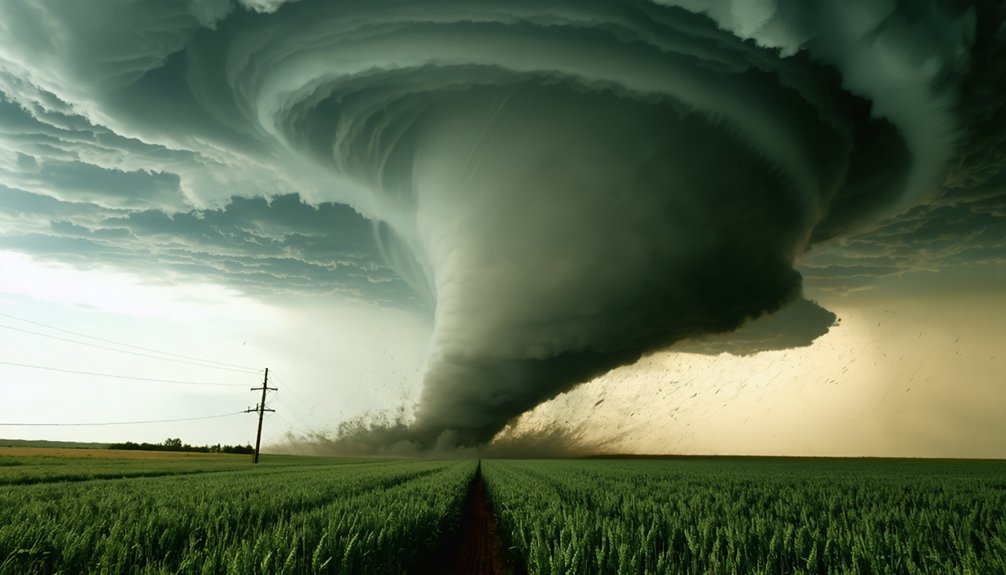
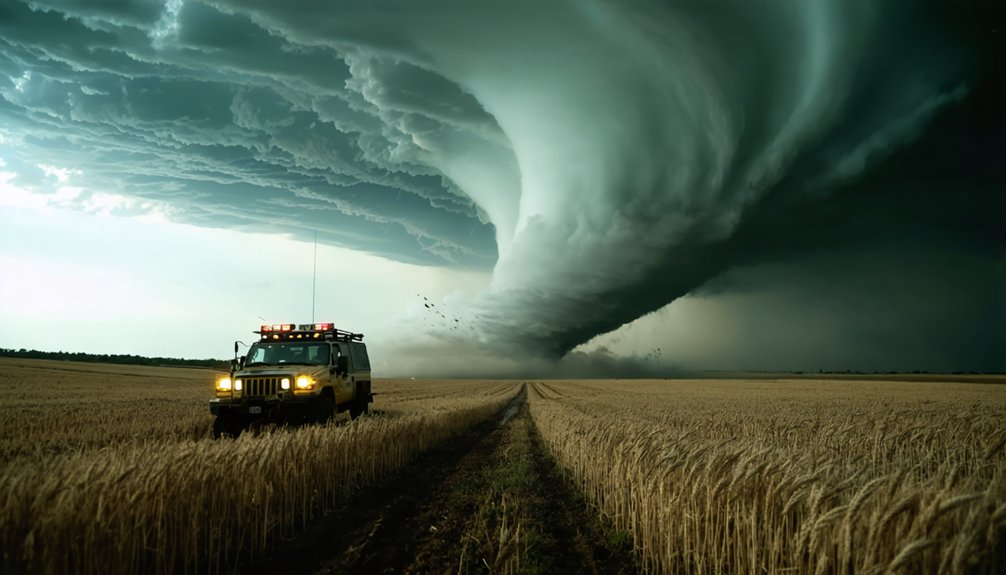
When you explore storm chasing and climate change impacts, you’re entering a rapidly evolving field. Warmer oceans are intensifying hurricanes faster, while tornado activity is shifting toward the lower Mississippi Valley and Southeast, with over 1,200 tornadoes reported in early 2024 alone. Every 1°C of warming increases severe storm conditions by 5-20%. Storm chasers now face shrinking decision windows and expanding risk zones—and there’s far more to uncover about what’s driving these dramatic changes.
Key Takeaways
- Climate change is intensifying storms faster, shrinking storm chasers’ decision-making windows and expanding traditional chasing zones toward the Southeast.
- Warmer ocean surfaces and increased water vapor significantly boost hurricane intensity and rainfall potential, creating more dangerous chasing conditions.
- Over 1,200 tornadoes were reported in early 2024, exceeding the historical average of 800, reflecting climate-driven storm increases.
- All 16 storm chasing fatalities through May 2024 were driving-related, worsened by reduced visibility and climate-altered storm trajectories.
- AI models and autonomous drones, like those recording a 252 mph gust, are revolutionizing storm data collection and forecasting accuracy.
How Is Climate Change Making Storms More Extreme?
As global temperatures climb, climate change is fundamentally restructuring how storms form, intensify, and behave. You’re seeing greenhouse gases trap heat, warming ocean surfaces and supercharging storm energy through increased ocean heat absorption. Hurricanes draw directly from these warmer waters, intensifying faster than historical patterns suggest.
Warmer air holds more water vapor, amplifying rainfall potential markedly. Aerosol effects further complicate storm dynamics, influencing cloud formation and precipitation distribution in ways scientists are still quantifying.
For every degree Celsius of warming, severe convective storm conditions increase 5 to 20 percent.
These aren’t abstract projections — they’re measurable shifts. You’re witnessing storms that strengthen rapidly, carry heavier precipitation loads, and strike with unprecedented force, driven by atmospheric mechanisms humans have directly accelerated since industrialization began.
Where Are Tornadoes Striking Now: And Why Has It Shifted?
The geography of tornado risk in the United States is shifting measurably — over 1,200 tornadoes were reported by early June 2024, compared to a historical average of roughly 800, and they’re no longer concentrating where you’d traditionally expect them.
The traditional Tornado Alley across the Great Plains is ceding activity to the lower Mississippi Valley and Southeast, where urban sprawl and dense agricultural zones now face escalating exposure. Warmer Gulf moisture penetrating further inland fuels this eastward migration.
Tornado risk is moving east — and the Southeast isn’t built to absorb what’s coming.
Research published in the Journal of Climate projects tornado frequency could increase by up to 20% by 2050 under continued warming trends.
You’re now dealing with a threat envelope that’s geographically broader, statistically more frequent, and striking communities with less institutional preparedness than the traditional high-risk corridor maintained.
Who Is Paying the Highest Price for Intensifying Storms?
Fatalities tell the clearest story: 54 tornado-related deaths struck the United States in 2024 alone, and 2025 has already confirmed 63 domestic tornado fatalities out of 69 worldwide. You’re watching communities absorb compounding losses — economic costs from property destruction, infrastructure failure, and emergency response strain budgets you depend on collectively.
Hurricane rainfall that once arrived every century now returns every 25 years, accelerating damage cycles faster than recovery systems can adapt. Beyond the financial toll, mental health consequences accumulate silently — survivors face anxiety, PTSD, and displacement trauma that standard disaster metrics rarely capture.
The IPCC Sixth Assessment Report confirms these risks escalate directly with warming temperatures. Every degree gained tightens the pressure on the populations least equipped to rebuild and recover.
What Do Storm Chasers Actually Face in a Warming World?
Storm chasers aren’t just battling fiercer weather — they’re steering a fundamentally altered operational landscape. Historical storm data confirms tornadoes have shifted eastward, unpredictable trajectories now dominate, and chasing technology must evolve accordingly. Here’s what you’re actually facing:
- Elevated death risk — All 16 chasing fatalities recorded through May 2024 were driving-related, worsened by reduced visibility and wet roads.
- Faster intensification — Storms escalate more rapidly, compressing your decision windows considerably.
- Expanded operational zones — Traditional Tornado Alley has migrated toward the lower Mississippi Valley and Southeast, stretching your coverage demands.
- Equipment strain — Harsher conditions accelerate wear on chasing technology, demanding rigorous maintenance protocols.
You’re operating in a system where warming rewrites every variable you’ve historically trusted.
How Are AI and Drones Improving Extreme Weather Prediction?
How profoundly has technology reshaped extreme weather prediction? Consider this: autonomous drones recorded a 252 mph gust during 2025’s Hurricane Melissa—the highest dropsonde measurement ever captured. You’re now operating in an era where satellite integration and AI-powered systems collect unprecedented storm data, delivering data accuracy that traditional methods simply can’t match.
Multi-university consortiums like TORUS deploy mobile radars and unmanned aircraft across 367,000 square miles, analyzing hurricane lifecycles in real time. AI weather models built from storm chase data outperform conventional forecasting systems while cutting computational costs markedly.
These advances don’t just improve prediction windows—they directly enable stronger early warning systems, giving communities the critical time they need to respond. Technology has fundamentally transferred forecasting power from guesswork into precision-driven science.
Frequently Asked Questions
What Role Does Melting Permafrost Play in Worsening Future Storm Conditions?
When permafrost melts, you’re triggering a dangerous permafrost feedback loop—methane release accelerates atmospheric warming far beyond CO₂’s impact. That additional heat fuels faster storm intensification, increases severe convective conditions by 5–20% per degree Celsius, and amplifies future extreme weather risks.
How Do Biodegradable Probes Reduce Storm Chasing’s Environmental Footprint?
When you deploy biodegradable probes, you’re using eco-friendly technology that naturally decomposes after data collection, eliminating persistent debris that would otherwise disrupt ecosystems and reduce wildlife impact, while field researchers simultaneously drive development of increasingly sustainable storm-chasing instrumentation.
Can Storm Chasing Data Directly Influence Community-Level Climate Adaptation Strategies?
Like David facing Goliath, you’re armed with storm chase data that directly shapes community resilience. You can influence policy development, using AI-driven storm insights to craft precise, freedom-preserving climate adaptation strategies that protect your community effectively.
How Does Atmospheric Warming Specifically Cause Larger and More Destructive Hailstones?
When atmospheric warming intensifies updrafts, you’re seeing hail formation accelerate—warmer air makes moist air rise faster, fueling storm intensity and keeping hailstones aloft longer, allowing them to accumulate more ice layers and grow larger, causing greater destruction.
What Makes Hurricane Rainfall Events Occur Four Times More Frequently Today?
Climate change has shifted historical patterns, making century-level hurricane rainfall strike every 25 years. You’re seeing key meteorological factors at work: warmer oceans fuel intensified storms, while heightened evaporation loads the atmosphere with considerably more moisture-rich energy.
References
- https://earthjustice.org/feature/how-climate-change-is-fueling-extreme-weather
- https://science.nasa.gov/climate-change/extreme-weather/
- https://climateinstitute.ca/news/fact-sheet-climate-change-and-storms/
- https://crazystormchasers.com/climate-change-and-the-future-challenges-for-storm-chasers/
- https://earthzine.org/storm-chasing-chaos-and-climate/
- https://climatecosmos.com/climate-news/i-chased-tornadoes-for-a-decade-heres-what-i-learned-about-natures-fury/
- https://crazystormchasers.com/preparing-for-climate-change-storm-chasers-mission-consequences/