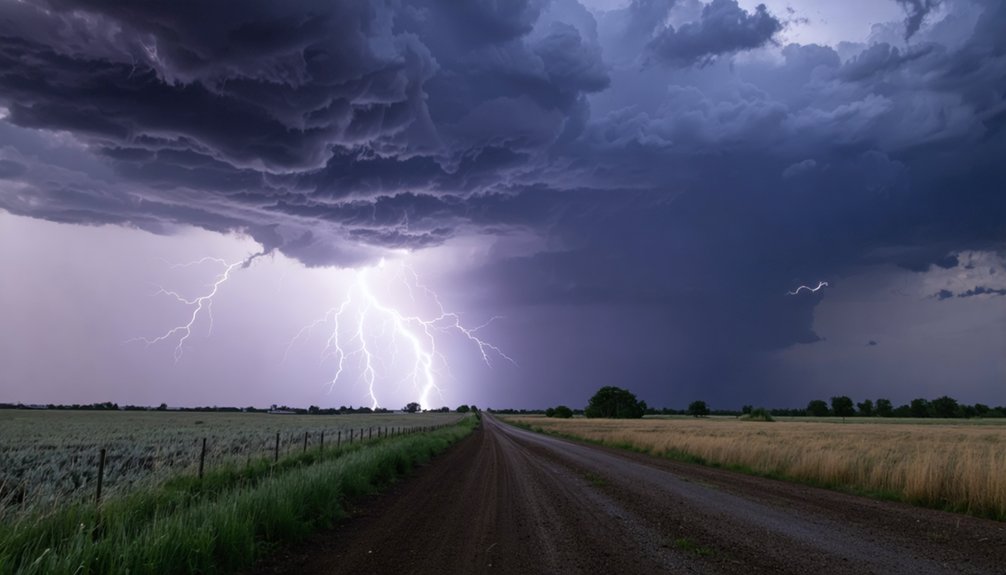
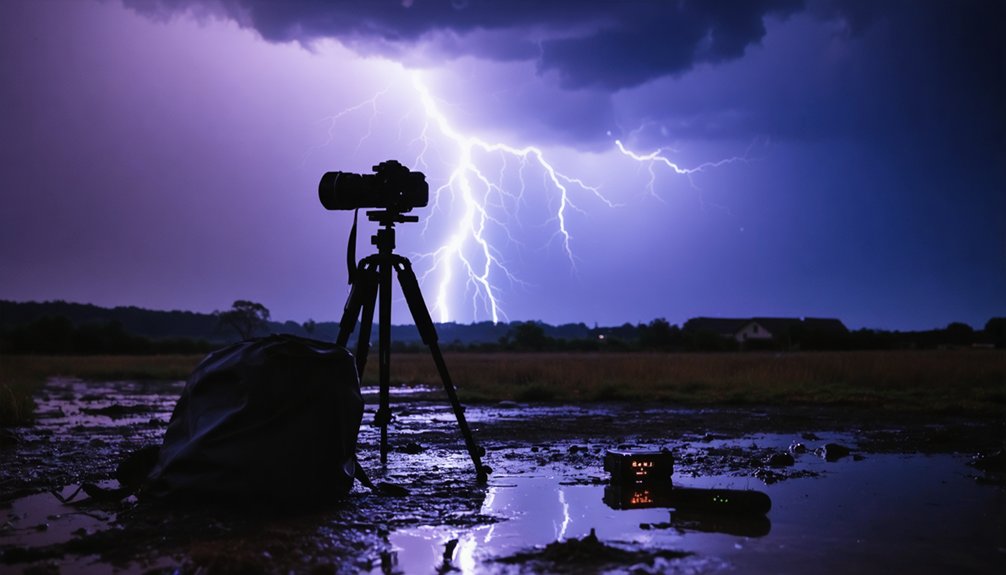
For storm chasing in rain and hail, you’ll want the Canon EOS R5 or Sony A7R IV. Both feature magnesium alloy bodies with thorough weather sealing across button joints, lens mounts, and port covers. The R5 excels in low-light performance, while the A7R IV delivers superior resolution for capturing intricate storm structures. Pair either body with sealed L-series or G Master lenses to maintain full system integrity. There’s considerably more to getting this setup right.
Key Takeaways
- Canon EOS R5 and Sony A7R IV are top mirrorless options, featuring magnesium alloy bodies with comprehensive weather sealing for storm chasing.
- True weather sealing requires gaskets across button joints, lens mounts, and port covers, as single unsealed gaps compromise the entire system.
- Pair weather-sealed bodies with Canon L-series or Sony G Master lenses to maintain complete system protection against rain and hail.
- Wide-aperture lenses (f/1.4–f/2.8) and high ISO sensors ensure proper exposure and sharp images inside dark, turbulent storm environments.
- Post-storm maintenance, including seal inspection, silica gel storage, and debris removal, prolongs gear reliability for subsequent storm-chasing sessions.
What Makes a Camera Truly Weather-Sealed?
When evaluating a camera’s weather resistance, you’ll want to look beyond marketing claims and examine its physical construction. Magnesium alloy bodies resist corrosion from rain and hail exposure while providing structural rigidity that supports superior camera ergonomics under field stress.
True weather sealing requires thorough gasket coverage across every vulnerable point — button joints, lens mounts, and port covers must all receive dedicated protection. A single unsealed gap compromises the entire system.
You’ll also need to contemplate battery life, since prolonged storm sessions demand extended operational capacity without housing breaches around battery compartment seals. Inferior sealing around this area frequently causes moisture ingress.
Match your lens sealing to your body’s protection rating, ensuring complete system integrity when conditions deteriorate rapidly during active storm pursuit.
Best Weather-Sealed Mirrorless Cameras for Storm Chasing
When you’re chasing storms, the Canon EOS R5 and Sony A7R IV stand out as top mirrorless picks. Both feature robust weather-sealed magnesium alloy bodies that resist moisture and dust ingress.
You’ll benefit from their all-encompassing sealing across button joints, lens mounts, and port covers, giving you reliable protection during severe weather exposure.
Their high ISO performance and fast autofocus systems also let you capture sharp, detailed images inside dark, lightning-lit storm interiors without sacrificing image quality.
Top Mirrorless Camera Picks
For storm chasers who demand reliability under brutal conditions, the Canon EOS R5 and Sony A7R IV stand out as the top weather-sealed mirrorless options available. Both cameras feature magnesium alloy bodies with thorough sealing across button joints, lens mounts, and port covers, giving you full protection against rain and hail penetration.
The R5 delivers exceptional low-light performance with fast autofocus that tracks rapidly moving storm elements in darkness.
The A7R IV counters with superior resolution, capturing intricate storm structures in fine detail.
You’ll appreciate the camera ergonomics on both models, designed for confident handling in turbulent conditions.
Battery life remains a practical consideration—carry spares, since cold storm environments drain power faster.
Both systems pair seamlessly with weather-sealed lenses for complete, uncompromised protection.
Weather Sealing Features Explained
Understanding how weather sealing actually works helps you make smarter gear choices before you’re standing in a supercell’s outer rain bands. Manufacturers construct sealed bodies using magnesium alloy frames with gaskets layered around every vulnerable junction — button joints, dials, lens mounts, and port covers all receive targeted protection.
Sealing integrity depends on all-encompassing coverage, not isolated patches. A single unsealed point lets moisture migrate toward your camera sensor, corrupting electronics and degrading image quality permanently. That’s why matched lens and body sealing matters — mismatching an unsealed lens with a sealed body defeats the entire system.
Mirrorless designs reduce internal moving parts, shrinking the number of penetration points moisture can exploit. You get a tighter, more defensible system specifically when hail impact and sustained rain exposure push your gear to its limits.
Low-Light Storm Performance
Sealed construction keeps your gear intact, but surviving the storm physically is only half the challenge — capturing usable images inside a rotating, lightning-lit supercell demands serious low-light performance.
Modern sensor technology in cameras like the Canon EOS R5 and Sony A7R IV delivers exceptional high-ISO output, letting you shoot clean frames in near-darkness without excessive noise degradation. Fast autofocus tracks turbulent, fast-moving storm structures accurately, even in minimal ambient light.
Wide-aperture, weather-sealed lenses maintain proper exposure without forcing dangerously slow shutter speeds.
Battery longevity becomes equally critical during extended chases — cold temperatures drain power rapidly, so carry multiple charged batteries and keep spares insulated.
Your camera’s low-light capability ultimately determines whether you return with compelling documentation or unusable, noise-riddled frames.
Canon EOS R5 vs Sony A7R IV: Which Handles Storms Better?
When you’re choosing between the Canon EOS R5 and Sony A7R IV for storm chasing, both cameras offer weather-sealed magnesium alloy bodies, but their sealing implementations and real-world durability differ in key ways.
You’ll find the R5 edges ahead in low-light performance with cleaner high-ISO output, making it more effective in dark storm interiors lit only by lightning.
However, the A7R IV’s superior resolution and robust build quality make it a strong contender when you need maximum structural detail from a distance in harsh conditions.
Weather Sealing Compared
Both the Canon EOS R5 and Sony A7R IV feature magnesium alloy bodies with all-encompassing sealing across button joints, lens mounts, and port covers, but their real-world storm performance differs in key ways. The R5 delivers tighter gasket integration, making it marginally more resistant during prolonged hail exposure.
The A7R IV’s larger full-frame sensor size captures superior detail in dark storm interiors, giving you a critical edge when lightning is your primary light source. However, battery life becomes a decisive factor in the field — the R5 outperforms the A7R IV in cold, wet conditions where battery drain accelerates.
If you’re chasing multi-hour storms, the R5’s endurance advantage matters. For maximum resolution with acceptable battery life, the A7R IV remains a compelling alternative.
Low-Light Storm Performance
Storm chasing frequently demands shooting in near-darkness, where lightning bursts serve as your primary illumination — and that’s where sensor performance separates the Canon EOS R5 from the Sony A7R IV.
The R5’s sensor sensitivity excels at high ISO ranges, delivering cleaner images in dim storm interiors with minimal noise degradation. Its in-body image stabilization compensates for wind-induced camera shake, keeping your shots sharp during turbulent conditions.
The A7R IV counters with a higher-resolution sensor that captures exceptional storm structure detail, though it produces slightly more noise at extreme ISO values. Its image stabilization system performs comparably under severe wind stress.
If low-light clarity is your priority, the R5 edges ahead. If resolution drives your decisions, the A7R IV remains a formidable competitor.
Build Quality Durability
Sensor performance matters little if your camera fails before the storm peaks, which makes build quality the next critical factor separating these two bodies. Both the Canon EOS R5 and Sony A7R IV feature magnesium alloy construction with all-encompassing sealing across button joints, lens mounts, and port covers.
The R5’s camera ergonomics give you a deeper grip and more intuitive control placement during gloved, rain-soaked operation. The A7R IV’s compact frame sacrifices some grip comfort but maintains equivalent sealing integrity.
Battery life becomes critical when you’re hours into a chase—the R5 delivers approximately 320 shots per charge versus the A7R IV’s 530. If extended field time without recharging defines your chase strategy, the A7R IV’s battery advantage directly impacts your operational freedom.
Weather-Sealed Lenses Built for Rain and Hail
When chasing severe storms, your lenses need the same level of protection as your camera body. Weather-sealed optics use advanced lens coating technologies that repel water, resist hail impact, and prevent internal condensation during rapid temperature shifts.
Your aperture design matters significantly here — sealed diaphragm mechanisms keep moisture from penetrating internal elements during direct precipitation exposure. Wide-angle lenses let you capture expansive storm systems, while telephoto options reveal precise structural details from safer distances.
Matching your lens sealing to your camera body’s sealing standard creates a complete, uncompromised system. Canon’s L-series and Sony’s G Master lenses deliver this integrated protection reliably.
You’ll maintain operational confidence knowing every junction between glass elements and barrel components actively resists the harshest storm conditions you’ll encounter.
How to Match Lens Sealing to Your Camera Body
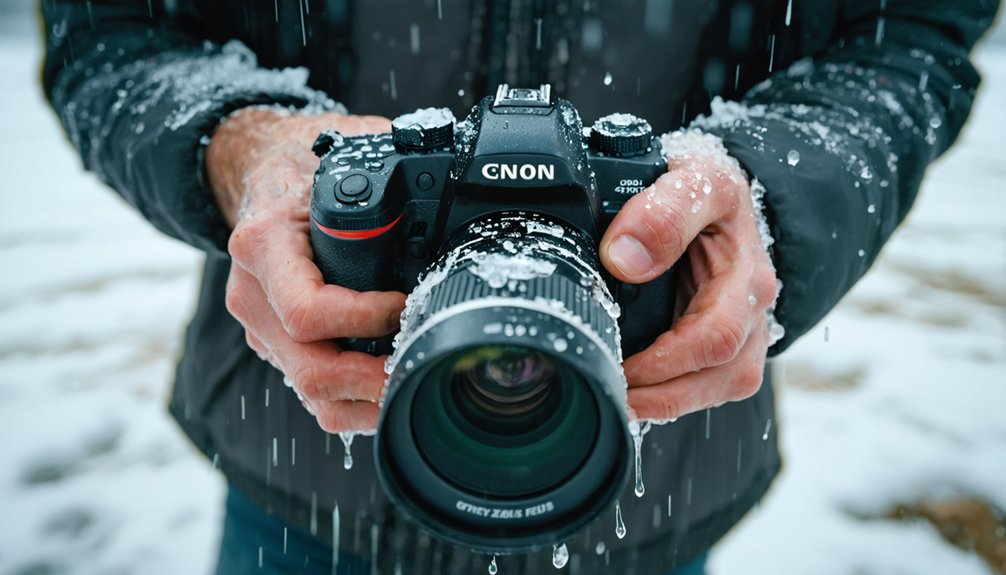
Achieving full system protection requires matching your lens sealing rating to your camera body’s sealing standard — mismatched components create vulnerable ingress points that undermine your entire setup. Lens compatibility isn’t optional when you’re operating in rain and hail; it’s foundational.
Verify sealing standards before committing to any lens-body combination:
- Check manufacturer sealing ratings — Canon, Sony, and Nikon publish official compatibility specifications.
- Match mount-point sealing — the lens mount gasket must align precisely with your body’s sealed flange.
- Confirm port and barrel sealing — zoom rings and focus rings require independent weather protection.
- Test combinations before deployment — controlled moisture exposure reveals gaps before storms do.
Prioritizing verified lens compatibility across your entire kit ensures no single weak point compromises your storm-chasing system when conditions turn severe.
Low-Light Performance When Storms Kill the Sun
When a supercell blocks out the sun, you’ll need a camera body capable of pushing high ISO performance without introducing debilitating noise into your storm shots.
You should pair that high-ISO capability with a fast autofocus system that tracks rapidly shifting storm structures in near-total darkness.
Wide aperture lenses then let you maintain proper exposure while keeping shutter speeds fast enough to freeze violent motion.
High ISO Storm Performance
Massive storm systems can reduce midday light to near-darkness, forcing your camera’s ISO to climb well beyond everyday shooting ranges. You need a sensor that handles ISO optimization without destroying image integrity.
The Canon EOS R5 and Sony A7R IV both deliver controlled sensor noise even at extreme sensitivity levels.
Key high-ISO performance factors for storm chasing:
- Dynamic range retention keeps shadow detail visible inside dark storm interiors
- Noise reduction algorithms preserve fine structural details without smearing texture
- Fast autofocus locks onto rotating debris and funnel formations in near-darkness
- Wide aperture compatibility lets you balance ISO against shutter speed precisely
You’re not shooting studio portraits—you’re capturing violent atmospheric events.
Your camera’s high-ISO capability directly determines whether you return with usable data or grain-destroyed failures.
Fast Autofocus In Darkness
Storm-darkened skies push autofocus systems to their absolute limits, and your camera’s AF architecture determines whether you lock onto a rotating funnel or miss the shot entirely.
When supercells block sunlight, autofocus speed degrades unless your system leverages phase-detection points across the full sensor plane.
Modern mirrorless cameras like the Canon EOS R5 and Sony A7R IV maintain aggressive autofocus speed through dedicated AF processors that operate independently of exposure calculations.
Their sensor sensitivity directly supports AF performance, allowing phase-detection algorithms to find contrast even in near-black conditions.
You’ll want a camera with subject-tracking capable of maintaining lock through rain-obscured glass and shifting debris fields.
Don’t settle for contrast-detect-only systems — they hunt continuously in darkness, costing you critical frames during peak storm activity.
Wide Aperture Light Capture
Fast autofocus locks your target, but without sufficient light reaching the sensor, even perfect focus produces unusable frames. Wide aperture control becomes your primary weapon when storms kill available light.
Shooting at f/1.4 or f/2.8 maximizes light sensitivity by flooding your sensor with available photons during the darkest storm conditions. You’ll maintain faster shutter speeds, freezing violent precipitation without sacrificing exposure.
Prioritize these aperture advantages during storm chasing:
- f/1.4–f/2.8 lenses preserve shutter speed in near-blackout storm interiors
- Wide aperture control reduces ISO dependency, minimizing digital noise
- Increased light sensitivity reveals tornado structure invisible to narrower optics
- Weather-sealed wide-aperture lenses maintain optical integrity through rain and hail
You’re not compromising—you’re commanding every photon nature allows.
Carbon Fiber Tripods and Gimbals for Wind Stability
When you’re shooting in high-wind storm conditions, carbon fiber tripods deliver the rigidity and vibration damping you need without adding excessive weight to your kit. Their inherent tensile strength resists lateral flex that aluminum alternatives simply can’t match during sustained gusts. You’ll maintain sharper exposures without compensating through storm shutter ergonomics alone.
Pair your tripod with a gimbal stabilizer to neutralize turbulent atmospheric movement during video capture. Gimbals counteract unpredictable wind buffeting electronically, producing fluid footage even when conditions deteriorate rapidly.
When combined with magnesium alloy advantages—corrosion resistance, structural integrity under impact—your entire support system becomes genuinely field-reliable. Choose a gimbal rated for your camera’s weight class, ensuring balanced load distribution prevents motor strain during extended storm-chasing sessions.
Remote Shutter Releases Keep Wet Hands Off Your Gear
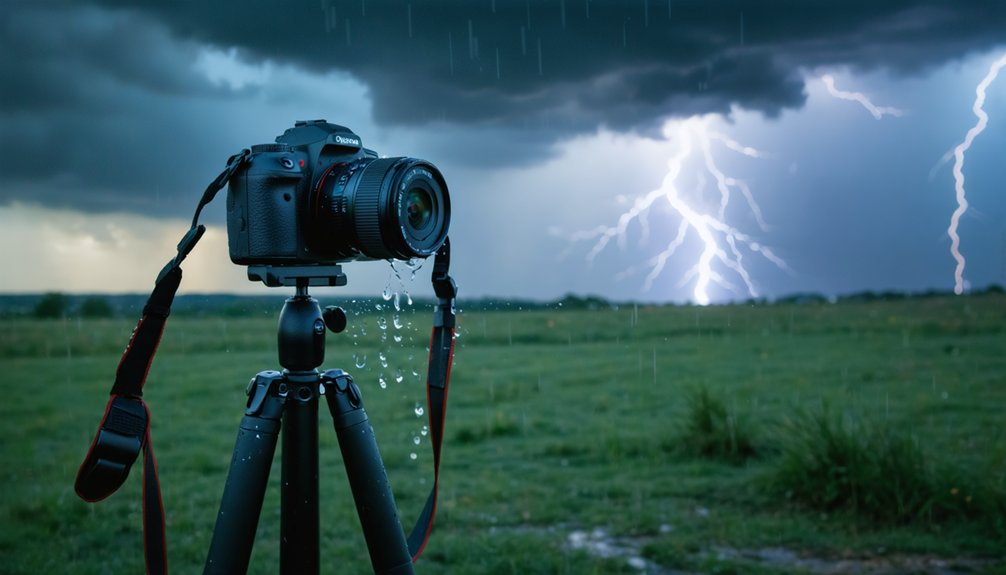
Keeping wet hands away from your camera body isn’t just about comfort—it’s a practical strategy for reducing moisture ingress at every control point. Remote operation eliminates repeated button contact during active precipitation, preserving your sealing integrity when it matters most.
Wet hands and camera buttons are a moisture pathway—remote operation removes that vulnerability entirely.
Key advantages of remote shutter releases in storm conditions:
- Moisture resistance: Your camera’s buttons stay dry during sustained rainfall
- Precision timing: You trigger shots without introducing camera shake
- Extended reach: You position yourself safely while maintaining full control
- Compatibility: Wired and wireless options suit both Canon EOS R5 and Sony A7R IV systems
Choose a remote with rubberized, weather-resistant construction. A compromised shutter button is a direct moisture pathway—remote operation removes that vulnerability entirely from your workflow.
Rain Covers and Weatherproof Bags That Actually Work
Remote releases protect your camera’s controls, but your entire system still needs physical shielding from direct precipitation. A quality rain cover fits your camera body precisely, preserving camera ergonomics so you’re not fumbling with awkward bulk during fast-moving storm sequences. Look for covers with sealed access ports aligned to your controls and battery compartment—maintaining battery longevity requires keeping moisture away from electrical contacts that accelerate drain.
Weatherproof bags with sealed zippers and padded compartments go beyond basic water resistance. They protect against hail impact, rapid temperature shifts, and prolonged downpours.
Choose bags featuring dedicated compartments for lenses, accessories, and battery packs. Systems that combine fitted rain covers with purpose-built weatherproof bags give you layered protection, ensuring your gear survives the storm fully operational.
Cleaning and Protecting Weather-Sealed Gear After Storms
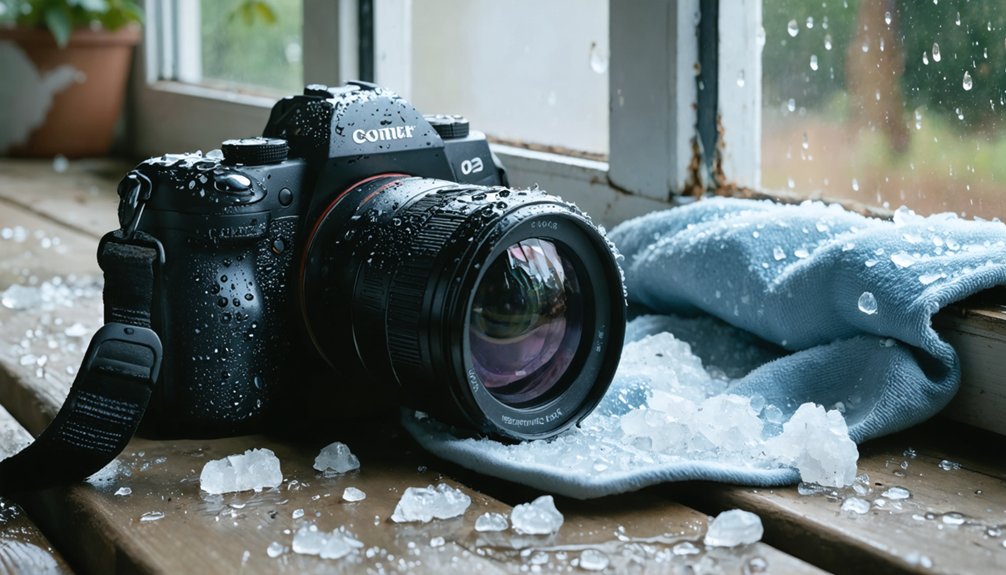
After every storm chase, you’ve got to clean and inspect your gear before storing it—salt air, hail residue, and particulate debris accelerate corrosion even on magnesium alloy bodies. Wipe down every surface methodically, paying attention to areas where camera ergonomics create recessed grooves that trap moisture.
Follow this post-chase protocol:
- Brush debris from button joints and port covers using a soft anti-static brush
- Wipe lens mounts and seals with a lightly dampened microfiber cloth
- Remove batteries immediately to protect battery longevity and prevent terminal corrosion
- Inspect all weather seals for cracking or compression failure before next deployment
Store your gear in a low-humidity environment with silica gel packs.
Consistent post-storm maintenance preserves your system’s integrity and keeps you operationally ready for the next chase.
Frequently Asked Questions
Can Weather-Sealed Cameras Survive Complete Submersion in Floodwater?
No, weather-sealed cameras can’t survive complete submersion — they’re not floodproof designs. You’ll need dedicated waterproof housing to protect your gear in floodwater, as seals only resist splashes, rain, and hail exposure.
How Long Do Weather Seals Typically Last Before Requiring Professional Replacement?
You’ll typically get 2–5 years of seal durability before professional replacement’s needed. Camera maintenance frequency depends on usage intensity—heavy storm chasing accelerates wear. Inspect seals annually and replace them proactively to maintain your gear’s full protective capability.
Does Cold Hail Impact Permanently Damage Magnesium Alloy Camera Bodies?
Built to endure, magnesium alloy won’t surrender easily. Cold hail impact rarely causes permanent damage—you’ll find magnesium corrosion resistance keeps your body structurally sound, though repeated strikes can compromise surface coatings over time.
Are Weather-Sealed Cameras Covered Under Manufacturer Warranty for Storm Damage?
Most manufacturers don’t cover storm damage under standard warranty coverage, even for weather-sealed bodies. You’ll need separate insurance. Maintain your gear with regular camera cleaning to preserve seals and support any future warranty or damage claims.
Can Lightning Strikes Permanently Damage Weather-Sealed Camera Electronic Components?
Yes, lightning damage can permanently destroy your camera’s electronic vulnerability points. Even weather-sealed bodies can’t protect internal circuits from electrical surges. You’ll need surge-protected housing or maintain safe distances during active lightning strikes.
References
- https://www.youtube.com/watch?v=5_apB16d7Yo
- https://crazystormchasers.com/top-rated-storm-chasing-camera-gear/