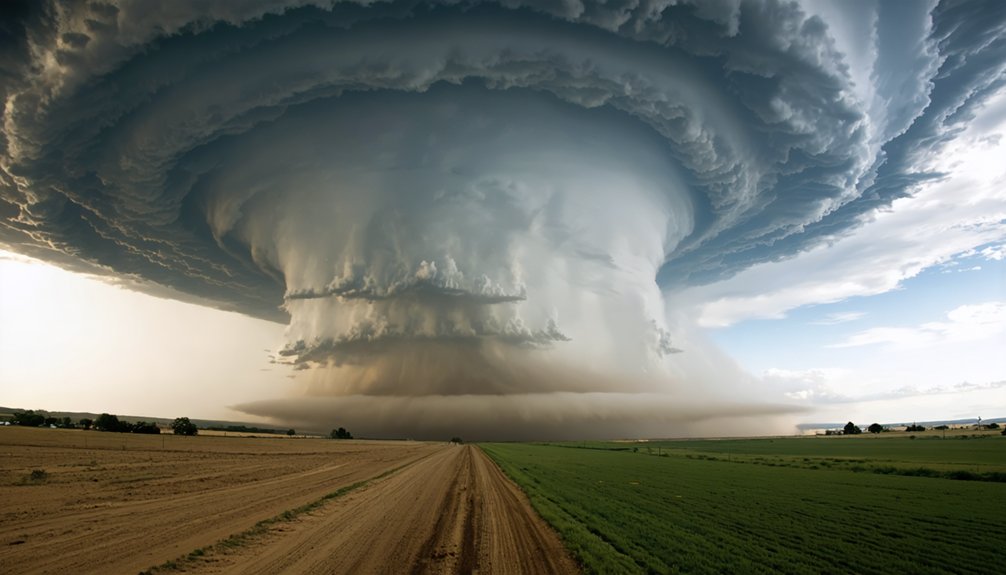
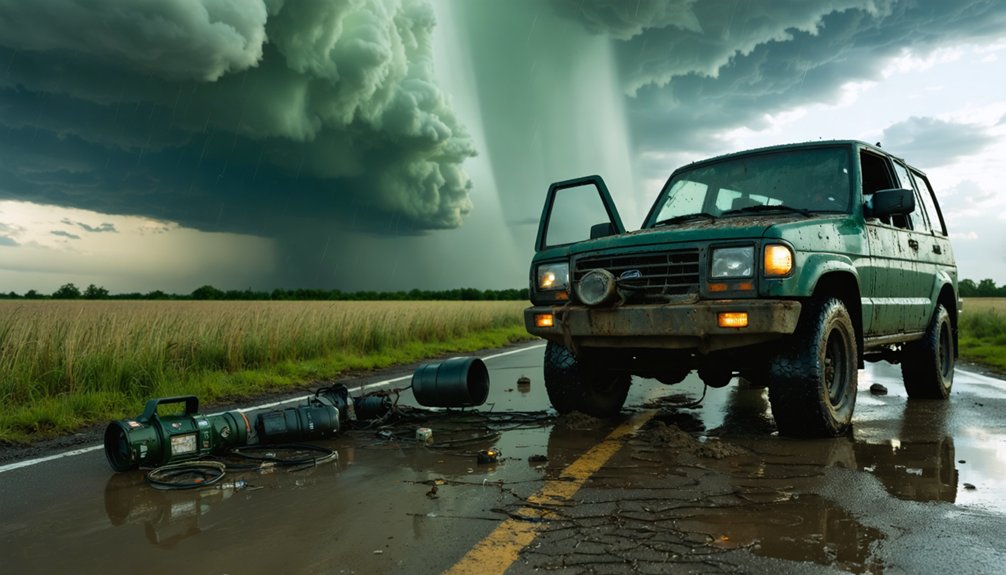
Climate change is forcing you to completely overhaul how you chase storms. Tornado Alley is shifting eastward into Tennessee, Alabama, and Georgia, making your traditional route maps obsolete. In 2024, a record 1,797 confirmed tornadoes stretched chase seasons beyond conventional spring windows. Atmospheric moisture increases are projected to push tornado frequency up 20% by 2050, while road accidents now kill more chasers than tornadoes themselves. The full operational impact runs deeper than you might expect.
Key Takeaways
- Climate change is shifting tornado activity eastward into the Southeast, forcing storm chasers to operate across unfamiliar, densely populated regions.
- The active chase season now extends beyond traditional spring windows, requiring chasers to maintain year-round operational readiness.
- Unpredictable storm trajectories demand real-time adaptive modeling and AI-powered tools to track rapidly changing severe weather conditions.
- Road accidents on unfamiliar roads have surpassed tornado impacts as the leading cause of storm chaser fatalities.
- Expanded operational zones exceeding 367,000 square miles require advanced equipment, including unmanned aircraft and mobile radar arrays.
How Climate Change Is Reshaping Tornado Season?
As global temperatures rise, climate change is fundamentally altering tornado season‘s timing, intensity, and geographic scope. You’re no longer dealing with predictable spring patterns confined to traditional Tornado Alley.
Tornado season shifts are pushing severe weather into the lower Mississippi Valley and Southeast, exposing densely populated regions to unprecedented risk.
Warmer temperatures increase atmospheric moisture, injecting more energy into thunderstorm development and intensifying tornado-producing supercells. Scientists project tornado frequency could climb 20% by 2050, and 2024’s 1,797 confirmed tornadoes already marked the second most active year on record.
Traditional seasonal baselines are unreliable now. Events extend beyond conventional months, expanding your operational exposure window notably.
You need continuously updated meteorological datasets and adaptive forecasting models to navigate this rapidly evolving severe weather landscape effectively.
Where Tornado Alley Is Moving: and Why It Matters
If you’ve been tracking severe weather patterns, you’ve likely noticed that Tornado Alley‘s traditional boundaries—once anchored across the central Great Plains—are shifting measurably eastward into the lower Mississippi Valley and Southeast.
You’re now seeing concentrated storm activity migrate toward densely populated states like Tennessee, Alabama, and Georgia, where building codes, infrastructure, and emergency preparedness haven’t historically accounted for high-frequency tornado exposure.
This geographic realignment means you can’t rely on traditional meteorological baselines, as the Southeast’s complex terrain and population density amplify both the operational challenges and the human cost of each event.
Tornado Alley’s Eastward Shift
Tornado Alley is moving, and the implications for storm chasers and vulnerable communities are significant. Atmospheric changes are reshaping tornado dynamics, pushing concentrated severe weather eastward into the lower Mississippi Valley and Southeast.
Key shifts you need to track:
- Traditional geographic baselines no longer reliably predict storm corridors
- Southeast and Gulf Coast states face increasing exposure to devastating storms
- Dense population centers now intersect more frequently with severe weather paths
- Storm seasons are extending beyond traditional months, expanding operational windows
- Real-time trajectory prediction requires continuous monitoring of evolving meteorological datasets
You can’t rely on outdated maps anymore. The data confirms an undeniable eastward migration, demanding that chasers, researchers, and communities adapt their strategies, preparation protocols, and early warning infrastructure to match this accelerating geographical reality.
Southeast Exposure Risks Rising
The eastward migration of Tornado Alley isn’t just a geographical curiosity—it’s placing millions of people directly in harm’s way. Southeast storm patterns now dominate regions historically unprepared for frequent tornado activity, straining local infrastructure and emergency response systems.
You’re watching rising tornado risks materialize across densely populated Gulf Coast and lower Mississippi Valley communities where building codes and shelter availability lag behind those in traditional Tornado Alley states. This gap creates compounding vulnerability.
Data from 2024’s near-record 1,797 confirmed tornadoes reinforces what experienced chasers already know: severe weather is targeting new corridors.
Traditional geographic baselines no longer protect communities that assumed distance provided safety. Without updated preparedness frameworks, Southeast populations face escalating exposure to storms they weren’t structurally or culturally equipped to handle.
The Real Dangers Killing Storm Chasers Today
While tornadoes dominate public perception of storm chasing fatalities, road accidents have surpassed tornado impacts as the primary killer of storm chasers today.
Operational risks extend far beyond the storm itself, demanding your full situational awareness at all times.
Recent data confirms four direct tornado deaths alongside 12 indirect fatalities, with roads claiming more lives than the storms you’re pursuing.
Here’s what’s actually threatening chasers today:
- High-speed repositioning on unfamiliar rural roads
- Fatigue-driven decision errors during extended deployments
- Reduced visibility from rain, hail, and debris
- Congested chase corridors creating collision risks
- Communication failures during rapid storm shifts
You’re maneuvering a complex operational environment where the drive between intercepts can be deadlier than standing near the tornado itself.
How Technology Keeps Field Chasers Alive in Worse Storms
When you’re operating in storm environments that are measurably more intense than prior decades, AI-powered early warning systems become your primary survival advantage—these systems analyze real-time atmospheric data to predict rapid intensification before conditions become unsuitable for field retreat.
You’re also depending on equipment engineered specifically to withstand extreme thermal stress and mechanical fatigue, as standard gear failure rates increase sharply in the harsher conditions that climate change now routinely produces.
Together, these technological advancements directly offset the elevated operational risks documented across 2024’s record-breaking 1,797 confirmed tornado events.
AI-Powered Early Warning Systems
As storm intensity escalates and weather patterns grow increasingly unpredictable, AI-powered early warning systems have become critical lifelines for field chasers operating in deteriorating conditions.
These monitoring systems process real-time atmospheric data, delivering early alerts that give you measurable response windows before conditions deteriorate fatally.
Key capabilities reshaping field safety include:
- AI predictions identifying rapid intensification patterns hours earlier than traditional models
- Algorithm improvements enhancing data accuracy across shifting tornado alley boundaries
- Risk assessment tools flagging sudden atmospheric destabilization in real-time
- Communication tools maintaining connectivity during bandwidth-limited severe events
- System integration linking mobile radar networks with emergency responses protocols
These advancements don’t just improve forecasting—they directly extend your operational freedom by replacing guesswork with quantifiable, actionable intelligence you can trust under pressure.
Durable Field Equipment Innovations
Beyond early warning systems, the physical gear keeping you alive in the field is undergoing rapid innovation—because harsher storms are destroying equipment faster than traditional designs can handle.
Autonomous drones now withstand conditions previously unimaginable—one recorded a 252 mph gust during Hurricane Melissa in 2025, the highest dropsonde measurement ever captured.
These equipment upgrades aren’t optional; thermal stress and mechanical fatigue are accelerating failure rates across radar systems and mobile sensors. Engineers are responding with durable materials engineered to resist extreme pressure differentials, moisture intrusion, and impact damage.
Biodegradable probes represent another critical advancement, reducing environmental footprint without sacrificing data integrity. High-bandwidth transmission solutions are also closing dangerous coverage gaps.
Your operational survival increasingly depends on whether your equipment evolves as fast as the storms you’re chasing.
How Eastward Storm Migration Changes Chase Routes?
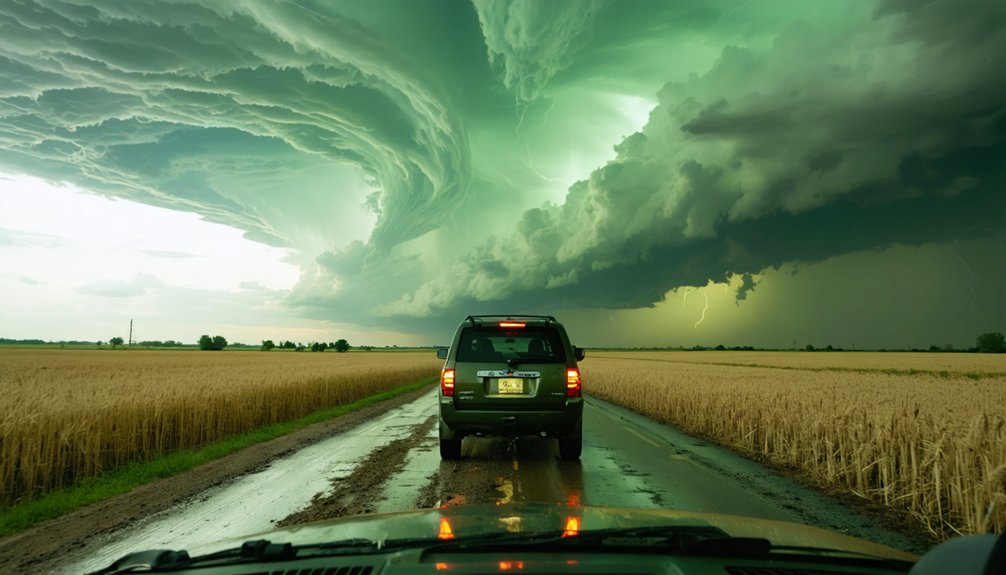
The documented eastward migration of Tornado Alley has fundamentally restructured traditional chase routes, pushing operational focus toward the lower Mississippi Valley, Southeast, and Gulf Coast states.
You’ll need to abandon outdated geographic baselines and embrace dynamic storm tracking systems that reflect evolving meteorological realities. Route optimization now demands continuous dataset monitoring rather than relying on historically predictable corridors.
Key operational shifts you must integrate:
- Prioritize Southeast and Gulf Coast deployment over traditional Great Plains positioning
- Expand your active chase calendar beyond conventional spring season windows
- Implement real-time adaptive modeling to counter unpredictable trajectory patterns
- Recalibrate logistical infrastructure toward densely populated eastern urban corridors
- Monitor lower Mississippi Valley atmospheric data as a primary operational baseline
These adjustments aren’t optional—they’re essential for staying ahead of increasingly volatile, shifting storm systems.
How Climate Change Is Forcing Storm Chasers to Adapt?
Climate change isn’t just intensifying storms—it’s forcing storm chasers to overhaul every operational layer, from equipment selection to risk protocols.
You’re no longer operating within predictable seasonal windows or geographic boundaries. Tornado Alley’s eastward migration toward the densely populated Southeast demands entirely rerouted chase strategies.
Tornado Alley has moved—and your chase routes must move with it.
Storm chaser adaptability now requires integrating AI-powered atmospheric models that detect rapid intensification before conditions become unsurvivable.
You’re deploying biodegradable probes, mobile radar arrays, and unmanned aircraft across expanded operational zones exceeding 367,000 square miles. Equipment must withstand recorded gusts hitting 252 mph.
Climate resilience strategies extend beyond hardware. Mental health assessments are now standard protocol, given escalating psychological exposure.
With road accidents surpassing tornado impacts as the leading fatality cause, your evacuation procedures demand the same precision as your data collection systems.
Frequently Asked Questions
How Does Climate Change Affect Storm Chasers’ Mental Health and Wellbeing?
Ironically, the thrill you chase threatens your wellbeing. Intensifying storm frequency fuels storm anxiety, demanding emotional resilience as mental health assessments now anchor risk management protocols—because surviving nature’s fury means protecting your mind first.
Are Storm Chasing Careers Becoming More Financially Costly Due to Climate Change?
Yes, you’re facing financial instability as climate change drives rising expenses in storm chasing. Equipment failures from extreme conditions, expanded operational windows, and advanced technology demands actively increase your career’s financial burden considerably.
How Do Biodegradable Probes Help Reduce Storm Chasers’ Environmental Footprint?
When you deploy biodegradable probes, you’re minimizing post-storm debris without sacrificing critical atmospheric data collection. These sustainable technology solutions let you gather real-time severe weather metrics while ensuring biodegradable materials naturally decompose, reducing your environmental footprint across increasingly active storm environments.
Is Storm Chasing Data Actually Improving Community Early Warning Systems?
Yes, storm chasing data’s actively improving early warning systems. You’re seeing AI models boost data accuracy, outperforming traditional forecasts while cutting costs. Community engagement strengthens as real-time insights help vulnerable populations prepare faster for intensifying severe weather events.
How Has Rapid Hurricane Intensification Changed Storm Chasers’ Coastal Operations?
You’re maneuvering “accelerating atmospheres” more urgently now. Rapid intensification’s doubled major hurricanes since 1980, forcing you to overhaul hurricane tracking, tighten safety protocols, adopt drone technology advancements, and confront unprecedented coastal operational challenges demanding faster, freedom-preserving adaptive responses.
References
- https://www.youtube.com/watch?v=uFGdZeKtYnI
- https://www.arcticfocus.org/stories/meeting-george-kourounis-storm-chaser/
- https://atmos.earth/science-and-nature/warming-skies-have-triggered-a-new-era-of-unpredictable-storms/
- https://crazystormchasers.com/climate-change-and-the-future-challenges-for-storm-chasers/
- https://www.nationalgeographic.com/travel/article/storm-chasing-is-an-exhilarating-rush-but-is-it-safe
- https://climatecosmos.com/climate-news/i-chased-tornadoes-for-a-decade-heres-what-i-learned-about-natures-fury/
- https://www.nbcnews.com/news/us-news/female-storm-chasers-pursue-passion-as-severe-weather-events-increase-rcna24886
- https://www.thecitizen.org.au/articles/more-storm-chasers-have-died-road-fatalities-actual-tornadoes
- https://www.youtube.com/watch?v=-DXTIqVbX4g
- https://www.nbcnews.com/science/climate-change/hail-chasers-rcna219122