When sharing storm footage responsibly, you’ll need to verify clips against NOAA/NWS radar data, satellite imagery, and official storm reports before publishing. Cross-check timestamps, GPS coordinates, and metadata to confirm authenticity. Always credit original sources, protect individual privacy by blurring identifiable details, and prioritize safety over dramatic visuals. Correct misinformation quickly and monitor comments after posting. Follow these core principles, and the full guidelines ahead will sharpen your verification process markedly.
Key Takeaways
- Always verify storm footage against official data sources like NOAA, NWS radar, and satellite imagery before sharing.
- Attribute footage directly to original creators or agencies, linking to source material rather than reposting without context.
- Include precise timestamps and GPS coordinates in captions, cross-referenced with verified weather conditions.
- Prioritize factual accuracy over dramatic visuals, rejecting unverified clips that contradict official storm records.
- Actively monitor comments after posting, correcting misinformation promptly and referencing official sources throughout discussions.
Verify Storm Footage Against Radar and Official Reports First
Before sharing storm footage, cross-reference it against radar data, satellite imagery, and official reports from NOAA or the NWS. Verify timestamps, GPS coordinates, and metadata to confirm the clip’s location and timing match documented conditions.
Even experienced storm chaser accounts post footage that’s mislabeled, reposted out of context, or edited to appear more dramatic than conditions warranted.
Don’t let weather myths drive your sharing decisions. If a clip contradicts official radar reflectivity or NWS storm reports, treat it as unconfirmed. Check whether independent sources corroborate the footage before amplifying it to your audience.
You maintain editorial control, so use it deliberately. Unverified footage spreads fast and undermines public trust. Authenticate first, publish second—your credibility and your audience’s safety depend on that order.
Cross-Check Every Clip With Official Weather Data
Before you post any storm clip, pull the corresponding radar loop from NOAA or NWS and confirm that storm signatures align with what the footage shows.
Match the video’s timestamp precisely against official storm reports to rule out recycled or misattributed content.
Then cross-reference the claimed location using satellite imagery to verify terrain, street layout, or coastline features visible in the frame.
Verify With Radar Data
When storm footage circulates online, radar data serves as your most reliable tool for confirming whether a clip is authentic and accurately placed in time and space. Cross-reference the footage against archived NEXRAD or dual-polarization radar loops from NOAA or the NWS, matching the timestamp and geographic coordinates precisely.
Radar reveals wind shear signatures, rotation, and precipitation intensity, letting you confirm whether conditions shown in the clip actually existed at that location and moment.
Storm surge events leave distinct radar footprints near coastal zones, providing additional corroboration. If the footage shows a violent tornado but radar shows no rotation in that area, treat the clip as unverified.
Always link your radar source directly so your audience can independently validate the data you’ve used.
Match Timestamps To Reports
Radar data narrows your verification window considerably, but timestamps seal the case. Cross-reference every clip’s embedded metadata against NWS storm reports, which log verified events down to the minute. A timestamp mismatch exposes weather myths instantly—footage labeled as a current tornado may actually show a storm from a different season or region entirely.
Pull the EXIF data from image files and compare it against official storm event databases at NOAA’s Storm Events Database. Discrepancies in date, time, or coordinates indicate manipulation or misattribution.
You protect storm safety when you reject clips that don’t align with documented meteorological records. Don’t amplify content simply because it looks dramatic. Verified timestamps paired with official reports give your audience accurate, traceable information they can act on confidently.
Confirm Location With Satellites
Satellite imagery closes the verification loop that timestamps open. When you receive storm footage, cross-reference it immediately against GOES-16, GOES-18, or equivalent satellite platforms. These systems provide real-time cloud-top temperature data, storm cell positioning, and precipitation band movement, letting you pinpoint whether the claimed location matches actual weather anomalies on record.
Don’t rely solely on embedded GPS metadata, since it’s easily manipulated. Instead, use satellite technology to independently confirm that storm structure, shadow angles, and terrain features align with the footage’s stated coordinates.
Tools like NOAA’s Satellite View or NASA Worldview give you timestamped, geolocated imagery for direct comparison.
If the satellite record contradicts the clip’s claimed location, flag it as unverified immediately and withhold publication until independent corroboration exists.
Before you share any storm footage, you must verify its authenticity against official weather data from sources like NOAA or the NWS.
Cross-reference the clip’s metadata, timestamps, and geographic markers with radar and satellite imagery to confirm the location and timing align with documented conditions.
Unverified footage stays unconfirmed until independent corroboration supports its provenance.
Verify Before You Share
When storm footage surfaces online, your first move should be cross-referencing it against NWS advisories, NOAA radar loops, and current satellite imagery to confirm the event’s time, location, and intensity match what’s shown.
Pull the clip’s metadata — timestamps, GPS coordinates, device data — and verify they align with documented conditions.
Storm safety depends on accurate information circulating freely, without distortion.
Social media etiquette demands you treat unverified footage as unconfirmed until independent corroboration exists.
Check whether the clip has been altered, selectively edited, or stripped of its original source attribution.
If inconsistencies appear between the footage and official data, don’t share it.
Use screenshots and account records to document disputes.
Amplifying unverified content undermines public trust and compromises real emergency response efforts.
Confirm Location And Timing
Storm footage without confirmed location and timing data is operationally useless — and potentially dangerous. Before you publish anything, cross-reference your clip’s GPS coordinates and timestamp against active radar loops, NWS advisories, and satellite imagery. Metadata embedded in your file often contains this data — verify it’s accurate and hasn’t been stripped or altered.
Precise location matters for storm tracking because weather patterns shift rapidly. Footage tagged to the wrong county or posted hours late can misdirect emergency responders and mislead the public. You’re responsible for what you amplify.
Check these boxes before sharing:
- Confirmed GPS coordinates
- Verified timestamp matching radar data
- Cross-referenced NWS or NOAA reports
- Accurate location description in your caption
Accuracy protects people. Ambiguity doesn’t.
Spot Altered or Misleading Storm Video Before It Spreads
Misleading storm videos spread fast, and catching them early requires a methodical verification process. Cross-reference any clip against NOAA radar archives, NWS advisories, and satellite imagery timestamped to the same event window.
Inspect the video’s metadata — file creation dates, GPS coordinates, and encoding signatures — to confirm storm footage authenticity and flag inconsistencies.
Reverse-image search key frames to detect recycled footage misrepresented as current.
Watch for unnatural cloud behavior, inconsistent lighting, or abrupt edits that suggest digital manipulation.
If a clip lacks a named source or traceable account history, treat it as unverified.
Misinformation prevention depends on your willingness to pause before amplifying. Remove or correct posts immediately when contradicting evidence surfaces, and document your verification steps so your audience can audit your process independently.
Add Timestamps and Locations to Every Storm Clip
When you post storm footage without a timestamp and precise location, viewers can’t confirm whether the clip matches current conditions or a storm from years ago, which opens the door to dangerous misinterpretation.
You’ll want to embed UTC or local time in ISO 8601 format (YYYY-MM-DD HH:MM), since that standard eliminates ambiguity across time zones and archival records.
Pair that timestamp with GPS coordinates or a verified landmark reference so anyone cross-checking your clip against radar data or official reports can pinpoint the exact capture location without guesswork.
Why Context Prevents Misinterpretation
A clip stripped of timestamps and location data becomes a vector for misinterpretation the moment it leaves your hands. Without verified coordinates and precise UTC timestamps, viewers can’t distinguish a 2019 tornado from yesterday’s outbreak.
That confusion carries real emotional impact — people panic over threats that aren’t current or misidentify affected regions entirely.
Cultural considerations matter too. Storm terminology, intensity scales, and warning systems vary internationally. A clip lacking regional context may trigger incorrect responses from audiences operating under different emergency frameworks.
Attach EXIF metadata, cross-reference radar timestamps from NOAA or NWS archives, and embed geographic coordinates directly into your post. You protect your audience’s ability to make informed, autonomous decisions — and you prevent your footage from becoming misinformation someone else weaponizes.
Timestamp Formats That Work
Standardizing your timestamp format eliminates the ambiguity that turns legitimate footage into misinformation. For storm timing accuracy and clip synchronization across platforms, use UTC alongside local time to prevent confusion when footage crosses time zones.
Adopt this structure: YYYY-MM-DD | HH:MM UTC | Local Time Zone | Location Coordinates
Apply it consistently across every clip you publish.
- A mislabeled timestamp buried a tornado warning — residents lost 11 critical minutes
- Unsynchronized clips sparked false reports of a second storm that never existed
- Correct storm timing data helped responders pre-position assets before landfall
- One verified timestamp cleared a storm chaser of wrongful property damage accusations
Your footage carries real-world consequences. Lock your format, verify your data, and protect the integrity every viewer deserves.
Pinpointing Exact Capture Locations
Timestamps anchor your footage in time — but without precise location data, they’re only half the picture. For accurate storm tracking, you’ll need GPS coordinates, not just city names. Record latitude and longitude at capture, then cross-reference against radar returns and NWS storm reports to confirm placement within the weather patterns you’re documenting.
Enable geotagging on your camera or drone before deployment. If your device doesn’t support automatic geotagging, log coordinates manually using a dedicated GPS app and sync entries to your footage timestamps.
Include elevation data when filming mountainous terrain, since altitude affects storm behavior and viewer interpretation.
Always verify location metadata against satellite imagery before publishing. Misplaced coordinates corrupt storm tracking datasets and mislead both forecasters and the public relying on accurate situational data.
Always Credit the Original Source of Storm Footage
When you share storm footage, you must attribute it directly to the original creator or source—whether that’s an individual storm chaser, a news outlet, or a meteorological agency like NOAA or NWS. Proper social media etiquette demands you link to the original post, not copy content without context. Storm photography represents someone’s risk, labor, and expertise—respect that.
- Uncredited footage strips creators of recognition they’ve earned under dangerous conditions
- Misattributed clips fuel misinformation, eroding public trust during critical emergencies
- Stolen content discourages storm chasers from sharing life-saving documentation freely
- Communities lose access to verified, sourced data when ownership chains break down
Always verify reposted accounts are authentic before amplifying them. Use only licensed or permitted materials, and include clear source identification so your audience can independently trace every clip’s origin.
Don’t Put Lives at Risk for the Shot
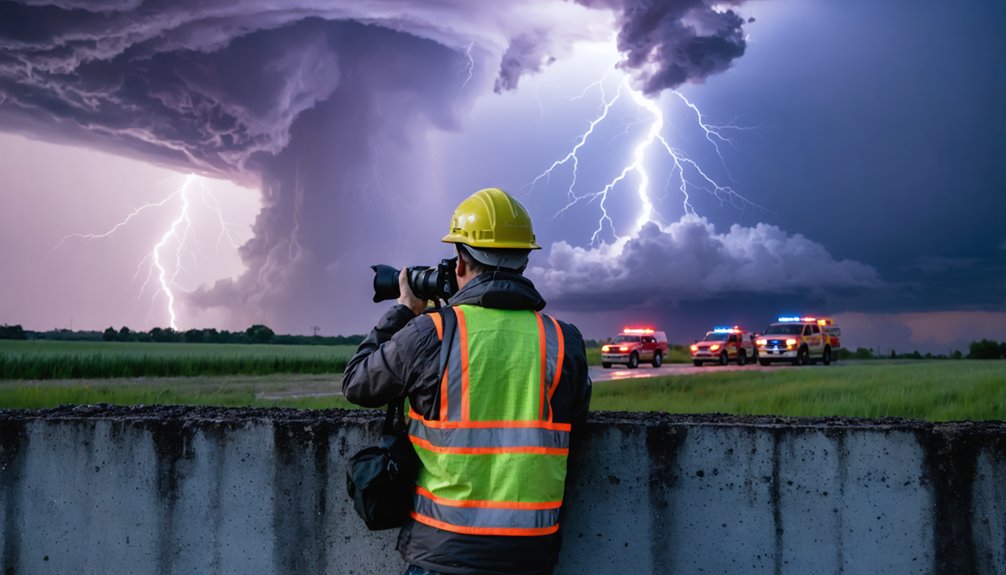
Crediting sources protects creators, but another responsibility sits closer to life and death: you must never compromise physical safety for footage. Storm safety isn’t optional—it’s your baseline operating standard during ethical filming.
Maintain safe distances from active debris fields, flooded roadways, and downed power infrastructure. Don’t broadcast footage that could misdirect emergency responders or encourage viewers to replicate dangerous positioning.
Respect FAA airspace restrictions if you’re operating drones near storm systems or active response zones.
Reckless capture behavior doesn’t just endanger you—it pulls first responders away from genuine emergencies. Prioritize situational awareness over dramatic angles.
Share your verified position data with local authorities when it’s relevant to public safety, but only when doing so doesn’t compromise your own security or active rescue operations.
Protect Privacy When Filming Storm Damage
Capturing storm damage puts you in close proximity to people at their most vulnerable, so privacy protections must be built into your filming protocol before you press record. Privacy considerations and consent requirements aren’t optional—they’re ethical obligations that protect survivors’ autonomy.
- A family standing in rubble hasn’t consented to becoming your content.
- Exposed personal documents, medications, or financial records deserve immediate redaction.
- Children in crisis zones require heightened protection from public exposure.
- Broadcasting license plates or addresses can enable exploitation of displaced residents.
Secure explicit verbal or written consent before filming identifiable individuals. Blur faces, private property details, and sensitive materials during post-processing. If consent is withdrawn, stop recording immediately and delete identifiable footage. Survivors’ dignity outweighs any engagement metric.
Stop Storm Footage Misinformation Before It Spreads
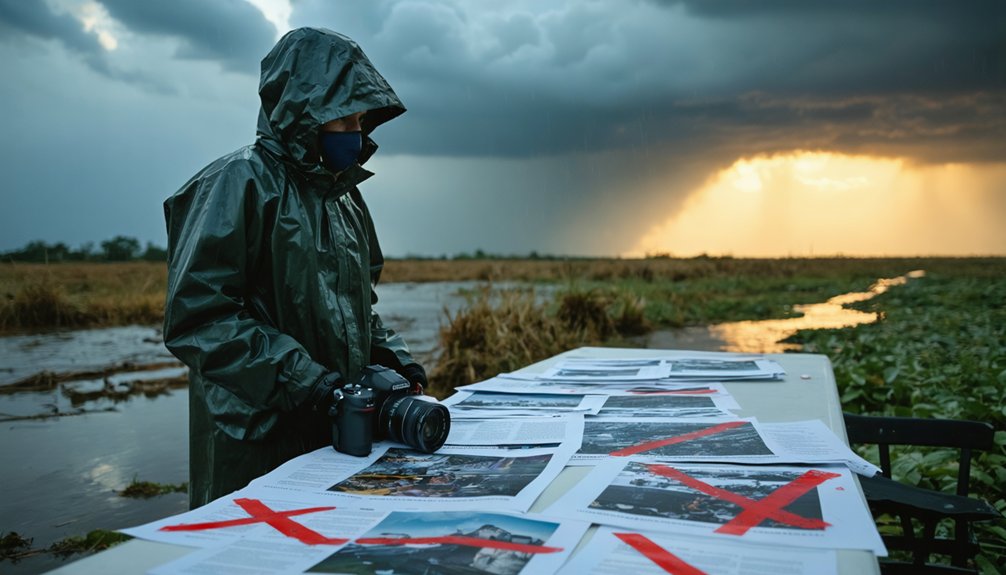
Storm footage spreads faster than verification can keep up, so you must cross-check every clip against official meteorological sources—NOAA, NWS radar, or satellite imagery—before resharing.
Weather myths circulate rapidly during active events, often distorting public understanding of actual threat levels and undermining storm safety protocols.
When you encounter disputed footage, pull metadata, timestamps, and geolocation data immediately. Compare those details against documented radar returns and official storm reports.
If discrepancies exist, don’t amplify the content.
Correct false information the moment you identify it. Edit or remove misleading posts, state explicitly what changed, and link directly to verified sources.
Monitor your comments section actively—misinformation compounds fast.
Prioritizing confirmed data over dramatic visuals protects your audience’s decision-making and preserves the credibility you’ve built as a responsible storm content publisher.
Correct Mistakes in Your Storm Footage Quickly and Clearly
When you discover an error in storm footage you’ve published, correct it immediately—delays erode credibility and allow misinformation to compound. Weather myths spread fast, and your platform carries real responsibility for storm safety outcomes.
- Pinpoint the exact error, whether a mislabeled location, wrong timestamp, or false intensity claim, and issue a transparent correction.
- Replace misleading visuals with verified data from NOAA, NWS radar, or confirmed eyewitness accounts.
- Publicly acknowledge what changed and why, so your audience understands the correction fully.
- Delete or update every reshared version you control to stop contaminated content from circulating further.
Monitor comments aggressively after correcting a post. Misinformation threads continue spreading even after corrections. Verified data always overrides dramatic visuals—prioritize accuracy over engagement without exception.
Frequently Asked Questions
Can Minors Be Filmed During Storm Events Without Parental Consent?
Like a locked gate, consent isn’t optional—you must secure parental permission before minors filming occurs during storm events. Without it, you’re violating privacy rights and ethical standards. Always obtain explicit authorization first.
What Legal Consequences Exist for Sharing Unverified Storm Footage Publicly?
You’ll face defamation claims, copyright infringement suits, and privacy concerns violations if you share unverified storm footage. Misused image rights can trigger FTC penalties, civil liability, and platform bans—verify data before you publish anything publicly.
Are Storm Chasers Legally Liable for Accidents Caused During Filming?
You could face liability—every reckless decision compounds your legal exposure. Without liability insurance, negligent filming that causes accidents makes you financially responsible. Conduct thorough risk assessment before chasing; courts evaluate whether you’ve taken reasonable precautions.
Which Platforms Have Specific Policies Governing Uploaded Storm Footage?
YouTube, Facebook, X, and TikTok each enforce distinct content policies governing storm footage uploads. You’ll encounter copyright concerns under YouTube’s Content ID system, while each platform’s community guidelines restrict misleading, unsafe, or unattributed meteorological content you share.
How Do You Monetize Storm Footage While Remaining Ethically Responsible?
Over 60% of viral storm clips lack proper attribution. You can monetize through storm footage licensing while practicing ethical content sharing by crediting sources, securing consent, verifying authenticity, and partnering with reputable media outlets that respect ownership rights.
References
- https://crazystormchasers.com/ethics-of-sharing-storm-footage-on-social-media/
- https://crazystormchasers.com/media-ethics-in-storm-chaser-reporting/
- https://www.wired.com/story/how-to-use-social-media-responsibly-during-storm/
- https://alllivingisstormchasing.substack.com/p/013-creating-with-care-a-code-of
- https://crazystormchasers.com/the-ethics-of-posting-graphic-storm-damage-on-social-media/
- https://www.weather.gov/media/directives/100_pdfs/pd10006curr.pdf
- https://www.youtube.com/watch?v=PHcQu8L5nMw
- https://www.ametsoc.org/ams/about-ams/ams-statements/statements-of-the-ams-in-force/best-practices-for-publicly-sharing-weather-information-via-social-media1/
- https://crazystormchasers.com/ensuring-ethical-practices-in-storm-chasing-technology/
- https://verificationhandbook.com/downloads/verification.handbook.pdf