Before you chase, review SPC outlooks and map both primary and alternate escape routes. Keep your fuel above half, assign clear crew roles, and confirm your vehicle’s ready to move fast. Stay 1–2 miles from confirmed circulation, trust visual storm structure over lagging radar, and never cross standing water. Abort immediately when routes narrow, visibility drops, or hazards stack. Professional chasers survive by planning their exit before they ever set up—and the details behind each decision matter.
Key Takeaways
- Always review SPC outlooks and map primary and alternate routes before departure, including shelter locations and flood-prone areas to avoid.
- Never let fuel drop below half a tank, and perform full vehicle checks before every chase.
- Maintain at least 1–2 miles from confirmed tornado circulation and always identify two independent escape routes before positioning.
- Never cross standing or rising water, and avoid hail above golf ball size to prevent vehicle disablement.
- Cease pursuit immediately if escape routes narrow, visibility drops, flooding appears, or darkness reduces your ability to spot hazards.
Know the Forecast Before You Leave the Driveway
Before you back out of the driveway, you need a solid grasp of the day’s forecast or you’re already behind. Review Storm Prediction Center outlooks, mesoscale discussions, and active storm warnings before you move. Know where instability is highest, where the cap is weakest, and where initiation is most likely.
Map your primary and alternate routes in advance, and identify shelter options along each corridor. Reconcile road network limitations before entering your target area, particularly in rural terrain where options narrow fast.
Download offline maps and cache weather radar data before cellular coverage drops. Define your abort criteria now, not mid-chase. Set hard limits around storm motion changes, nightfall, and flooding. Leaving those decisions open-ended costs you the margin you need to stay free and mobile.
Map Your Routes and Escape Routes Before You Chase
Route planning isn’t something you do in the field—it’s a pre-chase discipline that determines whether you stay mobile or get trapped. Before you leave, map your primary route and at least one alternate, accounting for storm drift as the system moves and evolves.
Rural road networks often have dead ends, washed-out sections, or limited crossroads that eliminate your options fast. Identify shelter locations along your corridors before you need them.
Storm segmentation can split your target area unpredictably, so build flexibility into your route structure rather than committing to a single path. Load offline maps as a backup when cellular coverage fails.
Define your abort criteria in advance—flooding, nightfall, communication loss—so you’re making decisions on protocol, not panic.
Keep Your Storm Chasing Vehicle Ready to Move Fast
Your vehicle isn’t just transportation—it’s your primary safety system, and it has to perform on demand. Vehicle maintenance isn’t optional before a chase—it’s a non-negotiable safety step. Inspect your tires, brakes, fluids, battery, and defroster before you enter the target zone. A mechanical failure during rapid repositioning can cost you your life.
Fuel management matters just as much. Never let your tank drop below half during a long pursuit window. Rural chase terrain offers few gas stations, and storms won’t wait while you refuel.
Keep your windshield clear and your wipers functional for sudden rain, hail, or dust. Your vehicle must support fast, decisive movement at any moment—because when conditions turn lethal, hesitation isn’t an option.
Never Chase Alone: Assign Roles Before the Storm
Solo chasing forces the driver to split attention between the road, radar, and storm structure—a dangerous combination that degrades decision-making when it matters most.
You should always bring at least one trained partner and lock in crew roles before departure, assigning specific responsibilities for driving, navigation, communication, and data logging.
Defined roles reduce task saturation, keep the driver focused, and guarantee critical information reaches the right person at the right time.
Partner Up For Safety
Chasing alone forces you to split attention between driving, radar, navigation, and storm monitoring—a task load that increases risk exponentially as conditions intensify. A partner isn’t optional; it’s a core storm safety requirement.
Assign distinct roles before departure: driver, navigator, communicator, and data logger. The driver stays focused on the road—period. Your partner handles radar interpretation, route adjustments, and communication with external contacts.
Pre-assign responsibilities the same way you’d handle vehicle maintenance checks—systematically, before pressure mounts. Tested communication devices, redundant systems, and clear role boundaries reduce task saturation when conditions deteriorate fast.
When a storm shifts unexpectedly, you can’t afford hesitation caused by divided focus. A coordinated two-person crew responds faster, repositions smarter, and escapes cleaner than any solo chaser operating at full cognitive load.
Define Roles Early
Before a single mile is driven, every crew member needs a defined role—driver, navigator, communicator, and data logger—assigned and understood without ambiguity. Clear role separation keeps decision-making fast and prevents dangerous task overlap when conditions escalate.
- Driver — Eyes on the road and storm environment only; never touches storm equipment or radar.
- Navigator — Manages maps, escape routes, and real-time repositioning calls.
- Communicator — Executes all communication protocols, including radio, spotter network check-ins, and emergency contacts.
- Data Logger — Records storm behavior, timestamps, and positional notes without interrupting active crew members.
When everyone owns their lane, you eliminate hesitation. Defined roles aren’t bureaucracy—they’re the operational framework that keeps your crew mobile, coordinated, and alive when the storm dictates the next move.
Read the Storm Structure, Not Just the Radar
Radar gives you data, but it doesn’t give you real-time truth. Radar scans lag, sometimes considerably, behind rapidly evolving storm cloud dynamics. What you’re seeing on screen may already be outdated by the time you’re making a positioning decision.
Train your eyes on the actual storm structure in front of you.
Watch precipitation patterns for sudden intensification, inflow banding, and wall cloud development. Monitor rotation visually, not just algorithmically. If the storm’s motion shifts or the condensation funnel widens faster than expected, that’s your cue to move—immediately.
Cross-reference what you observe directly with radar data, but never let radar override your field assessment. Your eyes process real-time information. Your radar app doesn’t. Trust the sky first.
How Far Should a Storm Chaser Stay From a Tornado?
When positioning near a confirmed tornado, you should maintain at least 1–2 miles of distance from the circulation to preserve meaningful reaction time.
Don’t set up at a viewing point until you’ve identified two independent escape routes that remain viable if the storm shifts direction or accelerates.
If either route becomes compromised, you leave immediately—no exceptions.
Recommended Safe Distance
Maintaining at least 1–2 miles from a confirmed tornado circulation isn’t just a guideline—it’s the operational baseline that keeps your escape options viable. Storm scale and wind shear determine how fast conditions deteriorate, so distance buys you decision time.
Use these four positioning benchmarks:
- Stay 1–2 miles minimum from confirmed circulation, adjusting farther for large, high-end storm scale events.
- Account for wind shear shifts that can cause rapid, unpredictable tornado direction changes.
- Identify two independent escape routes before you commit to any viewing position.
- Increase distance immediately when the debris field expands, the tornado widens, or your escape routes narrow.
Distance isn’t timidity—it’s tactical. The chaser who survives is the one who stays mobile, not the one who gets closest.
Escape Route Positioning
Escape route positioning determines whether distance becomes survivable margin or a fatal miscalculation. Before you stop, identify two independent exit routes that remain viable even if storm motion shifts or wind shear accelerates the tornado’s track unexpectedly. Don’t rely on a single road grid — rural networks collapse your options fast.
Position yourself where forward momentum stays possible. Storm surge from intense precipitation can flood low-lying escape corridors within minutes, eliminating routes you counted on. Always prefer paved roads on higher ground that support rapid repositioning.
If either escape route narrows, gets compromised by debris, or flooding cuts access, leave immediately — don’t wait for confirmation. Your position only works if movement remains fully available. Survivable distance means nothing without a clear path out.
Flash Flooding, Hail, and Lightning Are More Dangerous Than They Look
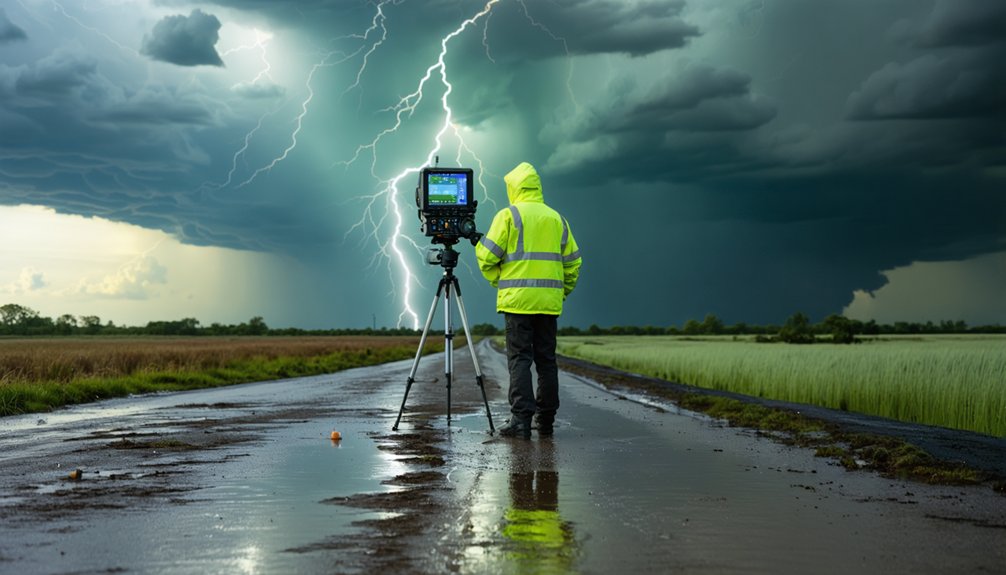
Storm chasers often fixate on the tornado itself, but flash flooding, hail, and lightning kill and injure more people in severe weather environments than the tornado does. Wind shear and storm surge compound these threats fast. Treat each hazard as an independent abort trigger:
- Flash flooding moves faster than most vehicles can escape—never cross standing or rising water regardless of depth appearance.
- Hail above golf ball size destroys windshields, disables vehicles, and removes your ability to reposition instantly.
- Lightning strikes without warning near rotating supercells—exiting your vehicle for any reason dramatically raises your exposure risk.
- Combined hazards stack quickly; flooding roads while hail reduces visibility while lightning targets open terrain leaves you with zero margin.
Recognize these threats early and exit before they converge.
When Should a Storm Chaser Abort the Chase?
Knowing when to abort is as critical as knowing how to position, because a chase that exceeds your ability to reposition safely has already become a liability. Define your abort criteria before the chase begins, not during it. Weather variability can compress your decision window faster than radar updates arrive, so you can’t afford to improvise thresholds mid-pursuit.
Abort immediately when escape routes narrow, visibility drops below safe navigation levels, flooding appears on your path, or communication fails. Storm intensity that outpaces your repositioning speed removes your margin entirely. Nightfall eliminates structural recognition and route clarity, making continued pursuit unjustifiable.
Don’t negotiate with deteriorating conditions. When the situation exceeds your pre-established limits, execute your exit. Discipline in that moment is what separates experienced chasers from casualties.
Why Storm Chasers Don’t Chase After Dark
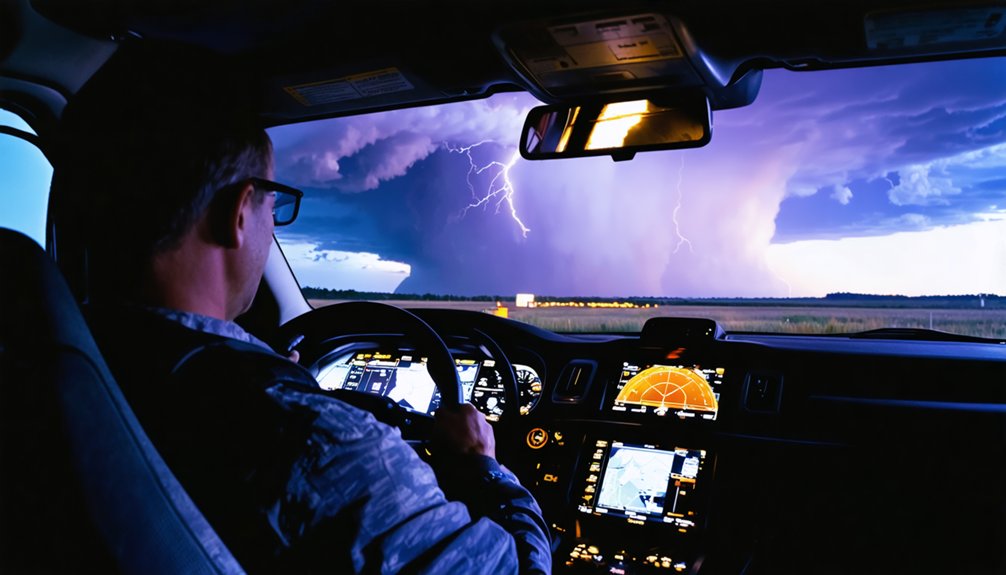
Chasing after dark removes your ability to read storm structure, and without that, you’re operating blind on every decision that matters. Night visibility eliminates your most critical safety tool: direct visual confirmation. Storm fatigue compounds every risk, slowing your reaction time exactly when conditions demand sharpest judgment.
Four reasons professional chasers don’t chase after dark:
- Tornado detection fails — you can’t see rotation, debris clouds, or wall cloud movement without ambient light.
- Escape routes disappear — roads that looked clear at dusk become unrecognizable in darkness and heavy rain.
- Flooding goes undetected — standing water on rural roads is invisible until you’re already in it.
- Decision speed drops — storm fatigue combined with darkness makes repositioning dangerously reactive instead of proactive.
Never Let Your Position Cut Off Your Escape Route
Before you commit to any viewing position, identify two independent exit routes and confirm they remain viable given the storm’s current motion and speed.
Don’t rely on a single road out, because a rapidly shifting tornado or expanding debris field can cut off that option in seconds.
Reposition as soon as one route shows signs of compromise—waiting until you’re forced to move guarantees you’ll be making high-speed decisions under maximum pressure.
Identify Two Exit Routes
Every position you choose during a storm chase must include two confirmed exit routes before you stop moving. If one route closes due to storm shift, roadside debris, or flooding, you need the second ready without hesitation.
Before committing to any viewing position, verify:
- Both exits lead away from the storm’s projected path, not parallel to it.
- Neither route crosses low-water crossings, storm drain hazards, or flood-prone terrain.
- Both roads are paved, passable, and visible under reduced-visibility conditions.
- You can reach either exit within seconds, not minutes.
You’re not chasing to get trapped — you’re chasing to stay mobile. The moment one exit disappears, execute the second immediately. Hesitation at that point isn’t caution; it’s a liability.
Reposition Before Escape Narrows
Escape routes don’t close all at once — they narrow incrementally, and by the time the threat is obvious, repositioning is already too late.
Monitor storm drift continuously, not just at setup. A tornado tracking northeast at 25 mph can shift east-northeast within minutes, converting a lateral escape into a direct intercept path.
Debris accumulation on roadways compounds the problem — what appeared passable on radar becomes impassable on the ground.
You must reposition before conditions force the decision, not after. Treat any narrowing of your exit options as an immediate trigger to move.
Waiting for visual confirmation of danger eliminates the margin you need. Freedom of movement is your primary tactical asset — protect it aggressively by repositioning early rather than reacting late.
Frequently Asked Questions
What Insurance Coverage Do Professional Storm Chasers Typically Carry on Their Vehicles?
Over 80% of chases involve hail risk. You’ll need extensive insurance coverage beyond standard policies for full vehicle protection—including hail, flood, and collision riders tailored specifically to high-risk storm chasing environments.
How Do Storm Chasers Legally Film or Photograph Tornadoes on Private Property?
You’ll need landowner permission to address legal permissions and privacy concerns when filming on private property. Obtain verbal or written consent before entry, respect posted boundaries, and never trespass—even during active tornado documentation.
Do Storm Chasers Need Special Licenses or Certifications to Chase Professionally?
You don’t need a mountain of licenses to chase professionally, but storm chasing ethics and public safety awareness demand you master meteorology, vehicle operations, and field protocols before you’re anywhere near a tornado.
How Do Storm Chasers Fund Their Equipment and Chase Operations Financially?
You’ll fund storm chasing gear and weather forecasting operations through media contracts, stock footage sales, crowdfunding, sponsorships, and scientific grants. Diversifying your income streams guarantees you’re maintaining financial independence while sustaining chase operations effectively.
What Physical Fitness Level Is Recommended for Active Storm Chasing Pursuits?
Like a soldier entering battle, you’ll need solid cardiovascular endurance. Complete a fitness assessment before chasing—endurance training guarantees you’re capable of sustained alertness, rapid vehicle repositioning, and managing high-stress physical demands without compromising your judgment or safety.
References
- https://www.youtube.com/watch?v=nxPSFg2R8YY
- https://www.atms.unca.edu/cgodfrey/courses/swfex/pdf/ChasingSafety.pdf
- https://www.reddit.com/r/stormchasing/comments/k89wnc/safety_tips_for_storm_chasing/
- https://crazystormchasers.com/best-practices-for-storm-chasing-safety-engagement/
- https://en.wikipedia.org/wiki/Storm_chasing
- https://www.livingskytours.com/storm-chasing-101/
- https://crazystormchasers.com/essential-storm-chasing-safety-tips-and-guidelines/
- https://crazystormchasers.com/storm-chasing-safety-rules/
- https://will.illinois.edu/weatherrealness/episode/storm-chasing-can-be-deadly-heres-how-to-stay-safe
- https://crazystormchasers.com/essential-safety-checklist-for-storm-chasing-expeditions/