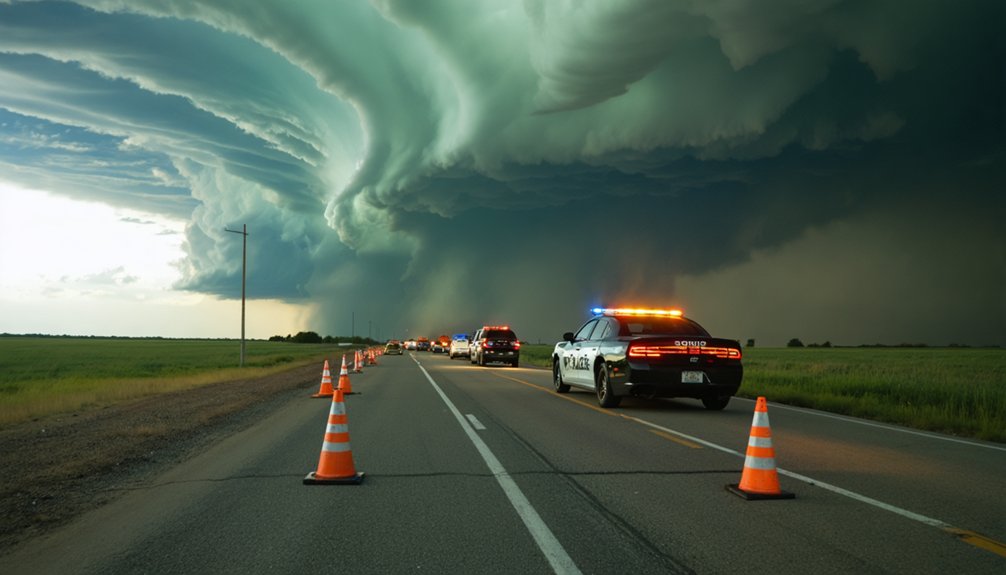
When an emergency declaration activates, it shifts your operating environment from standard traffic law to emergency authority—instantly. Agencies gain power to close highways, block bridges, and enforce evacuation zones you can’t legally enter. Your press badge or chase permit carries no statutory exemption; officers control access based on real-time conditions. Violating closures risks arrest, fines, and vehicle impoundment. The sections ahead break down exactly how these rules apply to every stage of your chase.
Key Takeaways
- Emergency declarations activate a separate tier of government authority, empowering agencies to close roads and enforce evacuation zones overriding normal traffic laws.
- No U.S. state grants storm chasers blanket exemptions from closures or restrictions during active emergency declarations.
- Press badges and chase permits carry no statutory exemption; access decisions are made by officers at the incident level.
- Violating restricted zones can result in arrest, fines, vehicle impoundment, and interference with emergency rescue operations.
- Road closures often persist well beyond storm dissipation, with reopening dependent on damage assessments rather than weather conditions alone.
What Is an Emergency Declaration and Why Does It Matter to Storm Chasers?
When a governor or local executive issues an emergency declaration, it does more than acknowledge that severe weather hit—it legally activates a separate tier of government authority that directly affects where you can drive and what orders you must follow.
That shift matters because your weather forecasting tools and storm tracking data can’t override a declaration’s legal weight. Once issued, the declaration empowers agencies to close roads, enforce evacuation zones, and direct law enforcement to block access—regardless of your chase objectives.
You’re no longer operating under normal traffic law alone; you’re operating under emergency authority. Understanding that distinction before you deploy keeps you legally compliant and operationally effective, preserving your freedom to chase when and where conditions legally allow.
How Declarations Empower Road Closures and Access Limits
Once a declaration activates emergency authority, road closures become its most immediate and enforceable tool against your access. State and local agencies can shut down highways, bridges, and local routes the moment conditions—flooding, debris, downed lines—make travel hazardous. No weather forecasting model or storm tracking data overrides a physical roadblock backed by emergency law.
Closures apply uniformly. Law enforcement doesn’t distinguish between commuters and chasers; the barrier holds regardless of your equipment or intent. Detours may exist, but the closed segment stays off-limits until officials reopen it, sometimes days later.
Declarations don’t just authorize closures—they legally insulate them. Challenging a closure mid-chase carries real consequences: arrest, fines, and interference with active rescue operations. Compliance isn’t optional; it’s the operational reality declarations create.
Who Actually Controls Storm Chaser Access: Officers, Managers, or the Declaration?
When you’re out chasing and you hit a roadblock, the declaration isn’t the entity stopping you — the officer in front of you is. Emergency declarations empower restrictions, but enforcement happens at the incident level, where individual officers and emergency managers make real-time access decisions based on conditions on the ground.
You need to understand that no declaration grants you access or denies it directly; it’s the command structure — officers enforcing closures, managers coordinating evacuation zones — that controls whether you move forward or turn around.
Declarations Empower, Officers Enforce
Although an emergency declaration sets the legal foundation, it doesn’t physically stop your vehicle at a barricade—an officer or emergency manager does. The declaration transfers legal authority downward, empowering incident-level personnel to act. Your weather forecasts and storm tracking data don’t grant you override capability at that barricade.
Understand the chain clearly: a governor signs a declaration, emergency managers activate response protocols, and officers execute closures at specific road segments. Each layer narrows your access further. The officer blocking your route isn’t operating on personal discretion—they’re enforcing a legally authorized order backed by that declaration.
No credential, media badge, or chase objective legally supersedes a direct officer instruction during an active closure. Compliance isn’t optional; it’s legally required and operationally enforced at the incident level.
Incident-Level Access Decisions
The declaration itself doesn’t control your access—incident commanders, law enforcement officers, and emergency managers make those calls in real time at the field level. Each closure decision reflects current ground conditions, not a blanket chase policy derived from the declaration’s text.
An officer managing a debris-blocked highway near a tornado track applies their own situational judgment, informed by weather forecasting data and resource availability. Emergency managers coordinating community outreach may open segments once hazards clear, or tighten restrictions if conditions deteriorate.
Your credentials, your equipment, and your objectives carry no automatic weight in those decisions. Access gets granted or denied incident by incident, road by road, officer by officer.
Understanding that hierarchy—declaration, manager, officer, field condition—lets you anticipate restrictions accurately and position yourself legally before closures lock you out.
Emergency Managers Coordinate Restrictions
Behind every road closure you encounter during an active emergency, there’s a chain of authority that runs from the declaration through emergency managers down to the officer standing at the barricade.
Emergency authority doesn’t originate at the roadblock—it flows downward from the formal declaration, giving emergency managers the power to coordinate evacuation zones, traffic controls, and access restrictions across the affected area.
Emergency managers translate that broad authority into specific operational decisions: which roads close, when they reopen, and who qualifies for access exemptions.
The officer you face enforces those decisions at ground level. You’re not arguing with one person—you’re contesting a coordinated structure.
Understanding this chain clarifies why credentials, persuasion, or chase objectives rarely override a closure. The decision was made well above the barricade.
Road Closures Are the Real Legal Barrier for Storm Chasers
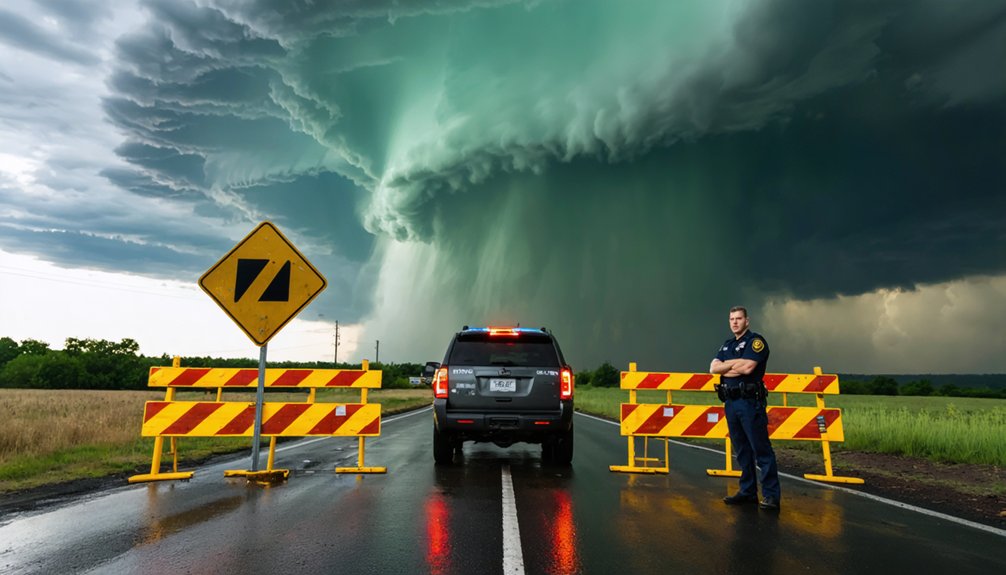
When an emergency declaration takes effect, it’s the road closure order—not the declaration itself—that becomes your immediate legal barrier as a storm chaser. Declarations empower authorities to act; closures enforce that power directly against your movement.
Your meteorological analysis may confirm a textbook supercell ahead, and your storm chasing gear may be deployment-ready, but a physical roadblock legally terminates your access to that segment. Law enforcement closures apply universally—media credentials and professional status don’t override them.
Closures can affect highways, county roads, and bridges simultaneously, compressing your positioning options in real time. They may persist for hours or days while crews assess structural damage and debris hazards.
Knowing which agency controls each road corridor lets you anticipate legal access boundaries before conditions deteriorate.
Can Emergency Road Closures Outlast the Storm for Chasers?
Road closures don’t expire when the last storm cell dissipates. Historical precedents confirm that post-storm conditions—flooded bridges, downed power lines, unstable road shoulders—legally justify extended closures lasting days or weeks. You’re still subject to those barriers even though the active weather threat is gone. Emergency authority persists as long as conditions remain hazardous, not just while rain falls.
International comparisons reinforce this point. Australian and European jurisdictions similarly extend road restrictions well beyond storm passage when infrastructure assessments remain incomplete. You don’t gain automatic re-entry rights because the sky clears.
Law enforcement determines when conditions meet reopening thresholds, and that timeline is driven by damage surveys, not weather data. Plan your chase operations assuming post-storm closures will compress your access window considerably.
Do Media Credentials or Chase Permits Change Anything?
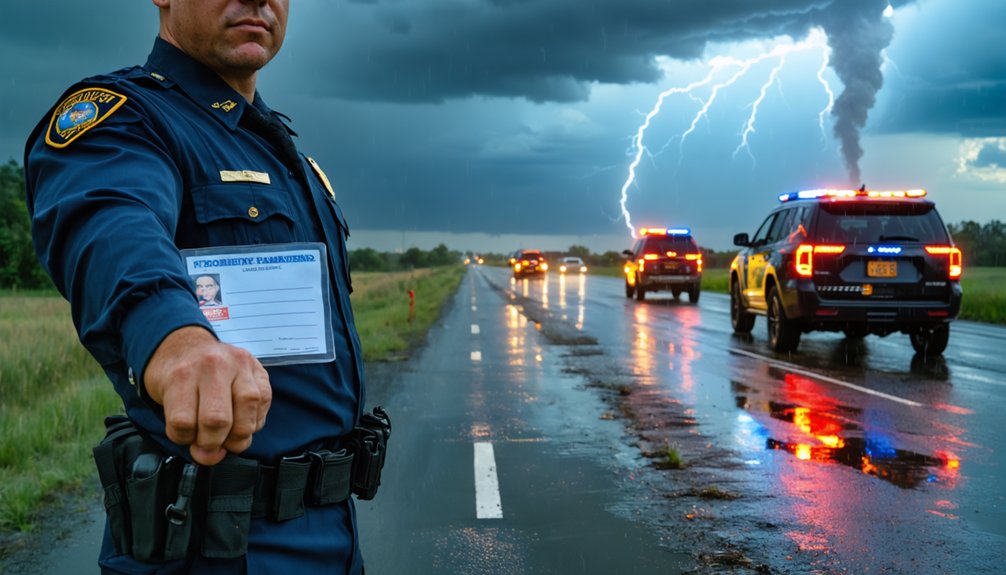
Media credentials and chase permits don’t override a closed road or a direct law enforcement order—that distinction matters operationally. If an officer blocks a highway under an active emergency declaration, your press badge or chase permit carries no statutory exemption. Access decisions happen at the incident level, meaning individual commanders control entry, not blanket credentialing systems.
Some states have explored legislation granting select chasers emergency-vehicle-style access, but no universal framework exists yet. Without codified exemptions, you’re subject to identical restrictions as any other motorist.
Media credentials may open dialogue with a public information officer, but they won’t legally compel an officer to lift a closure. Understand that distinction before assuming your credentials expand your operational range during an active emergency declaration.
How Flood vs. Tornado Emergencies Affect Storm Chaser Access
The type of emergency shaping your chase window matters because flood and tornado declarations impose different closure timelines and access triggers.
Flood closures tend to linger for days or even weeks after the storm passes, as rising water, compromised bridges, and debris keep conditions hazardous long after the initial event.
Tornado damage restricts your access more immediately but often clears faster once crews assess structural hazards, meaning the declaration type you’re operating under directly shapes how long and how strictly your movement stays limited.
Flood Closures Linger Longer
When a tornado tears through an area, closures often lift within hours once emergency crews confirm road surfaces are clear and structures aren’t actively collapsing—but flood emergencies operate on an entirely different timeline.
Floodwaters can undercut road foundations, compromise bridge load ratings, and deposit debris that requires engineering assessments before reopening. Historical precedents show closures extending days or even weeks after peak water levels recede.
Those legal nuances matter for you as a chaser—an area may look passable while remaining legally closed under an active emergency order. Law enforcement retains authority to enforce that closure regardless of visible conditions.
You can’t rely on visual assessment alone; you need to confirm official reopening through county emergency management channels before attempting access.
Tornado Damage Restricts Access
Tornado damage closures follow a faster reset curve than flood emergencies, but don’t mistake speed for simplicity. Historical case studies from Joplin (2011) and Moore (2013) confirm that structural collapse, downed power lines, and gas leaks trigger multi-day restricted zones independent of active weather.
Weather pattern analysis shows tornado damage clusters along narrow corridors, meaning law enforcement can surgically close specific road segments rather than broad regions. That precision cuts both ways—you’ll face hard barriers at exact intersections rather than general area restrictions.
Officers control access at the incident level, not through statewide policy. Your chase credentials carry no legal override. Until officials physically reopen a segment, you’re legally prohibited from entering it, regardless of how quickly the sky clears above you.
Declaration Type Shapes Rules
Declaration type isn’t a bureaucratic detail—it’s the variable that determines how long you’re locked out and under what legal framework. Flood emergencies historically extend closures far longer than tornado declarations—historical precedents show flood-related restrictions lasting days or weeks while tornado closures typically lift within hours once debris is cleared.
The legal authority activating each closure differs too. Flood declarations often invoke broader watershed and infrastructure statutes, while tornado emergencies rely on immediate public-safety orders tied to structural hazard assessments.
International comparisons reinforce this pattern—Australian and European emergency frameworks similarly distinguish between hydrological and wind-damage events, applying proportionally longer access restrictions to flood zones.
You need to identify the specific declaration type governing your target area before assuming any access window exists.
Does Any State Give Storm Chasers Special Access Rights?
Although storm chasing has grown into a recognized scientific and media pursuit, no U.S. state currently grants chasers a blanket legal exemption from road closures or emergency access restrictions. Storm chaser privileges simply don’t exist in codified law at the state level, meaning legal exemptions remain unavailable regardless of your credentials or equipment.
Storm chasing lacks legal standing — no U.S. state grants chasers exemptions from road closures or emergency restrictions.
Three legislative realities define your access rights:
- No universal statute establishes storm-chaser vehicle status comparable to emergency responders.
- Proposed legislation in select states has explored special access frameworks but hasn’t passed into enforceable law.
- Media credentials carry no automatic override authority against a law enforcement closure order.
You’re operating under the same restrictions as any other motorist until a specific jurisdiction formally creates an enforceable exemption — and none currently has.
What Happens If You Enter a Closed Zone During a Declaration?
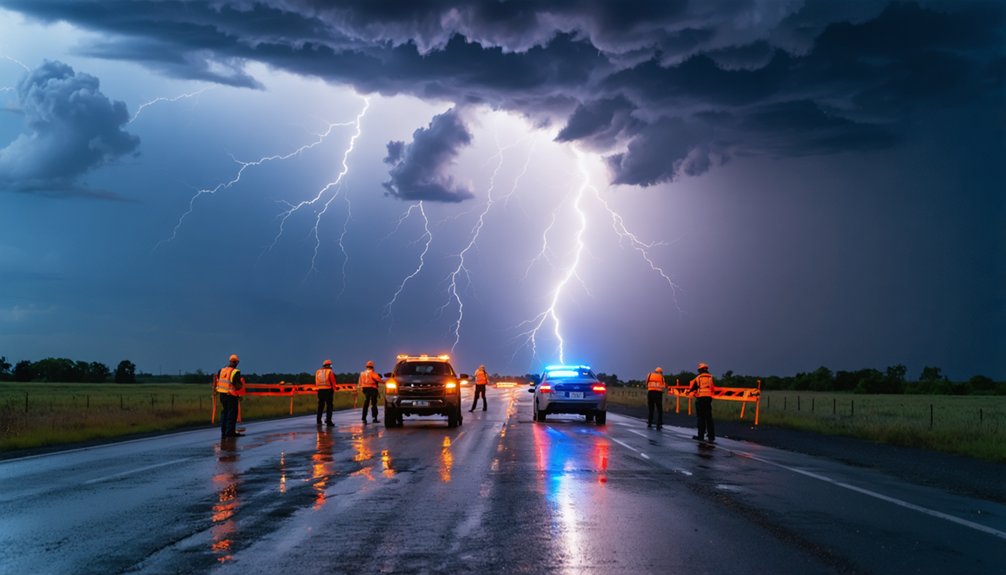
If you cross into a closed zone during an active emergency declaration, you expose yourself to arrest, fines, and potential criminal charges for obstructing emergency operations.
Your presence can block rescue vehicles, divert law enforcement from life-safety tasks, and complicate evacuation corridors already under strain.
Beyond the legal risk, you’re operating in an environment where flooding, downed power lines, and structural debris can incapacitate or kill you before responders can reach your position.
Legal Consequences Await
Entering a closed zone during an active emergency declaration carries concrete legal consequences that go well beyond a warning. Law enforcement has full authority to detain, cite, or arrest you on the spot. Your freedom to chase doesn’t override emergency orders backed by state statute.
Expect these three outcomes:
- Criminal citations or arrest — obstruction and trespassing charges apply in most jurisdictions.
- Insurance policies voided — vehicle and liability coverage often excludes damages incurred while violating emergency orders.
- Environmental regulations triggered — entering flood or debris zones can implicate hazmat and environmental statutes if your vehicle disturbs contaminated runoff.
Beyond legal exposure, you risk obstructing active rescue operations. Authorities track violations, and repeat offenses escalate penalties. Compliance isn’t optional — it’s legally enforced.
Obstruction Of Emergency Response
When you cross into a closed zone during an active emergency declaration, you don’t just risk personal injury — you actively disrupt coordinated response operations that depend on clear access corridors.
Emergency managers route rescue vehicles, utility crews, and damage assessment teams through specific corridors mapped against meteorological data and real-time hazard reports. Your unauthorized vehicle occupies that corridor, forcing responders to navigate around an obstacle they didn’t plan for.
That friction costs time — and in active emergencies, time determines outcomes. Law enforcement may redirect personnel to remove you rather than assist evacuees.
Public awareness campaigns consistently reinforce that closed zones exist precisely because conditions remain life-threatening. Your freedom to chase doesn’t override another person’s right to timely rescue.
Compliance isn’t bureaucratic submission — it’s operational respect.
Personal Safety Risks
Beyond disrupting rescue operations, closed zones carry direct, measurable threats to your own survival. Weather forecasting models don’t capture every micro-hazard on a closed road—downed power lines, submerged pavement, and structurally compromised bridges create conditions that exceed instrument detection. Public awareness of these specifics often lags hours behind actual field conditions.
Entering a restricted zone exposes you to three documented risks:
- Hydrological hazards — Six inches of moving water can disable your vehicle; twelve can carry it.
- Electrocution — Downed transmission lines remain energized without visible indication.
- Criminal liability — Violations can produce misdemeanor charges, vehicle impoundment, and barred future access.
You’ve chosen chasing for the freedom it provides. Respecting closures protects that freedom long-term.
How Storm Chasers Can Stay Legal When Emergency Orders Change the Route
Staying legal during a rapidly evolving emergency declaration starts with recognizing that the closure order—not the weather event itself—is the immediate legal barrier.
Monitor official channels—state DOT feeds, county emergency management alerts, and law enforcement dispatch updates—to track exactly when and where closures activate.
No universal legal exemptions exist for storm chasers, so you’re operating under the same access permissions as every other motorist until a jurisdiction explicitly grants otherwise.
When a roadblock appears, comply immediately and document the restriction’s location and timestamp.
Reroute using open corridors confirmed by real-time closure maps.
Media credentials don’t override a direct officer order.
Your operational freedom depends on staying within legal boundaries—jurisdictions that see chasers respecting closures are more likely to contemplate formal access permissions in future policy discussions.
Frequently Asked Questions
Can Private Landowners Grant Storm Chasers Access Despite Active Emergency Closures?
Private land isn’t a key *unsealing* closed roads—emergency closures override access rights even on private property. You can’t legally cross a blocked public road to reach it, regardless of the landowner’s permission.
Are Storm Chasers Ever Legally Required to Report Damage Observations to Authorities?
You’re generally not subject to mandatory damage reporting or legal obligations as a storm chaser. No universal statute compels you to report observations, though voluntary reporting to NWS or local emergency managers remains widely encouraged.
Do Emergency Declarations Affect Storm Chaser Vehicle Insurance Coverage During Incidents?
Emergency declarations don’t automatically trigger insurance liability shifts, but you’ll face coverage exclusions if you’ve entered restricted zones illegally. Your insurer can deny claims when you’ve violated emergency orders during active incidents.
Can Storm Chasers Be Deputized During Emergencies to Gain Expanded Access Rights?
You chase freely, yet you’re still bound by law. Deputization isn’t standard under storm chase regulations. Emergency response coordination rarely grants chasers expanded access—formal legal authority, not informal status, determines your rights during declared emergencies.
How Do Interstate Emergency Declarations Coordinate Access Rules Across State Borders?
Interstate coordination doesn’t unify legal jurisdiction automatically—you’ll face each state’s independent closure orders. Declarations align resources, but access rules shift at every border, so you must verify restrictions state by state before crossing.
References
- https://www.fema.gov/disaster/declarations
- https://crazystormchasers.com/competing-in-storm-chasing-rules-and-regulations/
- https://highways.dot.gov/traffic-info
- https://crazystormchasers.com/is-it-legal-to-chase-tornadoes-on-public-roads/
- https://www.nytimes.com/2025/12/10/weather/washington-rivers-flood-evacuations.html
- https://www.foxweather.com/lifestyle/ok-rules-severe-weather-tornado
- https://oklahomavoice.com/2025/02/04/oklahoma-house-advances-controversial-bill-giving-some-storm-chasers-emergency-vehicle-status/
- https://mayor.lacity.gov/news/city-declares-local-emergency-response-palisades-fire-and-ongoing-wind-event-president-biden
- https://www.wboy.com/news/national-guard-deployed-in-flood-hit-communities/
- https://hamilton.govt.nz/cyclone-vaianu-hamilton