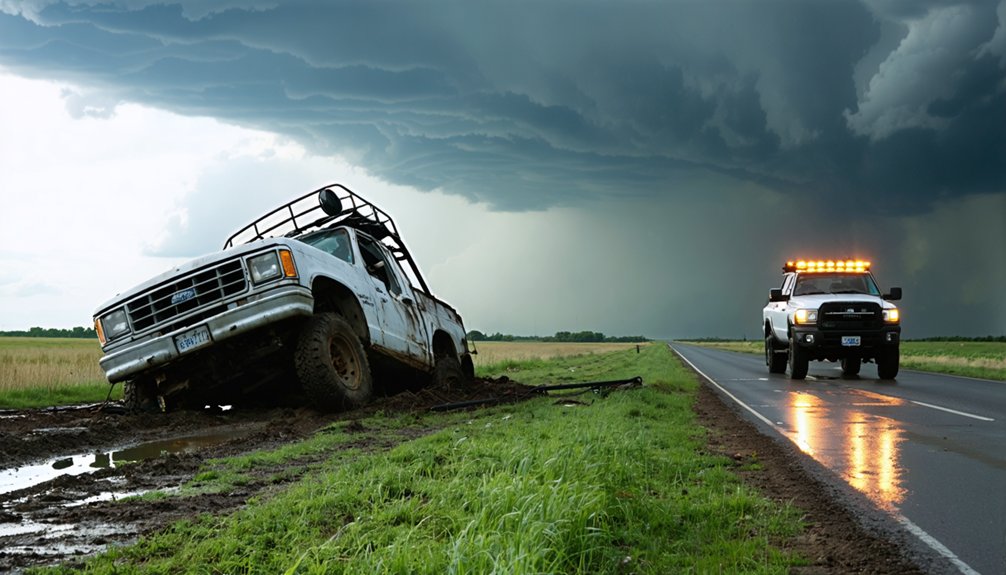
Close calls don’t just rattle you in the moment—they leave measurable neurobiological debt across your cognition, emotional regulation, and risk perception. Each near-miss encodes trauma-weighted memory, elevates cortisol output, and quietly recalibrates your threat-response thresholds without conscious authorization. Residual sympathetic activation compounds across a full chase season, degrading your field judgment through attentional constriction and normalized risk tolerance. Understanding these mechanisms is the first step toward reclaiming accurate situational awareness and operational resilience.
Key Takeaways
- Close calls trigger prolonged cortisol elevation and sympathetic activation, disrupting sleep, focus, and emotional regulation long after the event ends.
- Repeated near-misses gradually normalize dangerous risk thresholds, silently distorting judgment and increasing tolerance for life-threatening situations.
- Neurobiological imprinting of traumatic events causes intrusive imagery, hypervigilance, and cognitive fatigue, often misclassified as routine operational stress.
- Adrenaline-driven neurochemical reinforcement can unconsciously condition storm chasers to seek increasingly dangerous exposures as habitual behavior.
- Cumulative seasonal stress builds physiological debt gradually, eroding decision-making capacity before obvious symptoms of impairment appear.
What Happens to Your Mind After a Close Call?
When a close call ends, your nervous system doesn’t immediately stand down. Residual sympathetic activation keeps cortisol elevated, disrupting sleep, narrowing concentration, and sustaining hypervigilance well past the threat window.
Your brain engages memory reinforcement mechanisms, encoding the event with acute emotional intensity that can surface later as intrusive imagery or involuntary recall.
This neurological imprinting isn’t random — it’s your threat-response architecture cataloging high-stakes data for future survival referencing. The problem is that repeated encoding of traumatic stimuli progressively strains emotional resilience, reducing your capacity to regulate stress across subsequent chases.
Anxiety, irritability, and cognitive fatigue become measurable byproducts. Recognizing these responses as neurobiological sequelae rather than weakness lets you assess your actual operational state accurately and make autonomous, informed decisions about your next move in the field.
How Stress Quietly Accumulates Across a Full Chase Season
Across a full chase season, cumulative stress loads build through a compounding mechanism that’s largely invisible in real time — each acute stressor adds residual neurobiological cost that incomplete recovery fails to clear. Your autonomic nervous system doesn’t fully reset between events.
Sleep disruption, elevated cortisol, and sustained hypervigilance erode your emotional resilience incrementally, leaving you functionally compromised before you recognize the deficit. Stress adaptation doesn’t immunize you against accumulation; it masks it.
You’re still logging physiological debt while feeling operationally capable. Irritability sharpens, concentration narrows, and risk thresholds quietly shift.
When Stress Crosses Into Trauma for Storm Chasers
Cumulative seasonal strain establishes the neurobiological preconditions for trauma, but the actual threshold crossing is event-driven. When a near-miss exceeds your emotional resilience ceiling, stress stops being acute and becomes symptomatic.
You’ll recognize the shift through intrusive imagery, avoidance behaviors, sleep fragmentation, and emotional numbing that persist beyond several weeks. These aren’t temporary recalibrations—they’re indicators of post-traumatic stress pathology demanding structured intervention.
Your autonomic nervous system remains dysregulated long after the triggering event, distorting subsequent risk perception and degrading field judgment. Peer support functions as a critical early-intervention mechanism here, helping externalize reactions before symptoms entrench.
Autonomic dysregulation persists long after impact—distorting your risk perception precisely when clear field judgment matters most.
Without it, withdrawal accelerates and cognitive clarity deteriorates. Understanding when stress crosses into trauma isn’t weakness—it’s operational intelligence that protects your long-term capacity to chase safely and independently.
The Cognitive and Emotional Warning Signs Chasers Dismiss as Normal
After a near-miss, you’re likely dismissing cognitive degradation—narrowed attentional bandwidth, impaired risk-weighting, and slowed environmental processing—as ordinary post-chase fatigue.
Affective dysregulation, including irritability, emotional blunting, and hypervigilance, often gets normalized within chaser culture as standard operational residue rather than flagged as clinically significant stress symptomatology.
Recognizing these warning signs as neuropsychological data points, rather than routine discomfort, is critical to preventing cumulative strain from compounding across your chase season.
Recognizing Dismissed Emotional Signals
Storm chasers frequently misattribute post-event cognitive and emotional disruptions to ordinary fatigue, dismissing them as routine costs of field work rather than recognizing them as measurable stress indicators.
You’re likely normalizing irritability, concentration deficits, and intrusive imagery as standard operational residue. That misclassification is the problem.
Emotional awareness isn’t optional tradecraft — it’s a measurable, trainable competency that directly affects your field judgment and long-term resilience.
Signal recognition means identifying disrupted sleep, attentional narrowing, and emotional blunting as discrete post-acute stress indicators, not personality quirks.
When you reframe these symptoms as data rather than weakness, you’re engaging a feedback system that protects both your psychological integrity and your operational effectiveness.
Dismissing the signal doesn’t eliminate the load — it compounds it.
Cognitive Decline After Close Calls
Misclassifying stress signals as fatigue isn’t just an awareness failure — it’s the entry point for measurable cognitive degradation that compounds across your chase season.
When your nervous system remains hyperactivated post-event, prefrontal cortex function deteriorates, directly impairing executive decision-making and situational analysis.
Decision fatigue accelerates this decline, stripping your capacity to weigh environmental data accurately under field conditions.
You’re not tired — you’re neurologically compromised.
Memory loss compounds the problem, fragmenting your ability to retain spatial positioning, team communications, and evolving storm dynamics simultaneously.
Each unaddressed close call deposits additional cognitive load onto already strained neural pathways.
The cumulative result isn’t temporary sluggishness — it’s systematic erosion of the operational clarity that keeps you alive.
Autonomy in the field demands a functioning mind. Protect it deliberately.
How Close Calls Quietly Distort Risk Judgment in the Field
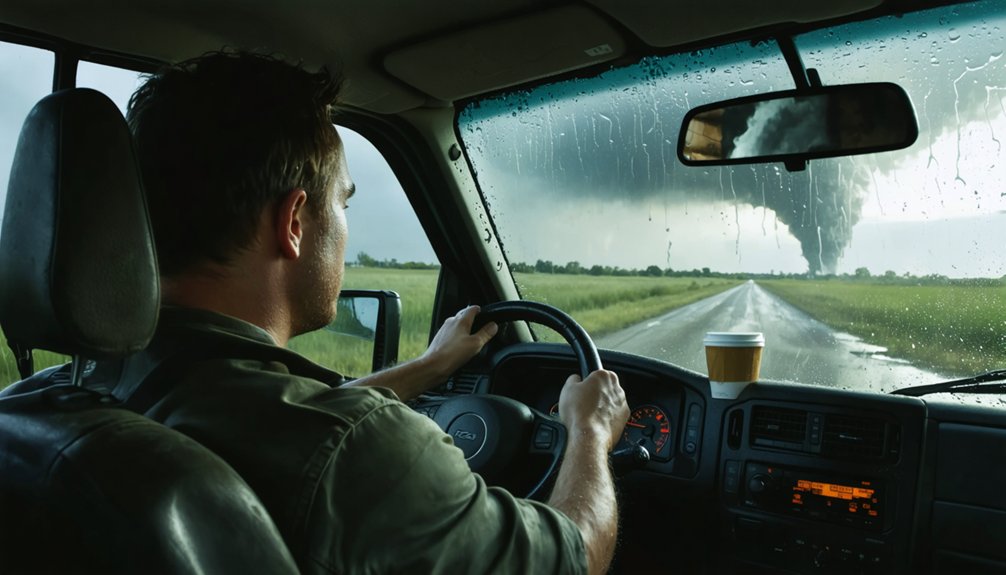
When you experience a close call, your autonomic stress response triggers attentional narrowing, constraining your perceptual field and reducing your capacity to integrate dynamic environmental cues in real time.
Simultaneously, the near-miss framing activates a cognitive reappraisal mechanism that reclassifies the event as survivable rather than as a probabilistic warning signal, systematically desensitizing your risk threshold.
Over repeated exposures, this dual process—attentional constriction paired with normalized risk tolerance—quietly degrades your field judgment without producing any subjectively detectable decline in decision-making confidence.
Stress Narrows Field Attention
After a close call rattles your system, your brain doesn’t reset cleanly—it stays locked in a hyperactivated threat-response state that quietly degrades the perceptual bandwidth you depend on in the field.
Stress-induced tunnel vision collapses your attention span, forcing your cognitive architecture to prioritize perceived immediate threats while filtering out peripheral environmental cues that carry critical safety data. Your field awareness narrows precisely when it needs to expand.
Decision fatigue compounds this dysfunction—each high-stakes choice depletes your prefrontal cortex’s executive resources, leaving you operationally compromised during subsequent threat evaluations.
You’re not reading conditions accurately; you’re processing them through a neurologically taxed filter. That distortion costs you the situational freedom and autonomous judgment that effective, independent chasing fundamentally requires.
Near Misses Normalize Risk
Surviving a near miss doesn’t reset your threat calibration—it corrupts it. Each survivable close call reinforces a dangerous cognitive distortion: if you made it through, the threat was manageable. That’s faulty logic operating as field doctrine.
Your brain recategorizes extreme exposure as within acceptable operational range, elevating your risk acceptance threshold without conscious authorization.
Simultaneously, adrenaline addiction embeds itself into your decision architecture. The neurochemical reward from surviving high-intensity encounters conditions you to unconsciously seek replication.
You’re not just tolerating greater danger—you’re pursuing it. Behavioral psychology identifies this pattern as reinforcement of hazardous behavior through survival outcomes.
Your autonomy depends on accurate threat modeling, but normalized risk quietly dismantles that capacity, leaving you confident in conditions that statistically demand retreat.
How Storm Chasers Can Recover Mentally After a Near Miss
A near-miss event doesn’t end when the storm moves on—your nervous system stays activated long after the immediate threat dissolves, sustaining elevated cortisol and adrenergic output that can destabilize cognition, sleep architecture, and emotional regulation. Rebuilding emotional resilience requires deliberate, structured intervention.
Prioritize physiological recovery first: sleep, hydration, and nutritional restoration recalibrate autonomic function. Deploy grounding and diaphragmatic breathing protocols to downregulate sympathetic dominance. Externalize your cognitive load through journaling or structured post-event debriefs—this accelerates symptom identification before patterns entrench.
Peer support from experienced chasers functions as a critical buffer against psychological isolation, normalizing reactions without minimizing them. If intrusive imagery, avoidance behavior, or affective numbness persists beyond several weeks, engage professional trauma-informed care immediately. Delayed intervention compounds symptom severity and compromises future field judgment.
Frequently Asked Questions
Can Close Calls Affect Relationships With Non-Chasing Family Members and Friends?
Like storm debris scattering across open plains, yes, close calls can fracture family dynamics. Your emotional resilience depletes, you withdraw, you irritate loved ones, and you’ll strain bonds with those who can’t comprehend your high-intensity psychological aftermath.
Do Veteran Chasers Experience Fewer Psychological Effects Than Beginners After Near Misses?
No, you don’t escape psychological effects just because you’re experienced. Veteran chasers often develop distorted risk perception and adrenaline addiction, which can actually amplify cumulative trauma responses after near misses, making long-term vulnerability comparable—or worse—than beginners’.
Should Storm Chasers Disclose Mental Health Struggles to Their Chase Partners?
Yes, you should disclose mental health struggles to your chase partners. Breaking mental health stigma strengthens collective emotional resilience, sharpens operational decision-making, and reduces cumulative psychological risk exposure during high-intensity pursuit scenarios where compromised judgment endangers everyone involved.
Are Certain Personality Types More Psychologically Vulnerable During High-Risk Chase Situations?
Yes, you’re more vulnerable if your personality resilience is low. Neuroticism amplifies stress reactivity, distorting your risk perception during high-stakes pursuits. Conversely, high openness and conscientiousness bolster adaptive coping, fortifying your psychological defenses against acute chase-induced stressors.
Can Chasing After a Traumatic Event Ever Be Considered a Healthy Coping Response?
Like Icarus returning to the sky, you can chase post-trauma, but only if your risk perception’s recalibrated and emotional resilience’s rebuilt—otherwise, you’re reinforcing avoidance patterns masked as courage, not genuine psychological recovery.
References
- https://alllivingisstormchasing.substack.com/p/the-hidden-toll-of-storm-chasing
- https://www.tornadosimulator.net/storm-chase-mental-health/
- https://crazystormchasers.com/essential-mental-health-advice-for-storm-chasers/
- https://crazystormchasers.com/improving-storm-chasing-safety-with-behavioral-psychology/
- https://crazystormchasers.com/navigating-mental-health-as-a-storm-chaser-experts-insights/
- https://crazystormchasers.com/maintaining-mental-health-for-storm-chasers/
- https://www.tornadotitans.com/p/staying-mentally-fit-while-storm
- https://crazystormchasers.com/what-drives-adrenaline-junkies-to-chase-tornadoes/
- https://www.psychologytoday.com/us/blog/extreme-fear/201105/is-storm-chasing-immoral
- https://crazystormchasers.com/transformative-lessons-from-storm-chasing-experiences/