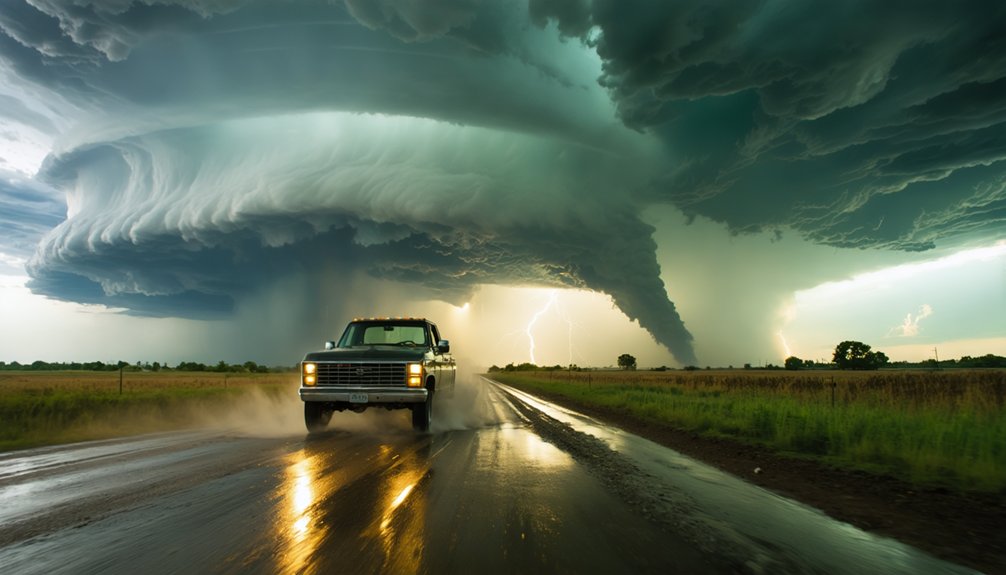
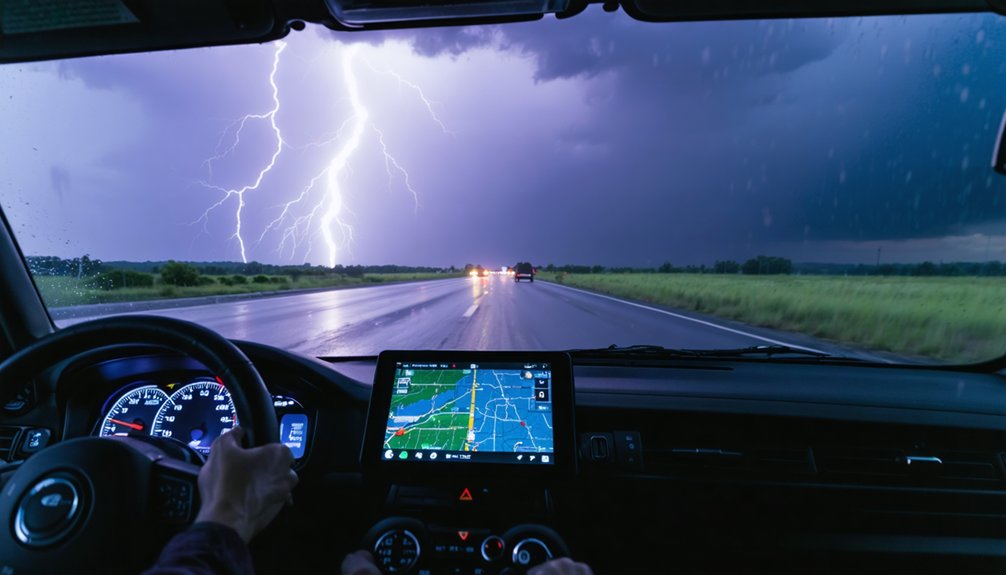
Storm chasing games compress days of driving and waiting into minutes of tornado intercepts, which isn’t how real chasing works. You’d typically spend 90% of your time on the road, covering thousands of miles for one or two sightings per season. Games also inflate encounter rates, downplay hazards like hydroplaning and flying debris, and simplify data collection methods. If you want the full breakdown of where simulations succeed and fail, there’s much more to unpack.
Key Takeaways
- Storm chasing games compress days of travel and waiting into minutes of action, unlike real chasing which involves mostly driving and patience.
- Games inflate tornado encounter rates dramatically; real chasers average roughly one tornado sighting per fifteen days in the field.
- Real storm chasers collect data through safe-distance photography and observation, while games often require deploying physical probes into tornado paths.
- Car accidents, hail, and flying debris pose the greatest real dangers, but games underplay or omit these genuine safety risks.
- No storm chasing game fully replicates real-world unpredictability, storm evolution, or the logistical challenges professional chasers routinely face.
What Storm Chasing Games Actually Get Right About Supercells
Data collection mechanics, while sometimes exaggerated through probe deployment, still reflect genuine atmospheric variables worth measuring.
The visual representation of a supercell’s updraft tower and its surrounding environment gives you a credible spatial understanding of storm anatomy.
These accurate structural elements distinguish serious storm chasing simulations from casual weather games, delivering recognizable atmospheric fidelity that both entertains and educates simultaneously.
How Game Objectives Differ From Real Storm Chasing Goals
While storm chasing games reward you for intercepting multiple tornadoes per session, real chasers consider seeing one or two tornadoes across an entire season a success. Game objectives fuel a storm chasing fantasy that compresses days of driving into minutes of action, whereas real chasing demands thousands of miles of road time for roughly three minutes of tornado observation every fifteen chase days.
Real goals extend beyond tornadoes entirely. You’re observing cumulonimbus structures, documenting hail events, capturing lightning sequences, and filing weather reports. Games strip this breadth away, reducing the discipline to a single interception metric.
That simplification distorts your understanding of what chasers actually pursue. Recognizing how game objectives diverge from operational reality helps you evaluate both the entertainment value and the factual limitations of any storm chasing simulation.
Tornado Frequency in Games vs. What Real Chasers Actually See
When you play a storm chasing game, you’ll encounter tornadoes with a frequency that bears no resemblance to reality. In actual chasing, you’d see a tornado slightly less than once every fifteen days on the road after driving thousands of miles.
Games compress this timeline dramatically, rewarding you with multiple tornado sightings per session to maintain engagement rather than simulate authentic meteorological probability.
Game Tornado Frequency Inflated
Storm chasing games inflate tornado frequency to a degree that bears little resemblance to what real chasers actually experience in the field. In reality, you’ll witness a tornado slightly less than once every fifteen days of active chasing, after driving thousands of miles across open terrain.
Storm simulation engines sacrifice meteorological accuracy to deliver constant engagement, compressing days of atmospheric development into minutes of on-screen action. Games reward you with multiple daily tornado sightings, creating a distorted benchmark that doesn’t reflect legitimate field conditions.
Real chasers understand that most days yield nothing but empty highways and dissipating cloud formations. When developers prioritize entertainment over accuracy, they strip away the patience, discipline, and calculated decision-making that define authentic storm chasing as a serious scientific pursuit.
Reality’s Rare Tornado Sightings
Tornadoes, in real chasing conditions, appear far less frequently than any game engine would have you believe. Meteorological models confirm that you’ll encounter roughly one tornado per fifteen storm tracking days, covering thousands of miles. Games compress that timeline drastically.
Real frequency data breaks down like this:
- You’ll average one tornado sighting per fifteen days of active chasing
- Most seasons yield only one or two multi-tornado days
- Driving consumes roughly 90% of your total time investment
- Meteorological models predict tornado formation windows lasting minutes, not hours
- Storm tracking across multiple states often produces zero confirmed sightings
That gap between game rewards and reality is significant. You’re not intercepting tornadoes daily — you’re grinding miles, reading data, and accepting that nature operates on its own schedule.
The Real Time Investment Storm Chasing Games Skip Entirely
When you sit behind the wheel as a real storm chaser, you’re committing to thousands of miles of highway driving for a payoff that may never come. You’ll spend the vast majority of your time waiting on empty plains, watching skies that never develop into anything worth filming.
Storm chasing games strip out this exhausting reality entirely, compressing days of fruitless road time into minutes of guaranteed tornado action.
Miles Driven, Rarely Rewarded
Real storm chasing demands a time investment that no game has meaningfully replicated. Storm chasing myths suggest constant action, but the actual data collection ratio tells a different story. You’re driving thousands of miles for minutes of tornado visibility.
The real breakdown looks like this:
- 90% of chase time is pure driving across open highways
- 7% involves waiting with no storm development
- 3% constitutes actual storm observation
A tornado sighting occurs slightly less than once every fifteen chase days.
Car accidents, not tornadoes, represent your greatest danger.
Games compress this timeline entirely, delivering immediate gratification that real chasers never experience. You won’t replicate the financial cost, physical exhaustion, or repeated disappointment that defines authentic chasing.
That freedom to roam open skies carries a steep, unglamorous price.
Waiting With No Tornado
Games skip the 7% entirely. In reality, you’ll spend hours parked on a county road, scanning radar, watching anvil clouds dissolve into nothing. Storm fatigue sets in fast — you’ve driven 300 miles, fuel costs are mounting, and the atmosphere simply won’t cooperate. False alarms aren’t exceptions; they’re standard operating procedure. A promising supercell weakens before rotation develops, and you’re left recalculating tomorrow’s setup.
Games eliminate this friction by design. Developers compress atmospheric timelines, dropping you directly into active storm environments because waiting isn’t monetizable entertainment. But that waiting period is where real chasing lives — in the meteorological analysis, the repositioning, the strategic patience. Removing it doesn’t just simplify the experience; it fundamentally misrepresents what storm chasing actually demands from you.
Daily Reality Vs. Games
Every active storm chasing season compresses into a brutal statistical reality: you’ll drive thousands of miles to witness a tornado for minutes, averaging a sighting slightly less than once every fifteen chasing days. Games eliminate this friction entirely, delivering tornadoes on demand.
Real storm chase logistics look nothing like that.
Your actual daily breakdown:
- 90% driving through featureless terrain analyzing weather data
- 7% stationary waiting as storm systems develop or collapse
- 3% active storm observation
- One or two productive tornado days per full season
- Significant fuel, lodging, and equipment costs with no guaranteed return
Games compress this ratio ruthlessly, optimizing every session for immediate storm interaction. That freedom feels satisfying virtually, but it fundamentally misrepresents the discipline real chasing demands from you.
Safety Risks Storm Chasing Games Consistently Underplay
While storm chasing games deliver adrenaline-fueled sequences of tornado intercepts and dramatic debris fields, they consistently underplay the dangers that kill and injure real chasers. Every storm hazard you’d encounter on actual plains—hydroplaning on rain-slicked roads, baseball-sized hail shattering your windshield, flying cinderblocks at lethal velocities—gets minimized or omitted entirely.
Games rely on safety exaggeration, framing tornado proximity as thrilling rather than genuinely fatal.
Car accidents remain your most likely cause of death as a real chaser, not the tornado itself. Games rarely simulate degraded road visibility, tire blowouts from hail-covered asphalt, or the financial devastation of destroyed equipment.
Which Storm Chasing Games Handle Danger Most Realistically?
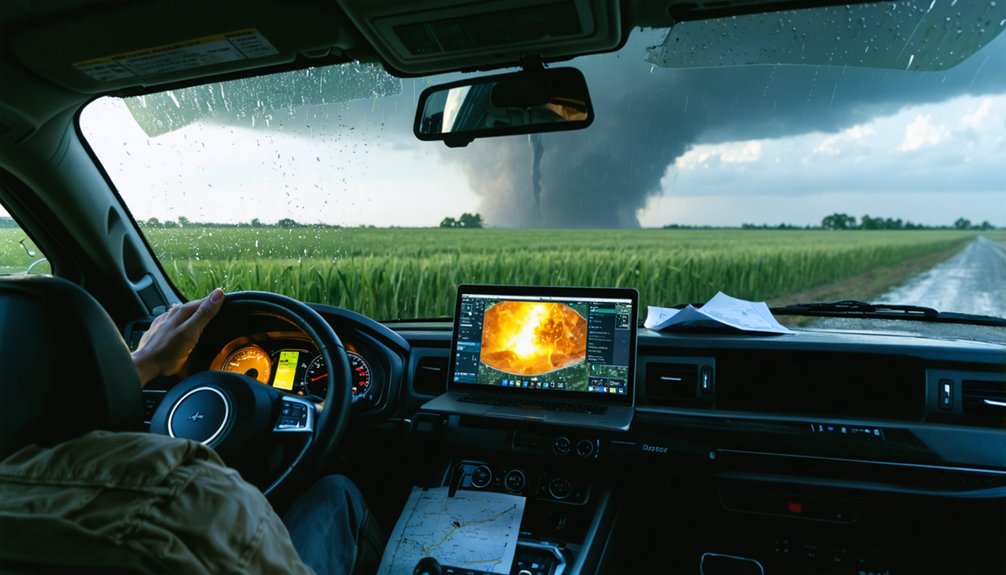
- Debris fields include vehicles, bricks, and structural fragments at lethal velocities.
- Wind pressure actively destabilizes your vehicle during close intercepts.
- Supercell positioning requires deliberate approach angles.
- Hail intensity escalates unpredictably, punishing poor route selection.
- Storm structure dynamically shifts, eliminating static safe zones.
No game fully replicates real-world consequences, but Helicity compresses authentic risk variables into decisions that genuinely challenge your judgment rather than your reflexes alone.
How Storm Chasing Games Collect Data vs. Real-Life Methods
Data collection separates storm chasing games from real-life practice more sharply than any other mechanic. Most games require you to execute probe deployment directly into a tornado’s path, positioning physical instruments inside the storm to gather usable storm data. That mechanic drives engagement but contradicts how real chasers actually operate.
Data collection is where storm chasing games diverge most sharply from reality.
In practice, you’d collect storm data through photography and weather reporting from a controlled, safe distance — no physical probe deployment required.
*Chased* breaks from the traditional game model by replacing probe mechanics with a photography-based system, accurately mirroring real-world methodology. This design choice gives you a more honest representation of field work.
If you want authentic data collection mechanics, prioritize games that reward observation over physical storm penetration. That distinction defines operational accuracy.
How Games Represent Storm Visuals vs. Actual Supercells
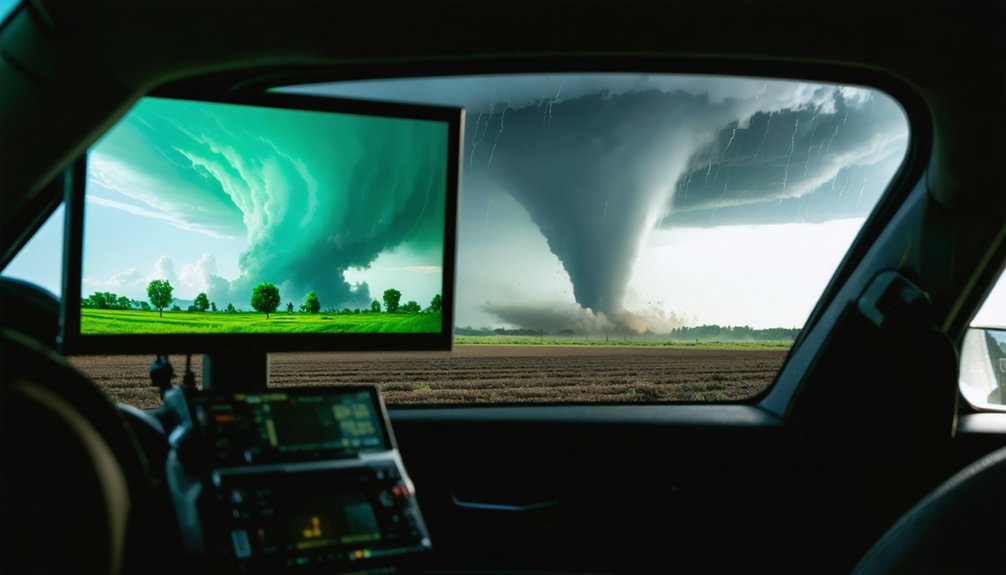
Storm chasing games nail certain visual elements — supercell structures, dynamic wind behavior, and debris effects — but they consistently compress and dramatize what you’d actually observe in the field. Storm visualization in games prioritizes spectacle over accuracy, and supercell realism often gets sacrificed for immediate visual payoff.
Real supercells involve far more than a tornado drop:
- Massive cumulonimbus towers dominating the horizon
- Layered cloud structures with distinct wall clouds and flanking lines
- Extended hail cores obscuring visibility before rotation develops
- Subtle color shifts in the sky signaling atmospheric instability
- Lightning displays spanning miles across multiple storm cells
Games collapse these details into tornado-centric sequences. You’re getting the highlight reel, not the full meteorological event unfolding across hours of atmospheric complexity.
Which Storm Chasing Games Come Closest to Reality?
Both titles prioritize weather simulation accuracy over artificial reward loops, giving you mechanics grounded in actual observation rather than gamified data collection.
Neither fully replicates storm chase logistics — the thousands of miles driven, the 90% road time, or the genuine rarity of tornado intercepts — but they come closer than most competitors.
If you want a simulation that respects how real chasing works without burying you in fabricated objectives, these two are your strongest options.
Frequently Asked Questions
Can Playing Storm Chasing Games Help Train Real Storm Chasers?
Storm chasing games can partially train you through virtual simulation, sharpening storm recognition skills, but they’ll fall short on risk assessment since they don’t replicate real hazards like lethal debris, hail, and exhausting time investments.
Are Storm Chasing Games Used in Any Official Meteorology Education Programs?
No official meteorology programs currently use storm chasing games, but you’ll find virtual reality tools emerging in training contexts. They’re building safety awareness by simulating hazardous conditions without exposing you to real-world risks.
Do Real Storm Chasers Enjoy Playing Storm Chasing Video Games?
Many do, yet you’ll find it’s complicated — storm chaser stereotypes suggest they’d dismiss low video game realism, but chasers often enjoy experiencing condensed tornado action they’d normally wait weeks to witness.
Have Any Storm Chasing Games Been Developed With Professional Chaser Input?
You’ll find that *Helicity* leverages professional chaser input to enhance virtual simulations, achieving gaming realism through accurate supercell structures and dynamic debris effects, earning it a 9/10 score for technical authenticity.
Can Storm Chasing Games Help Players Understand Basic Meteorological Concepts?
Like a flight simulator teaching lift and drag, storm chasing games can sharpen your meteorological accuracy instincts. You’ll reveal real educational potential by observing supercell structures and dynamic wind patterns embedded within high-realism simulations like *Helicity*.
References
- https://www.youtube.com/watch?v=YcJxg0OWY1c
- https://www.youtube.com/watch?v=ORbGYq2HzGI
- https://www.youtube.com/watch?v=P5iHJipK46A
- https://en.wikipedia.org/wiki/Storm_chasing
- https://stormhighway.com/chasingfaq.php
- https://www.youtube.com/watch?v=HwbDwrqazco
- https://store.playstation.com/en-us/concept/10016500