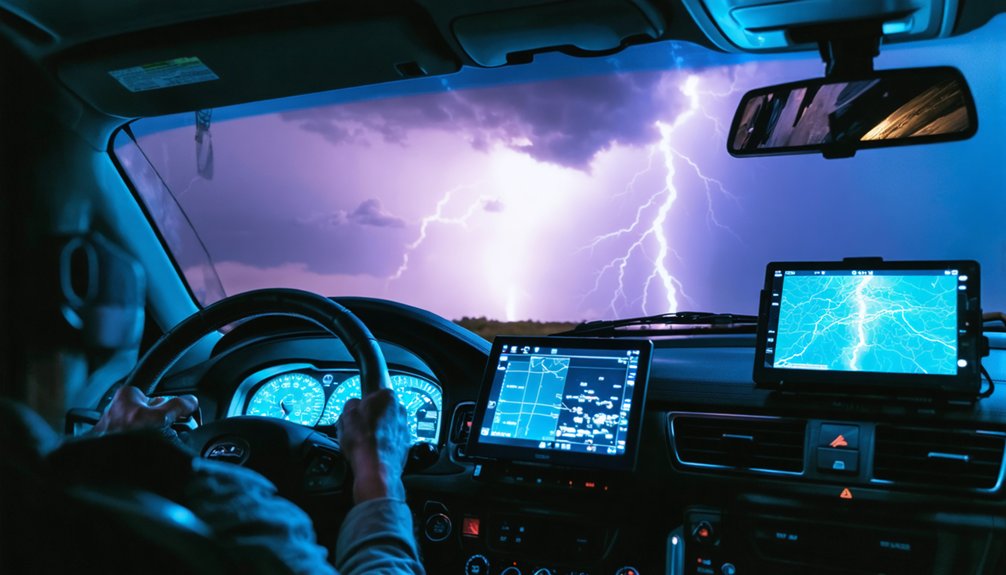
In 2026, you’re watching storm chasing evolve through AI-driven forecasting, 3D volumetric radar, and machine learning that processes atmospheric variables in real time. GPS and mobile broadband keep field teams precise and connected. Tourism packages now range from $2,000–$5,000, while viral footage commands up to $50,000 in licensing deals. The industry’s projected to hit billion-dollar status, fueled by climate volatility and premium media demand. There’s considerably more driving this transformation beneath the surface.
Key Takeaways
- AI algorithms and machine learning now process atmospheric variables in real time, enabling faster, safer storm interception decisions.
- Storm chasing tourism is experiencing sharp growth, projected to surpass the $400 million generated in 2023 by 2026.
- 8K cameras and 3D volumetric scanning are elevating footage quality, commanding premium licensing rates from broadcasters and streamers.
- Climate-driven unpredictability is compressing operational margins, pushing insurance premiums higher and forcing revenue diversification strategies.
- Standardized ethical codes and community partnerships are becoming essential to prevent regulatory restrictions on storm chasing operations.
The Tech Powering Storm Chasing in 2026
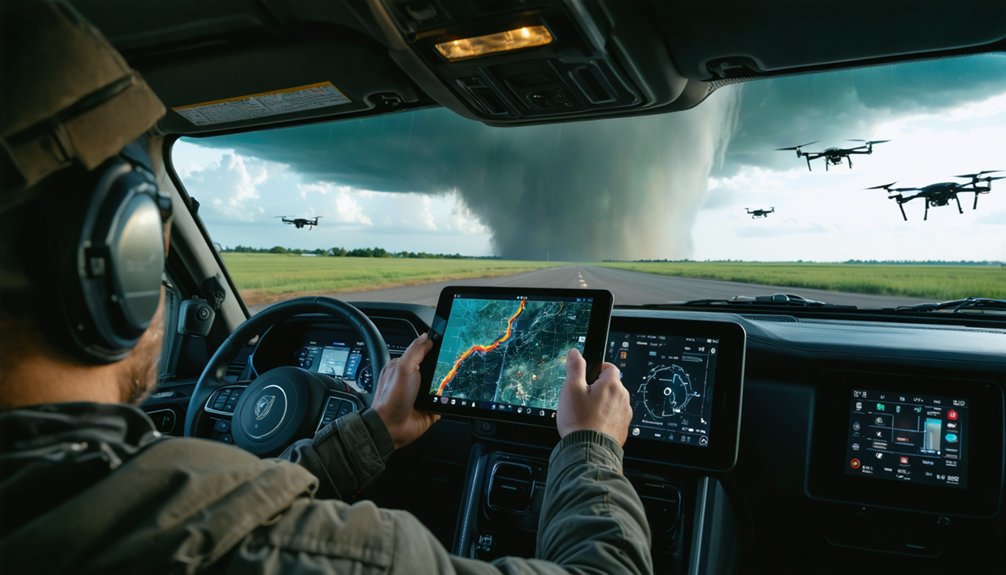
Storm chasing in 2026 runs on a tightly integrated stack of technologies that’s transformed what chasers can do in the field.
Real-time radar systems deliver immediate storm tracking data, giving you rotation details the moment a supercell develops. Mobile broadband keeps high-speed data flowing directly from your vehicle, while GPS locks onto supercell trajectories with precision you couldn’t access a decade ago.
AI algorithms process historical storm patterns against live conditions, sharpening data accuracy to levels that actually influence split-second decisions.
You’re also capturing everything on 8K cameras, producing footage sharp enough for broadcast or documentary licensing.
These tools don’t just make chasing more efficient — they give you the operational independence to work smarter, move faster, and stay ahead of rapidly evolving storm systems.
How AI and Radar Are Changing Storm Chasing Predictions
Predictive accuracy in storm chasing has shifted dramatically as AI and advanced radar systems take over tasks that once depended on manual interpretation.
AI predictions now process atmospheric variables in real time, identifying supercell initiation patterns before you’d detect them manually.
Radar innovations, including 3D volumetric scanning, reveal internal storm dynamics with unprecedented resolution, letting you assess rotation depth and intensity within seconds.
Machine learning algorithms cross-reference historical data against current conditions, delivering forecasts you can trust when positioning your vehicle near a developing mesocyclone.
Chaser technology integrates these AI-driven outputs directly into mobile dashboards, giving you autonomous decision-making capability in the field.
You’re no longer guessing—you’re operating with verified, data-backed intelligence that fundamentally redefines how close you can safely operate.
What Does a Storm Chasing Tour Actually Cost?
If you’re considering a storm chasing tour in 2026, you’ll typically pay between $2,000 and $5,000 per person for a guided expedition package covering transportation, equipment access, and expert chase coordination.
Beyond the base rate, you should budget for hidden costs including travel insurance, liability waivers, specialized gear rentals, and lodging during multi-day pursuits across Tornado Alley.
Analyzing these expenses carefully before committing guarantees you’re not blindsided by out-of-pocket costs that can push your total investment well above the advertised package price.
Tour Package Pricing Breakdown
Booking a storm-chasing tour in 2026 typically runs between $2,000 and $5,000 per person, with pricing tiers reflecting core variables like trip duration, group size, equipment access, and guide expertise.
Tour package variations segment largely across three tiers: budget expeditions averaging $2,000 to $2,500 cover basic vehicle access and standard routing.
Mid-range packages, priced between $3,000 and $4,000, include radar data feeds, closer intercept positioning, and smaller group ratios.
Premium offerings push toward $5,000, granting you direct access to professional meteorologists, 8K video equipment, and priority supercell positioning.
Pricing trends indicate steady upward pressure driven by climate-related storm unpredictability, advanced tracking technology costs, and surging civilian demand.
You’re fundamentally paying for calculated proximity to nature’s most volatile atmospheric events.
Hidden Costs To Expect
While tour package pricing establishes a clear baseline, the actual cost of a storm-chasing expedition runs noticeably higher once you factor in mandatory and discretionary expenses that operators don’t bundle into advertised rates.
Trip insurance covering weather-related costs and legal liabilities typically adds $300–$600. Safety training certifications run $150–$400 before departure.
You’ll absorb travel costs independently, including fuel surcharges and lodging during multi-day pursuits. Equipment maintenance fees surface when shared gear requires field repairs. Emergency services charges apply if medical intervention becomes necessary mid-chase.
Mental health support resources, increasingly recommended post-expedition, carry separate costs. Hidden expenses accumulate fast, and unexpected fees from permit requirements or restricted-zone access can blindside unprepared participants.
Budget conservatively at 30–40% above your base package rate.
Why Storm Chasing Tourism Has Become a Billion-Dollar Industry
Storm chasing tourism has evolved into a billion-dollar industry, driven by a convergence of technological advancements, social media virality, and an insatiable public appetite for extreme experiences.
In 2023, the sector generated an estimated $400 million, with projections accelerating sharply by 2026. You’re witnessing an industry where guided expeditions command $2,000 to $5,000 per person, while viral footage sells for up to $50,000.
Mobile broadband, AI-driven forecasting, and 8K cameras have transformed raw danger into marketable spectacle. However, storm chasing ethics and public safety concerns remain critical pressure points.
Increased tornado frequency—reaching 1,880 preliminary reports in 2024—amplifies operational risks. The industry’s growth isn’t accidental; it’s the calculated intersection of freedom-seeking consumers, cutting-edge technology, and monetizable disaster documentation.
How Climate Change Is Expanding Storm Chasing Beyond Tornado Alley
Climate change is dismantling the geographic boundaries that once confined serious tornado activity to the central United States. Shifting atmospheric conditions are pushing violent storm activity into the Southeast, Northeast, and even parts of the Pacific Northwest.
Climate change is redrawing the tornado map — and no region is safe anymore.
You’re now tracking supercells in regions where infrastructure and populations weren’t built to handle them, creating both expanded opportunity and heightened risk.
These climate impacts are forcing chasers to abandon traditional Tornado Alley routes and develop entirely new operational strategies. Expanding geography means you’re traversing unfamiliar terrain, dealing with denser tree coverage, and managing inconsistent road networks that complicate intercept positioning.
The 1,880 preliminary tornado reports logged in 2024 reflect this volatility. You can’t rely on historical patterns anymore — adaptability isn’t optional, it’s your primary competitive advantage in this shifting landscape.
How Storm Chasers Actually Make Money From Their Footage
When you capture a high-impact tornado on 8K video, you’re sitting on a multi-tiered revenue asset you can monetize across several channels simultaneously.
You can sell breaking footage directly to news networks for $5,000 to $50,000, license cinematic shots to streaming platforms producing weather documentaries, and push viral clips through social media to build audience-driven ad revenue.
Each channel demands a different licensing structure, so you’ll need to understand rights management to avoid leaving significant money on the table.
Selling Footage To Networks
Capturing a tornado on camera is only half the equation—monetizing that footage is where storm chasers actually build sustainable income.
Network partnerships and footage licensing define your revenue ceiling. You’ll navigate competitive market demands by mastering these four distribution channels:
- News networks purchase real-time storm coverage, paying $5,000–$50,000 per clip based on content quality and exclusivity.
- Streaming platforms acquire cinematic documentary footage, rewarding superior resolution and audience engagement potential.
- Insurance companies license analytical storm data paired with visual documentation.
- Educational institutions buy footage supporting climate research initiatives.
Your pricing strategies must reflect ethical considerations—never fabricate risk for dramatic effect.
Authentic, high-resolution 8K footage commands premium rates. Understanding distribution channels separates casual chasers from professionals building truly independent income streams.
Monetizing Viral Storm Content
Viral storm content transforms raw footage into scalable revenue—but maximizing that income requires understanding platform-specific monetization mechanics.
You’re operating across multiple channels simultaneously—YouTube ad revenue, licensing deals, and direct platform sales each follow distinct rules.
Content monetization works best when you diversify strategically. News outlets pay $5,000–$50,000 for exclusive real-time coverage, while streaming platforms acquire cinematic sequences for documentary licensing.
You retain maximum control by distributing independently before approaching networks.
Viral marketing amplifies reach exponentially—properly tagged, high-impact footage spreads across social ecosystems, driving organic discovery without paid promotion.
Timestamp your metadata precisely, because networks verify footage authenticity before purchasing.
Owning your masters means you license repeatedly, generating compounding income from a single capture event.
That’s genuine financial independence built on technical execution.
Licensing Cinematic Storm Shots
- Resolution quality and capture conditions
- Exclusivity terms within media partnerships
- Geographic and platform-specific usage rights
- Copyright considerations tied to location and consent
Streaming platforms, news networks, and documentary producers each demand different contractual terms.
You’re fundamentally controlling intellectual property with significant market leverage.
Ethical concerns emerge when monetizing destruction—balancing profitable media partnerships against responsible storytelling requires deliberate judgment.
Understanding these frameworks lets you maximize revenue while maintaining legal and ethical integrity across every distribution agreement you execute.
How Modern Storm Chasers Manage Risk in the Field
As storm intensity escalates and trajectories grow increasingly unpredictable, modern chasers rely on a layered risk management framework that integrates real-time data, coordinated communication, and disciplined field protocols.
Your risk assessment begins before deployment, combining satellite imagery, 3D radar data, and machine learning forecasts to map probable storm paths.
Before deployment, satellite imagery, 3D radar, and machine learning forecasts converge to map probable storm paths.
Safety training guarantees you’re executing precise entry and exit routes under rapidly shifting conditions. Emergency preparedness means carrying redundant communication systems and maintaining constant contact with regional coordination teams.
Communication strategies now leverage social media for real-time alerts, keeping your team synchronized across vast terrain.
Equipment durability standards have tightened as storms grow harsher. Weather monitoring runs continuously throughout operations, while mandatory mental health assessments protect your psychological resilience—because sustained decision-making under extreme stress demands you stay sharp, adaptable, and mission-ready.
Is the Storm Chasing Industry Built to Last?
The storm chasing industry’s long-term viability hinges on whether its economic foundations can absorb mounting operational costs, climate-driven volatility, and intensifying regulatory scrutiny.
You’re operating in a market where sustainability demands structural discipline. Four factors determine whether it endures:
- Revenue diversification across tourism, media licensing, and data sales
- Storm chaser ethics frameworks that prevent reckless civilian exposure
- Community engagement strategies that build public trust and political goodwill
- Technology reinvestment into AI forecasting and durable field equipment
Climate shifts are generating more preliminary tornado reports, but unpredictable trajectories compress your operational margins.
Insurance premiums climb. Equipment fails harder.
Without standardized ethical codes and genuine community partnerships, regulators will tighten restrictions, and the industry’s freedom to operate shrinks considerably.
Frequently Asked Questions
What Mental Health Resources Are Available for Professional Storm Chasers?
Amid roaring winds and chaos, you’ve got mental health assessments, coping strategies, peer support networks, and stress management programs maintaining your mental wellness, ensuring you’re psychologically equipped to navigate storm chasing’s intense, unpredictable demands.
How Do Storm Chasers Handle Equipment Damage During Extreme Weather Events?
You’ll conduct rapid damage assessment post-storm, prioritizing equipment maintenance to restore functionality fast. You’ve got to carry redundant systems, seal gear against moisture, and document failures analytically to refine your protocols for future extreme weather deployments.
Are Storm Chasing Tours Covered Under Standard Travel Insurance Policies?
Sure, standard travel policies *totally* cover tornado pursuits—just kidding. You’ll find most storm insurance excludes high-risk activities like chasing. You’ll need specialized coverage, as standard travel policies rarely protect against voluntary extreme weather exposure.
What Physical Fitness Requirements Exist for Joining Storm Chasing Expeditions?
You’ll need solid physical endurance to handle rapid deployments and prolonged field operations. Expeditions enforce strict safety protocols, requiring you to pass cardiovascular assessments, demonstrate mobility under pressure, and sustain alertness during unpredictable, high-intensity storm environments.
How Do Storm Chasers Coordinate With Local Emergency Services During Disasters?
As lightning splits the sky, you’ll relay communication protocols through dedicated radio channels and social media, pushing real-time updates directly to emergency dispatch teams, ensuring coordinated responses that keep civilians safely ahead of the storm’s destructive path.
References
- https://en.wikipedia.org/wiki/Storm_chasing
- https://www.youtube.com/watch?v=k1jn7wL9i5Q
- https://www.rmets.org/metmatters/history-storm-chasing
- https://medium.com/@valforov/any-weather-is-good-enough-how-storm-chasing-became-different-92a3c112dc82
- https://www.stripes.com/living/2026-06-01/web-weather-lifestyle-living-tracking-tornados-storms-trackers-21844405.html
- https://crazystormchasers.com/how-technology-transformed-storm-chasing/
- https://stormtrack.org/threads/predictions-of-the-future-of-chasing.27280/
- https://www.vox.com/culture/359689/storm-chasing-twister-tornado-expert
- https://www.weatheradar.com/article/into-the-vortex-the-high-stakes-world-of-storm-chasing-a14
- https://crazystormchasers.com/climate-change-and-the-future-challenges-for-storm-chasers/