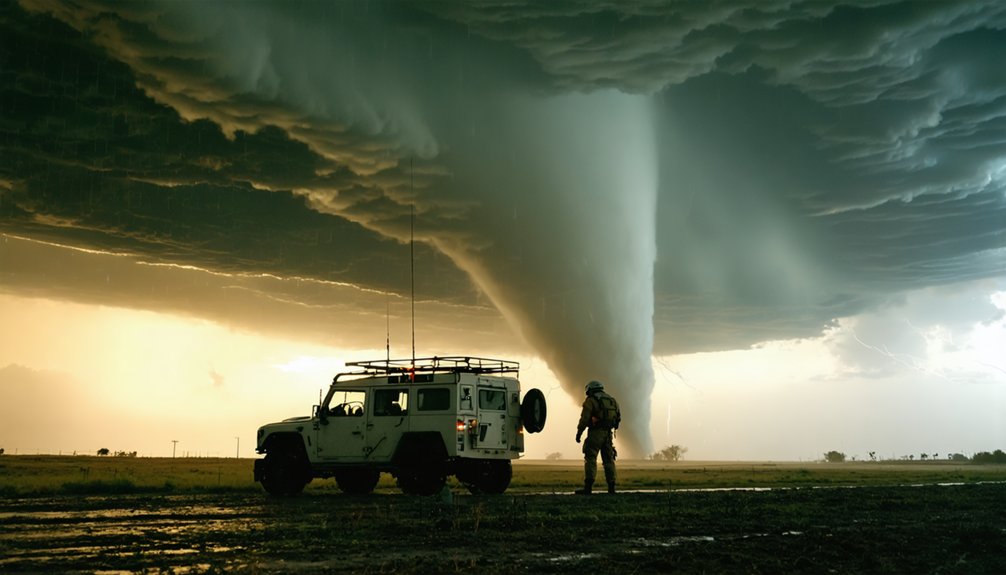
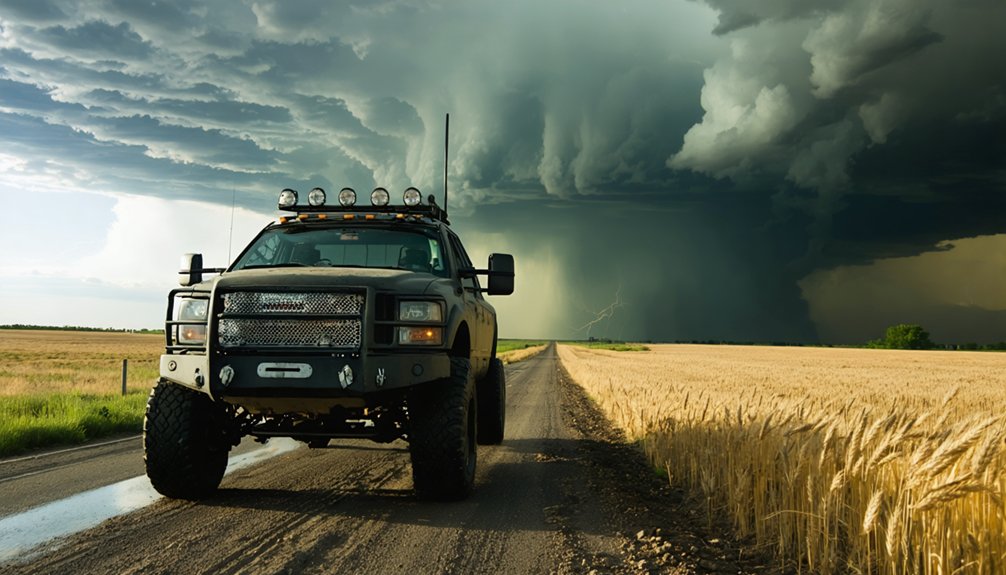
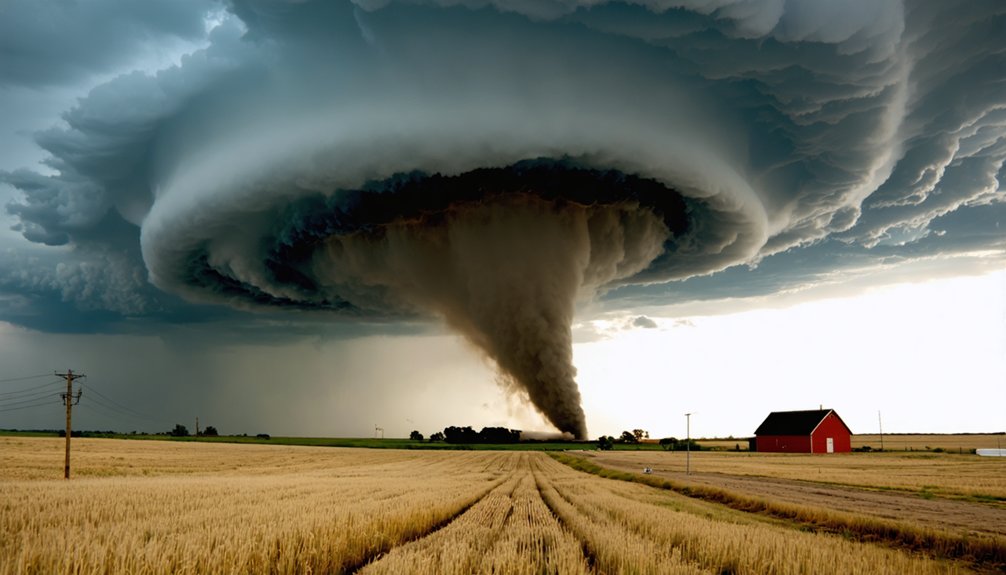
Peak season hits in May and June, when clashing air masses, elevated CAPE values, and strong wind shear create ideal supercell conditions across Tornado Alley. You’ll want to complete National Weather Service spotter training, study historical outbreak corridors, and shadow experienced chasers for a full season before going solo. Master surface map analysis, sounding balloon data, and radar interpretation before you ever leave camp. The real preparation runs far deeper than most newcomers expect.
Key Takeaways
- Storm chasers focus preparation on May and June, when clashing air masses create optimal severe weather conditions across Tornado Alley.
- Chasers complete National Weather Service spotter training to identify critical storm features and understand ethical field responsibilities.
- Teams verify radar software, GPS, weather radios, cameras, and communication devices through thorough pre-season equipment checks.
- Chasers study CAPE values, wind shear data, surface maps, and sounding balloon data to sharpen forecasting skills.
- Shadowing experienced chasers for a full season builds real-world decision-making skills before operating independently in the field.
Why May and June Are Peak Season for Storm Chasing in Tornado Alley
During spring and early summer, the atmospheric conditions across Tornado Alley align to create the highest probability of severe convective storm activity, making May and June the most productive months for storm chasers.
Historical storm patterns confirm that clashing air masses, elevated CAPE values, and strong wind shear converge most reliably during this window.
You’ll find that meteorological anomalies, including unexpected atmospheric boundaries and explosive instability, occur more frequently in May than any other month.
Peak intercept times typically run from mid-late afternoon into early evening, giving you ideal daylight for target acquisition.
Tours spanning April through August capture this cycle, but concentrating your efforts in May and June maximizes your statistical odds of intercepting significant severe weather events across the Plains.
How Storm Chasers Train Before Their First Tornado Season
Before you chase your first storm, you’ll need to build a foundation in meteorology, radar interpretation, and field safety protocols. Start by completing storm spotter training through your local National Weather Service office, where you’ll learn to identify wall clouds, scud clouds, and rotation signatures.
Storm chasing begins with education—meteorology basics, radar skills, and spotter training through your National Weather Service office.
Study historical tornado patterns across Tornado Alley to understand peak outbreak corridors and seasonal timing. Familiarize yourself with CAPE values, wind shear data, and surface map analysis before entering the field.
No certification is required, but ethical responsibility matters. Storm chasing ethics demand you prioritize public safety over dramatic footage, maintain situational awareness, and never block emergency routes.
Shadow experienced chasers for at least one full season before operating independently, absorbing their decision-making process under real, high-stakes atmospheric conditions.
How Storm Chasers Read Weather Data Before Hitting the Road
Every chase day begins the same way: you’re scanning surface maps at dawn, hunting for atmospheric boundaries where hot and cold air masses collide. You check CAPE values to confirm atmospheric instability, then cross-reference wind shear data to assess rotating supercell potential.
Satellite imagery reveals moisture plumes and cloud development before storms organize, giving you a critical head start. Atmospheric modeling helps you project storm initiation timing and movement, narrowing your target area before you ever touch the accelerator.
You’ll also review twice-daily sounding balloon data and local station observations to verify surface conditions match model output.
The Gear Every Storm Chaser Checks Before Leaving Camp
Once your forecast is locked and your target area confirmed, you run a double-check of every piece of gear before the vehicle moves an inch. Your storm detection equipment—radar software, GPS, and weather radio—gets verified first. Dead batteries or failed connections cost you the intercept.
Gear check before wheels roll—dead batteries and failed connections don’t just cost time, they cost the intercept.
Next, you confirm your camera mounts, spare memory cards, and communication devices are operational.
Safety protocols demand equal attention. You verify escape route maps are loaded, first aid kits are stocked, and everyone knows their assigned role—navigator, driver, photographer.
High-profile vehicles get flagged if downburst winds are forecast along your corridor.
Nothing leaves to chance. Every system check compounds your situational awareness and keeps the team mobile, decisive, and clear-headed when conditions escalate faster than any forecast predicted.
How Storm Chasing Teams Assign Roles for Safe and Efficient Operations
When you’re building a storm chasing team, you’ll assign three core roles—driver, navigator, and photographer—each demanding undivided focus to keep operations sharp under rapidly evolving conditions.
Your navigator monitors radar, tracks storm movement, and calls escape routes in real time, while your driver executes those decisions without distraction.
This specialization eliminates role overlap, reduces reaction time, and directly lowers your operational risk when a storm’s forward speed or direction shifts without warning.
Core Team Role Assignments
Effective storm chasing demands clear role assignments before your team ever leaves the staging area. You’ll typically structure your crew around three critical positions: driver, navigator, and meteorologist-spotter.
Your driver focuses exclusively on vehicle control and escape route execution — no distractions.
Your navigator manages real-time GPS routing, monitoring road networks across the Great Plains while calling out turn decisions.
Your meteorologist-spotter interprets radar, reads wall clouds, and translates meteorological terminology into actionable intelligence the entire team understands immediately.
You’ll also establish communication protocols before departure — designating a primary radio frequency, backup channels, and clear verbal commands for emergency repositioning.
Every team member confirms their role during the pre-chase briefing.
Defined responsibilities eliminate hesitation when conditions deteriorate rapidly, keeping your team mobile, coordinated, and free to chase effectively.
Operational Efficiency Through Specialization
Specialization transforms a storm chasing team from a group of individuals into a precision unit capable of executing rapid decisions under dangerous, fast-moving conditions. When you’re deep in Tornado Alley with a supercell intensifying ahead, defined roles eliminate hesitation:
- Meteorologist interprets meteorological models and real-time CAPE values
- Navigator manages routing and escape corridors simultaneously
- Driver focuses exclusively on road conditions and vehicle positioning
- Photographer/Documenter captures storm tracking techniques and visual data without distraction
Each role operates independently yet synchronizes with the others, creating seamless situational awareness across the team. You’re not duplicating effort — you’re multiplying capability.
When the storm shifts unexpectedly, everyone executes their function without confusion. Specialization isn’t convenience; it’s the structural foundation that keeps your team mobile, informed, and alive.
Why Great Plains Roads Make or Break a Storm Chasing Day
Traveling the Great Plains road network can determine whether you intercept a tornado or watch it dissipate from the wrong county. Rivers, dead-end sections, and sparse urban infrastructure force critical routing decisions under time pressure.
You’ll often find yourself orchestrating gravel roads that cut through isolated terrain where wildlife interactions — deer crossings, cattle on open range — create unexpected hazards at speed.
Pre-plan multiple escape routes before storms initiate. A north-south grid road running parallel to a storm’s eastward track gives you maximum repositioning flexibility. Avoid diagonal county roads that funnel you directly into a storm’s path.
Mobile apps displaying real-time road networks help, but local knowledge outperforms digital tools when pavement ends unexpectedly. Your route discipline separates successful intercepts from dangerous compromises.
How Storm Chasers Stay Safe: Distances, Escape Routes, and Hard Rules
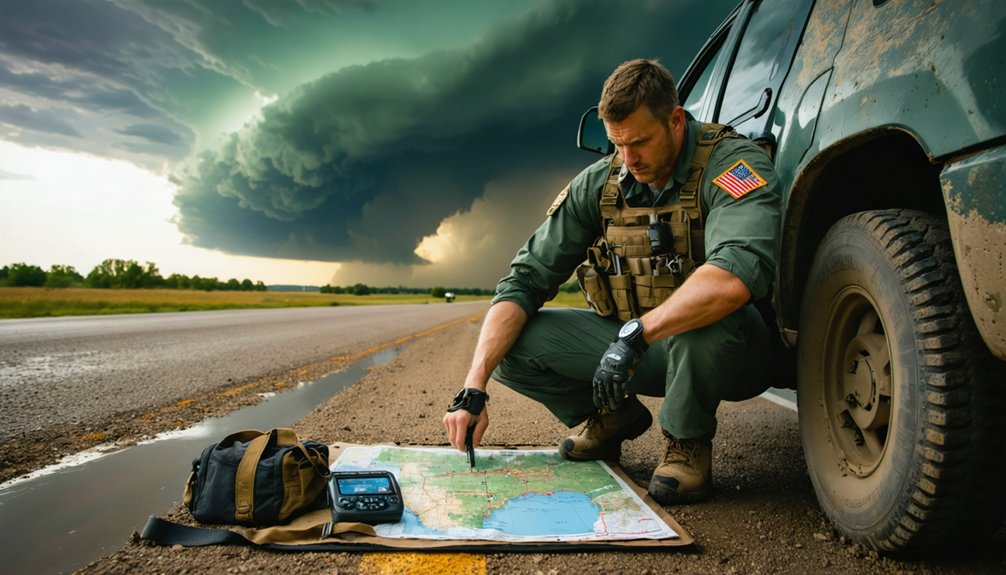
Route discipline keeps you alive on the road, but distance discipline keeps you alive near the storm. Your storm safety framework must be non-negotiable before you deploy. Build your storm strategy around hard rules that don’t bend under pressure:
Route discipline keeps you alive on the road. Distance discipline keeps you alive near the storm.
- Maintain several miles of buffer from the storm core to avoid large hail and lightning strikes.
- Always position in the southeast sector relative to storm movement for ideal visibility and exit angles.
- Keep a confirmed escape route open at all times — never let the tornado’s projected path cut off your exit.
- Avoid the north and east sides of a Northern Hemisphere tornado without exception.
Lightning remains an unavoidable hazard regardless of positioning. Accept it, plan around it, and never let excitement override your predetermined safety margins.
What a Typical Storm Chasing Day Actually Looks Like in the Field
Before you ever set eyes on a storm, you’ve already logged hours of data analysis. By 9 or 10 AM, you’ve reviewed sounding balloon data, CAPE values, and wind shear indices to pinpoint your target area. You’re driving toward that zone while continuously updating radar on your meteorological instruments, watching for supercell signatures.
Mid-afternoon, convection fires. You reposition into the storm’s southeast sector, balancing storm photography opportunities against your pre-planned escape routes. Your navigator calls out storm motion vectors while you monitor hook echoes and wall cloud development in real time.
Every decision moves fast. You’re adjusting position by miles, not feet, keeping hazards like large hail and lightning in your calculation. The chase window closes by early evening — then the data review begins again.
Frequently Asked Questions
How Much Does It Cost to Join a Professional Storm Chasing Tour?
You’ll typically invest $2,000–$3,500 for a 7–10 day tour. That covers expert guides, storm chasing gear, and access to advanced weather prediction tools that maximize your intercept odds during peak May activity.
Can Beginners Legally Chase Tornadoes Without a Professional License or Certification?
You don’t need a license or certification to legally chase tornadoes. However, you should prioritize beginner training through NWS storm spotter courses and master tornado safety protocols before attempting any independent intercept operations.
Do Storm Chasers Carry Special Insurance Policies for Tornado-Related Vehicle Damage?
You’ll need specialized insurance coverage beyond standard auto policies. Many chasers secure liability protection for storm-related incidents, though policies vary widely. Review your insurer’s exclusions carefully, as tornado damage claims often fall under high-risk adventure activity clauses.
How Do Storm Chasers Handle Medical Emergencies Far From Hospitals?
You’d carry a trauma kit and prioritize emergency preparedness by completing wilderness first aid or EMT medical training. You’ll stabilize injuries on-site, coordinate with dispatch via radio, and pre-identify nearest trauma centers along your planned chase routes.
Are There Age Restrictions for Participating in Organized Storm Chasing Tours?
Most organized tours don’t enforce strict age restrictions, but you’ll find safety regulations typically require minors to have parental consent. You’re responsible for confirming each tour operator’s specific policies before booking your storm chasing experience.
References
- https://en.wikipedia.org/wiki/Storm_chasing
- https://www.youtube.com/watch?v=GfaUAKSIFkY
- https://www.youtube.com/watch?v=nukYjHliTDg
- https://www.discovermagazine.com/planet-earth/storm-chasing-a-chess-match-with-nature
- https://www.usatoday.com/story/news/nation/2024/05/20/tornado-tourism-storm-chasing-tours/73687994007/
- https://www.stormgroupchasers.com/storage/uploads/8ed8c163-b0ec-404c-83c4-43cd88c42b26/Storm+Structure+Briefing+Sept+2025+Updated+for+Web+Site-compressed.pdf
- https://blog.daytripto.com/storm-chasing-101-all-you-need-to-know-about-tornado-hunting-tours/