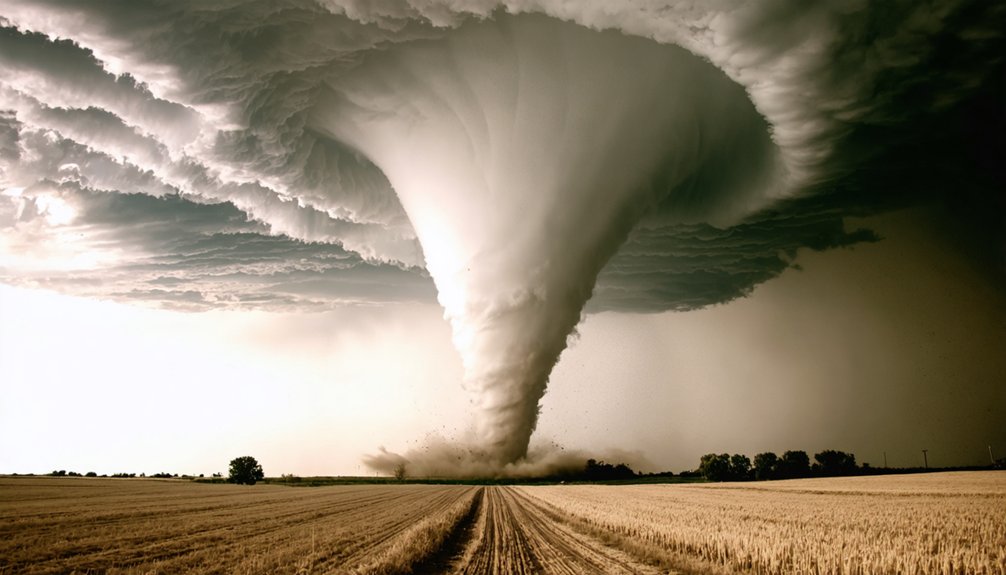
University research programs started storm chasing culture when Dr. Joe Golden held a 1972 classroom meeting at the University of Oklahoma, recruiting students to intercept tornadoes and validate experimental Doppler radar systems. That single academic initiative became the Tornado Intercept Project, producing the landmark 1973 Union City tornado dataset. You can trace today’s protocols, safety standards, and chaser community directly to those foundational efforts — and the full story reveals just how much that one meeting still shapes modern severe weather science.
Key Takeaways
- In 1972, Dr. Joe Golden initiated a classroom meeting at OU, recruiting students for tornado interception to test experimental Doppler radar systems.
- This academic effort launched the Tornado Intercept Project, framing storm chasing as structured data collection rather than spectacle or adventure.
- The May 1973 Union City tornado intercept validated Doppler radar signatures, proving coordinated field observation’s scientific value and advancing warning systems.
- David Hoadley’s independent chasing and *Storm Track* magazine built community infrastructure, connecting chasers outside formal meteorological channels through shared knowledge.
- University research established safety protocols, positioning techniques, and data methods that remain foundational to modern storm chasing operations and public safety.
The 1972 Classroom Meeting That Changed Storm Chasing Forever
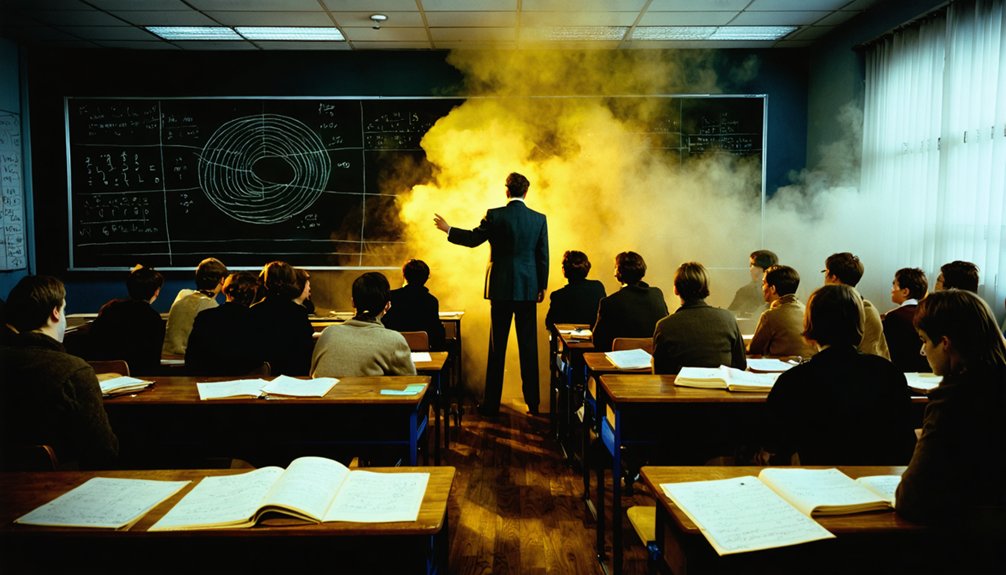
In 1972, a single classroom meeting at Felger Hall on the University of Oklahoma campus set in motion what would become the modern tornado warning program.
Dr. Joe Golden, a scientist with the National Severe Storms Laboratory, addressed the student chapter of the American Meteorological Society with a direct request: intercept tornadoes to test two experimental Doppler radars. These radars represented cutting-edge meteorological instrumentation that required real-world ground truth to validate their effectiveness.
Golden’s appeal to students wasn’t bureaucratic—it was an open call for community engagement that empowered individuals to contribute meaningfully to scientific advancement.
You’d recognize this moment as a turning point where academic research, emerging technology, and citizen participation converged, ultimately shaping the warning systems that today give communities the freedom to respond to severe weather threats.
Who Was Dr. Joe Golden and Why Did He Matter?
When you examine the origins of university-based storm chasing research, Dr. Joe Golden’s role at the National Severe Storms Laboratory emerges as foundational.
As an NSSL scientist in 1972, Golden actively recruited University of Oklahoma students to chase tornadoes, providing ground truth data for two experimental Doppler radars under development.
His recruitment effort transformed storm chasing from an informal pursuit into a structured, academically sanctioned research methodology.
Golden’s Role at NSSL
Dr. Joe Golden served as a scientist with the National Severe Storms Laboratory, where his work directly shaped meteorological innovations that transformed how researchers understood tornado behavior. You can trace the origins of organized storm chasing back to his initiative.
In 1972, Golden walked into a classroom at Felger Hall at the University of Oklahoma and addressed the student chapter of the American Meteorological Society. He needed people willing to intercept tornadoes to test two experimental Doppler radars. That request wasn’t routine — it was a call to action that sparked community formation among a generation of students who’d never considered chasing storms scientifically.
Golden’s role wasn’t passive; he actively recruited the human infrastructure that made the Tornado Intercept Project possible and credible.
Recruiting Student Storm Chasers
What made Golden’s recruitment effort so consequential wasn’t the ask itself — it was who he asked and where he asked it. In 1972, Golden stood before the University of Oklahoma’s student chapter of the American Meteorological Society at Felger Hall.
He wasn’t recruiting professionals — he was recruiting curious, capable students willing to chase tornadoes for science.
The meteorological ethics here matter: Golden framed the mission around data collection, not spectacle. Students would gather ground truth to validate two experimental Doppler radars, making data visualization possible at scales previously unachievable.
You’d have recognized this as consequential — ordinary students suddenly held instruments shaping tomorrow’s warning systems. That voluntary, academically grounded commitment transformed storm chasing from isolated curiosity into structured, university-backed scientific inquiry.
The Scientists Who Chased Before It Had a Name
Before storm chasing had a name, you can trace its scientific roots to Neil Ward, whose early research into thunderstorm structure laid the conceptual groundwork for systematic storm observation.
You’ll find that David Hoadley extended this tradition in 1956, when he began pursuing storms across North Dakota in what stands as one of the earliest documented voluntary intercepts.
These men pursued severe weather not as a cultural phenomenon, but as a disciplined scientific inquiry into atmospheric mechanics.
Ward’s Early Storm Research
Neil Ward stands as the first scientific storm chaser, having developed foundational ideas about thunderstorm structure long before the practice had a name or a community behind it. You can trace modern chasing methodology directly back to his early fieldwork, which challenged prevailing meteorological myths about how supercells behave.
Ward didn’t rely on assumption; he pursued direct observation, building an empirical foundation that later researchers would expand through data visualization and instrumentation. His commitment to ground-level inquiry preceded the formal university partnerships that would eventually institutionalize storm chasing as a discipline.
Hoadley’s Pioneering 1956 Chase
Ward’s empirical approach found a parallel in another figure working entirely outside institutional frameworks. David Hoadley began chasing storms across North Dakota in 1956, driven by curiosity rather than institutional mandate. You’d find no laboratory backing him, no federal grant sustaining his work — only personal discipline and careful observation.
Hoadley operated independently during an era when urban development was reshaping America’s relationship with open land, and early signals of climate change remained largely unrecognized. Yet he documented thunderstorm behavior with remarkable consistency, building a personal archive that predated formal chase methodology.
His work eventually produced *Storm Track* magazine, a newsletter that connected isolated observers into a coherent community. That community became the cultural foundation upon which later university-sponsored programs would deliberately build their own storm chasing research.
Before Storm Chasing’s Name
What these early figures practiced had no agreed-upon name yet. Neil Ward and David Hoadley pursued tornadoes armed with meteorological theories and research methodologies that hadn’t yet earned formal recognition. You’d find no established protocols, no institutional frameworks, and no shared terminology guiding their work.
Ward developed foundational ideas about thunderstorm structure while Hoadley documented his observations beginning in 1956. They operated independently, driven by scientific curiosity rather than cultural momentum.
Their pursuit existed outside mainstream meteorology, yet their contributions proved indispensable. You can trace today’s warning systems directly back to their groundwork.
Before storm chasing carried its name, before it claimed its culture, these pioneers established the intellectual foundation that would eventually pull universities, federal laboratories, and independent observers into a unified, purposeful scientific community.
Storm Track Magazine and the Birth of a Chaser Community
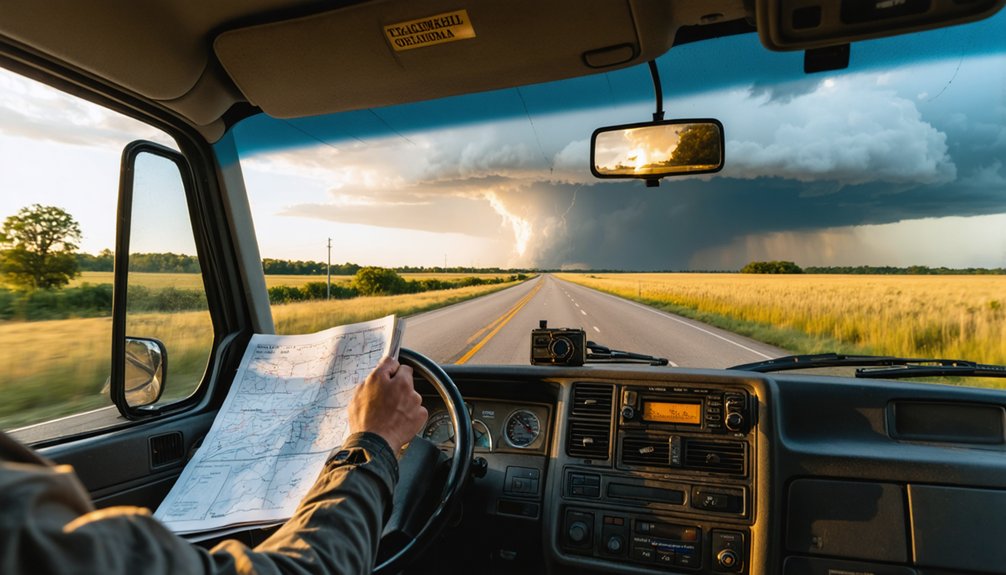
Although Neil Ward pioneered the scientific framework for understanding thunderstorm structure, it was David Hoadley who transformed storm chasing from isolated pursuit into a connected discipline.
Starting in North Dakota in 1956, Hoadley pursued storms independently before recognizing that chasers needed a shared platform. He founded Storm Track magazine, initially a modest newsletter, which became the connective tissue of an emerging community.
Hoadley chased alone for years before understanding that isolation was the discipline’s greatest obstacle.
Storm Track enabled chasers to exchange observations, refine techniques, and build collective knowledge outside formal meteorological education channels. You can trace the community’s cohesion directly to that publication.
It created a space where independent observers compared notes, accelerating both radars development awareness and field methodology. From this foundation, the first generation of organized storm chasers emerged, establishing chasing as a disciplined, community-driven pursuit rather than a solitary, uncoordinated endeavor.
NSSL’s Unlikely Recruitment: College Students as Tornado Interceptors
In 1972, you’d have witnessed an unconventional moment in meteorological history when Dr. Joe Golden, a scientist with the National Severe Storms Laboratory, addressed the University of Oklahoma’s student chapter of the American Meteorological Society in a classroom at Felger Hall.
Golden asked these students to intercept tornadoes, not for adventure, but to provide ground truth data for two experimental Doppler radars being tested in the field.
This unlikely recruitment of college students as tornado interceptors would prove foundational to the development of modern tornado warning systems.
Golden’s Unconventional Student Request
During a 1972 classroom meeting at Felger Hall, Dr. Joe Golden made an unconventional request that would reshape meteorological innovations for decades. Golden, a scientist with the National Severe Storms Laboratory, addressed the University of Oklahoma’s student chapter of the American Meteorological Society with a bold proposition: chase tornadoes to test two experimental Doppler radars.
You’d have been sitting in that classroom, weighing the risks of intercepting nature’s most violent storms against the thrill of scientific discovery. Golden needed ground truth data to validate the radars’ efficacy, and student engagement became his solution.
He wasn’t recruiting seasoned professionals—he was trusting motivated students to gather critical field observations. That unconventional decision planted the seed for what would eventually grow into a formalized, culture-defining scientific pursuit.
Testing Radars Through Chasing
What the National Severe Storms Laboratory needed wasn’t professional field crews—it was agile, motivated observers willing to position themselves near violent storms on short notice.
Two experimental Doppler radars represented significant radar advancements, but their efficacy required ground truth validation that laboratory scientists alone couldn’t provide.
You’d have been sitting in that Felger Hall classroom in 1972 when Dr. Joe Golden made his unconventional ask: intercept tornadoes, document conditions, and report back.
Students from OU’s American Meteorological Society chapter answered that call, becoming essential contributors to meteorological innovation.
Their field observations confirmed what the radar signatures suggested, establishing a methodology that bridged academic theory with violent atmospheric reality.
That partnership between student chasers and NSSL researchers directly shaped the warning infrastructure Americans rely on today.
The Tornado Intercept Project: Storm Chasing’s Scientific Origin
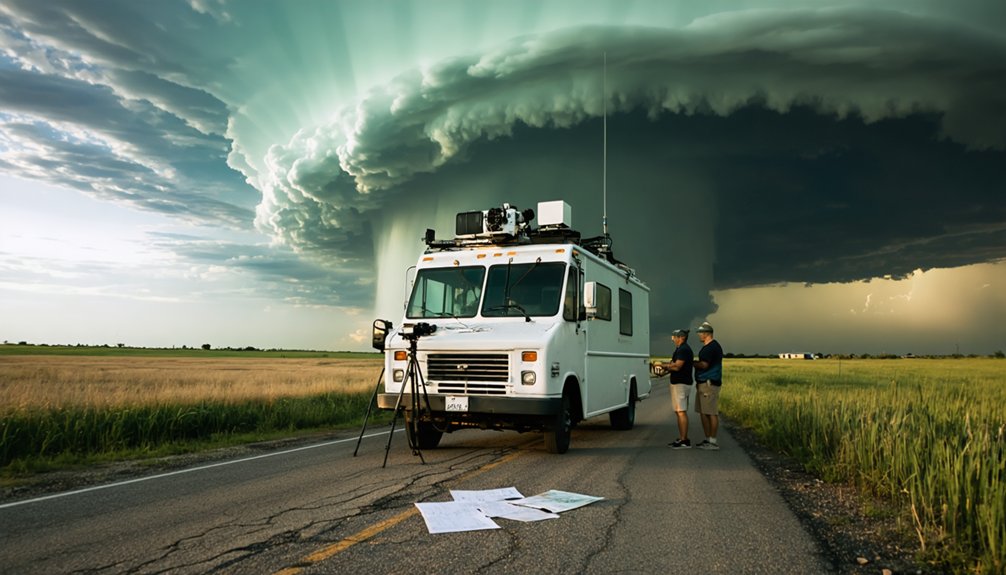
The Tornado Intercept Project, launched in 1972 as a joint effort between the University of Oklahoma and the National Severe Storms Laboratory, marks the formal scientific origin of organized storm chasing. You can trace the program’s purpose directly to radar advancements — specifically, two experimental Doppler systems requiring real-world validation against meteorological anomalies. Researchers needed ground truth data that laboratory conditions couldn’t provide.
The project’s defining moment arrived on May 24, 1973, when chasers successfully intercepted the Union City tornado. That single event transformed scientific understanding of supercell morphology and demonstrated that coordinated field observation could yield measurable results.
The intercept validated Doppler technology’s operational potential and established a replicable methodology. What began as an academic exercise effectively built the structural foundation upon which all subsequent storm chasing culture developed.
Why the Union City Tornado Changed Storm Chasing Forever
On May 24, 1973, chasers intercepted the Union City tornado and handed meteorology a dataset it couldn’t have generated any other way. You’re looking at a moment when student engagement translated directly into meteorological innovations that reshaped how scientists understood supercell morphology.
The intercept confirmed what Doppler radar signatures suggested but couldn’t alone verify — ground truth mattered enormously. Before Union City, researchers theorized about tornado structure from a distance. After it, you’d documented evidence synchronizing radar data with direct field observation.
That alignment accelerated warning system development and validated the joint OU-NSSL methodology. The tornado didn’t just advance science; it legitimized chasing as a disciplined pursuit. Every modern warning program you benefit from today traces part of its foundation to that single intercept.
How the Late 1990S: and Hollywood: Turned Storm Chasing Into a Hobby
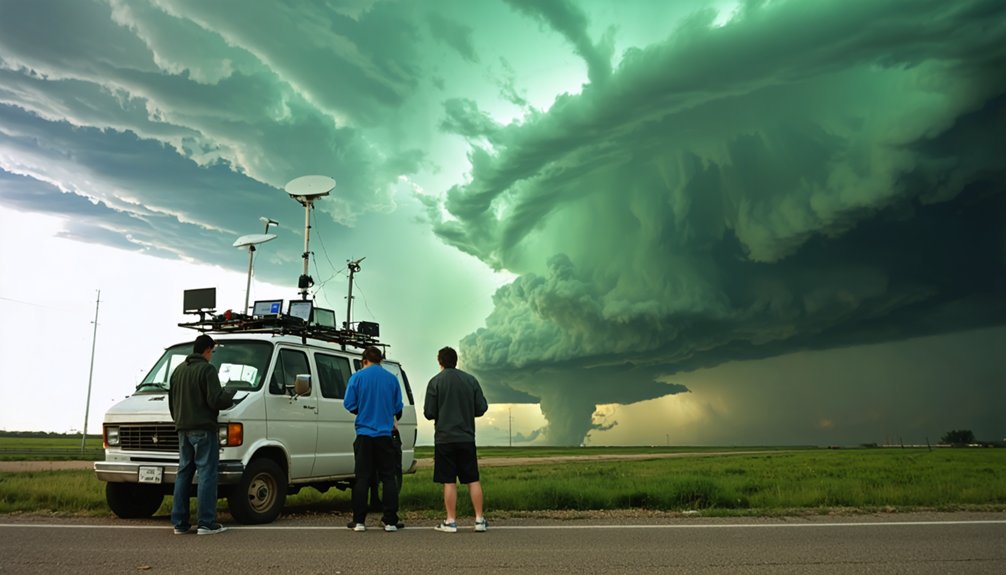
Scientific legitimacy, once chasing’s defining credential, gave way to something far more accessible in the late 1990s. Three distinct popularity spurts reshaped the community during this period, pulling storm chasing away from its research roots and toward recreational pursuit.
Hollywood accelerated this shift dramatically. Films romanticized the chase, presenting tornadoes as thrilling spectacles rather than meteorological phenomena requiring disciplined study. You could now pursue storms without formal training, institutional affiliation, or scientific purpose.
Community evolution followed naturally. New chasers entered the field carrying cameras instead of instruments, drawn by adventure rather than meteorological innovation. What began as a rigorous data-gathering discipline transformed into a mainstream hobby within roughly a decade.
The original research framework, built carefully through university partnerships and federal collaboration, became the cultural foundation for something far broader and less structured.
What Today’s Chasers Still Owe to 1970s Research
Whatever storm chasing has become culturally, its operational foundation remains inseparable from the research framework built in the 1970s. When you position yourself 2 to 5 km ahead of a supercell’s path, you’re executing a protocol refined through the Tornado Intercept Project.
When you interpret sounding data each morning, you’re applying methods that Golden’s collaboration with OU first systematized. Ignoring this lineage invites meteorological misconceptions about what chasing actually demands technically.
The historical weather patterns documented from Union City forward gave modern chasers their visual and structural models. That 1973 intercept didn’t just advance radar technology—it established reproducible field methodology.
You owe your positioning logic, your data interpretation habits, and your conceptual understanding of supercell morphology directly to researchers who built this discipline before it became entertainment.
The 1972 Classroom Decision Behind Today’s Tornado Warnings
Few decisions in meteorological history carry the downstream consequences of what unfolded in a Felger Hall classroom in 1972. Dr. Joe Golden, representing the National Severe Storms Laboratory, addressed OU’s student American Meteorological Society chapter with a direct request: intercept tornadoes to validate two experimental Doppler radars. Those radar innovations needed ground truth data that only field observers could provide.
You can trace today’s tornado warning infrastructure directly to that moment. The Tornado Intercept Project launched that same year, culminating in the landmark Union City intercept on May 24, 1973. The meteorological techniques refined through that joint OU-NSSL effort transformed supercell understanding and radar interpretation.
What began as a classroom conversation became the operational foundation that now protects millions of lives across tornado-prone regions annually.
Frequently Asked Questions
How Dangerous Was Storm Chasing for Early University Student Participants?
You’d have faced significant storm chasing risks with minimal university safety protocols when you intercepted tornadoes in 1972—you’re pioneering experimental fieldwork, positioning yourself kilometers from violent supercells without today’s advanced warning technology or established safety guidelines.
What Equipment Did Student Chasers Use During the 1972 Tornado Intercept Missions?
Coincidentally, you’d have relied on minimal safety equipment — just vehicles, notebooks, and basic instruments for data collection. In 1972, student chasers gathered humidity and wind speed readings while positioning themselves near supercells, pioneering methods that’d shape modern warning systems.
Were Student Chasers Compensated or Given Academic Credit for Participating?
The records don’t confirm you’d have received pay or academic credit. Your student motivations likely centered on discovery itself. Academic recognition came informally, as participation shaped early careers in meteorology and advanced Doppler radar’s critical development.
How Did Insurance and Liability Work for Early Scientific Storm Chasers?
Historical insurance and liability regulations weren’t formalized for early scientific storm chasers—you’d have operated largely without institutional protection. NSSL and OU’s joint project relied on personal responsibility, as formal coverage frameworks hadn’t yet caught up with this pioneering fieldwork.
What Percentage of Early Storm Chasers Continued Chasing After Graduation?
No exact percentage exists in the record, but you’d find that historical motivations and academic influences kept many chasing beyond graduation—like early floppy-disk data collectors driven by NSSL’s 1972 Felger Hall mission, pursuing storms indefinitely.
References
- https://journals.ametsoc.org/view/journals/wefo/14/4/1520-0434_1999_014_0558_ahossi_2_0_co_2.xml
- https://en.wikipedia.org/wiki/Storm_chasing
- https://hull-repository.worktribe.com/preview/4415817/Hunter_ Nicolle – Storm Chasing in Contemporary American Society and Culture.pdf
- https://barbieri.wordpress.ncsu.edu/files/2019/05/2012_xu_tornado.pdf
- https://cornerstone.lib.mnsu.edu/cgi/viewcontent.cgi?article=1139&context=etds
- https://www.blockmuseum.northwestern.edu/cinema/2026/a-brief-history-of-chasing-storms-2025-with-curtis-miller-robin-tanamachi.html
- https://jasonherbert.substack.com/p/twisters-and-the-history-of-modern
- https://plainshumanities.unl.edu/encyclopedia/doc/egp.sr.052.html
- https://www.rmets.org/metmatters/history-storm-chasing
- https://survive-a-storm.com/blog/the-history-of-storm-chasing/