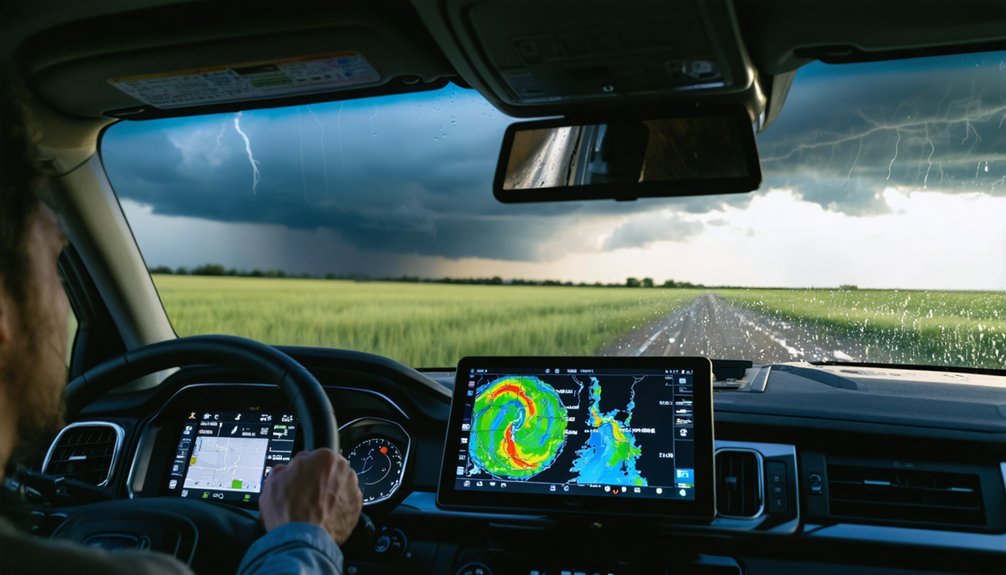
To optimize Doppler radar for storm chasing, you’ll need to cross-reference multiple data sources, scan every 1–2 minutes across tilts from 0.5° to 2.4°, and track gate-to-gate shear values at or above 0.02 sec⁻¹. Monitor velocity couplets for mesocyclone tightening, eliminate ground clutter interference, and calibrate your equipment each season for 15% better precision. Integrating machine learning apps accelerates real-time anomaly detection. The strategies ahead will sharpen every decision you make in the field.
Key Takeaways
- Cross-reference multiple radar sources like NWS and Rain Viewer to eliminate dangerous blind spots and ensure reliable storm tracking data.
- Monitor velocity couplets exceeding 0.02 sec⁻¹ gate-to-gate shear thresholds to detect mesocyclone rotation before visual confirmation becomes possible.
- Prioritize 0.5° elevation tilt scans, then progress to 1.5° and 2.4° within 1–2 minutes for optimal hook echo capture.
- Regular calibration and seasonal maintenance improve Doppler tracking precision by 15%, ensuring accurate and reliable severe storm detection.
- Integrate machine learning radar apps to automatically flag rotation signatures and deliver real-time mesocyclone probability scores for faster decisions.
Why Doppler Radar Defines Every Decision You Make in the Field
When you’re chasing storms, Doppler radar isn’t just a tool—it’s the decision engine behind every route adjustment, positioning call, and retreat you’ll make in the field.
Real-time velocity data tells you whether a mesocyclone is tightening, whether rotation is descending, and whether your current position is becoming untenable. Storm safety depends entirely on your ability to interpret that data accurately and act before conditions deteriorate. Every second of delay compounds your risk.
Doppler radar also shapes your decision making by revealing what’s invisible to the naked eye—hook echoes, rear-flank downdrafts, and inflow boundaries that define survivable positioning.
Without it, you’re reacting instead of anticipating. You’re not just reading weather; you’re reading intent. Master the data, and you maintain the freedom to chase effectively and exit safely.
Choose the Right Doppler Radar Data Sources for Field Operations
Choosing the right radar data source isn’t preference—it’s operational infrastructure. Your storm data pipeline directly determines radar accuracy and field survival margins.
The National Weather Service delivers free, real-time storm tracking with integrated alerts, while Rain Viewer provides customizable radar overlays with rotation detection notifications—both essential tools for mobile operations.
The National Weather Service and Rain Viewer aren’t optional—they’re foundational radar infrastructure for any serious mobile operation.
For independent field monitoring, portable radar systems eliminate dependency on external broadcast networks, strengthening data reliability when connectivity degrades. You need redundancy built into your protocol stack.
Cross-reference multiple sources simultaneously. Single-source dependence creates dangerous blind spots, especially when tracking rapidly evolving supercells.
Integrate your radar platforms with your emergency protocols and safety measures so data failures trigger predetermined responses automatically. Your infrastructure must function when conditions deteriorate fastest.
Read Reflectivity and Velocity Products Like an Expert
Reflectivity and velocity products aren’t interchangeable—they answer fundamentally different questions about storm structure. Reflectivity patterns reveal precipitation intensity and distribution, helping you identify hook echoes, bounded weak echo regions, and hail cores. High dBZ values exceeding 65 indicate large hail; a classic hook shape signals potential tornado development.
Don’t confuse intense reflectivity with guaranteed rotation—that’s where velocity products become critical.
Velocity anomalies expose wind shear and rotational signatures invisible in reflectivity data. Look for tight couplets of inbound and outbound velocities indicating mesocyclone development. Gate-to-gate shear exceeding 0.02 sec⁻¹ warrants immediate attention.
Aliased velocities—where colors wrap unexpectedly—require dealiasing interpretation to avoid misreading storm dynamics. Cross-reference both products simultaneously, maintaining awareness of beam limitations at extended ranges to guarantee accurate, confident storm analysis.
Calibrate Your Doppler Radar Before Every Storm Season
Before storm season begins, calibrate your Doppler radar to lock in baseline accuracy—regular calibration improves tracking precision by 15%, ensuring your reflectivity and velocity readings remain dependable when conditions deteriorate fast.
Quarterly seasonal maintenance keeps Doppler reliability sharp and data integrity intact. Follow these calibration techniques to maintain storm preparedness:
Seasonal calibration sharpens Doppler reliability and protects data integrity—follow proven techniques to maintain peak storm preparedness year-round.
- Eliminate ground clutter using signal processing to clean up nearby echo contamination and preserve radar accuracy.
- Verify tangential shear thresholds at 0.02 sec⁻¹ to maintain reliable severe storm and tornado detection.
- Reduce signal noise through precise antenna positioning, strengthening monitoring protocols and overall system performance.
- Schedule equipment upgrades before peak season to replace degraded components compromising measurement fidelity.
Skipping calibration means trusting corrupted data during life-or-death decisions—don’t surrender that margin.
How Does Beam Spreading Degrade Storm Detection at Distance?
As your radar beam travels outward, beam spreading widens the pulse dramatically over distance, degrading resolution and masking critical storm features like hook echoes and mesocyclones. Beam width expands roughly 1° per kilometer, meaning at 100 km, you’re sampling a volume far too large to resolve tight rotation signatures accurately.
Distance attenuation compounds signal degradation further, weakening return energy and reducing detection accuracy for low-topped supercells or shallow rotation.
Earth’s curvature lifts the beam above low-level storm features entirely, creating beam overshooting that eliminates critical near-surface data from your radar limitations equation.
To counter these effects during storm tracking, position yourself closer to active cells, cross-reference multiple radar sites, and prioritize composite reflectivity products when beam blockage or spreading compromises individual tilt data reliability.
Filter Ground Clutter Without Discarding Critical Storm Returns
Ground clutter presents a different but equally disruptive problem once you’ve accounted for beam spreading and overshooting.
Stationary returns from terrain, buildings, and trees contaminate low-level scans, masking genuine storm signatures. You’ll need ground clutter filtering strategies that eliminate false returns without sacrificing storm return preservation.
Ground clutter masks real storm signatures — filter it out without losing the precipitation data that matters most.
Apply these targeted techniques:
- Elevation tilts: Switch to 0.5°–1.5° tilts above the lowest beam to bypass dense clutter fields.
- Doppler velocity filtering: Reject zero-velocity returns while retaining storm-relative motion data.
- Composite reflectivity: Cross-reference multiple tilts to confirm legitimate storm echoes.
- Clutter suppression algorithms: Use built-in processing tools that distinguish stationary ground targets from moving precipitation.
Balancing ground clutter filtering against storm return preservation keeps your radar picture clean and operationally accurate when conditions deteriorate rapidly.
Spot Hook Echoes and Mesocyclones Before They Vanish
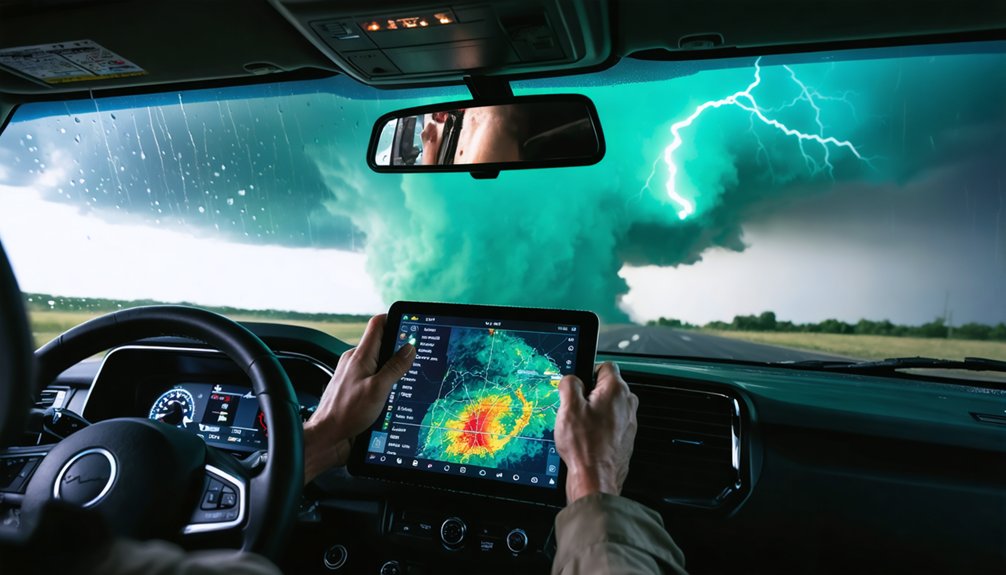
When scanning for hook echoes, you’ll want to focus on the rear-flank region of a supercell, where precipitation wraps cyclonically around a developing mesocyclone, often appearing as a distinctive appendage on reflectivity displays.
You can detect mesocyclone rotation early by monitoring radial velocity data for gate-to-gate shear values exceeding 0.02 sec⁻¹, which signal organized rotation before a tornado touches down.
Act quickly, because beam spreading at distances beyond 100 km degrades resolution considerably, potentially masking these critical signatures before you can reposition for a cleaner radar angle.
Identifying Hook Echo Signatures
Spotting hook echoes and mesocyclones before they dissipate demands that you scan the lowest available tilt angles first, since beam spreading and overshooting at distant ranges can mask low-level rotational signatures within minutes.
Prioritize radar signature analysis at 0.5°–1.5° elevations to capture hook echo characteristics before beam degradation obscures critical features.
- Monitor reflectivity gradients tightening along the hook’s inflow notch, signaling intensifying rotation
- Track velocity couplets exceeding 0.02 sec⁻¹ tangential shear thresholds for tornado probability assessment
- Cross-reference multiple radar sites to compensate for beam blockage or ground clutter contamination
- Use composite reflectivity overlays when single-tilt data becomes unreliable at ranges beyond 100 km
Acting decisively on these indicators gives you maximum lead time before dangerous signatures vanish entirely.
Detecting Mesocyclone Rotation Early
Detecting mesocyclone rotation early hinges on your ability to parse velocity data before beam geometry steals critical low-level signatures. At ranges beyond 100 km, beam spreading degrades resolution, masking the tight couplets essential for mesocyclone identification.
You’ll want to prioritize the 0.5° tilt first, then rapidly scan 1.5° and 2.4° tilts to build vertical continuity within 1–2 minutes.
Target gate-to-gate shear values at or above 0.02 sec⁻¹ as your early warning threshold—anything tighter signals intensifying rotation demanding immediate route reassessment.
Leverage multi-radar composite views to compensate for beam blockage at single sites. Machine learning anomaly detection flags unusual rotational patterns in real time, buying you precious minutes.
Don’t wait for hook echo confirmation; velocity signatures precede visual storm structure every time.
Track Supercell Updrafts With Smarter Doppler Radar Scan Strategies
Tracking supercell updrafts demands smarter scan strategies, and even small adjustments to your radar protocol can yield significant returns.
Smarter scan strategies unlock supercell updraft tracking—small protocol adjustments deliver outsized returns.
Tightening your scan intervals to every 1–2 minutes dramatically improves updraft tracking, especially above 5 km where storm dynamics evolve fastest.
Key optimizations to implement:
- Multi-radar cross sections deliver superior multi-Doppler updraft retrievals compared to single-site analysis
- Cell-tracking algorithms enhance detection of updraft velocities exceeding 10 m s⁻¹ inside active supercells
- Single-RHI techniques provide granular detail for cells positioned close to your radar unit
- Avoid spatially constant storm motion assumptions at higher altitudes—they introduce significant retrieval errors
You’re not locked into default scan modes.
Customize your strategy, push scan frequency higher, and you’ll capture updraft behavior that standard protocols routinely miss.
Use Radar Apps With Built-In Machine Learning to Interpret Data Faster
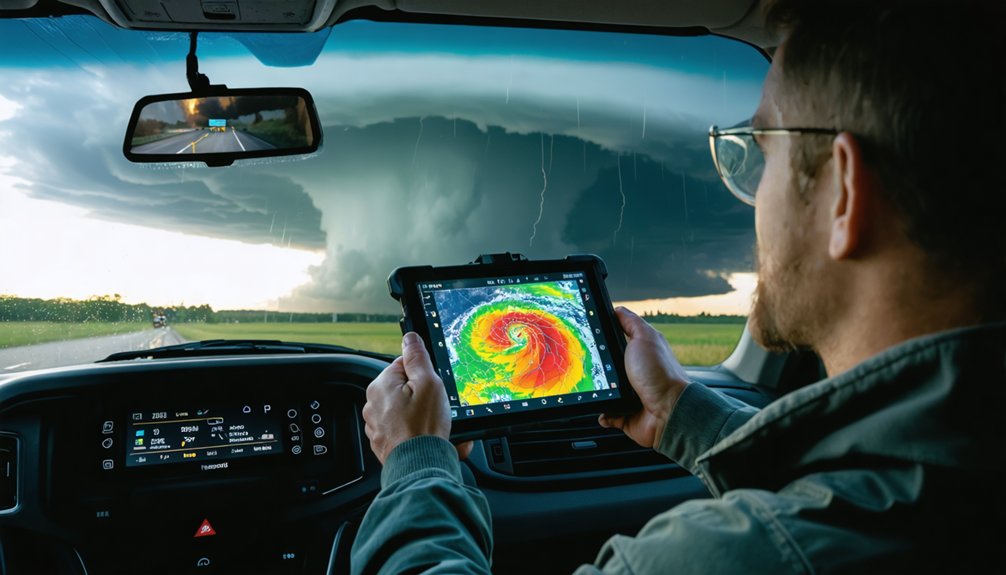
When raw radar data streams in faster than you can manually process it, machine learning fills the gap. Modern radar apps with machine learning integration automatically flag rotation signatures, anomalous velocity couplets, and emerging hook echoes before you’d catch them manually.
These tools don’t just display data — they interpret it. Radar data visualization layers become dynamic, highlighting mesocyclone probability scores and updraft intensity thresholds in real time.
Apps like Rain Viewer leverage anomaly detection algorithms that continuously learn from historical storm datasets, sharpening predictive accuracy with every event.
You gain faster situational awareness without sacrificing analytical depth. Instead of manually cycling through tilt sequences, you’re acting on algorithm-filtered intelligence.
That speed advantage directly translates into better route decisions and safer positioning during rapidly evolving supercell environments.
Build a Real-Time Doppler Radar Protocol That Keeps You Alive
Machine learning gets you faster data interpretation, but algorithms alone won’t keep you alive — protocol does. Real time protocols turn raw Doppler data into structured decisions before conditions deteriorate.
Machine learning interprets data faster — but protocol is what keeps you alive when conditions deteriorate.
You need repeatable safety measures executed automatically, not improvised under pressure.
Build your protocol around these non-negotiables:
- Scan every 1–2 minutes across multiple radar tilts to track mesocyclone intensification and hook echo development
- Monitor tangential shear thresholds — values hitting 0.02 sec⁻¹ signal severe rotation requiring immediate route reassessment
- Maintain elevation tilt discipline — use tilts above ground clutter to preserve clean low-level storm return data
- Rehearse evacuation paths before deployment so deteriorating conditions trigger muscle memory, not hesitation
Your protocol is your autonomy. Own it, drill it, execute it.
Frequently Asked Questions
How Does Dual-Polarization Radar Differ From Single-Polarization Doppler Systems?
Dual-polarization radar technology transmits both horizontal and vertical pulses, giving you richer storm tracking data than single-polarization systems. You’ll distinguish precipitation types, detect debris signatures, and reduce false returns, dramatically improving your situational awareness in the field.
What Legal Regulations Govern Storm Chasers Using Portable Radar Equipment?
Like traversing open skies, storm chaser regulations remain largely uncodified federally. You’ll find portable radar laws vary by state—check local spectrum licensing, FCC equipment rules, and road traffic codes before deploying your system.
Can Doppler Radar Detect Lightning Activity Within Developing Thunderstorm Cells?
Doppler radar doesn’t directly perform lightning detection, but you can analyze storm cell dynamics through reflectivity gradients and rotation signatures that correlate with electrical activity, helping you identify lightning-prone supercells and make informed, independent chasing decisions.
How Do Terrain Elevation Changes Affect Doppler Radar Performance in Mountainous Regions?
Terrain interference severely limits your radar’s beam in mountainous regions. Elevation impact causes beam blockage and ground clutter, so you’ll need composite reflectivity products and higher elevation tilts to compensate for obstructed low-level storm data.
What Insurance Coverage Options Exist Specifically for Storm Chasers Using Radar Equipment?
You’ll want specialized storm chaser insurance that includes radar equipment coverage for field operations. Policies typically cover theft, accidental damage, and liability. Compare providers offering tailored plans protecting your Doppler systems, ensuring you’re free to chase without financial risk.
References
- https://www.youtube.com/watch?v=G2upCSLvmks
- https://crazystormchasers.com/doppler-radar-efficiency-in-storm-tracking/
- https://amt.copernicus.org/articles/15/4931/2022/amt-15-4931-2022.pdf
- https://ultratechlife.com/science/5-28-19-linwood-tornado-analysis/
- https://apps.dtic.mil/sti/trecms/pdf/ADA010434.pdf
- https://crazystormchasers.com/how-does-doppler-radar-help-storm-chasers/
- https://journals.ametsoc.org/view/journals/atot/29/8/jtech-d-11-00177_1.pdf
- https://www.youtube.com/watch?v=ELK1eBye9ek
- https://pure.tudelft.nl/ws/portalfiles/portal/236405185/PhDThesisTDv11.pdf
- https://nssl.noaa.gov/publications/dopplerguide/Doppler Guide 2nd Ed.pdf