Preparing for a storm chaser expedition means mastering both meteorology and field logistics before you leave the driveway. You’ll need to interpret CAPE values, wind shear, and SPC outlooks while keeping your vehicle fueled, equipped, and mechanically sound. Map at least two escape routes, establish redundant communication systems, and pack trauma-grade first aid supplies alongside sufficient food and water. Complete Skywarn certification to sharpen your spotter skills. Everything you need to execute a safe, successful chase is covered ahead.
Key Takeaways
- Master storm forecasting by tracking CAPE values, wind shear, SPC outlooks, and refreshing data every 30 minutes during active storm development.
- Prepare your vehicle thoroughly by verifying brakes, tires, and battery, while packing tow straps, jump starters, and essential emergency fluids.
- Plan at least two escape routes before departure, avoiding flood-prone roads, bridges, and low-water crossings during heavy rainfall events.
- Build a redundant communication system combining two cellular carriers, HAM radio, and a satellite phone for continuous severe weather updates.
- Complete Skywarn certification, pack trauma-grade first aid supplies, and carry caloric food, water, and emergency shelter for remote environments.
Storm Forecasting Skills Every Chaser Needs Before Departure
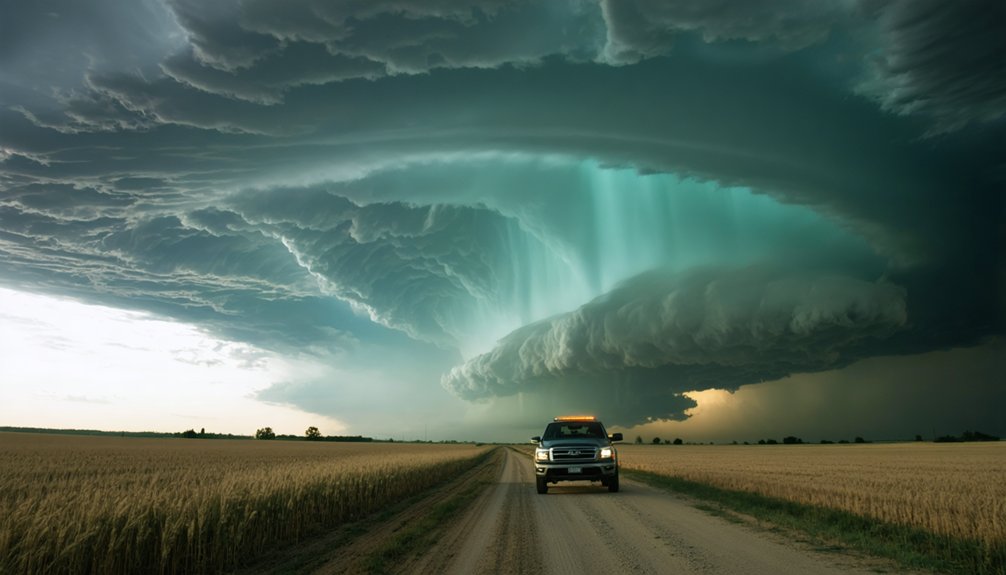
Before you head out on a chase, you’ll need a working command of storm structure and storm types—supercells, squall lines, and tornadoes behave differently, and misreading them costs you positioning and safety.
Misread a supercell, squall line, or tornado and you lose both position and safety.
Study the storm environment thoroughly using SPC outlooks, mesoscale analysis, surface observations, and local radiosonde data. Track CAPE values and wind shear to confirm favorable severe-weather setups before committing to a target.
Forecast accuracy degrades fast during active development, so refresh your data every 30 minutes. Satellite imagery and radar trends reveal initiation timing and storm mode shifts that static morning forecasts miss.
Identify your primary target early, then lock in fallback locations before conditions evolve beyond your initial read. Chasers who skip rigorous pre-departure analysis surrender their greatest tactical advantage: knowing what’s coming before it arrives.
What to Check and Carry in Your Chase Vehicle
Sharp forecasting gets you to the right county, but a mechanically sound vehicle keeps you alive once you’re there. Before departure, verify brakes, battery, lights, defroster, and tire condition, including your spare. Fuel up completely — chase days routinely exceed 400 miles.
Pack tow straps, a jump starter, fix-a-flat kits, and essential fluids. Hail, mud, and flash flooding can strand you fast, so recovery gear isn’t optional.
Inside the cab, carry a first aid kit with trauma supplies, food, water, and weather resistant clothing rated for cold and wet conditions. Designate an emergency shelter option for each target region before you enter the field.
Redundant navigation tools — GPS with offline maps plus a paper atlas — guarantee you’re never driving blind.
Mapping Your Route and Planning Storm Chasing Escape Roads
Route planning isn’t a last-minute task — you’ll want at least two mapped escape routes built before you leave home. Terrain navigation demands that you study road networks ahead of time, identifying which rural roads dead-end, flood quickly, or cross a projected tornado track. Avoid bridges and low-water crossings that become impassable under heavy rainfall.
Load GPS mapping software with offline capability onto your device, then back it up with a paper atlas. Rural signal gaps are real, and they’ll strand you without redundancy.
Hazard awareness means you’re constantly reassessing your position relative to storm movement. Identify a bail-out shelter for every target region before you enter it. If your primary route closes, you execute the secondary immediately — no hesitation, no improvisation.
Communication Setup Every Storm Chaser Should Have Ready
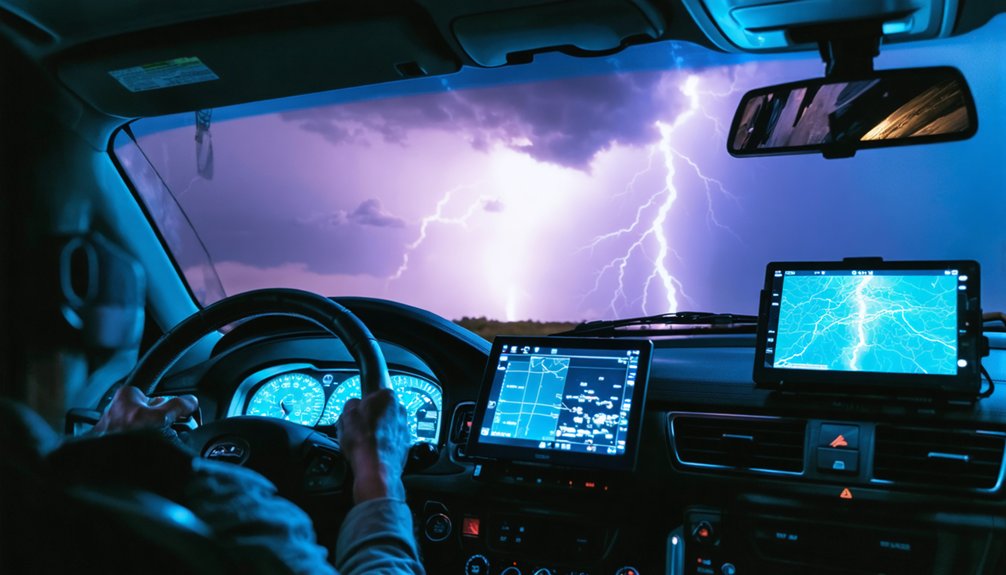
Redundant communication systems aren’t optional — they’re what keep you connected when rural signal drops mid-chase. Build communication redundancy into every expedition by combining cellular data from two carriers, a HAM radio, and a satellite phone as your fallback.
Each layer serves a distinct purpose: cellular supports radar interpretation and live warning feeds, HAM connects you to local spotters, and satellite ensures emergency contact when both fail.
Share your GPS coordinates and target location with your team on a scheduled check-in interval. Standardize your protocols before departure so everyone knows the contact schedule and fallback plan.
Rural networks fail without warning, so never depend on a single carrier for radar interpretation or severe weather updates. Redundancy isn’t paranoia — it’s operational discipline.
Personal Gear and Training to Survive Long Chase Days
Long chase days stretch past 12 hours, and what you pack directly determines your performance and survivability when conditions deteriorate. Build your kit around trauma-grade first aid supplies—tourniquets, gauze, and trauma shears—because remote environments won’t offer quick medical response.
Your pack is your lifeline—trauma-grade supplies aren’t optional when the nearest help is miles away.
Carry dense caloric food, adequate water, and waterproof storage to protect documentation gear, spare batteries, and high-speed memory cards.
Include emergency shelter options for scenarios where conditions ground your movement entirely. A compact, weather-resistant shelter layer buys critical decision-making time when escape routes close.
Don’t skip safety training. Complete Skywarn or equivalent spotter certification before independent fieldwork, and log field hours alongside experienced chasers. That structured knowledge base converts raw enthusiasm into disciplined judgment—the single most critical resource you’ll carry into any severe-weather environment.
Frequently Asked Questions
What Legal Permits Are Required for Storm Chasing on Private Property?
The provided knowledge doesn’t cover legal permits for storm chasing on private property. You’ll need to research local laws, secure landowner permission before entering private property, and consult legal counsel to guarantee you’re operating within your rights.
How Do Storm Chasers Handle Mental Health After Witnessing Devastating Tornado Damage?
You’ll build emotional resilience by seeking mental health support through peer debriefs, professional counseling, and structured post-chase reviews. Don’t suppress trauma—process it actively with trusted networks to maintain psychological freedom and long-term chasing effectiveness.
Are There Age Restrictions or Requirements for Joining Storm Chasing Expeditions?
Most expeditions require you to be 18+. Over 90% of professional chasers trained as adults, mastering weather forecasting and storm safety protocols. You’ll need verified skills and maturity to make life-or-death field decisions independently.
What Insurance Coverage Do Professional Storm Chasers Typically Carry for Expeditions?
The provided knowledge doesn’t cover insurance policies or liability coverage specifics. You’ll want to consult an insurance professional experienced in high-risk occupations to secure appropriate protection for your storm chasing expeditions.
How Do Storm Chasers Coordinate With Emergency Responders During Active Tornado Events?
Imagine you’re tracking the 2011 Joplin tornado—you’d relay real-time GPS coordinates and weather forecasting data directly to NWS and local emergency responders via HAM radio, following established safety protocols to support rapid, life-saving decisions.
References
- https://crazystormchasers.com/storm-chaser-expedition-preparation-coverage/
- https://www.livingskytours.com/storm-chasing-101/
- https://crazystormchasers.com/essential-safety-checklist-for-storm-chasing-expeditions/
- https://www.tornadosimulator.net/storm-chaser-beginner-guide/
- https://crazystormchasers.com/first-time-storm-chasing-what-to-bring-and-what-to-expect/
- https://www.reddit.com/r/stormchasing/comments/1jgc295/a_beginners_guide_to_storm_chasing/
- https://www.wiu.edu/SevereWeather/images/presentations/How_to_Effectively_Storm_Chase.pdf
- https://crazystormchasers.com/safety-measures-for-storm-chasers-guidelines/
- http://www.stormeyes.org/tornado/chasing/FAQ/
- https://www.reddit.com/r/stormchasing/comments/1boanfg/how_do_i_get_started_storm_chasing/