Storm chasing isn’t just about following storms — it demands real meteorological knowledge, sharp situational awareness, and disciplined decision-making. You’ll need to understand supercell structure, interpret radar data, and plan escape routes before you ever approach a target. Safety depends on the choices you make before and during a chase, not luck. Starting with storm spotter training and guided tours accelerates your learning curve considerably. Everything you need to chase smarter and safer is covered ahead.
Key Takeaways
- Storm chasing requires strong meteorological knowledge, radar interpretation skills, and situational awareness to safely observe severe weather events like tornadoes and supercells.
- Safety depends on smart pre-chase planning, knowing escape routes, carrying emergency supplies, and prioritizing observation over dangerously close storm approaches.
- Beginners should pursue storm spotter training to quickly build foundational skills in supercell structure, hazard recognition, and SPC convective outlook interpretation.
- Guided storm chasing tours offer fast-track field experience alongside professional meteorologists, providing expert radar insights while managing logistics and route planning.
- On chase days, analyze instability, moisture, and shear data, then continuously monitor radar every 2–3 minutes to catch critical directional shifts early.
What Is Storm Chasing, Really?
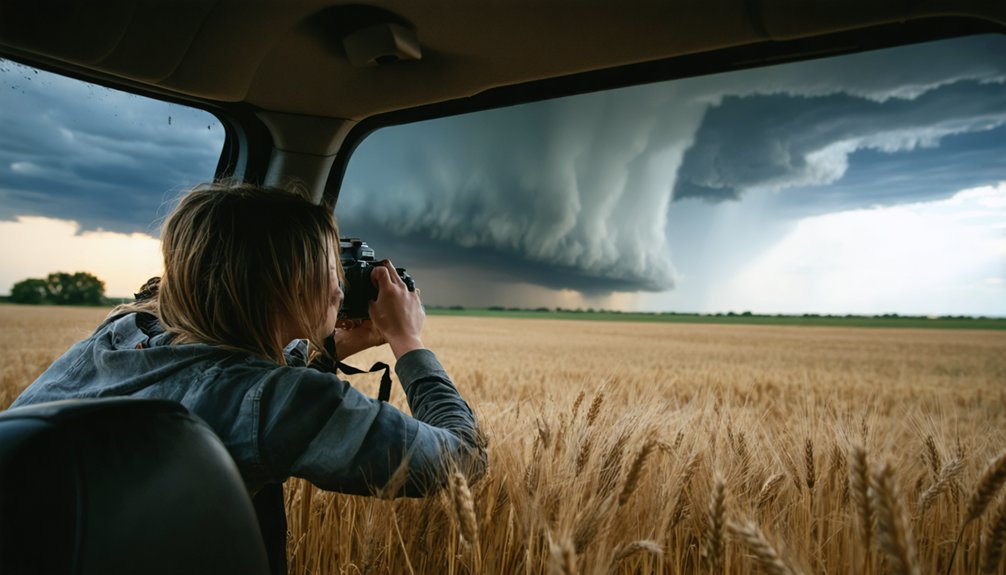
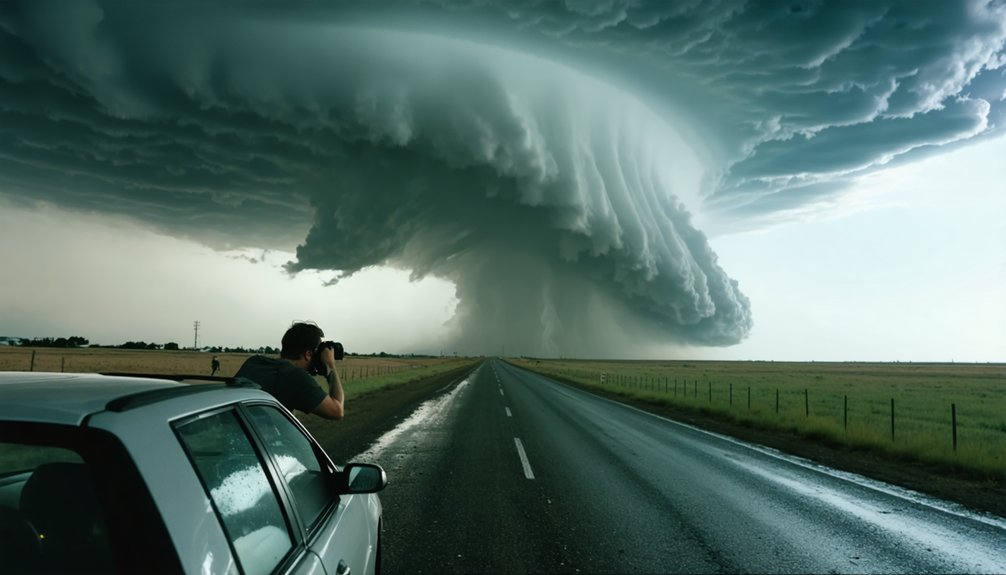
Storm chasing is the practice of traveling to observe and document severe weather events up close, including supercells, squall lines, heavy hail, intense lightning, and occasionally tornadoes.
It’s not a passive hobby. You’re actively analyzing storm behavior, making real-time decisions, and repositioning constantly based on radar data, road networks, and shifting atmospheric conditions.
Expect unpredictability. Storms change speed, direction, and intensity with little warning, and most chase days end without a significant target.
Success depends on your meteorological knowledge, forecasting ability, and situational awareness—not luck.
Chasing rewards preparation, not chance—sharp forecasting and situational awareness separate skilled chasers from the rest.
Chase ethics matter from day one. Reckless positioning, blocking traffic, or pursuing tornadoes without experience endangers you and others.
Responsible chasers prioritize safety, respect local communities, and treat every outing as both a learning opportunity and a serious field operation.
Is Storm Chasing Safe for Beginners?
Whether storm chasing is safe for beginners depends almost entirely on the choices you make before and during a chase. With the right safety measures in place, you greatly reduce your exposure to unnecessary risk.
Start with a solid beginner mindset — prioritize observation and learning over dramatic close approaches.
Understanding storm behavior is non-negotiable. Supercells shift direction, accelerate, and intensify without warning. If you can’t read a radar or recognize a storm’s motion, you’re operating blind in a dangerous environment.
Chase preparation separates survivable outings from preventable disasters. Know your escape routes before you need them. Keep your gas tank full, carry emergency supplies, and never position yourself where the storm controls your exit.
Freedom in chasing comes from competence, not recklessness.
What Training Do You Need Before Chasing Storms?
Before you set foot in a chase vehicle, you need a working knowledge of thunderstorm meteorology, radar interpretation, and hazard recognition.
Before your first chase, earn your seat with knowledge — meteorology, radar, and hazard recognition aren’t optional extras.
Storm spotter training through programs like Spotter Network builds that foundation fast. Pairing that with meteorology basics gives you the forecasting literacy needed to make smart, independent decisions in the field.
Prioritize these training areas before your first chase:
- Thunderstorm life cycles and supercell structure
- SPC convective outlooks and forecast terminology
- Real-time radar interpretation using apps like RadarScope
- Instability, wind shear, moisture, and lift concepts
- Hazard recognition including tornado motion and escape route planning
You can’t buy your way out of a bad decision in a storm. Training is what keeps you free to chase another day.
Should You Join a Guided Storm Chasing Tour First?
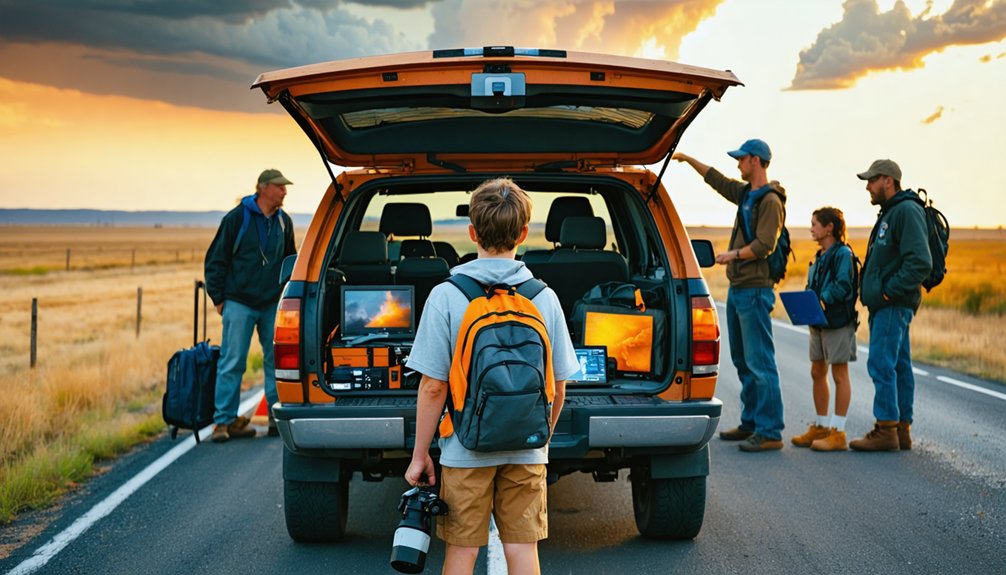
For most beginners, a guided storm chasing tour is the fastest path from classroom knowledge to real field experience. You’ll chase alongside seasoned meteorologists who provide expert insights on storm structure, positioning, and radar interpretation in real time.
That guided experience removes guesswork and compresses your learning curve dramatically. Tours handle logistics, route planning, and escape strategies, freeing you to focus entirely on observation and education.
You’ll learn to read supercell structure, identify rotation, and understand storm motion without the pressure of making every critical decision yourself.
Choose a reputable tour operator with verified meteorological credentials and a documented safety record. Expect long drives, schedule changes, and occasionally low storm activity.
Patience is part of the process. A single well-guided chase week can build foundational skills that take solo chasers years to develop.
What Gear Do You Actually Need as a Beginner Storm Chaser?
Getting the right gear doesn’t require a massive investment, but a few essentials will define whether your first chase is productive or dangerous. Your beginner checklist should prioritize function over novelty.
The right gear isn’t about spending big — it’s about choosing what keeps you safe and effective.
- Radar apps: RadarScope or RadarOmega outperform standard weather apps for real-time storm analysis.
- Navigation apps: GPS with offline capability keeps you moving when cell service drops.
- Communication devices: A charged phone plus a backup power bank maintains your lifeline.
- Safety equipment: First aid kit, extra fuel, food, and water handle remote-area emergencies.
- Storm photography: A camera, spare batteries, memory cards, and a tripod capture clean documentation.
Skip anything that doesn’t serve a direct operational purpose.
Your vehicle should stay fueled, your tech tools should stay updated, and your escape routes should stay planned.
How to Read Radar and Pick a Storm Chasing Target
Before you head out on your first chase, you’ll need to develop a working understanding of real-time radar interpretation, since raw radar data tells you far more than any general weather app can.
Apps like RadarScope give you velocity scans, reflectivity data, and storm-relative motion that let you identify rotating supercells, hook echoes, and debris signatures.
Once you’re reading radar confidently, you can cross-reference SPC convective outlooks, surface boundaries, and storm initiation zones to narrow your target area and position yourself ahead of the most promising storm.
Reading Radar Effectively
Learning to read radar effectively can determine whether you intercept a storm safely or find yourself in the wrong position when severe weather develops. Mastering radar interpretation means recognizing critical storm signatures before conditions escalate.
- Monitor reflectivity for hook echoes, bow signatures, and high-dBZ cores indicating hail.
- Use velocity data to identify rotation, mesocyclone development, and wind shear gradients.
- Track storm motion vectors to anticipate positioning and plan escape routes.
- Watch correlation coefficient and dual-pol products to distinguish debris signatures from precipitation.
- Prioritize professional-grade apps like RadarScope over consumer weather platforms for accuracy and speed.
You’ll make better decisions under pressure when you understand what each radar layer tells you.
Practice interpreting radar during non-chase days so your reads become instinctive in the field.
Selecting Your Chase Target
Knowing what the radar tells you only gets you so far—you still need to decide which storm is worth chasing. Effective decision making starts days before you leave, using model analysis to identify favorable weather patterns and environmental factors like instability, moisture, and wind shear.
SPC outlooks help narrow your target areas by highlighting likely storm initiation zones along drylines, fronts, or boundary intersections.
On chase day, your situational awareness sharpens through continuous radar interpretation, satellite trends, and surface data. Not every storm deserves your attention—prioritize discrete supercells over clustered convection.
Sound chase strategies demand that you assess storm motion, road networks, and escape routes before committing. Smart risk management means knowing when to abandon a target and reposition without ego getting in the way.
How Do You Track a Storm Without Losing It?
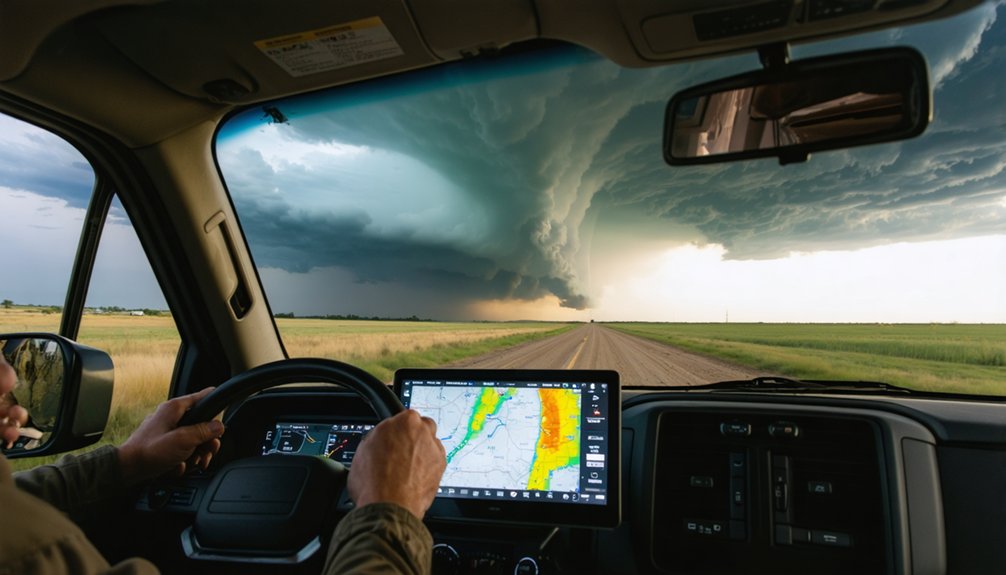
Once you’ve locked onto a storm, you’ll need to keep RadarScope or a similar app open and refresh it constantly, watching velocity data and reflectivity trends to detect any shifts in storm motion or intensification.
You should anticipate where the storm is heading by tracking its forward speed and direction, then position yourself ahead of it on a parallel road rather than directly in its path.
Always identify your escape routes before you reposition, because a storm that accelerates, wobbles, or produces a tornado can cut off your options faster than you’d expect.
Real-Time Radar Monitoring
Real-time radar monitoring is the backbone of any successful chase, giving you the situational awareness needed to track storm movement, intensity changes, and structural evolution as they happen.
Dedicated radar apps like RadarScope or RadarOmega deliver real-time updates that general weather platforms simply can’t match.
Prioritize these five monitoring essentials:
- Scan frequency – Refresh radar every few minutes to catch rapid storm changes
- Velocity data – Watch rotation signatures to identify developing mesocyclones early
- Storm motion vector – Track movement direction and speed before repositioning
- Multiple tilts – Analyze low and mid-level scans for structural changes
- Dual-polarization products – Use correlation coefficient and differential reflectivity to assess storm intensity
Mastering these tools keeps you ahead of the storm, not reacting to it.
Anticipating Storm Movement
Radar gives you the data, but anticipating where a storm is headed before it gets there is what keeps you in position and out of danger. Understanding storm dynamics means reading environmental factors like wind shear, instability, and moisture before storms even fire.
Storm patterns rarely lie when you’re interpreting upper-air data alongside surface observations.
Effective chase strategies combine weather forecasting with continuous observation techniques. Monitor storm motion vectors on radar, track mesocyclone rotation, and identify how storm behavior shifts near boundaries or terrain changes.
Always calculate intercept angles relative to the storm’s projected path, not its current position.
Safety measures demand you pre-plan escape routes. A storm that accelerates or turns can cut you off fast. Anticipate it.
Planning Flexible Escape Routes
Tracking a storm without losing it comes down to 3 core principles: knowing your exit options before you need them, reading storm motion continuously, and never letting position comfort override route awareness.
Escape route planning and terrain awareness aren’t optional—they’re survival fundamentals.
Before repositioning, always confirm:
- Your current road options in every direction relative to storm motion
- Terrain chokepoints like dead-end roads, river crossings, or limited-exit zones
- Storm forward speed, which can exceed 60 mph unexpectedly
- Radar updates every 2–3 minutes to catch directional shifts early
- Flooded road indicators, since water depth is rarely visible until it’s too late
You maintain freedom of movement only when you’ve already mapped your way out.
What Should You Wear and Pack for a Chase Day?
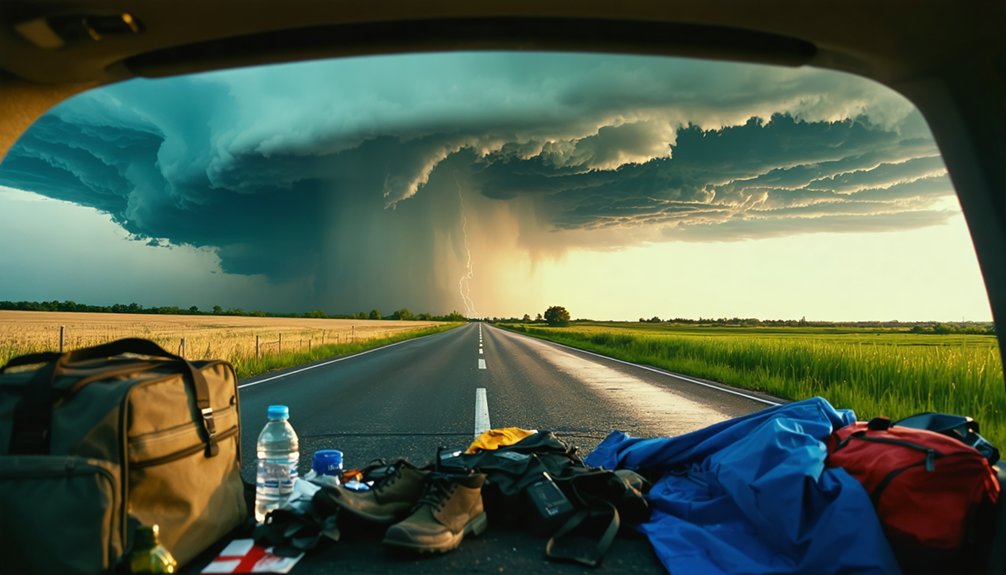
Whether you’re heading out for a single chase day or a multi-day tour, what you wear and pack directly affects your safety, comfort, and ability to stay focused on the storm.
Chase attire should handle shifting weather conditions without restricting movement. Comfort layers allow you to adapt from afternoon heat to sudden cold outflow.
Footwear choices matter—closed-toe, sturdy shoes protect you on uneven terrain.
Essential packing includes radar-capable devices, a first aid kit, emergency supplies, and navigation tools. Hydration needs are easily underestimated during long drives; carry more water than you think you’ll need.
Personal items like medications, sunscreen, and rain gear reduce preventable problems.
Pack efficiently, stay self-sufficient, and treat every chase day as a scenario where outside help may not be available.
What Actually Happens During a Typical Chase Day?
A typical chase day begins well before you ever leave the hotel or driveway. You’ll study models, SPC outlooks, and surface charts to understand that day’s chase day dynamics. Storm behavior patterns shift fast, so constant re-evaluation is non-negotiable.
Expect these realities:
- Morning: Deep analysis of instability, moisture, shear, and initiation zones
- Midday: Target refinement as satellite and surface data update
- Afternoon: Positioning ahead of expected storm development
- Active chase: Continuous radar monitoring, repositioning, and route adjustments
- Evening: Storm weakening, final repositioning, or abandoning the chase entirely
Long drives, waiting, and busted setups are common.
Patience isn’t optional — it’s fundamental to operating effectively in the field.
Frequently Asked Questions
Can Storm Chasing Be Done Solo or Do You Need a Partner?
You can chase solo, but it compromises your solo safety greatly. Teamwork benefits include shared navigation, radar monitoring, and faster decision-making. A partner lets you focus on driving while they track storm movement continuously.
How Much Does a Typical Storm Chasing Trip Actually Cost?
Surprise—it’s not free! Trip budgeting typically runs $500–$1,500 for fuel, food, and lodging. Add gear expenses like radar apps and camera equipment, and you’re investing real money chasing nature’s most spectacular chaos.
What Legal Considerations or Permits Apply to Storm Chasers on Private Land?
You must respect private property laws at all times. Never enter private land without securing landowner permissions first. Trespassing exposes you to legal liability, so always observe storms from public roads to maintain your freedom and safety.
Are There Age Restrictions or Requirements for Joining Storm Chasing Activities?
Over 90% of tour operators require participants under 18 to have parental consent. You’ll need proper safety gear and necessary training regardless of age, but most organized chases welcome motivated beginners who respect protocol and prioritize learning.
How Do Experienced Chasers Handle Mental Stress After Witnessing Storm Destruction?
You’ll build emotional resilience by debriefing with fellow chasers, reviewing footage analytically, and separating observation from personal trauma. Post-storm recovery improves when you maintain community connections, process experiences openly, and recognize that witnessing destruction demands deliberate psychological self-care.
References
- https://www.livingskytours.com/storm-chasing-101/
- https://www.stormchasingusa.com/blog/learning-the-basics-about-storm-chasing/
- https://stormchasing.com/the-ultimate-guide-to-planning-your-first-storm-chasing-adventure/
- https://www.reddit.com/r/stormchasing/comments/1jgc295/a_beginners_guide_to_storm_chasing/
- http://www.stormeyes.org/tornado/chasing/FAQ/
- https://stormtrack.org/threads/basic-storm-chasing-process.29691/
- https://www.weathercentertx.com/weather-101-different-types-of-weather/storm-chasing-101/
- https://www.facebook.com/groups/870182493143062/posts/2819645211530104/
- https://www.youtube.com/watch?v=dCGFK8JI-mU
- https://www.facebook.com/groups/382818555149437/posts/5217857284978849/