In 2026, you’re watching storm chasing technology evolve at an unprecedented pace. AI-driven radar systems like NEXRAD Build 24.0 are delivering sharper precipitation estimates, while machine-learning models predict storm evolution with greater skill. Autonomous drones are penetrating hurricane cores, and EF4-rated chase vehicles equipped with hydraulic spike anchoring are surviving direct tornado strikes. Real-time GOES satellite imagery updates every 30 seconds, giving you tactical precision. There’s considerably more to unpack across each of these breakthrough categories.
Key Takeaways
- AI-powered weather models now analyze radar, satellite feeds, and historical patterns simultaneously, predicting storm evolution with significantly higher skill than legacy systems.
- Autonomous drones like the Black Swift S0 penetrate hurricane cores, collecting pressure, wind, and moisture data, including historic 252 mph gusts.
- NOAA GOES-East and GOES-West satellites deliver rapid-scan updates every 30 seconds, enabling real-time tactical storm positioning before visual contact.
- EF4-rated Dominator vehicles feature hydraulic spike anchoring, disk-like aerodynamic geometry, and 360-degree cameras, withstanding winds exceeding 240 mph.
- Modern chase vehicles operate as rolling data hubs, integrating GPS, live radar, atmospheric sensors, and HD video into unified broadband-connected platforms.
AI and Radar Upgrades Reshaping Storm Chasing Forecasts
As storm chasing evolves into a data-driven discipline, AI weather models and next-generation radar systems are fundamentally reshaping how forecasters detect, track, and respond to severe weather.
AI algorithms now analyze radar integration outputs, satellite feeds, and historical storm patterns simultaneously, identifying atmospheric signals that traditional methods miss entirely.
AI now catches what human eyes miss — scanning radar, satellites, and storm history all at once.
NEXRAD’s Build 24.0 upgrade and the Range-Defined Quasi-Vertical Profile product sharpen quantitative precipitation estimates, giving you more precise storm dynamics analysis in real time.
Machine-learning architectures process sequential radar imagery to predict near-term storm evolution with measurably higher skill than legacy baselines.
Predictive analytics reduce computational costs while outperforming conventional forecasting systems during rapidly developing severe weather events.
You’re no longer constrained by delayed data cycles — you’re operating with faster, sharper situational awareness than any previous generation of chasers.
Autonomous Drones Penetrating the Most Dangerous Storm Cores
Beyond radar algorithms and AI forecasting, physical data collection inside storm cores has advanced just as dramatically. Autonomous drone capabilities now let you access atmospheric measurements that were previously impossible to gather safely.
Key advancements driving this shift include:
- Hurricane penetration: Black Swift S0 platforms enter hurricane cores, collecting granular pressure, wind, and moisture data directly.
- Record wind capture: During 2025 Hurricane Melissa, autonomous dropsondes recorded a 252 mph gust — a historic benchmark.
- Supercell deployment: FAA-approved systems launch miniaturized sensors into supercell inflow zones, delivering real-time structural data.
- 3D storm visualization: High-resolution drone imaging constructs precise three-dimensional storm models, sharpening your situational awareness considerably.
These platforms eliminate dangerous human exposure while dramatically expanding the volume and precision of collected storm data.
How Chasers Use Real-Time Satellite Imagery to Track Supercells
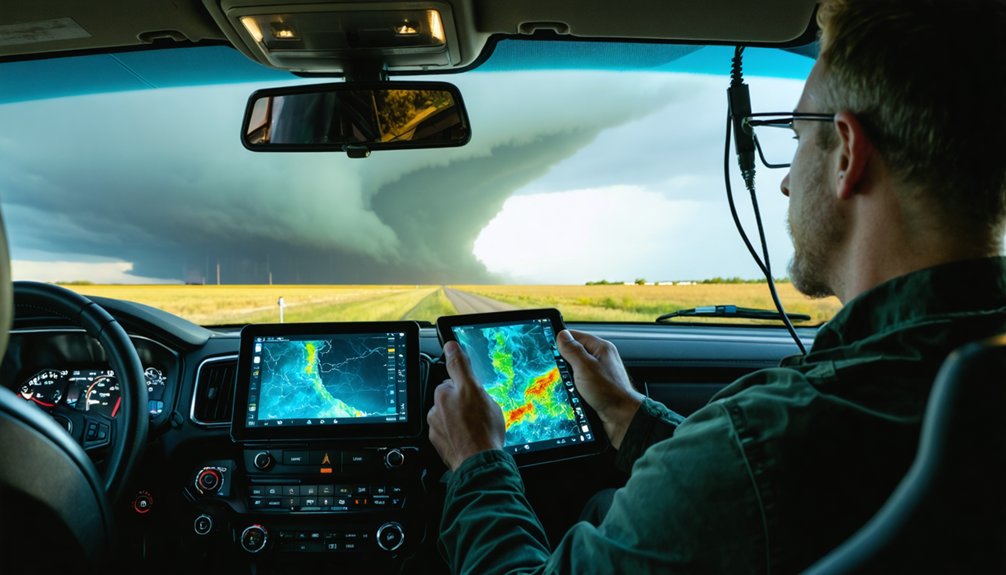
Satellite imagery has become one of your sharpest tactical tools for tracking supercell development in real time. NOAA GOES-East and GOES-West deliver rapid-scan updates every 30 seconds, giving you precise visibility into rotation signatures, updraft towers, and eyewall shifts as they evolve.
That temporal resolution transforms satellite integration from passive observation into active tactical positioning. You’re not waiting for the next radar sweep—you’re watching storm structure shift in near real time and adjusting your intercept accordingly.
High-resolution imagery reveals mesocyclone intensification, overshooting tops, and anvil characteristics that guide real-time decision making before you’re ever within visual range.
Combined with mobile broadband platforms, you can stream, analyze, and act on satellite data directly from your chase vehicle without delay.
EF4-Rated Chase Vehicles Engineered to Survive Direct Tornado Strikes
When you’re positioning for a direct tornado intercept, your survival margin depends entirely on the engineering tolerances of your chase vehicle. The 2026 builds push tornado resilience and chase vehicle innovations further than any previous generation:
- EF-rated armor systems on Dominator vehicles enable unrestricted tornado penetration without structural compromise.
- Hydraulic spike anchoring proven during EF4 intercepts locks vehicles against winds exceeding 240 mph.
- Disk-like aerodynamic geometry on Dominator 5 eliminates lift vectors that destabilize conventional vehicle profiles.
- 360-degree cameras with terrain-adaptive positioning maintain situational awareness during zero-visibility debris conditions.
These aren’t incremental upgrades — they’re fundamental reengineering of what a chase platform can withstand.
These aren’t minor refinements — they’re a ground-up reimagining of what storm chasing technology can endure and deliver.
You’re no longer just observing tornadoes from safe distances; you’re operating inside them with calculated, engineered confidence.
Mobile Tech Turning Storm Chase Vehicles Into Rolling Data Hubs
Engineering your vehicle to survive a direct EF4 strike is only half the equation — the other half is what that vehicle does with the data it collects.
Today’s technology advancements have transformed chase vehicles into rolling data hubs, integrating mobile weather stations, live radar feeds, and broadband connectivity into unified operational platforms. You’re no longer just surviving the storm — you’re interrogating it in real time.
Seamless data integration pulls GPS positioning, atmospheric sensor readings, and HD video streams into a single dashboard you can act on instantly. Mobile broadband pushes that data outward to forecasters and researchers simultaneously.
Your vehicle becomes a node in a distributed sensing network, delivering field intelligence that static infrastructure simply can’t match.
Frequently Asked Questions
What Training Do Storm Chasers Need Before Using Autonomous Drone Technology?
You’ll need FAA certification, hands-on drone operation practice, and mastery of safety protocols before deploying autonomous systems into supercells. Train rigorously in real-time data interpretation, emergency procedures, and AI-interface management to maximize operational effectiveness and personal safety.
How Do Storm Chasers Financially Fund Their Advanced Equipment and Operations?
Over 60% of chasers rely on mixed funding streams. You’ll typically secure sponsorship deals with weather tech firms, launch crowdfunding campaigns for specialized gear, and pursue research grants to finance advanced radar systems, drones, and tactical vehicles.
Are There Legal Restrictions on Where Storm Chasers Can Legally Operate?
Yes, you’ll face storm chaser regulations restricting access to closed roads, emergency zones, and private property. Public safety concerns drive these legal boundaries, but open highways and public land remain largely unrestricted for your tactical operations.
How Do Chasers Coordinate With Emergency Management Agencies During Active Tornado Events?
You’ll coordinate through real-time communication channels, pushing data sharing directly to emergency management networks. Mobile broadband platforms transmit your field observations instantly, enabling agencies to validate tornado tracks and issue faster, more precise public warnings.
What Career Pathways Exist for Aspiring Professional Storm Chasers in 2026?
Ready to chase your future? Storm chasing careers demand you master AI-driven radar systems, drone operations, and real-time analytics. Your professional development thrives by blending meteorological education with hands-on field technology expertise in 2026’s rapidly evolving landscape.
References
- https://crazystormchasers.com/storm-chasing-vehicle-reveals-and-new-builds/
- https://www.youtube.com/watch?v=uInuI3qVkr0
- https://www.accio.com/blog/next-gen-tornado-chase-vehicles-redefining-storm-intercept
- https://wickedwxlive.com/chasing-the-future-how-advancing-weather-technology-is-changing-storm-tracking/
- https://climeradar.com/blog/has-storm-tracking-radar-improved-2026
- https://www.youtube.com/watch?v=k1jn7wL9i5Q
- https://stormtrack.org/threads/predictions-of-the-future-of-chasing.27280/
- https://www.spreaker.com/episode/future-storms-climate-change-and-the-evolution-of-storm-chasing–68166085
- https://crazystormchasers.com/preparing-for-climate-change-storm-chasers-mission-consequences/
- https://stormtrack.org/threads/what-will-you-add-change-to-your-chasing-in-2026.33258/