Storm chasing vehicles have transformed dramatically since the 1950s, when chasers like David Hoadley relied on unmodified Chevrolet Bel Airs and paper maps. By the 1970s, the National Severe Storms Laboratory deployed instrumented trucks collecting real wind and precipitation data. The 1990s introduced civilian GPS and Doppler radar integration, revolutionizing field decisions. Today, you’ll find armor-plated platforms carrying research-grade sensors and AI analytics. The full technical progression reveals just how sophisticated this science has become.
Key Takeaways
- Early storm chasers used standard passenger vehicles like Chevrolet Bel Airs, relying on paper maps, AM radio, and visual observation for navigation.
- The 1969 Alberta Hail Studies introduced purpose-built research vehicles carrying meteorological instruments, marking a shift from casual observation to structured data collection.
- In the early 1970s, the National Severe Storms Laboratory deployed instrumented trucks collecting wind, precipitation, and storm-structure data as mobile laboratories.
- The 1990s brought GPS, Doppler radar, satellite data, and cellular modems, enabling real-time storm analysis directly from chase vehicles.
- Modern storm chasing vehicles feature armor plating, research-grade radar, atmospheric sensors, drones, and AI analytics, with future designs potentially incorporating autonomous navigation.
The Ordinary Passenger Cars That Started Storm Chasing
Before storm chasing became the sensor-laden, armored pursuit it’s today, chasers relied on nothing more than standard passenger cars. You didn’t need specialized equipment — just mobility.
Before radar rigs and reinforced hulls, storm chasing demanded one thing: a car that moved.
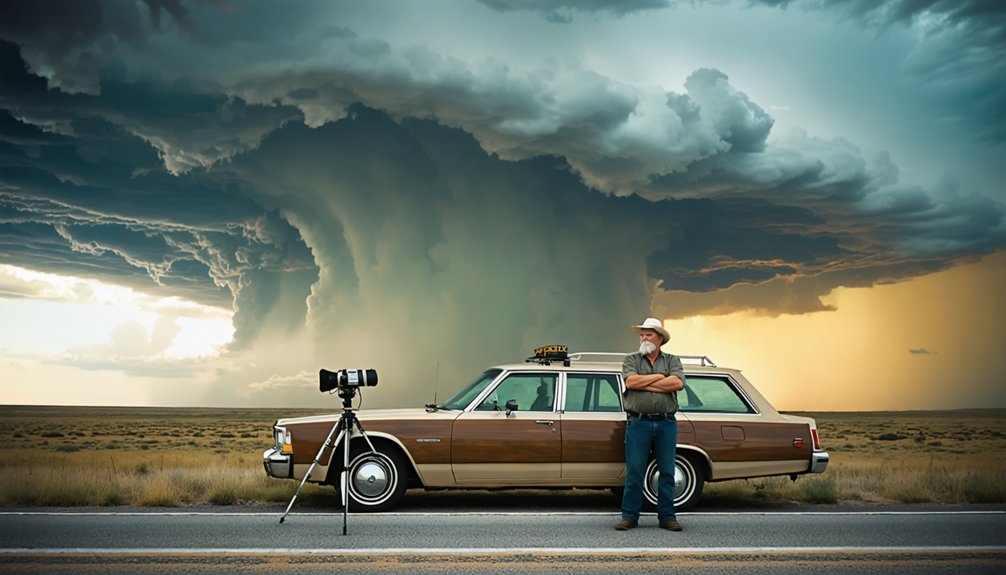
David Hoadley’s early work exemplified this era, using a Chevrolet Bel Air equipped with handwritten notes and AM radio forecasts as his primary data sources.
Vehicle aesthetics carried practical weight here — an unremarkable car attracted no attention, preserving freedom of movement through rural areas without disrupting public perception of what storm research looked like.
These vehicles carried zero armor, zero sensors, and zero built-in instrumentation.
Navigation depended entirely on paper maps, visual observation, and local weather office reports.
The sole requirement was reaching a storm fast.
Simplicity, not sophistication, defined this foundational period of storm chasing.
The First Storm Chasing Vehicles Built for Field Research
When the Alberta Hail Studies launched in 1969, storm chasing crossed a fundamental threshold — vehicles weren’t just transportation anymore. For the first time, you’d see field vehicles carrying actual meteorological instruments and hail-catching apparatus directly into storm regions. That historical context matters: it separated purposeful research from casual observation.
Vehicle design shifted accordingly. A radar-site controller directed these instrumented cars by radio into suspected hail zones, creating a coordinated intercept framework that hadn’t existed before. You weren’t just driving toward a storm — you were executing a data-collection mission.
How Modified Trucks Turned Storm Chasing Into Real Science
How did a fleet of modified trucks and vans transform storm chasing from opportunistic observation into structured science? In the early 1970s, the National Severe Storms Laboratory deployed instrumented trucks and vans capable of capturing in situ wind, precipitation, and storm-structure data.
Unlike aerial reconnaissance, these ground platforms operated within a storm’s direct influence, collecting measurements no aircraft could safely gather. You’re looking at vehicles that functioned as mobile field laboratories rather than simple transport.
Radio gear enabled real-time coordination between field teams and base researchers. That raw data fed directly into climate modeling efforts, giving scientists verifiable ground-truth measurements.
This shift from passive observation to active, instrument-driven data collection gave researchers the freedom to interrogate severe storms on their own terms, producing reproducible, structured scientific results.
GPS, Doppler Radar, and the 1990s Storm Chasing Data Revolution
By the mid-1990s, two technologies had fundamentally restructured what storm chasers could do in the field. Civilian GPS, available after 1996, gave you precise positioning without paper maps or guesswork.
Simultaneously, Doppler radar revealed internal storm rotation and tornado indicators that were previously invisible to ground-based observers.
These tools didn’t operate in isolation. Satellite integration connected field vehicles to real-time atmospheric data streams, while data visualization software transformed raw radar returns into actionable storm structure displays.
You could now interpret a supercell’s behavior while sitting inside your chase vehicle.
Consumer cellular modems extended this capability further, pulling live weather data away from fixed offices.
The Rise of Armored Storm Chasing Vehicles
The data revolution of the 1990s made storm chasers faster and better informed, but it didn’t make them safer. Closing distance with a tornado still meant exposing yourself to debris, pressure drops, and unpredictable motion. That gap drove a new class of vehicle design focused on driver safety over vehicle aesthetics.
In 2003, Sean Casey introduced the Tornado Intercept Vehicle, built on a Ford F-450 chassis with armor plating, bulletproof glass, and hydraulic ground anchors. Its successor, the TIV 2, used a Dodge Ram 3500 platform and weighed approximately 7,500 kg. These weren’t built for looks—they were engineered to survive direct tornado contact while capturing close-range data.
Armored chase vehicles redefined what you could pursue and how close you could responsibly get.
Why Today’s Storm Chasing Vehicles Are Rolling Science Labs
Armored vehicles solved the survival problem, but modern storm chasers pushed further, transforming their rigs into fully integrated mobile laboratories.
Today’s chase vehicles carry Doppler radar units, real-time atmospheric sensors, and high-definition imaging systems simultaneously. The Doppler on Wheels concept proved that you could mount research-grade radar on a truck and deploy it rapidly into a storm’s path.
You’re no longer limited to ground-level observation either. Drone integration lets you launch aerial platforms directly from chase vehicles, capturing storm data from angles no ground sensor can reach.
AI analytics then process that incoming data stream instantly, identifying rotation signatures and pressure anomalies faster than manual interpretation allows.
These vehicles don’t just survive storms — they actively decode them in real time.
What the Next Generation of Storm Chasing Vehicles Could Look Like
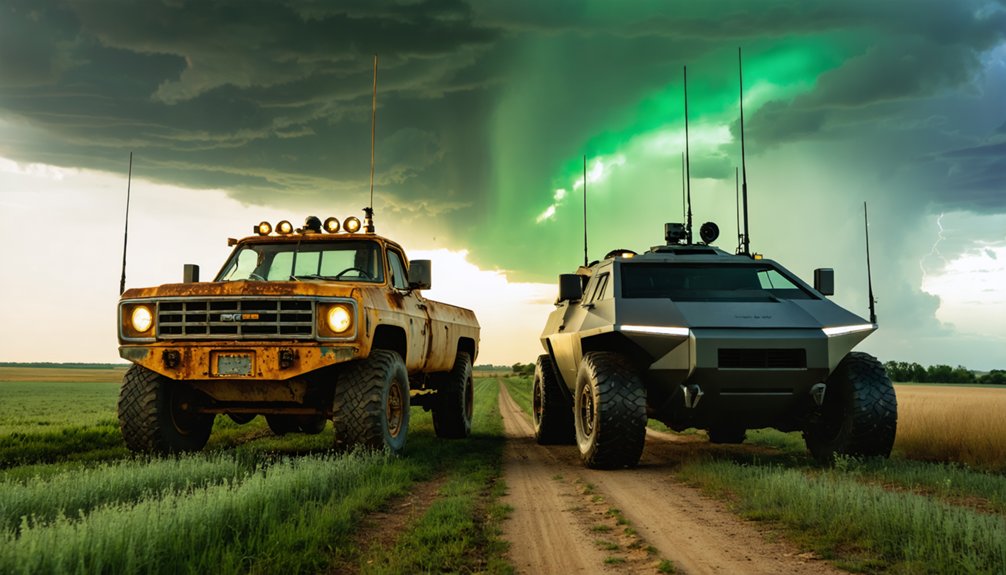
Future chase vehicles will likely integrate autonomous navigation systems capable of repositioning without a human driver, letting researchers focus entirely on data collection during critical intercept windows. AI navigation will process real-time radar feeds, surface observations, and mesoscale model output simultaneously, calculating ideal intercept positions faster than any human crew can manage.
You’ll see platforms deploying autonomous drones directly from vehicle bays, sending instrumented payloads into wall clouds and forward-flank regions without risking personnel. These drones will transmit pressure, wind velocity, and humidity data back to onboard systems within seconds.
Structural designs will likely incorporate lighter composite armor, reducing vehicle mass while maintaining protection thresholds.
Combined with expanded sensor arrays and satellite uplinks, next-generation chase rigs will operate as fully self-sufficient mobile research stations requiring minimal outside infrastructure support.
Frequently Asked Questions
How Much Does It Typically Cost to Build an Armored Storm Chasing Vehicle?
The knowledge doesn’t provide cost data, but you’d invest heavily in vehicle customization and safety equipment. Armored builds like the TIV used Ford F-450 platforms, suggesting six-figure expenses when integrating plating, bulletproof glass, and hydraulic systems.
Are Storm Chasers Required to Hold Any Special Licenses or Certifications?
You don’t need special licenses to chase storms, but you’ll want proper insurance requirements covered for your rig. Vehicle customization choices can affect your policy terms, so verify coverage before heading into the field.
How Do Storm Chasing Teams Coordinate With Emergency Services During Active Tornadoes?
You’re juggling a thousand radio frequencies while tornadoes tear the sky apart! Storm chasing teams coordinate through strict communication protocols, sharing real-time GPS positions and storm safety alerts directly with emergency services via dedicated radio channels.
Have Any Storm Chasing Vehicles Ever Been Completely Destroyed by a Tornado?
Yes, tornado vehicle safety failures have resulted in total losses. You’ve seen storm chaser accidents claim unarmored vehicles caught in violent vortices, where wind speeds exceeding 300 km/h can shred unprotected cars completely, reinforcing why armored intercept vehicles were developed.
How Many Storm Chasers Are Actively Operating in the United States Today?
You’ll find exact numbers are hard to pin down, but estimates suggest hundreds of active storm chasers operate across the U.S., leveraging advanced storm chasing technology and vehicle safety equipment to pursue severe weather independently.
References
- https://www.facebook.com/reedtimmer2.0/posts/here-is-the-evolution-of-my-storm-chasing-vehicle-starting-with-the-og-dominator/417940416355322/
- https://en.wikipedia.org/wiki/Storm_chasing
- https://www.rmets.org/metmatters/history-storm-chasing
- https://www.youtube.com/watch?v=yhF2bsyGsi8
- https://survive-a-storm.com/blog/the-history-of-storm-chasing/
- https://www.youtube.com/watch?v=uRQ-nTTCazo
- https://crazystormchasers.com/how-technology-transformed-storm-chasing/
- https://makezine.com/article/science/storm-chasers-real-twister-tech/
- https://interestingengineering.com/innovation/storm-chaser-dominator-tornado
- https://journals.ametsoc.org/view/journals/wefo/14/4/1520-0434_1999_014_0558_ahossi_2_0_co_2.xml