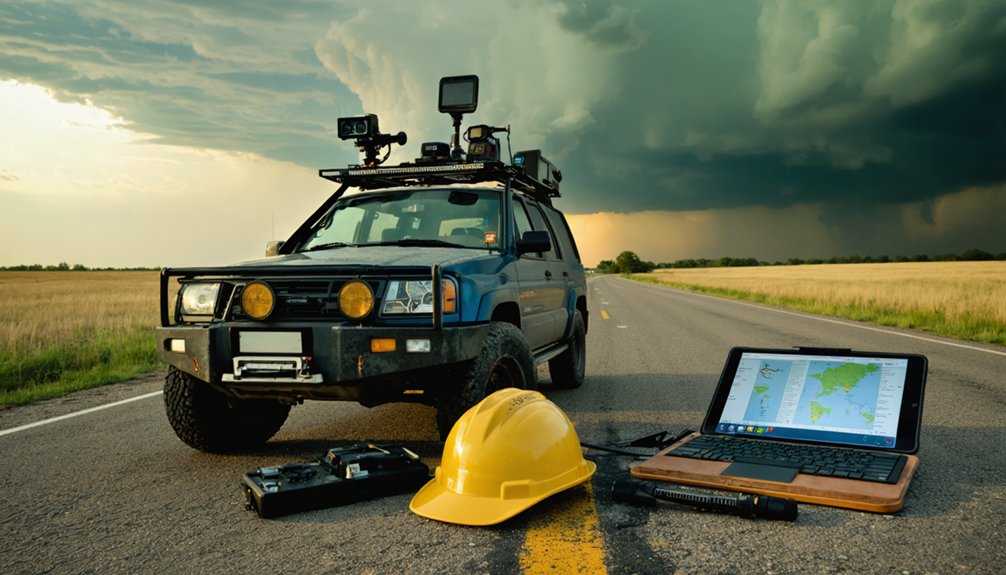
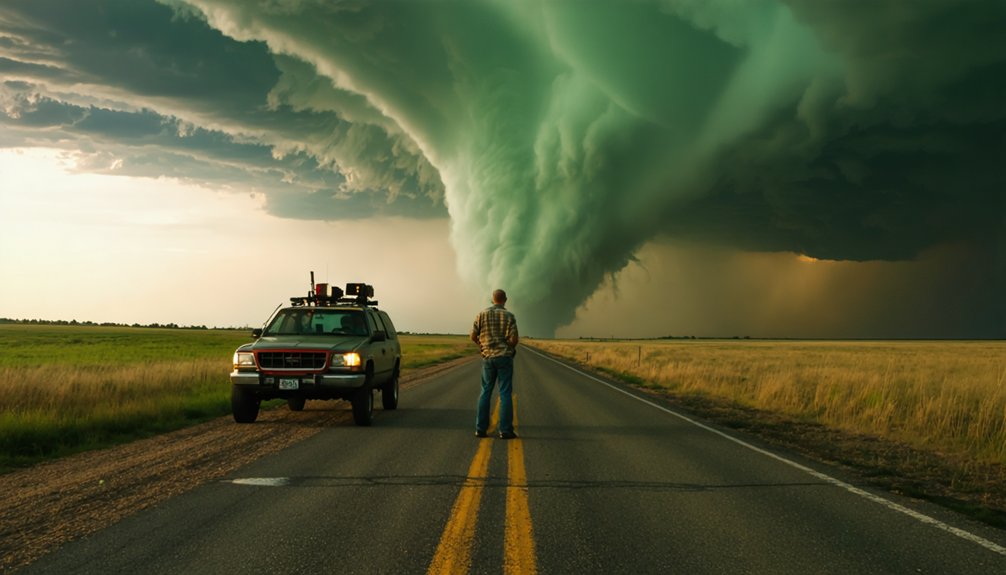
Sean Casey is a film director and storm chaser who built two purpose-engineered vehicles to capture IMAX footage from inside tornado cores. You’re looking at a program that started with a reinforced 1997 Ford F-450 chassis, capable of withstanding EF0 to EF3 winds up to 165 mph, and evolved into the 14,000-pound TIV 2, featuring 2-inch armor and ground-anchoring steel spikes. The full story behind these machines goes much deeper than most people realize.
Key Takeaways
- Sean Casey, a film director and storm chaser, built the TIV to capture IMAX footage from directly inside tornadoes.
- The first TIV was built on a 1997 Ford F-450 chassis, reinforced to withstand EF0–EF3 tornadoes with winds up to 165 mph.
- TIV 2, built in 2007, weighed 14,000 pounds and featured 2-inch armor, steel ground spikes, and dual polycarbonate windows.
- The TIVs were used to produce the IMAX film *Tornado Alley* and were featured prominently in the TV series *Storm Chasers*.
- TIV 1 now sits abandoned on a Kansas farm, while TIV 2 remains fully operational and continues intercepting tornadoes.
Who Is Sean Casey and Why Did He Build the TIV?
Sean Casey isn’t your typical storm chaser — he’s a film director who built the Tornado Intercept Vehicle (TIV) with a singular goal: capturing IMAX-quality footage from inside a tornado. His fascination with weather phenomena drove him to engineer a solution no standard vehicle could provide.
Rather than observing tornadoes from a safe distance, Casey wanted you inside the storm itself — where the real data lives. That vision demanded serious vehicle engineering, resulting in two purpose-built models: TIV 1, based on a 1997 Ford F-Series chassis, and the more advanced TIV 2, completed in 2007.
Casey’s dual expertise in filmmaking and storm pursuit gave him a unique edge, letting him chase atmospheric extremes while simultaneously documenting them with cinematic precision.
How the Tornado Intercept Vehicle Program Got Started
Building the TIV program required Casey to solve a fundamental engineering problem: no existing vehicle could survive direct tornado contact long enough to capture usable IMAX footage. Standard storm-chasing vehicles couldn’t withstand the meteorological phenomena Casey intended to document up close.
His solution started with vehicle engineering centered on a 1997 Ford F-450 chassis. He fitted it with an armored steel shell, hydraulic ground-anchoring claws, and bullet-resistant windows, creating TIV 1.
The platform proved capable of penetrating EF0 to EF3 tornadoes directly.
TIV 1: The Modified Ford F-450 That Started It All
If you trace TIV 1 back to its roots, you’ll find a heavily modified 1997 Ford F-450 truck chassis serving as its foundation.
Sean Casey’s team reinforced it with an armored steel shell, hydraulic ground-anchoring claws, and bullet-resistant windows to withstand violent atmospheric conditions.
The vehicle’s capabilities topped out at EF3-rated tornadoes, meaning you’re looking at a machine engineered to survive winds reaching up to 165 mph.
Modified Ford F-450 Chassis
When Sean Casey set out to build the first Tornado Intercept Vehicle, he didn’t start from scratch—he started with a 1997 Ford F-450 truck chassis and transformed it into one of the most specialized storm-chasing platforms ever constructed.
The F-450’s heavy-duty frame gave Casey a solid foundation to layer on armored steel plating, hydraulic ground claws, and bullet-resistant windows. Every modification prioritized strict safety protocols over aesthetic design, meaning you won’t find unnecessary styling choices here—only purpose-driven engineering.
The hydraulic claws anchor directly into the ground, reducing the risk of the vehicle becoming airborne. These upgrades allowed TIV 1 to safely penetrate EF0 to EF3 tornadoes, giving Casey the freedom to operate inside environments most vehicles—and people—would never survive.
TIV 1 Tornado Capabilities
Though TIV 1 wasn’t built to handle every tornado on the scale, it was engineered to safely operate within EF0 to EF3 storms—a range that still represents wind speeds up to roughly 165 mph. That capability isn’t accidental—it’s the direct result of deliberate design choices prioritizing tornado safety and vehicle durability under extreme atmospheric stress.
You’re looking at a machine built to hold its ground when most vehicles would become projectiles. The armored steel shell deflects debris traveling at lethal velocities, while bullet-resistant windows maintain structural integrity under sustained pressure.
Hydraulic claws anchor the chassis directly to the ground, preventing wind uplift from compromising your position inside the storm. TIV 1 doesn’t just survive these conditions—it’s engineered to operate purposefully within them.
What TIV 1 Could Actually Withstand Inside a Tornado
If you’re wondering what TIV 1 could actually take, it’s rated for EF0 to EF3 tornadoes, meaning it’s not built to survive the most violent storms on the scale.
Its armored steel shell and bullet-resistant windows give you solid protection against debris, but the vehicle’s real defense against being thrown comes from its hydraulic claw system, which anchors directly into the ground beneath it.
You’re fundamentally relying on those claws to keep the truck grounded when a tornado’s rotational winds are working hard to lift it.
TIV 1 Armor Capabilities
The TIV 1’s armor was built to handle EF0 to EF3 tornadoes, meaning it could withstand winds ranging from 65 to 165 mph. Its armored steel shell and bullet-resistant windows gave occupants real protection against debris traveling at lethal speeds.
You’re looking at vehicle engineering designed with precise structural limits — it wasn’t built for EF4 or EF5 storms, and exceeding those boundaries meant certain danger.
For tornado safety, those parameters mattered enormously. The hydraulic claws anchoring the chassis to the ground prevented the vehicle from being lifted or rolled. Every system worked within calculated tolerances.
You’d need to understand that TIV 1 wasn’t invincible — it was purpose-built for a specific threat range, and operating within that range kept the crew alive and functional.
Hydraulic Ground Anchoring System
Anchoring a multi-ton vehicle against tornado-force winds required more than mass alone. TIV 1’s hydraulic claw system deployed directly into the ground, creating a mechanical grip that resisted vertical and lateral forces simultaneously.
You’re looking at engineering that predates modern stabilization methods now common in drone technology and deployable solar panels used in field operations. The claws extended on command, driving into soil to lock the chassis against wind-driven lift.
Without this system, atmospheric pressure differentials inside a tornado’s vortex could shift even a heavily armored vehicle. The hydraulic mechanism gave Casey’s team genuine positional control — something passive weight alone couldn’t guarantee.
Every intercept depended on that system firing correctly, because inside an active tornado, there’s no margin for mechanical failure.
Tornado Rating Limits
Rated for EF0 to EF3 tornadoes, TIV 1 operated within a defined structural ceiling that reflected both material limits and engineering priorities of its era. Its armored steel shell and bullet-resistant windows delivered real tornado safety, but the design deliberately excluded EF4 and EF5 events, where wind speeds exceed 166 mph and debris mass becomes catastrophically unpredictable.
You need to understand that this rating wasn’t a failure—it was an honest engineering boundary. EF3 tornadoes already generate winds up to 165 mph, pushing the vehicle’s structural tolerances to their edge.
Vehicle maintenance directly influenced those tolerances; as TIV 1 aged and maintenance declined, even its rated ceiling became unreliable. That degradation ultimately rendered it non-functional, now sitting idle on a Kansas farm awaiting a restoration that may never come.
TIV 2: Heavier, Stronger, and Built for IMAX
While TIV 1 proved the concept, Casey built TIV 2 in 2007 to push further into violent tornado cores and capture IMAX-quality footage. This machine weighs approximately 14,000 pounds and features 2-inch thick armor, giving you a clear picture of how serious the vehicle engineering became.
Unlike TIV 1, TIV 2 deploys panels that lower directly to the ground, cutting off wind lift beneath the chassis. Two spikes drive 40 inches into the earth, anchoring the vehicle against extreme rotational forces.
Windows consist of two polycarbonate layers, replacing TIV 1’s bullet-resistant glass with a material better suited for tornado safety under debris impact.
Casey completed TIV 2 in time for the 2008 tornado season, ready to film what TIV 1 simply couldn’t survive.
What Makes TIV 2 Nearly Impossible to Flip or Destroy
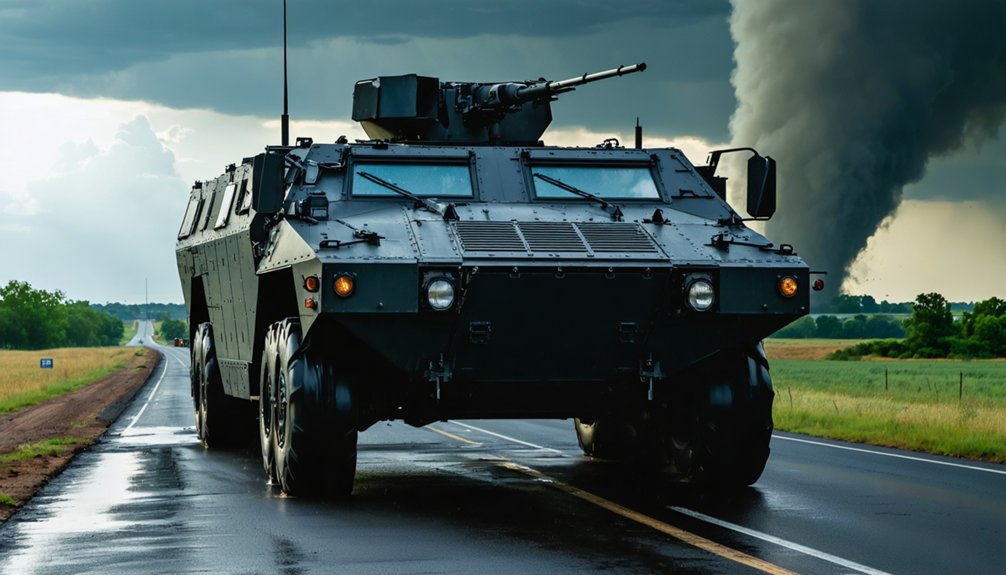
The engineering behind TIV 2’s stability goes beyond raw weight. You’re looking at a system designed to eliminate every vulnerability a tornado exploits.
Two steel spikes drive 40 inches into the ground, anchoring the vehicle against violent updrafts. Simultaneously, panels drop to the earth’s surface, cutting off wind from lifting the chassis. Together, these systems make displacement nearly impossible.
Steel spikes anchor deep while panels seal the chassis — displacement becomes nearly impossible.
The 2-inch armor plating protects occupants from debris traveling at lethal speeds, while dual polycarbonate window layers resist shattering under extreme pressure differentials.
For tornado safety, this redundancy matters. No single failure point compromises the crew.
Vehicle maintenance keeps these mechanical systems operational — hydraulics, spikes, and panels require consistent servicing. You can’t enter a violent EF3 with equipment that hasn’t been rigorously maintained.
The Most Extreme Tornadoes the TIV Has Ever Entered
The TIV’s most notable intercepts include the June 12, 2005 Jayton, Texas tornado, the June 5, 2009 Goshen County, Wyoming encounter, and the May 27, 2013 Kansas intercept—the strongest on record for the vehicle.
You can trace the program’s progression through these three events, each representing escalating intensity and refined tactics.
The 2013 Kansas intercept stands as the benchmark, with TIV 2 successfully filming from inside the tornado itself.
Jayton Texas Tornado Intercept
Among the most significant early milestones for the TIV program, the June 12, 2005 Jayton, Texas intercept marked one of the first real tests of what the TIV 1 could withstand. You can appreciate how this event validated critical vehicle design decisions, particularly the armored steel shell and hydraulic ground anchors that kept the rig stable under direct exposure.
Tornado safety wasn’t theoretical here — it was proven under real conditions. The TIV 1, built on a 1997 Ford F-450 chassis, demonstrated it could handle EF-range winds without structural failure.
This intercept gave the team hard data on what worked, what needed refinement, and how the vehicle performed when atmospheric forces pushed against every design choice Casey had made.
Goshen County Wyoming Encounter
Four years after Jayton, the June 5, 2009 Goshen County, Wyoming intercept pushed the TIV 2 into far more violent atmospheric territory. You’re looking at a moment where vehicle engineering faced its most demanding real-world stress test.
The TIV 2’s 14,000-pound frame, two-inch armor, and 40-inch ground spikes weren’t theoretical specifications anymore—they were actively resisting the rotational forces of a markedly stronger storm system.
Meteorological innovations captured during this intercept delivered data that laboratory environments simply can’t replicate. The dual polycarbonate window layers held, the ground panels performed their lift-blocking function, and the spikes anchored the vehicle against lateral displacement.
Goshen County proved that Casey’s engineering philosophy—build it heavy, anchor it deep, armor it completely—wasn’t overengineering. It was exactly right.
Kansas 2013 Strongest Intercept
May 27, 2013 marked the TIV 2‘s most extreme operational test when Casey’s team intercepted a Kansas tornado that exceeded everything Goshen County had delivered. You’re looking at a moment where vehicle engineering and meteorological innovations converged under maximum stress conditions.
The Kansas tornado pushed the TIV 2 beyond any previously recorded intercept threshold. Casey’s team drove directly inside the vortex, capturing footage that Goshen County couldn’t produce.
The 14,000-pound vehicle’s two-inch armor, dual ground spikes, and polycarbonate-layered windows faced wind loads and debris impacts far surpassing earlier encounters.
This intercept validated every structural decision Casey’s engineers had built into the TIV 2. The data collected inside that Kansas vortex represented the most operationally significant payload the vehicle had ever returned from an active tornado.
How the TIV Went From Field Tool to IMAX Star
What started as a field tool for storm interception evolved into a platform for cinematic history. Sean Casey didn’t just engineer the TIV for tornado safety — he built it to capture footage no camera crew had ever shot before.
The TIV 2’s vehicle engineering made that possible, with 2-inch armor, polycarbonate-layered windows, and ground-anchoring spikes delivering both crew protection and stable filming conditions inside rotating winds.
Casey used this platform to produce the IMAX film *Tornado Alley*, bringing raw intercept footage to audiences worldwide. The Discovery Channel’s *Storm Chasers* series, airing from 2007 onward, expanded the TIV’s reach further.
You’re looking at a machine that crossed the line between scientific instrument and cinematic tool — and did both without compromising either.
Where Is TIV 1 Now?
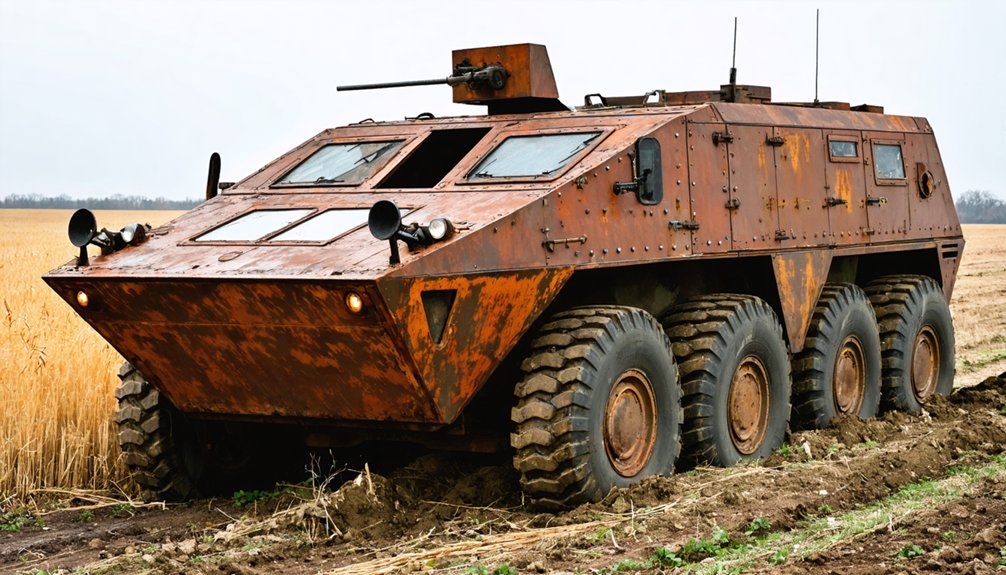
While TIV 2 remains operational, TIV 1 hasn’t fared as well. This pioneering piece of meteorological equipment now sits abandoned on a Kansas farm, sidelined by years of neglect. Here’s where things stand:
- Functionality: TIV 1 is no longer operational, making it useless for tornado safety or active intercepts.
- Location: It’s been sitting on a Kansas farm for several years, deteriorating without maintenance.
- Ownership: A new owner now holds the vehicle, driven by dreams of full restoration.
You might find it disheartening that such a groundbreaking machine has fallen into disrepair. TIV 1 redefined what tornado safety equipment could accomplish, pushing into EF3-rated storms before anyone else dared. Its potential restoration could return a true legend to working condition.
TIV 2 Today: Still Chasing, Still Evolving
Unlike its abandoned predecessor, TIV 2 remains fully operational and continues active tornado intercept missions under the Storm of Passion team, affectionately nicknamed “The Dog House.”
While its predecessor sits abandoned, TIV 2 keeps chasing — still active, still intercepting, still earning its nickname.
You’ll find this 14,000-pound armored platform still pushing its twin 40-inch ground spikes into the earth while its 2-inch thick armor and dual-layer polycarbonate windows keep occupants protected during direct intercepts.
The team continues advancing tornado safety protocols, using TIV 2’s hardened platform to refine intercept techniques that protect both crew and equipment.
Its aerial photography capabilities capture critical storm data from positions no standard chase vehicle could survive, contributing directly to atmospheric research.
You’re looking at a machine that’s still evolving — purpose-built, battle-tested, and actively pushing the boundaries of what structured tornado intercept operations can achieve.
Frequently Asked Questions
How Much Did It Cost to Build the TIV 2?
“Knowledge is power” — but the exact cost of TIV 2’s vehicle engineering isn’t documented in available data. You’ll find its storm safety specs impressive though: 14,000 pounds, 2-inch armor, and dual ground-penetrating spikes.
How Many People Can Fit Inside the TIV 2?
The knowledge doesn’t specify how many people fit inside the TIV 2. What’s confirmed is that its storm safety features, including 2-inch armor and vehicle modifications like ground-sealing panels, protect whoever’s inside during extreme tornado intercepts.
Has Anyone Ever Been Injured While Riding Inside the TIV?
The knowledge doesn’t confirm any injuries inside the TIV. Its safety concerns focus on injury prevention through 2-inch armor, dual polycarbonate windows, and ground-anchoring spikes—features you’d rely on when intercepting tornadoes up to EF3 intensity.
How Fast Can the TIV 2 Travel on Open Roads?
Like a beast chained by its own weight, the TIV 2’s vehicle specifications don’t include confirmed top speed data. You won’t find that figure in available storm chasing records — it remains undisclosed.
Did Sean Casey Have a Storm Chasing Background Before Building TIV?
Sean Casey wasn’t a storm chasing veteran — he’s a film director. You’ll find his background centered on vehicle engineering and cinematography, not meteorology, yet he built one of history’s most technically advanced tornado intercept platforms.
References
- https://en.wikipedia.org/wiki/Tornado_Intercept_Vehicle
- https://en.wikipedia.org/wiki/Sean_Casey_(filmmaker)
- https://www.youtube.com/watch?v=AXR30pT2rwk
- https://www.youtube.com/watch?v=eIXCXviKvh0
- https://www.youtube.com/watch?v=KgMOXD0wrbY
- https://www.youtube.com/watch?v=FiVSfktzVWQ
- https://stormchasers.fandom.com/wiki/Tornado_Intercept_Vehicle
- https://www.youtube.com/watch?v=nNcOVYmhym4
- https://www.youtube.com/watch?v=miCJEj-UE5Y
- https://livestormchasers.com/tiv1/