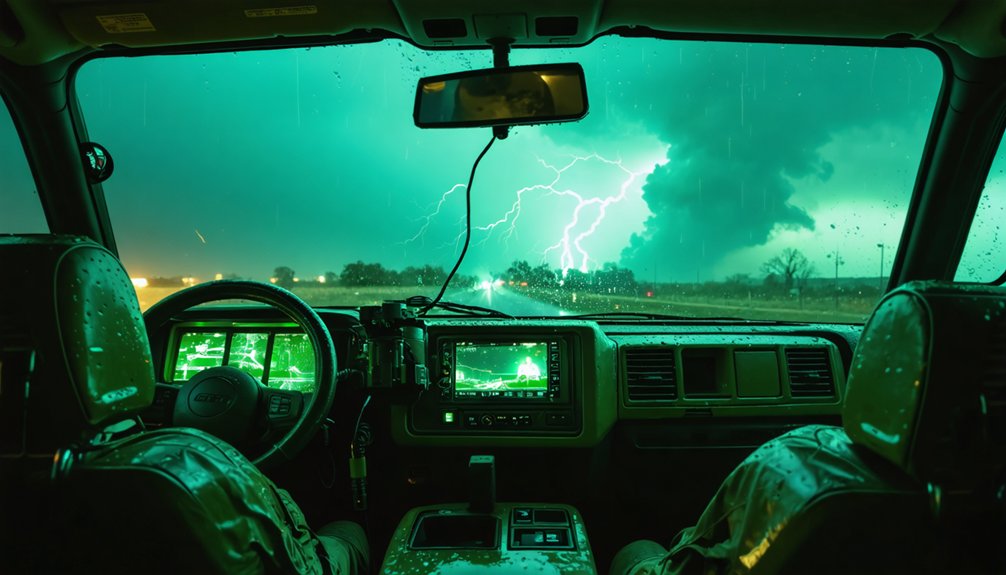
For night-time storm chasing, you’ll need gear across five critical categories: a capable AWD vehicle with redundant power systems, high-resolution mobile radar tools for real-time situational awareness, reliable navigation apps with offline capability, low-light camera equipment with manual exposure control, and layered weather-resistant apparel. A dual-band ham radio and cellular signal booster round out your safety stack. Each category contains specific upgrades that can dramatically sharpen your operational edge in the field.
Key Takeaways
- An AWD SUV with upgraded deep-cycle battery, signal booster, and quality inverter ensures reliable power and mobility during night storm chasing.
- The Nikon D750 with Tamron 15-30mm f/2.8 lens, set to f/2.8 and ISO 1600-3200, excels in low-light storm photography.
- A Pluto Trigger paired with a Manfrotto XPRO Ball Head tripod enables autonomous, vibration-free lightning capture during nighttime pursuits.
- Dual-band ham radios, mobile high-resolution radar platforms, and dedicated hotspots from multiple carriers maintain critical communication and situational awareness.
- Strategic layering with moisture-resistant apparel, a wind jacket, and polarized sunglasses protects chasers from cold temperatures and lightning glare.
The Best Vehicles for Night-Time Storm Chasing
Choosing the right vehicle for night-time storm chasing comes down to 3 core requirements: power, traction, and reliability. Sedan advantages include fuel economy and agility for solo pursuit, but SUV features like all-wheel-drive and ground clearance give you a decisive edge on compromised rural roads.
Power, traction, and reliability define your storm-chasing vehicle—choose wisely between sedan agility and SUV dominance on rural roads.
You’ll want to match tire types to terrain, prioritizing wet-weather traction compounds over standard all-seasons.
Equip your rig with signal boosters to maintain cellular connectivity when radar maps and backup navigation become critical. Battery importance escalates at night, since you’re powering communication tools, lighting solutions, and photography essentials simultaneously.
Assess your budget categories honestly before committing to gear upgrades—every component must justify its weight and cost against real-world, data-driven performance demands.
High-Resolution Radar and Night Vision Tools for Safer Chasing
Once your vehicle’s power and connectivity infrastructure is locked in, your next performance gap to close is situational awareness—specifically, what high-resolution radar and night vision tools add to your decision-making loop after dark.
Mobile high-resolution radar dramatically improves radar accuracy, delivering real-time storm structure data that static broadcasts can’t match. You’re reading cell rotation, precipitation intensity, and debris signatures with precision that keeps your exit routes calculated rather than guessed.
Night vision capability compounds this advantage by revealing terrain features, road conditions, and storm positioning that darkness otherwise conceals. Together, these tools shift your night chasing posture from reactive to anticipatory.
You’re not waiting for lightning illumination to confirm your surroundings—you’re operating with a continuous, layered picture that protects both your safety and your freedom of movement.
When you’re chasing storms after dark, your navigation toolkit must go beyond standard GPS apps to include platforms that integrate live radar overlays with road routing.
Tools like Pivotal Weather and the College of DuPage Model Viewer give you critical meteorological data—storm trajectories, road accessibility, and atmospheric parameters—that keep you positioned safely ahead of a moving target.
You’ll also want dedicated radar apps running simultaneously on a hotspot-connected laptop, ensuring you’re pulling high-resolution data even when rural cellular signals degrade.
Essential Night Navigation Apps
Steering at night during an active storm chase demands apps that deliver real-time, high-resolution data without lag or interface clutter.
You’ll rely on Pivotal Weather for precise model guidance and the College of DuPage Model Viewer for road availability assessments, both offering superior app comparisons against standard consumer tools.
For navigation safety, integrate offline maps so cellular dead zones don’t strand you on unfamiliar rural roads. Weather alerts from the Storm Prediction Center’s mesoscale analysis keep you ahead of rapidly shifting parameters.
Paper maps remain essential alternative tools when digital systems fail. Cross-referencing local resources, including county road databases, sharpens repositioning decisions.
User experiences consistently confirm that layering radar apps over mapping platforms creates seamless app integrations, giving you the situational freedom needed to chase confidently after dark.
Radar Tools For Darkness
Radar tools sharpen your night chase beyond what navigation apps alone provide. Mobile high-resolution radar transforms nighttime visibility, letting you track storm cells with precision most standard apps can’t match. You’re operating in darkness, so radar accuracy becomes non-negotiable—a misread cell position could put you directly in a dangerous path.
Integrate your radar platform with real-time mesoscale analysis from the Storm Prediction Center to cross-reference atmospheric parameters against what your display shows.
Layer velocity data alongside reflectivity to distinguish rotation from rain cores. You’ll want dual-polarization products, which reveal precipitation type and storm structure depth that standard single-pol feeds miss entirely.
This layered approach gives you actionable intelligence rather than guesswork, keeping your positioning decisions grounded in hard meteorological data rather than assumption.
Camera Gear Built for Low-Light Storm Photography
Capturing storms after dark demands three core pieces of camera equipment that balance light-gathering capability with operational flexibility.
Your Nikon D750 paired with the 24-70mm f/2.8 ED lens delivers consistent low light techniques, letting you push ISO values while retaining structural detail in supercell formations. Dial your camera settings toward manual mode, targeting f/2.8, ISO 1600-3200, and exposures between 10-30 seconds for lightning integration.
Switch to the Tamron 15-30mm f/2.8 Di VC USD when documenting full storm structure—its wider field captures rotating wall clouds without sacrificing aperture performance.
Mount both systems on your Manfrotto XPRO Ball Head tripod to eliminate vibration during extended exposures. Deploy your Pluto Trigger for autonomous lightning capture, freeing you to monitor storm position simultaneously.
How to Capture Lightning During a Night Storm Chase
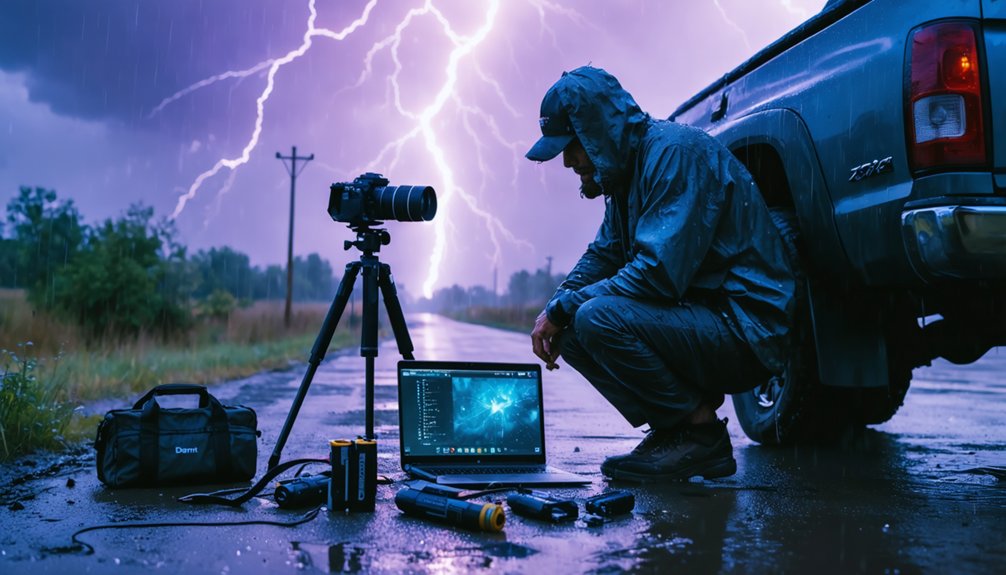
Lightning photography at night hinges on two complementary methods: long-exposure ambient capture and trigger-assisted autonomous shooting.
For long exposures, you’ll set your Nikon D750 to ISO 400–800, aperture f/5.6–f/8, and shutter speeds between 10–30 seconds, letting ambient darkness work for you. Mount your camera on the Manfrotto XPRO Ball Head for rock-solid stability during extended exposures.
For trigger-assisted storm photography, deploy the Pluto Trigger in lightning-detection mode. It monitors light differentials and fires your shutter autonomously within milliseconds of a strike—eliminating human reaction lag entirely. Pair it with your Tamron 15-30mm f/2.8 to maximize structural context around each bolt.
The Pluto Trigger fires your shutter within milliseconds of a strike—eliminating human reaction lag entirely.
Both lightning techniques demand pre-focused lenses, since autofocus fails in darkness. Manually focus to infinity, verify sharpness on distant lights, then lock your settings before the action begins.
Power Solutions for All-Night Storm Chasing Sessions
All-night storm chasing drains power reserves faster than most chasers anticipate—your Nikon D750, Pluto Trigger, laptop, ham radio, and cellular data booster running simultaneously can pull several amps continuously through your vehicle’s electrical system.
Smart power management starts with an upgraded automotive battery rated for deep-cycle demands. Run a power strip with a surge protector through a quality inverter, giving you simultaneous charging capability at every hotel stop.
Carry spare battery packs for cameras and accessories, eliminating mid-chase interruptions. Dedicated Verizon and AT&T hotspots require consistent laptop power, so you can’t afford battery efficiency failures during critical targeting decisions.
A headlamp preserves night vision while conserving your vehicle’s interior lighting draw. Audit your total amperage load before departure—staying independent from unreliable power sources keeps you mobile and fully operational throughout the chase.
Ham Radios and Safety Tools for Night Storm Chasers
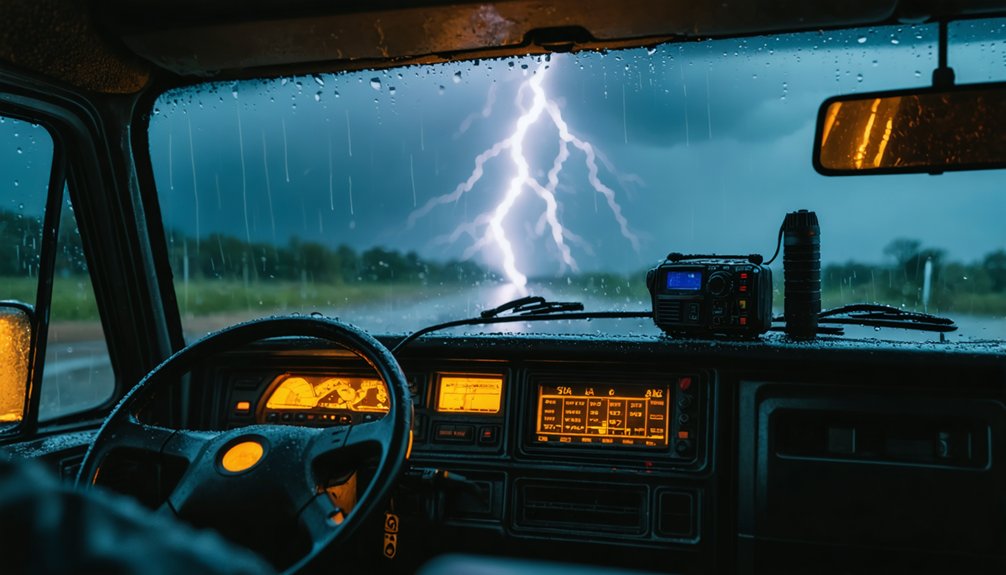
When darkness eliminates visual reference points, communication and real-time hazard awareness become your primary safety infrastructure. Your handheld dual-band ham radio delivers both offensive and defensive capability—it’s your conduit to SKYWARN nets and NOAA weather radio broadcasts simultaneously.
These ham radio essentials aren’t optional redundancy; they’re operational necessities when cellular networks saturate during severe weather events.
Pair your radio with a high-resolution mobile radar platform, which dramatically improves night chasing safety by identifying hook echoes, rotation signatures, and debris indicators before you’re visually exposed to them.
Your thermometer and sling psychrometer quantify boundary layer conditions, giving you data-driven positioning decisions rather than guesses.
Effective safety communication demands discipline—monitor designated frequencies consistently, transmit position updates regularly, and treat your radio protocol as rigorously as your camera protocol.
What to Wear for Cold, Wet Night-Time Chases
Protecting your communication and positioning assets means nothing if exposure shuts you down mid-chase. Cold weather gear starts with a lightweight wind jacket that blocks dropping overnight temperatures without restricting movement.
Prioritize moisture resistant apparel — wet fabric accelerates heat loss, degrading your decision-making speed precisely when storm dynamics demand sharpest focus.
Wet gear isn’t just uncomfortable — it’s a liability that slows your thinking when storms demand everything you have.
Layer strategically. A base layer manages perspiration, a mid-layer retains core heat, and your outer shell deflects wind-driven rain. Jacket pockets should secure small electronics like your phone, keeping them accessible without fumbling.
Add polarized sunglasses to cut glare from lightning-illuminated cloud structures.
Variable conditions define night chasing. Temperatures shift rapidly as storm boundaries pass. Build your kit for a 20-degree swing — you’ll stay operational when others retreat.
Night Storm Chasing Gear by Budget: Entry-Level to Pro
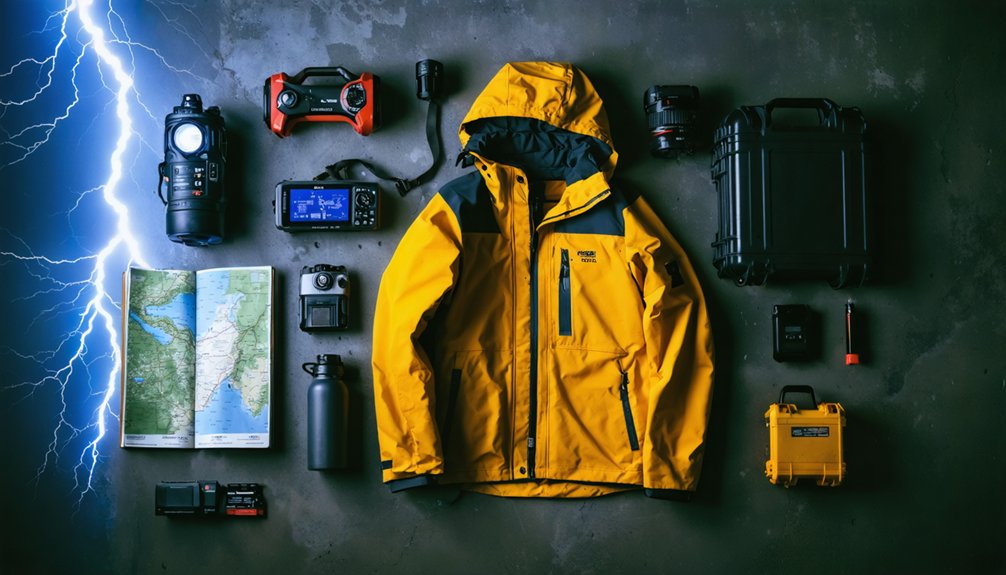
Whether you’re just starting out or running a fully equipped chase vehicle, your budget shapes every gear decision you make.
At the entry level, you’ll prioritize a reliable headlamp, a smartphone with a radar app, and a basic camera capable of manual exposure settings for lightning capture.
As you scale toward pro-level operations, you’ll add dedicated lightning triggers like the Pluto Trigger, a dual-band ham radio for SKYWARN reporting, and a cellular data booster to maintain radar coverage in rural chase corridors.
Entry-Level Night Chasing Essentials
Night chasing on a budget doesn’t mean compromising your core operational capability—it means prioritizing gear that delivers the highest functional return per dollar spent.
Your entry level gear should center on three non-negotiables: reliable navigation, real-time radar access, and basic safety equipment. A smartphone running RadarScope, paired with a cellular data booster, gives you actionable situational awareness without significant capital outlay.
Add a headlamp for hands-free visibility during roadside repositioning, and a handheld ham radio for SKYWARN reporting and NOAA broadcasts. Paper maps eliminate navigation failure risk when data connectivity drops.
A lightweight wind jacket handles overnight temperature shifts effectively. These foundational investments establish operational discipline before you scale into advanced equipment categories, ensuring your initial field deployments remain both productive and defensibly safe.
Pro-Level Gear Upgrades
Once your foundational kit is field-tested and your operational habits are locked in, pro-level upgrades shift your capability from reactive to anticipatory.
Advanced gear like the Nikon D750 paired with a Tamron 15-30mm f/2.8 Di VC USD delivers uncompromised wide-angle storm structure documentation in low-light conditions. Add a Pluto Trigger for precision lightning capture, eliminating guesswork from your workflow.
Tech innovations extend beyond optics. A cellular data booster sustains signal integrity in rural dead zones, keeping your radar feeds uninterrupted.
A Manfrotto XPRO Ball Head tripod locks compositions during high-wind events without drift. Dual dedicated hotspots—Verizon and AT&T—ensure redundant connectivity when one network saturates.
Mobile high-resolution radar transforms your night-chasing decisions from instinct-based to data-confirmed, giving you measurable operational autonomy when conditions deteriorate fast.
The Complete Night Storm Chasing Kit Checklist
Assembling a complete night storm chasing kit means organizing gear across six critical categories: vehicle and power systems, navigation tools, photography equipment, lighting and charging solutions, protective apparel, and communication and safety devices.
These storm chasing essentials guarantee you’re operationally ready when conditions develop after dark. Prioritize nighttime visibility tools, including headlamps and high-resolution mobile radar, to maintain situational awareness.
- Vehicle & Navigation: Run an AWD SUV with a cellular booster, Pivotal Weather access, and paper map backups.
- Photography & Power: Pack your Nikon D750, Pluto Trigger, extra batteries, and a surge-protected power strip.
- Safety & Communication: Carry your dual-band ham radio, sling psychrometer, and layered wind-resistant apparel.
Cross-check each category before every chase deployment.
Frequently Asked Questions
How Do Storm Chasers Stay Alert During Long Overnight Chasing Sessions?
You’ll maintain alertness strategies by scheduling rest breaks, monitoring caffeine consumption carefully, and deploying technology tools like high-resolution radar apps. Safety measures include sharing your location and using dual-band ham radios to stay connected throughout demanding overnight sessions.
Are There Legal Permits Required for Night-Time Storm Chasing in Certain States?
Like a free bird, you’re largely unshackled—storm chasing regulations don’t typically require permit requirements in most states. However, you’ll want to actively research local jurisdictions, as some areas enforce specific road access restrictions.
How Do Chasers Coordinate Meetups With Other Teams During Nighttime Pursuits?
You’ll coordinate nighttime meetups using ham radio’s dual-band communication tools, sharing GPS coordinates and radar data. Team strategies rely on real-time mesoscale analysis, cellular boosters, and dedicated hotspots, ensuring you’re synchronized with other chasers efficiently.
What Insurance Coverage Do Professional Night Storm Chasers Typically Carry?
Like armor in a battlefield, you’ll need robust coverage types: commercial auto, liability, and equipment insurance. Risk assessment drives your policy choices, ensuring you’re protected without sacrificing the freedom to chase.
How Do Night Chasers Manage Fatigue While Simultaneously Monitoring Weather Data?
You’ll combat fatigue management by rotating co-pilots, scheduling strategic rest stops, and using caffeine deliberately. For weather monitoring, you’re leveraging mobile high-resolution radar and cellular data boosters, ensuring real-time data flows without overwhelming your cognitive bandwidth during night pursuits.
References
- https://www.stormtours.com/information/must-bring-items/
- https://willardsharpphotography.com/2019/03/my-storm-chasing-photography-gear/
- https://www.youtube.com/watch?v=Sr2lz72ZYwM
- https://www.youtube.com/watch?v=3GlPEfCqqL0
- https://www.benholcomb.com/storm-chasing/equipment/
- https://www.stormchase.us/Articles/gear.html
- https://www.youtube.com/watch?v=IUIhoR0HRGM
- https://stormtrack.org/threads/night-storm-chasing-techniques.17618/