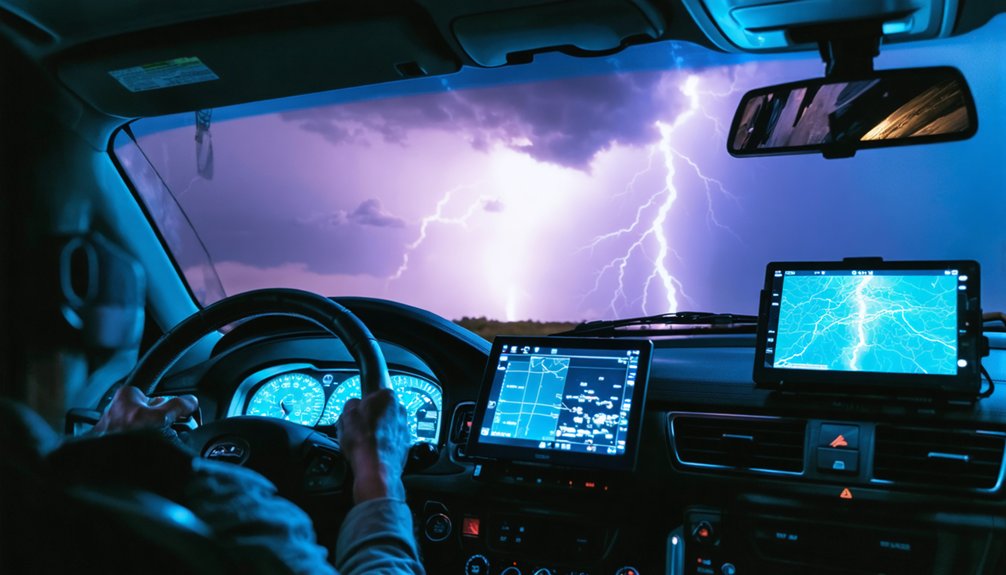
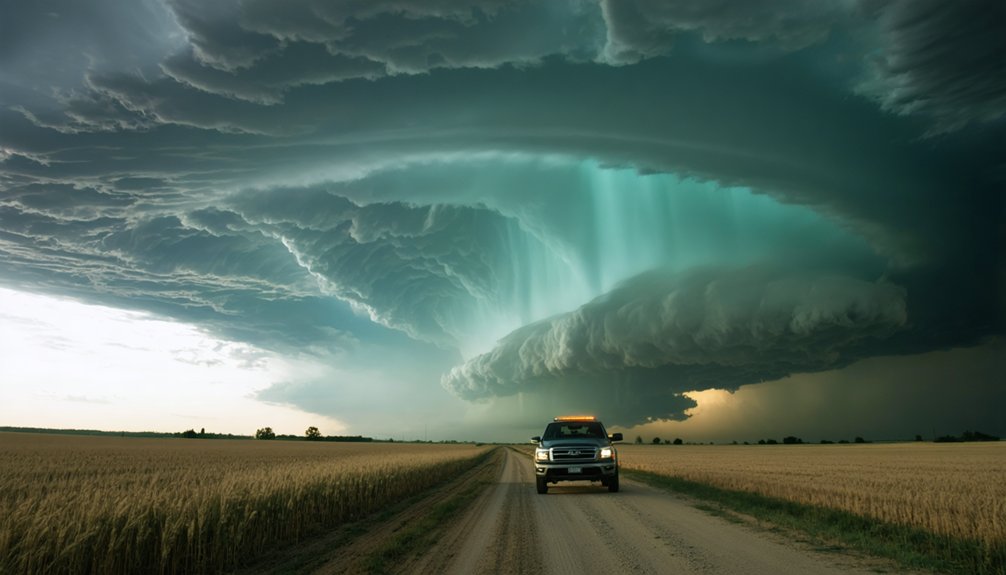
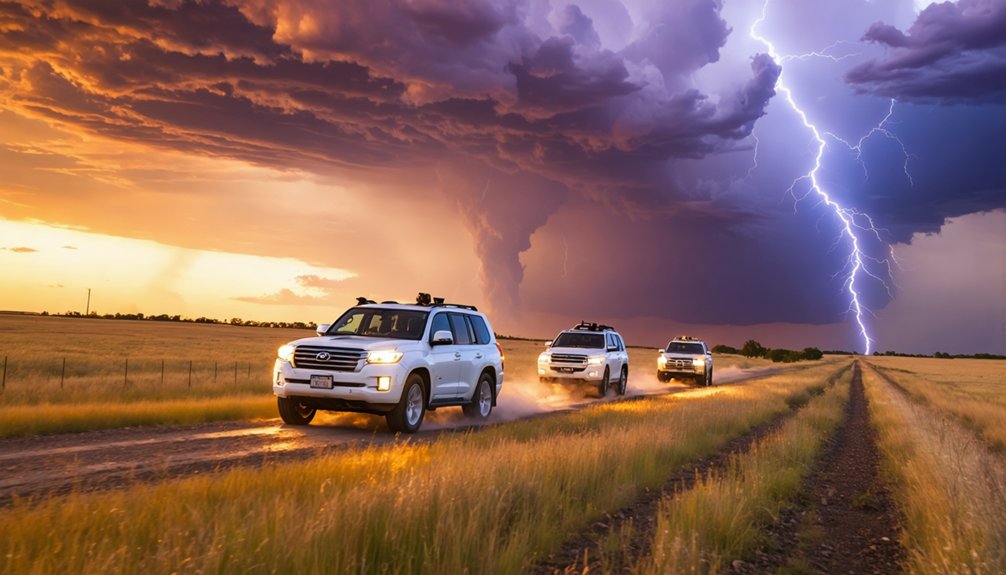
2025 handed you one of the most violent storm seasons on record. You saw a 12-hour supercell travel 580 miles, a mile-wide EF3 tear through St. Louis, and a deadly EF4 carve through Kentucky on May 16 alone—the year’s deadliest single tornado. Hail topped 3.50″ in Austin, and Wichita logged 81,000 damaged structures. Brandon Copic earned FOX Weather’s Storm Chaser of the Year honors. Every record broken this season tells a much bigger story.
Key Takeaways
- The May 16, 2025 outbreak was the deadliest tornado event of the year, producing 26 fatalities and four deadly tornadoes across multiple states.
- A violent EF4 tornado in Kentucky became the deadliest single tornado of 2025, part of a 12-hour, 580-mile supercell.
- Brandon Copic was named FOX Weather’s 2025 Storm Chaser of the Year, logging nearly two hours of close-range tornado footage.
- Teams recorded over 30 tornado intercepts, with dangerous close calls documented in Nebraska, South Dakota, Arkansas, and North Dakota.
- Record hailstorms struck Austin, DFW, Lubbock, and Wichita in 2025, making it a benchmark year for hail damage.
The Deadliest Tornado Outbreak of 2025
The May 16, 2025 outbreak stands as the deadliest tornado event of the year, producing four deadly tornadoes that killed 26 people across multiple states.
Four deadly tornadoes. Twenty-six lives lost. The May 16, 2025 outbreak became the year’s deadliest tornado event.
You’re looking at outbreak impacts that included a mile-wide EF3 striking St. Louis, Missouri, a second EF3 intercepted in southern Missouri, and a violent long-tracking EF4 in Kentucky — the deadliest single tornado of 2025.
One supercell alone lasted 12 hours, traveled 580 miles, and produced two of those deadly tornadoes.
That’s an extraordinary meteorological event by any measure. The scale and concentration of destruction across this single outbreak underscore how quickly organized severe weather can overwhelm communities.
Understanding the mechanics behind these systems gives you a clearer picture of what made 2025 such a violent and consequential chase season.
Where 2025’s Most Destructive Storms Actually Hit
Knowing where these storms hit matters as much as knowing how powerful they were. The geographic patterns across 2025 reveal clear storm hotspots you should track:
- Southern Plains – Texas dominated with deadly tornadoes near Matador, Silverton, and Briggs, plus catastrophic flooding in central Texas.
- Central Midwest – Missouri took a direct hit from a mile-wide EF3, while Kentucky suffered the deadliest single tornado of 2025.
- Northern Plains – Nebraska, South Dakota, and North Dakota produced violent wedge tornadoes near Wellfleet, Gary, and Spiritwood.
- Hail Corridors – Austin, DFW, and Lubbock absorbed repeated 5-star hailstorms, with Wichita closing out September with 81,000 damaged structures.
These aren’t random clusters — they’re predictable corridors where preparation and positioning determine whether you document history or become part of it.
The Most Extreme Tornado Intercepts Caught on Camera
Capturing a tornado on camera is one thing — intercepting one at close range with live footage is another entirely.
In 2025, you’re watching tornado footage analysis reach new technical standards, with violent wedge tornadoes documented in Arkansas, Nebraska, South Dakota, and North Dakota. Locations like Wellfleet, NE, Gary, SD, and Spiritwood, ND delivered extraordinary close-range intercepts.
The season also produced extreme near-misses across Tornado Alley, pushing chase safety tips to the forefront of every debrief.
Brandon Copic’s compiled footage — nearly two hours of unseen material — captured massive tornadoes, giant hail, and high-risk moments with precision.
The 2025 season confirmed that disciplined positioning, real-time data, and strict safety protocols separate survivable intercepts from catastrophic outcomes. You don’t get a second chance at those margins.
Record-Breaking Hailstorms That Defined the 2025 Season
While violent tornadoes dominated the intercept logs, hailstorms carved their own destructive record across the 2025 season.
Four events stood out as defining hailstorm impacts you couldn’t ignore:
- May 28 – Austin, TX: 3–3.50″ hail buried streets in drifts during a 5-star event.
- June 1 – DFW Metroplex: 3.25″ hail delivered widespread hail damage across tens of thousands of vehicles, homes, and properties.
- June 5 – Lubbock, TX: Severe hail clogged streets during an early-June outbreak.
- September 3 – Wichita, KS: Two back-to-back 5-star storms dropped 2.50″ hail, damaging 81,000 structures in a single day.
Texas and Kansas absorbed the heaviest punishment, confirming 2025 as a benchmark year for large-hail production across the central Plains.
The Storm Chasers Who Captured 2025’s Most Violent Weather
Behind every devastating tornado and record hailstone in 2025 stood storm chasers who put themselves directly in harm’s way to document it all.
Brandon Copic earned FOX Weather’s 2025 Storm Chaser of the Year, executing precise storm chaser strategies that positioned him within striking distance of wedge tornadoes across Arkansas and violent supercells spanning Texas to the Northern Plains.
You’d see his extreme weather preparedness reflected in nearly two hours of compiled footage capturing massive hail, close tornado intercepts, and catastrophic Central Texas flooding.
Teams logged 30-plus tornado intercepts, including dangerous close calls in Tornado Alley and a single supercell tracked across 580 miles over 12 hours.
These chasers didn’t chase recklessly — they combined disciplined positioning, real-time data analysis, and calculated risk to deliver unprecedented documentation of 2025’s most violent weather.
The Records 2025 Officially Broke Across Tornado and Hail Season
When the final tallies came in, 2025 didn’t just produce dangerous weather — it shattered benchmarks across multiple categories simultaneously.
You can track the tornado statistics and hail damage numbers yourself:
- 26 fatalities from a single May 16 outbreak involving four deadly tornadoes across multiple states.
- 580 miles traveled by one supercell over 12 hours, producing two confirmed deadly tornadoes.
- 81,000 structures damaged in Wichita, Kansas from two 5-star hailstorms on a single September day.
- Three consecutive 5-star hail events struck Texas between May 28 and June 5, burying streets and destroying tens of thousands of vehicles.
These weren’t isolated anomalies.
They represented a concentrated, multi-front assault on records that forecasters and chasers hadn’t seen compressed into one season before.
Frequently Asked Questions
How Do Storm Chasers Stay Safe During Extreme Close-Call Tornado Intercepts?
You stay safe through constant risk assessment and strict safety protocols—monitor storm data, maintain escape routes, know your exit timing, and you’ll avoid getting trapped as conditions rapidly shift during extreme close-call tornado intercepts.
What Equipment Do Professional Storm Chasers Use to Document Violent Tornadoes?
With 30+ tornadoes chased in 2025, you’ll rely on high-resolution camera technology, mobile Doppler radar, and GPS for precise data collection. You’re mounting cameras on armored vehicles to document violent tornadoes safely and accurately.
How Are Tornadoes Officially Rated on the Enhanced Fujita Scale?
You’ll find that tornado formation’s aftermath drives official EF Scale ratings through damage assessment — meteorologists survey destroyed structures, analyzing 28 damage indicators across EF0-EF5 categories, with wind speeds ranging from 65 mph to exceeding 200 mph.
What Training Is Required to Become a Professional Storm Chaser?
Like forging steel under pressure, you’ll need a meteorology degree, hands-on storm prediction fieldwork, and mastery of weather patterns. Certifications in severe weather spotting sharpen your edge, while real-world chasing experience transforms knowledge into professional-grade skill.
How Does Storm Chasing Data Help Improve Severe Weather Forecasting Accuracy?
When you chase storms, you’re collecting real-time storm patterns and data analysis that sharpen forecasting models. Your ground-truth observations validate radar readings, refine atmospheric measurements, and directly improve the accuracy of severe weather predictions that protect lives.
References
- https://www.youtube.com/watch?v=jhSwacvz_jk
- https://www.youtube.com/watch?v=YySTBxbRNOE
- https://blog.hailtrace.com/2025s-most-shocking-weather-moments/
- https://www.youtube.com/watch?v=N4ds5v9HB2Q
- https://www.youtube.com/watch?v=FEKEuHdYYNI
- https://www.youtube.com/watch?v=MoYoxri27wY