Storm chasing vehicle safety features span five critical categories you’ll need to understand. Your vehicle should include reinforced steel plating, crumple zones, and roll cages for structural impact absorption. High-traction tires and all-wheel-drive systems keep you stable on compromised surfaces. You’ll also need reliable power management for electronics, water-repellent visibility tools, and redundant navigation systems. Emergency protocols like five-point harnesses and satellite communicators complete your safety profile—and each category runs far deeper than it appears.
Key Takeaways
- Reinforced steel plating and integrated roll cages protect occupants from high-speed debris and violent vehicle movements during extreme storms.
- High-traction tires with deep-tread designs and all-wheel-drive systems maintain stability across wet, slick, or unpredictable terrain.
- Five-point harnesses counteract wind uplift forces, while low-profile shelter positioning minimizes dangerous debris exposure during active chasing.
- Optimized power systems, including 200W inverters and dedicated 12V ports, keep critical radar, GPS, and camera equipment operational.
- Redundant navigation tools and satellite communicators ensure team coordination and escape route execution when primary systems fail.
How Storm Chasing Vehicles Absorb and Survive Structural Impact
Storm chasing vehicles endure some of the most punishing conditions imaginable, so their structural systems are engineered specifically to absorb, redirect, and dissipate impact forces before they reach occupants.
Frame durability starts with reinforced construction using advanced materials capable of absorbing crash energy without catastrophic deformation. Steel plating adds another layer, shielding you from high-speed debris that tornadic winds routinely launch at vehicle surfaces.
Reinforced frames and steel plating absorb punishment so the vehicle—and you—survive what storms unleash.
Bulletproof window systems extend that impact resistance outward, handling object collisions that standard glass simply can’t survive. Integrated roll cages stabilize your position during violent vehicle movements, while crumple zones strategically deform to convert kinetic energy away from the occupant compartment.
Together, these systems don’t just protect you passively—they actively manage destructive forces so you retain control when conditions deteriorate fastest.
Traction and Tire Systems That Keep Chasers Moving Safely
Traction failures kill chases before severe weather ever gets the chance, making your tire system one of the most operationally critical components on the vehicle.
Deep-tread, high-traction tire technology provides the grip necessary to navigate waterlogged roads, loose gravel, and unstable terrain without losing momentum. Advanced rubber compounds actively resist hydroplaning during heavy precipitation, keeping your contact patch planted when conditions deteriorate rapidly.
Pair that tire technology with a calibrated all-wheel-drive system and integrated traction control, and you’ve dramatically reduced your margin for error on slick surfaces.
Traction control modulates wheel spin before it escalates into a slide, buying you critical seconds during evasive maneuvers. Wet-weather tire specifications must balance durability against emergency handling performance—because in storm chasing, compromised traction equals compromised escape routes.
Electronics and Power Management in Storm Chasing Vehicles
Every electronic system on a storm chasing vehicle competes for power, and without proper load management, that competition collapses your operational capacity mid-chase.
You need an optimized alternator delivering consistent output across multiple USB ports and a 200W inverter handling camera and laptop chargers simultaneously. True sine wave generation protects sensitive equipment from voltage spikes that would otherwise destroy your instruments at critical moments.
Effective battery management means distributing power consumption across dedicated 12V ports for radar apps and GPS units without overloading any single circuit.
Distribute your load or lose your chase — one overloaded circuit ends everything.
You’ll wire every circuit with appropriately rated fuses meeting National Electric Code standards, eliminating failure points before they occur. That discipline gives you the electrical independence to chase longer, deeper, and without infrastructural compromise slowing your pursuit.
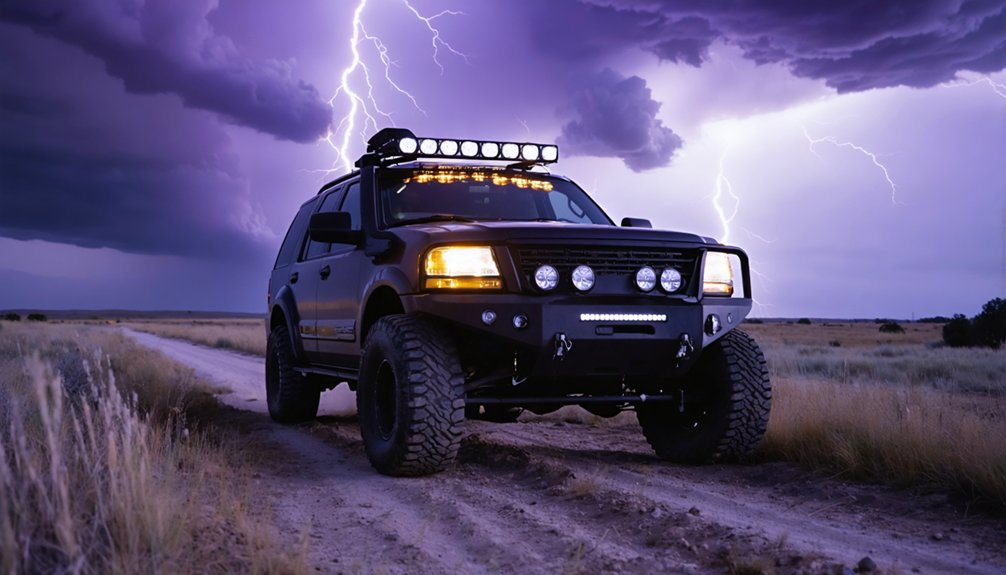
Powering your electronics means nothing if you can’t see the road or track the storm moving around you. High-intensity headlights cut through rain, dust, and low-light conditions, keeping your path clear when visibility drops fast.
Water-repellent windshield coatings actively dispel moisture, eliminating smearing that compromises your reaction time. Backup headlight systems prevent mission failure from hail strikes that destroy primary units.
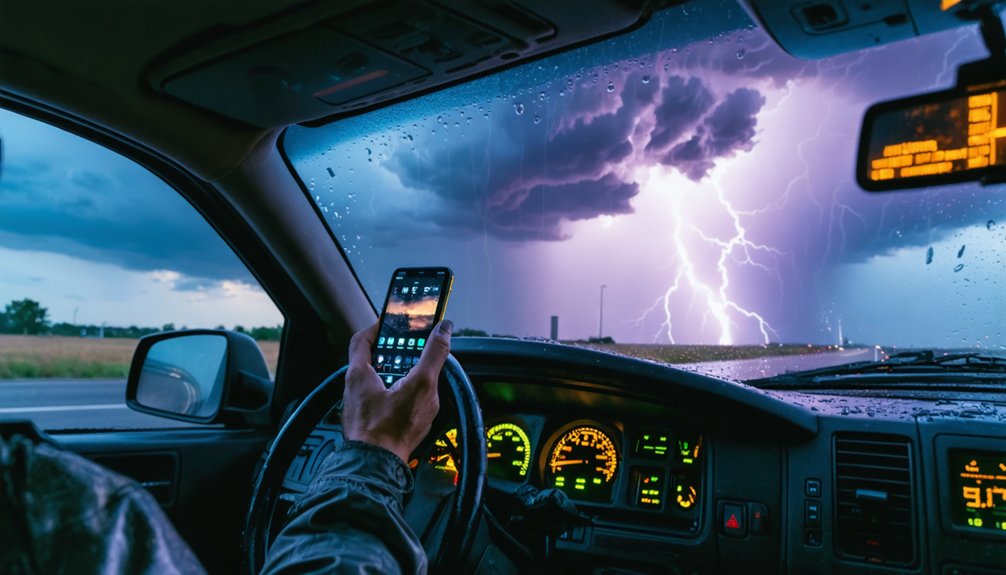
For storm tracking, dual-screen swivel mounts deliver live Doppler radar feeds without pulling your eyes fully off the road. GPS units and radar apps run simultaneously through dedicated 12V ports, giving you precise positional awareness.
Suction cup mounts secure devices without blocking critical sightlines. Visibility enhancements and real-time navigation work together, giving you the situational freedom to intercept storms while maintaining controlled, deliberate movement.
Emergency Protocols and Safety Gear Storm Chasers Rely On
When tornado winds reach destructive velocities, your survival depends on layered emergency protocols built into the vehicle before you leave the driveway.
Storm preparation begins with five-point harness installation, anchoring systems counteracting wind uplift forces, and low-profile shelter positioning minimizing debris exposure.
Storm preparation anchors every decision — harness systems, uplift resistance, and low-profile positioning before the first wind arrives.
Safety training determines whether your escape routes stay open or collapse under pressure. You’ll drill tornado damage area avoidance strategies until they’re instinctive, not reactive. Your protocols include identifying exit corridors before positioning, never surrendering perpendicular options to the storm’s forward track.
Redundancy defines every layer. Hardlined paper maps back failed GPS units. Satellite communicators maintain team coordination when cell infrastructure collapses.
Every fused circuit, every reinforced panel, every anchoring point reflects one principle: autonomous preparedness keeps you alive when conditions exceed predictions.
Frequently Asked Questions
How Much Does a Fully Equipped Storm Chasing Vehicle Typically Cost?
You’ll typically spend $50,000–$150,000 on a fully equipped setup, as vehicle modifications like armor plating and storm equipment such as satellite systems and radar units drive costs considerably higher than standard builds.
Are Storm Chasers Required to Hold Special Licenses or Certifications?
Like a wild frontier with no gatekeepers, storm chasing regulations don’t require you to hold formal licensing requirements. You’re free to chase, though meteorological training and safety certifications sharpen your analytical edge considerably.
How Do Storm Chasers Coordinate With Official Weather Agencies During Operations?
You coordinate with official weather agencies through communication strategies like satellite links and live Doppler feeds, while technology integration connects your GPS tracking and radar systems directly with National Weather Service operations, ensuring real-time data sharing during active chase missions.
What Insurance Coverage Options Are Available for Storm Chasing Vehicles?
You’ll need specialized storm coverage policies acknowledging your vehicle modifications. Seek insurers offering off-road adventure riders, equipment endorsements, and liability extensions—they’re your financial armor against tornado-related damage, equipment loss, and collision risks.
How Long Does Converting a Standard Vehicle Into a Storm Chaser Take?
Converting your vehicle typically takes 2–6 weeks, depending on the complexity of your vehicle modifications. Your conversion timeline varies based on armor plating, harness installation, electrical systems, and roll cage integration—each requiring specialized labor and precision engineering.
References
- https://www.atms.unca.edu/cgodfrey/courses/swfex/pdf/ChasingSafety.pdf
- https://stormtrack.org/threads/recommended-chaser-equipment-list.23013/
- https://www.youtube.com/watch?v=5eEe7Q-cKeE
- https://crazystormchasers.com/safe-storm-chasing-vehicle-design-features/
- https://insights.globalspec.com/article/16827/what-does-it-take-to-chase-tornadoes-the-right-car-of-course
- https://www.reddit.com/r/stormchasing/comments/12ykc89/what_are_some_good_vehicles_to_go_storm_chasing/
- https://dspace.bluehill.edu.ec/article/104peei/bluehill-dominator-the-ultimate-tornado-chasing-vehicle-1767647618
- https://en.wikipedia.org/wiki/Storm_chasing
- https://www.vehiclesafetyfirm.com/blog/car-accident-injuries/warning-tornado-chasing-family-car-can-deadly/
- https://www.stormchase.us/Articles/VehiclePrep.html