Warren Faidley, born May 11, 1957, is recognized as the world’s first full-time professional storm chaser. He shifted from photojournalism to extreme weather documentation in the mid-1980s, building a sustainable career through stock footage licensing and media syndication. He positions himself within hundreds of feet of tornadoes, hurricanes, and lightning strike zones using calculated, data-driven risk assessment. His work influenced the film *Twister* and reached global audiences through CNN and BBC. There’s far more to his methodology and legacy worth uncovering.
Key Takeaways
- Warren Faidley, born May 11, 1957, is recognized as the world’s first full-time professional storm chaser.
- He transitioned from photojournalism to storm photography in the mid-1980s, establishing a stock footage collection by 1985.
- Faidley developed a data-driven methodology, positioning within hundreds of feet of tornadoes and hurricanes for high-value imagery.
- His work influenced the film *Twister* and gained international media coverage through CNN and BBC Radio 5 Live.
- He established storm chasing as a professional discipline, creating a replicable template for independent storm documentation worldwide.
Who Is Warren Faidley, the First Storm Chaser?
Warren Faidley, born May 11, 1957, is recognized as the world’s first full-time professional storm chaser—a distinction that sets him apart from the amateur enthusiasts and research scientists who’d previously documented severe weather.
Operating as a photojournalist, he transformed storm photography into a viable profession, systematically pursuing tornadoes, hurricanes, and lightning across the United States.
By 1985, he’d established a foundational stock footage collection, demonstrating that extreme weather documentation could sustain a career.
You can trace today’s storm chasing industry directly to his pioneering methodology—approaching severe weather within a few hundred feet to capture precise, publishable imagery.
His nickname, “Cyclone Cowboy,” reflects both his boldness and his disciplined, data-informed approach to maneuvering through dangerous atmospheric conditions professionally.
From Journalism Student to Storm Photographer
His path to becoming the world’s first professional storm chaser began not in a field but in a classroom. Faidley’s journalism journey gave him the analytical framework to document severe weather with precision. By the mid-1980s, he translated that training into storm photography, building his initial stock footage collection by 1985.
His academic foundation shaped three critical competencies:
- Visual storytelling under extreme field conditions
- Systematic documentation of atmospheric data and events
- Strategic positioning to capture high-impact weather imagery
These skills weren’t accidental — they were engineered through disciplined study and direct application. His journalism background distinguished him from hobbyist chasers, establishing a data-driven methodology that transformed storm photography into a legitimate professional discipline.
That distinction ultimately earned him global recognition as a pioneering photojournalist.
How Faidley Became the World’s First Full-Time Storm Chaser
Shifting from photojournalist to full-time storm chaser required more than technical skill — it demanded a sustainable professional model that didn’t yet exist. Faidley built that model himself, monetizing extreme weather photography through stock footage licensing and media syndication before either market was established.
You can trace his conversion to the mid-1980s, when he systematically refined storm chasing techniques that positioned him within hundreds of feet of active tornadoes and hurricanes. That proximity produced rare, high-value imagery no competitor could replicate.
He leveraged those assets into worldwide publication deals, transforming field documentation into a viable career framework. By establishing both the methodology and the revenue structure independently, Faidley didn’t just chase storms — he engineered an entirely new professional discipline from the ground up.
The “Cyclone Cowboy” Nickname and What It Represents
Warren Faidley earned the nickname “Cyclone Cowboy” through his practice of approaching severe weather systems within a few hundred feet—a methodology that mirrors the calculated risk-taking associated with frontier-era cattle wranglers.
You can trace the nickname’s origins to his pattern of pursuing tornadoes, hurricanes, and extreme atmospheric events with precision-driven abandon, treating each storm as a quantifiable target rather than an uncontrollable hazard.
The designation’s legacy persists because it accurately encapsulates Faidley’s documented approach: systematic, aggressive proximity to dangerous meteorological phenomena that no other professional had previously sustained as a full-time career.
Origins of the Nickname
The nickname “Cyclone Cowboy” distills Faidley’s professional identity into two analytically precise terms: “cyclone” references the class of rotating atmospheric systems he documents, while “cowboy” signals his lone-operator methodology and willingness to approach severe weather within a few hundred feet.
Understanding the nickname origin requires examining what cyclone symbolism actually encodes:
- Atmospheric precision — cyclones represent measurable, rotating storm systems Faidley actively pursues.
- Independent operation — the cowboy framework reflects autonomous, self-funded field methodology.
- Risk tolerance — proximity-based documentation distinguishes professional storm chasing from passive observation.
You can recognize that this designation isn’t ceremonial — it’s functional shorthand for a documented professional framework.
The nickname emerged organically from Faidley’s operational patterns, cementing his identity as storm chasing’s pioneering independent practitioner.
Daring Storm Chasing Approach
Beyond the nickname’s origins lies its operational reality: Faidley’s storm chasing approach is defined by calculated proximity, often placing him within a few hundred feet of active tornadoes, hurricanes, and lightning events.
His daring techniques aren’t reckless—they’re methodical, built on years of atmospheric pattern recognition and risk assessment.
You’d recognize the distinction immediately: where others maintain safe distances, Faidley closes the gap deliberately, maximizing visual documentation quality while managing storm risks through precise positioning.
He chases across the entire United States, capturing tornadoes, hurricanes, wildfires, and lightning on film, video, and motion picture formats.
This operational philosophy prioritizes data-rich imagery over personal comfort, producing documentation that’s both scientifically valuable and visually compelling—a direct reflection of what “Cyclone Cowboy” actually means in practice.
Legacy of the Nickname
Endurance, in storm chasing culture, separates the transient hobbyist from the committed professional—and “Cyclone Cowboy” encapsulates precisely that distinction for Faidley. His nicknamed legacy carries measurable cultural weight, embedding cyclone symbolism into professional meteorological identity.
The nickname signals three distinct realities:
- Independent pursuit of severe weather without institutional constraints
- Sustained professional commitment spanning multiple decades of documented fieldwork
- Pioneering methodology that redefined atmospheric journalism standards
You recognize that nicknames functioning at this level aren’t arbitrary—they’re earned through verifiable performance data. Faidley’s designation reflects hundreds of documented storm intercepts, proximity footage within hundreds of feet, and globally published imagery.
The “Cowboy” element specifically communicates autonomous, boundary-pushing fieldwork. That freedom-oriented identity continues influencing storm chasers who prioritize independent documentation over bureaucratic meteorological frameworks.
How Close Faidley Gets to Tornadoes, Hurricanes, and Lightning
When you consider Faidley’s field methodology, the numbers are striking: he positions himself within a few hundred feet of active tornadoes to capture usable imagery.
For hurricanes, he maintains similarly aggressive proximity, placing himself directly within the storm’s path rather than observing from a safe perimeter.
His lightning work follows the same data-driven logic—you get close enough to maximize frame composition and detail, accepting calculated risk as a professional variable.
Proximity To Tornadoes
Faidley routinely positions himself within a few hundred feet of active tornadoes, a distance that places him well inside the zone where wind speeds and debris fields can prove lethal. Understanding tornado dynamics is critical to surviving these encounters. His approach relies on three calculated factors:
- Exit route identification before the tornado closes within striking range
- Real-time wind speed assessment to gauge debris projection distance
- Terrain analysis to avoid low-lying areas that concentrate airborne materials
Storm safety at this proximity isn’t guesswork—it’s disciplined data interpretation. You’d need to process atmospheric shifts rapidly, recognizing rotational acceleration patterns that signal unpredictable vortex movement.
Faidley’s decades of field experience allow him to operate where most photographers wouldn’t survive, extracting imagery that defines public understanding of tornado behavior.
Hurricane Approach Distances
Tornado proximity demands split-second terrain reading, but hurricane approach distances introduce an entirely different calculus.
Hurricanes aren’t singular events you sidestep — they’re sprawling systems demanding precise hurricane tracking before you commit to a position. Faidley analyzes storm forecasting data to determine safe operational zones within the storm’s outer bands, where wind speeds and surge potential remain documentable without becoming fatal.
Unlike tornadoes, hurricanes give you hours of approach data, yet that extended window breeds dangerous overconfidence.
Faidley maintains disciplined distance thresholds based on sustained wind measurements, barometric pressure drops, and forward speed calculations. He positions himself where structural cover remains viable while still capturing authentic destructive force.
That disciplined proximity — never arbitrary, always calculated — separates professional documentation from reckless exposure.
Capturing Lightning Up Close
Lightning presents the most statistically unforgiving variable in Faidley’s work — a 300-million-volt discharge traveling at 270,000 mph doesn’t negotiate safe distances the way a tornado’s visible funnel does.
His lightning techniques demand precise positioning based on storm cell behavior, wind direction, and discharge frequency patterns.
When you study his storm photography approach, three calculated factors define his lightning captures:
- Positioning 300–500 feet from the primary strike zone
- Timing exposures during peak electrical activity cycles
- Reading ground-to-cloud discharge patterns before committing to location
These aren’t guesses — they’re data-driven decisions built from decades of field observation.
You’re watching a methodology where survival depends on understanding atmospheric electricity as a measurable, predictable system rather than treating it as random chaos.
Tornadoes, Wildfires, and the Storms That Defined His Career
Throughout his career, Warren Faidley documented some of the most violent atmospheric events ever recorded, approaching tornadoes, wildfires, and hurricanes within a few hundred feet to capture high-resolution imagery that few photographers have replicated.
His work on tornado evolution tracked rotational dynamics from initial wall cloud formation through full condensation funnel development, producing visual data that meteorologists actively referenced.
Faidley’s tornado documentation captured rotational dynamics from wall cloud formation through full funnel development, creating visual data meteorologists relied on.
He didn’t restrict his focus to tornadoes alone — wildfire impact documentation became equally significant, capturing fire behavior under extreme wind conditions across multiple U.S. regions.
His cross-hazard approach generated a stock footage archive that media outlets worldwide continue using for severe weather analysis.
How Faidley’s Footage Inspired the Movie Twister
Three documented contributions shaped the film’s production:
- His photographic evidence demonstrated actual storm structure and movement patterns.
- His survival methodology informed realistic chase sequences.
- His imagery directly influenced the iconic *Twister* movie poster.
You’re looking at a rare case where independent field documentation crossed into mainstream entertainment without losing scientific integrity.
Faidley’s work proved that authentic atmospheric data, captured at close range, could drive cultural impact far beyond meteorological reporting — fundamentally reshaping how audiences visualize severe weather events.
How Faidley’s Work Reached a Global Audience
You can trace Faidley’s global reach through three distinct channels: international media publications, Hollywood film influence, and broadcast television and radio appearances. His work appeared in outlets worldwide, while his storm chasing footage directly shaped the 1996 blockbuster *Twister*, exposing his methodology to mass audiences.
Interviews on CNN and BBC Radio 5 Live’s *Up All Night* further cemented his authority as the world’s foremost severe weather documentarian.
Global Media Publications
Faidley’s storm photography reached audiences across multiple continents, appearing in print, broadcast, and digital media outlets worldwide. His media influence extended far beyond American borders, earning him global recognition as the definitive authority on severe weather documentation.
You can trace his work across three primary distribution channels:
- Print publications – Magazines and newspapers worldwide licensed his imagery for editorial coverage.
- Broadcast media – CNN interviews and BBC Radio 5 Live appearances amplified his analytical insights on violent weather survival.
- Film industry – His footage directly inspired the 1996 Hollywood production *Twister*, including its iconic movie poster.
These distribution points demonstrate how one independent photographer systematically penetrated global information networks, transforming raw storm data into compelling visual records that informed millions worldwide.
Hollywood Film Influence
Film adaptations of real-world extreme weather work carry measurable cultural weight. *Twister* grossed over $494 million worldwide, meaning Faidley’s methodology reached audiences who’d never encounter meteorological journals or stock footage libraries.
You can trace a direct analytical line between his fieldwork—approaching tornadoes within hundreds of feet—and Hollywood’s dramatized portrayal of storm chasing. His work fundamentally converted raw atmospheric data into a globally consumed cultural narrative.
Television And Radio Appearances
- Educating audiences on severe weather survival strategies.
- Contextualizing storm data through firsthand field experience.
- Challenging passive consumption by encouraging independent weather awareness.
You can trace Faidley’s media influence across multiple broadcast formats, each amplifying verified storm documentation.
His recurring media presence transformed raw meteorological data into accessible, actionable knowledge for freedom-minded individuals who refuse to remain uninformed.
The Awards That Cemented Faidley’s Reputation
Warren Faidley’s storm photography and cinematography earned him multiple awards that solidified his standing as a premier extreme weather documentarian. These recognitions aren’t merely symbolic—they quantify the photography impact his work has had on meteorological journalism and disaster documentation.
You can trace the awards significance directly to his methodology: approaching severe weather within hundreds of feet produces imagery that reshapes how you understand atmospheric violence.
His prize-winning contributions span both still photography and motion picture formats, reflecting technical mastery across multiple documentation disciplines. Each award represents verified, peer-recognized excellence in capturing data-rich visual records of tornadoes, hurricanes, and lightning events.
Faidley’s accolades ultimately validate his pioneering approach, confirming that independent, frontline storm documentation delivers measurable scientific and journalistic value that institutional frameworks rarely replicate.
The Storm Chasers Warren Faidley Inspired
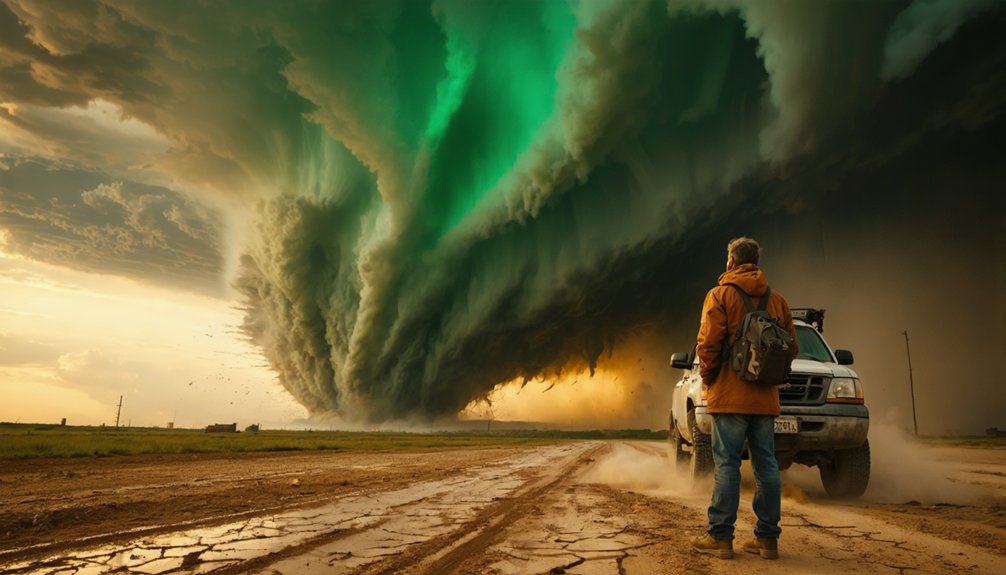
Because Faidley established storm chasing as a viable professional discipline, he effectively created a template that subsequent chasers could replicate, refine, and expand. His documented storm chasing techniques gave emerging photographers measurable benchmarks to study and build upon.
His influence shaped three critical professional standards:
- Approaching severe weather within calculated distances for maximum photographic yield
- Maintaining weather photography ethics by prioritizing accurate documentation over sensationalism
- Building sustainable stock footage archives as independent revenue streams
You can trace today’s storm chasing community directly back to Faidley’s foundational work. Professionals who followed him inherited a discipline with established methodologies, ethical frameworks, and commercial viability.
He didn’t just chase storms—he constructed an entire professional ecosystem that empowered independent operators to pursue atmospheric documentation on their own terms.
Frequently Asked Questions
What Equipment Does Warren Faidley Use to Photograph Severe Storms?
Like Ansel Adams capturing nature’s soul, Faidley’s storm photography relies on film, video, and motion picture formats. You’ll find he’s mastered weather technology, approaching storms within hundreds of feet to document severe atmospheric events precisely.
Has Warren Faidley Ever Been Seriously Injured While Chasing Storms?
The knowledge base doesn’t confirm he’s suffered serious injuries. His storm safety protocols and injury prevention strategies have kept him alive through decades of chasing. You’d find his survival record reflects calculated, data-driven risk assessment near violent atmospheric events.
How Much Does Warren Faidley Charge for His Stock Footage Licensing?
The footage pricing isn’t publicly listed — you’d need to contact Faidley directly to explore licensing options. His rates likely vary based on usage scope, media type, and exclusivity, making each deal uniquely negotiated.
What Survival Techniques Does Faidley Recommend for Extreme Weather Situations?
The knowledge base doesn’t detail Faidley’s specific survival techniques, but as a disaster survival expert, he’d emphasize your weather awareness and proper survival gear—you’ve got to monitor atmospheric data analytically and equip yourself before conditions deteriorate dangerously.
Does Warren Faidley Offer Storm Chasing Training or Mentorship Programs?
While storms rage and skies darken, the knowledge base doesn’t confirm Faidley offers formal storm chasing basics programs. You’d benefit exploring his documented work independently, as mentorship benefits remain unverified through available data on his current professional activities.
References
- https://en.wikipedia.org/wiki/Warren_Faidley
- https://www.youtube.com/watch?v=GmLtYwTMPJ4
- https://www.youtube.com/watch?v=X-yNDbsYduA
- https://www.stormchaser.com/warren-faidley-bio.html
- https://www.bbc.co.uk/news/science-environment-13142662
- https://www.latimes.com/archives/la-xpm-1992-07-08-vw-1542-story.html
- https://www.youtube.com/watch?v=P0TNFELfhgU
- https://www.azcentral.com/story/news/local/arizona/2024/07/19/storm-chasers-reflect-on-changed-industry-ahead-of-twisters-film/74073156007/
- https://www.arizonahighways.com/archive/issues/chapter/Doc.1076.Chapter.6
- https://www.stormchaser.com/bio-2014.html