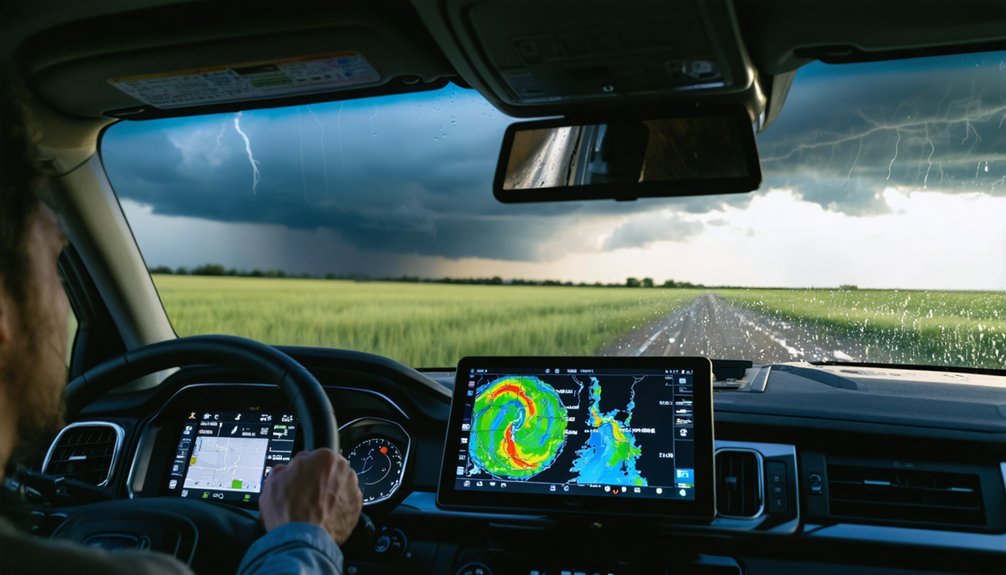
To track hurricane paths effectively, you’ll want to combine multiple data sources for the best accuracy. Monitor NOAA’s satellite imagery and Doppler radar outputs to detect early storm signatures. Cross-reference sea surface temperatures, atmospheric pressure, and ensemble forecast models to assess intensification potential. Use GIS tools like nowCOAST to map real-time storm tracks against local terrain. The strategies and tools outlined ahead will sharpen your ability to anticipate a storm’s next move.
Key Takeaways
- Utilize geostationary satellites like GOES and Doppler radar systems to monitor storm formation, atmospheric pressure, and real-time wind behavior.
- Cross-reference numerical weather prediction models with ensemble forecasting to improve track accuracy and reduce forecast blind spots.
- Monitor sea surface temperatures exceeding 26°C, as warmer waters directly fuel rapid hurricane intensification and strengthen storm paths.
- Use NOAA’s Historical Hurricane Tracks and HURDAT2 database to compare current storms against historical patterns for better predictions.
- Integrate GIS mapping tools with real-time radar and satellite data to visualize storm tracks and identify high-risk zones.
How Satellites and Radar Detect Hurricanes Before They Form
Before a hurricane ever makes landfall, satellites and radar systems are already building a detailed picture of atmospheric conditions that may signal its formation.
You can leverage satellite technology to monitor sea surface temperatures, atmospheric pressure patterns, and upper-level wind behavior continuously. Geostationary satellites like GOES track storm development across the Atlantic and Pacific without interruption, giving you real-time observational coverage from formation through dissipation.
Radar advancements now allow Doppler systems to detect precipitation intensity and wind speeds with precision, identifying early rotational signatures before a storm fully organizes.
Platforms like Horizon AI Global integrate these data streams for early detection and track planning. Cross-referencing satellite imagery with radar outputs sharpens your situational awareness, ensuring you’re acting on accurate, multi-source intelligence rather than incomplete data.
What Hurricane Hunter Aircraft Actually Measure Inside a Storm
Satellites and radar give you an accurate atmospheric picture from orbit and coastlines, but they can’t replace the ground-truth data that comes from flying directly into a hurricane’s core.
Hurricane Hunter aircraft conduct flight missions through the storm’s eyewall, collecting in-storm measurements that ground systems simply can’t capture. Their aircraft instrumentation records critical storm dynamics in real time, enabling precise atmospheric analysis of pressure gradients, wind shear, and moisture distribution.
During data collection, crews measure:
During data collection, crews measure central pressure, flight-level winds, and dropsonde profiles — capturing what no ground system can.
- Central pressure — the most reliable intensity indicator available
- Flight-level winds — actual wind speeds at operational altitudes
- Dropsonde profiles — vertical atmospheric snapshots from altitude to ocean surface
This hurricane data feeds directly into forecast models, sharpening your understanding of evolving weather patterns before they reach shore.
The Best Apps for Tracking Hurricane Paths in Real Time
When ground systems and aircraft data reach forecasters, that information flows into mobile platforms that put hurricane tracking directly in your hands.
Clime, My Hurricane Tracker, and StormTrack each deliver distinct app features worth evaluating through user reviews before storm season begins.
Prioritize data accuracy by checking how frequently each platform refreshes radar, satellite, and buoy feeds.
Interface design should display layered data without cluttering your screen during high-stress decisions.
Configure notification settings to trigger alerts based on specific wind radii or track shifts affecting your location.
Use comparison charts to evaluate integration options, including GOES satellite overlays and spaghetti model access.
Subscription models vary—free tiers limit update frequency while premium access grants real-time reconnaissance data, giving you the decision-making freedom critical when storms threaten your area.
How Forecast Models Predict a Hurricane’s Track and Intensity
When you track a hurricane’s projected path, you’re relying on numerical weather prediction models that ingest atmospheric pressure, sea surface temperatures, and upper-level wind data to generate ensemble forecasts.
Track accuracy depends heavily on how well these models capture steering currents and large-scale atmospheric patterns, while intensity prediction tools like SHIPS (Statistical Hurricane Intensity Prediction Scheme) factor in ocean heat content and wind shear to estimate strengthening or weakening.
Platforms like Horizon AI Global and NOAA’s HURDAT2 database give you access to both long-range track planning and historical storm data to cross-validate model outputs.
How Models Work
Forecast models predict a hurricane’s track and intensity by ingesting massive datasets—atmospheric pressure, sea surface temperatures, upper-level wind patterns, and real-time reconnaissance data—then running them through complex mathematical equations that simulate atmospheric behavior.
Different model types use distinct simulation techniques, so understanding their strengths sharpens your predictive analytics edge.
Three critical factors drive model accuracy:
- Data sources — Ensemble forecasting blends satellite, buoy, and aircraft inputs, reducing single-model blind spots.
- Historical comparisons — NOAA’s HURDAT2 database benchmarks current storm behavior against past tracks.
- Model limitations — No model perfectly captures rapid intensification; cross-referencing multiple outputs compensates.
You’ll make smarter decisions when you recognize that ensemble forecasting outperforms any single model, especially beyond 72 hours where uncertainty compounds rapidly.
Track Accuracy Factors
Several interacting variables determine how accurately forecast models predict a hurricane’s track and intensity, and understanding them helps you evaluate competing model outputs more critically.
Track reliability depends heavily on data accuracy from sensor integration across satellites, buoys, and reconnaissance aircraft. Atmospheric conditions, including upper-level wind shear and sea surface temperatures, directly influence storm behavior and introduce forecasting challenges when they shift unexpectedly.
Predictive modeling improves when real time analysis incorporates dense observational networks, reducing uncertainty in track projections. Technology advancements, particularly in GIS platforms and AI-driven tools like Horizon AI Global, have measurably narrowed forecast error margins.
You’ll also find that cross-referencing historical patterns from NOAA’s HURDAT2 database strengthens model calibration, giving you a sharper, more independent read on where a storm’s headed.
Intensity Prediction Tools
While track accuracy depends on integrating observational data and atmospheric variables, predicting a hurricane’s intensity introduces a separate and often more difficult forecasting challenge.
Intensity forecasting requires you to monitor variables that shift rapidly and interact unpredictably. Wind shear, ocean heat content, and internal storm structure each influence whether a hurricane strengthens or weakens.
Three tools sharpen your intensity predictions:
- Hurricane Hunter aircraft — deliver high-resolution in-storm pressure and wind data directly to forecasters.
- SHIPS (Statistical Hurricane Intensity Prediction Scheme) — analyzes environmental factors, including wind shear, to generate intensity probabilities.
- HWRF Model (Hurricane Weather Research and Forecasting) — simulates storm-scale dynamics for precise short-range intensity guidance.
Cross-referencing these tools gives you a data-driven advantage when conditions evolve quickly.
What Sea Surface Temps Reveal About Hurricane Strength
Sea surface temperatures (SSTs) serve as one of the most critical variables in determining a hurricane’s potential strength and intensification rate. When you’re tracking a storm, monitoring ocean temperatures gives you a direct indicator of available energy.
Hurricanes intensify rapidly over SSTs exceeding 26°C (79°F), with deeper warm water layers accelerating that process further. You’ll notice hurricane intensity spikes when storms cross the Gulf Loop Current, where temperatures exceed 30°C.
Storms crossing the Gulf Loop Current encounter SSTs above 30°C, triggering the rapid intensification that defines a hurricane’s most dangerous phase.
Conversely, upwelling of cooler water beneath a slow-moving storm can weaken it. Real-time SST data, accessible through NOAA’s satellites and ocean buoy networks, lets you anticipate intensification windows before official forecasts confirm them.
Integrating SST maps with atmospheric pressure data sharpens your understanding of where a hurricane’s true destructive potential lies.
How to Map Your Evacuation Route Before a Hurricane Hits
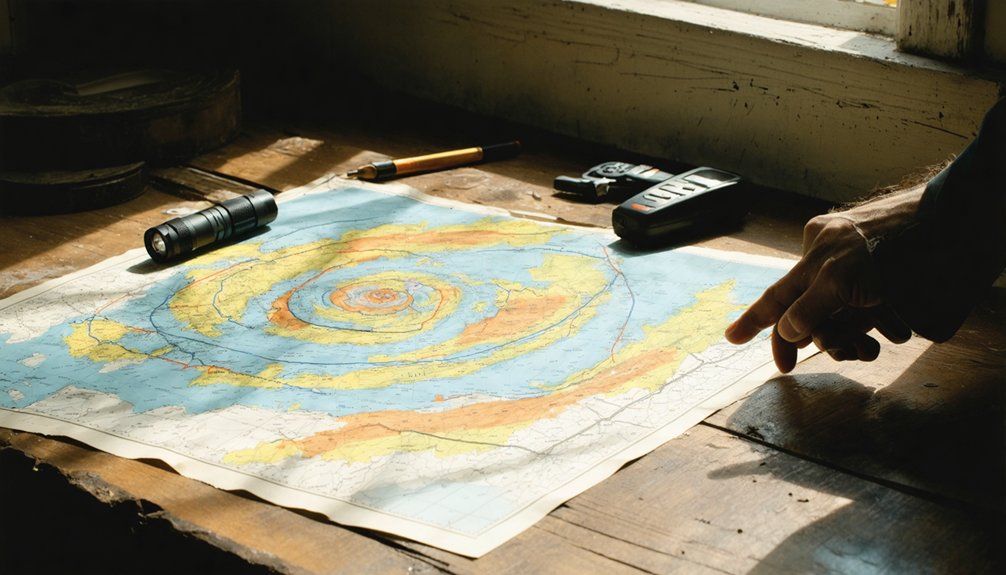
When a hurricane threatens your area, you need to plan your evacuation route before conditions deteriorate and roads become congested.
You can use GIS mapping tools to analyze predicted storm paths, topographic data, and real-time traffic patterns to identify the safest corridors out of harm’s way.
Tools like NOAA’s Historical Hurricane Tracks and GIS-based models let you cross-reference storm trajectories with local road networks, giving you a data-backed route that accounts for flood-prone terrain and surge zones.
Plan Your Evacuation Route
Planning your evacuation route before a hurricane hits requires 3 critical steps: identifying your risk zone, selecting a viable path, and validating it against real-time storm data.
Effective evacuation logistics demand that you cross-reference GIS-based models with current forecast tracks before committing to a route.
- Identify your risk zone using NOAA’s Historical Hurricane Tracks tool to assess location-specific storm surge and wind exposure.
- Select your route by leveraging GIS evacuation routing tools that factor in topography and projected storm paths.
- Validate in real-time using StormTrack or nowCOAST to confirm your chosen route remains clear of the storm’s projected landfall zone.
Disciplined route planning eliminates guesswork, giving you the freedom to move decisively when conditions deteriorate rapidly.
Use GIS Mapping Tools
GIS mapping tools give you a decisive edge in evacuation planning by fusing satellite imagery, radar data, and topographic layers into a single actionable interface.
Through spatial analysis, you’ll identify flood-prone corridors, elevation changes, and road vulnerabilities before conditions deteriorate. GIS applications like NOAA’s Historical Hurricane Tracks tool and nowCOAST portal deliver geographic insights through interactive features that let you cross-reference storm paths against local terrain in real time.
Data visualization transforms raw atmospheric and oceanic inputs into clear, layered maps that sharpen mapping accuracy during fast-moving decisions.
Risk assessment becomes precise when you overlay predicted storm tracks with population density and infrastructure data. User engagement with these platforms guarantees you’re not reacting blindly—you’re executing an informed exit strategy backed by verified, multi-source spatial intelligence.
How to Look Up Historical Hurricane Data for Your Region
Accessing historical hurricane data for your region starts with NOAA’s Historical Hurricane Tracks tool, which lets you search storm records by name, year, or geographic location.
Historical hurricane data begins with NOAA’s tracking tool — search by storm name, year, or location.
Cross-referencing historical patterns reveals regional impacts you can use for preparedness planning.
Supplement your research using these key databases:
- NOAA HURDAT2 – Provides Atlantic and Eastern Pacific storm track records with intensity and pressure data.
- IBTrACS – Merges global storm tracks from multiple meteorological agencies into one searchable dataset.
- Track The Tropics – Displays formation probabilities and spaghetti models alongside historical comparisons.
Together, these resources give you precise, data-rich insight into how storms have historically behaved in your area, empowering independent, informed decision-making before hurricane season peaks.
Frequently Asked Questions
How Does Atmospheric Pressure Help Predict Hurricane Formation Timing?
Just as freedom demands vigilance, you’ll monitor dropping pressure systems to predict hurricane forecasting timing. Falling meteorological data signals storm intensity surges, letting you anticipate formation windows before they strike.
What Role Do Ocean Buoys Play in Real-Time Hurricane Monitoring?
You’ll rely on ocean buoys to deliver real-time buoy technology data, measuring storm intensity, ocean currents, and sea temperatures. They’re boosting data accuracy by transmitting critical oceanographic readings directly to forecasters, ensuring you’re tracking hurricanes with precision.
How Does GIS Technology Integrate Multiple Data Sources During Hurricanes?
When Hurricane Ian struck, GIS integration let you merge satellite imagery, radar, and topographic data instantly. You’ll harness spatial analysis for hurricane modeling and data visualization, cross-referencing IoT and aircraft sources to track paths with precision.
What Is the Difference Between HURDAT2 and IBTRACS Storm Databases?
You’ll find HURDAT2 focuses on Atlantic hurricane data with refined historical records, while IBTrACS merges global storm tracks. Both improve data accuracy, but you’d use them for different model comparisons depending on your regional hurricane data needs.
How Do Spaghetti Models Show Multiple Possible Hurricane Track Scenarios?
Spaghetti modeling displays multiple forecast model outputs simultaneously, letting you visualize track uncertainty across diverging path lines. Each strand represents a different model’s prediction, so you’re seeing the full range of possible hurricane trajectories at once.
References
- https://climavision.com/blog/how-are-hurricanes-tracked-tools-and-tips-for-superior-coverage/
- https://online.utpb.edu/about-us/articles/gis-geospatial/how-to-track-a-hurricane-gis-and-storm-tracking
- https://teamrubiconusa.org/news-and-stories/best-hurricane-tracking-apps-and-tools/
- https://www.noaa.gov/historical-hurricane-tracks
- https://hurricanescience.org/science/forecast/forecasting/forecastprocess/index.html
- https://secoora.org/hurricane-resources/
- https://www.climate.gov/maps-data/dataset/historical-hurricane-tracks-gis-map-viewer
- https://www.trackthetropics.com
- https://www.facebook.com/groups/196269661170517/posts/294354304695385/
- https://www.thoughtco.com/find-best-hurricane-tracking-charts-3443940